

Atomic Habits Vs Deep Work: Which Problem Does Each Book Help You Solve?
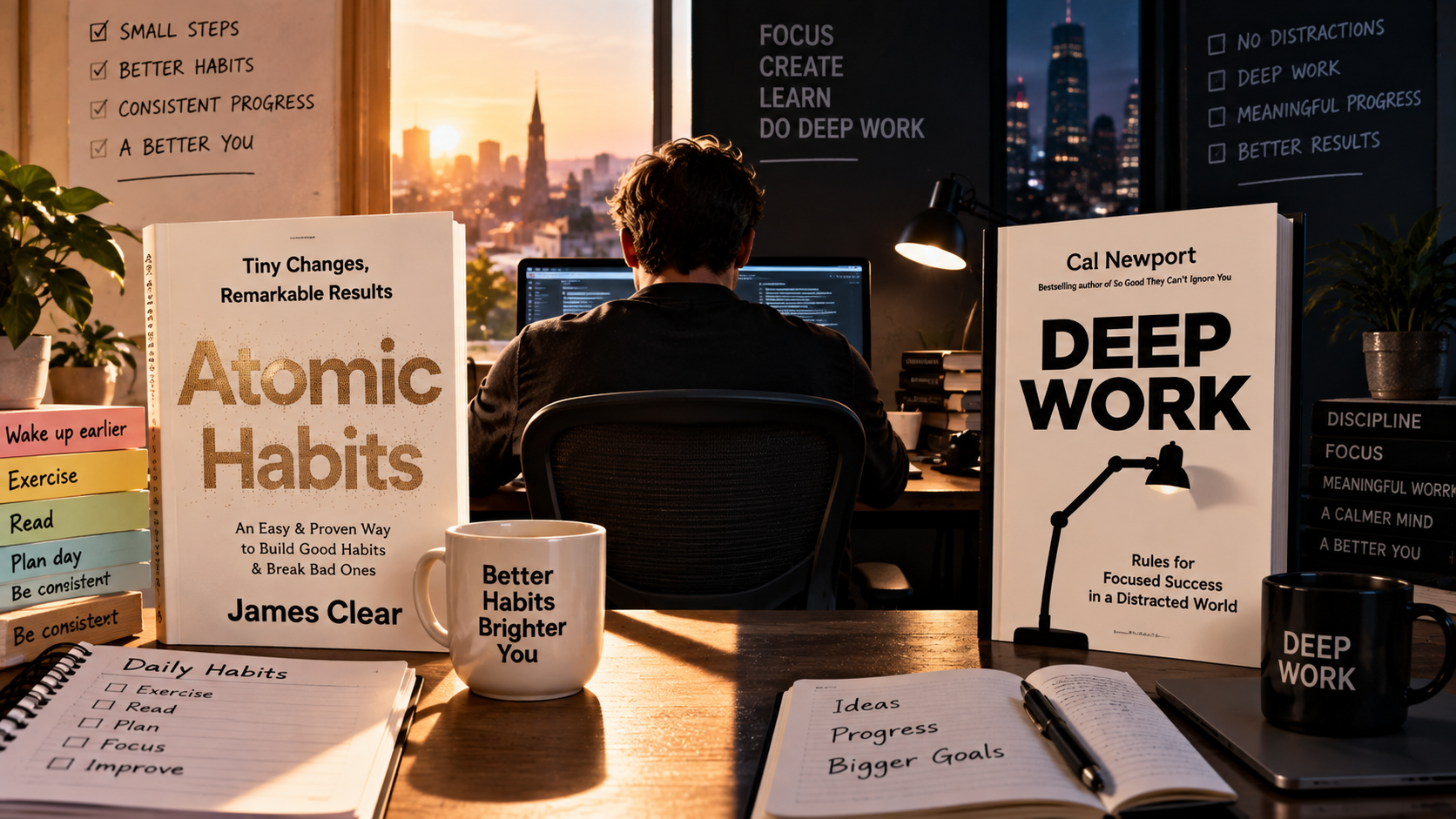
How To Combine Habit Design With Concentrated Work
Starting Is Not The Same As Focusing
James Clear helps organise repeated behaviour; Cal Newport focuses attention on demanding work. Your bottleneck determines which lens is more useful.
If you struggle to begin a useful activity consistently, Atomic Habits offers a helpful starting point. If you begin but spend the session switching between messages, tabs and minor tasks, Deep Work addresses a different problem.
James Clear’s Atomic Habits (2018) and Cal Newport’s Deep Work (2016) are often grouped together as productivity books. Their overlap should not conceal their different emphases: repeating behaviour and protecting demanding concentration.
The most useful comparison is diagnostic. Identify what prevents progress before choosing a method, then test whether the change improves meaningful output rather than merely producing a more impressive routine.
What Atomic Habits Emphasises
Clear’s public summary presents behaviour change through cues, motivation, ease and immediate satisfaction. It also emphasises systems and the connection between repeated actions and identity.
The practical attraction is that improvement becomes something to design into an ordinary day. A small action can be easier to repeat than an ambitious routine requiring ideal conditions.
That does not mean every important goal can be reduced to a tiny habit. Some tasks require sustained effort, resources or decisions that a cue cannot supply.
My reading is that the book is strongest as a lens for reducing avoidable friction around useful behaviour. It becomes weaker when treated as a universal explanation of success or failure.
What Deep Work Emphasises
Newport describes deep work in terms of distraction-free concentration on cognitively demanding activity. His account argues that this capacity is valuable and that working arrangements should protect it.
The central concern is not simply being busy. It is creating conditions in which difficult thinking can continue long enough to produce something worthwhile.
That focus is useful when visible activity conceals little progress: messages answered, tabs opened and meetings attended, but the difficult analysis remains unfinished.
It also requires adaptation. A role involving urgent support or care cannot necessarily adopt long periods of complete unavailability. The relevant question is what concentration the work needs and what the role can realistically protect.
A Comparison By Bottleneck
You rarely start
Useful Lens: Atomic Habits
What To Test: A clear cue and smaller first step
You start, then fragment attention
Useful Lens: Deep Work
What To Test: A protected task-specific session
You repeat low-value activity
Useful Lens: Both need a goal check
What To Test: Whether output serves the objective
Your workload is impossible
Useful Lens: Neither is sufficient alone
What To Test: Priorities, resources and scope
You cannot control interruptions
Useful Lens: Adapt both
What To Test: Negotiated availability and shorter blocks
These are editorial applications, not claims that either author offers a guaranteed diagnosis for every reader.
A Worked Example: Writing An Article
Imagine a writer who wants to produce a researched feature each week. They repeatedly delay opening the draft because the task feels large and undefined.
A habit-focused experiment might attach a ten-minute opening task to an existing part of the day: write the central question and identify the first source. The purpose is to make starting easier, not pretend ten minutes completes the feature.
Once the writer starts reliably, the bottleneck may change. They spend the session checking messages and polishing the introduction before the reporting is complete.
A concentration-focused experiment would define the output for a protected session: compare three sources and resolve one factual question. Progress is measured by the completed investigation, not by how long the writer looked busy.
A Worked Example: Learning A Difficult Skill
A learner may consistently open a course but spend most sessions reviewing comfortable material. The habit exists; the challenge is whether the activity develops the intended skill.
The next experiment could involve attempting a problem without looking at the solution, identifying the gap and working through it. This is an original practical example, not a summary of a specific chapter from either book.
Protected attention helps, but concentration on an ineffective method can still waste time. The learner needs feedback about performance as well as a reliable schedule.
This reveals the limitation of productivity advice organised entirely around behaviour. Repetition and focus are valuable only in relation to the quality and direction of the work.
Do Not Turn Compound Growth Into A Promise
Clear uses the idea of small improvements accumulating over time. The arithmetic can be illustrative, but human performance does not grow at a fixed percentage indefinitely.
Progress can plateau, regress or depend on changes in method. Some improvements make later ones easier; others face physical, organisational or practical limits.
Use the compounding metaphor to appreciate consistency, not to predict that a particular routine will multiply your income or skill by a precise amount.
The same caution applies to focus. A distraction-free hour is an opportunity for better work, not proof that a valuable result was produced.
Identity Can Help Without Becoming A Verdict
Thinking of yourself as someone who writes, learns or exercises can support a routine. It can also become unhelpful if a missed session turns into a conclusion about your character.
A more useful interpretation is behavioural and revisable: what conditions made the activity easier, and what prevented it today?
This matters when illness, caring responsibilities or unstable work schedules interrupt a plan. A routine should respond to reality rather than provide a new language for self-blame.
The practical test is whether the idea helps you resume useful action, not whether it produces a perfectly consistent self-description.
Focus Is Also An Organisational Problem
An employee cannot always solve interruption through personal discipline. Expectations about response times, meeting schedules and workload can determine whether sustained work is possible.
A team might agree on specific periods for concentration, a genuine urgent-contact route and clearer criteria for meetings. The details depend on the service being provided.
For a solo worker, the equivalent is deciding which activities deserve immediate attention and which can wait. Constantly responding to every signal makes other priorities theoretical.
Neither arrangement should be judged by aesthetic neatness. The question is whether it improves output while maintaining the obligations that matter.
A Two-Week Experiment
For the first week, observe the current process. Record when you intended to start, when you actually started, what interrupted you and what useful output appeared.
For the second week, change one bottleneck. If starting is the problem, simplify the first action and give it a clear cue. If fragmentation is the problem, protect a realistic period for one defined task.
At the end, compare completed work, quality and effort. Do not judge the experiment solely by streaks or minutes logged. If the change fails, use the result to revise the design.
This is a suggested personal experiment, not a clinically validated programme or an author-prescribed schedule.
A Routine Can Become A Substitute For The Work
Productivity methods can create visible rituals that feel satisfying to maintain. A tracker fills up, a timer runs and the desk looks ready. None of those observations establishes that the central task advanced.
For an original practical test, define a small output before the session: a resolved question, a drafted section or a completed problem. Afterwards, inspect the output before recording the session as a success.
This does not make process measures useless. Starting regularly and protecting time can be important intermediate improvements. They simply need a connection to the result you care about.
If the routine is consistent but the result remains poor, examine task choice, feedback and technique. Adding more discipline to the wrong activity can make the problem harder to notice.
Match The Session To The Work
Not every task requires the same kind of concentration. Reviewing a document, generating possibilities and checking a calculation can place different demands on attention.
A useful schedule distinguishes demanding work from routine administration without treating the latter as worthless. Administrative tasks often keep the work possible; the problem is when they occupy every available moment by default.
For a team, the distinction should support coordination rather than become a status hierarchy in which some people’s work is dismissed as shallow. A service role may create value through responsiveness that another role needs to limit.
The practical objective is to give each important activity suitable conditions. That is a more flexible application of the books than trying to make every working day resemble an author’s personal routine.
Your experiment succeeds when the design fits the work and the life around it—not when it most closely resembles an attractive productivity ideal.
A useful result may also be a decision to reduce the workload. If there is more essential work than available time, a better cue or quieter desk cannot create unlimited capacity. Prioritisation is part of the problem, not evidence of insufficient commitment to the method.
Which Should You Read First?
Choose according to the problem you recognise most clearly. Atomic Habits is a useful entry point for building repeatable routines. Deep Work is especially relevant when demanding thinking is crowded out by fragmented activity.
Taylor Tailored’s broader self-improvement comparison places habit design alongside other approaches. This comparison keeps the question narrower: how do you start, and what happens once you have?
You may need both lenses, but you do not need to implement every technique at once. One well-chosen change that improves real output is more useful than a routine built from every attractive idea in two books.
