Their Love Story From the Fountain to Dunkirk
Briony Watches From the Wrong Window
From an upstairs window, thirteen-year-old Briony Tallis sees her sister take off most of her clothes in front of a man. Cecilia steps into the fountain, disappears beneath the water, climbs out and walks away. Robbie Turner remains behind. Briony has seen the whole extraordinary performance and missed the few seconds that would explain it. On a hot day in 1935, on an English country estate she knows almost as well as her own bedroom, a girl discovers how little she understands two people she has known all her life. In Ian McEwan’s Atonement, the danger begins when she finds an explanation she likes better than admitting she does not know.
The Play That Will Put Everybody in Order
Briony begins the day with a theatrical production to organise. Her older brother Leon is coming home, and she has written The Trials of Arabella in his honour. The heroine makes an unfortunate romantic choice, suffers the consequences and arrives at a conclusion the audience can recognise as just. Briony has supplied parts for her visiting cousins, Lola Quincey and Lola’s younger twin brothers, Jackson and Pierrot. All the ingredients of a triumphant homecoming are present except three children who want to do what she tells them.
The cousins have reasons for being poor collaborators. Their parents’ marriage is breaking down. The twins miss home, while fifteen-year-old Lola has discovered how much authority she can exercise by behaving as if she is already a young woman. Briony sees three actors and a rapidly diminishing rehearsal period. Her guests are living through an event for which nobody has thought to give them a script. Their resistance to the play offers Briony a small, safe lesson in the difference between assigning somebody a motive and asking what they want.
Cecilia, some years older than Briony, has come home from Cambridge without settling what to do next. Robbie has returned from the same university with an excellent degree and hopes of studying medicine. He is the son of Grace Turner, who works for the Tallises, and owes his education to the financial support of Cecilia’s father, Jack. Robbie and Cecilia grew up close enough to take each other for granted. Now they cannot quite determine whether childhood familiarity permits intimacy or obliges them to pretend nothing has changed.
Money complicates even their attempts at courtesy. Cecilia sometimes finds Robbie too deferential; at other moments, his ease seems presumptuous. Robbie cannot correct one impression without risking the other. The education Jack paid for has given him every reason to regard Cecilia as his intellectual equal. It has supplied no answer to the question of what standing he would have if a disagreement arose between him and the people in the big house. So far, the generosity of the arrangement has spared everybody the discomfort of finding out.
What Actually Happens at the Fountain?
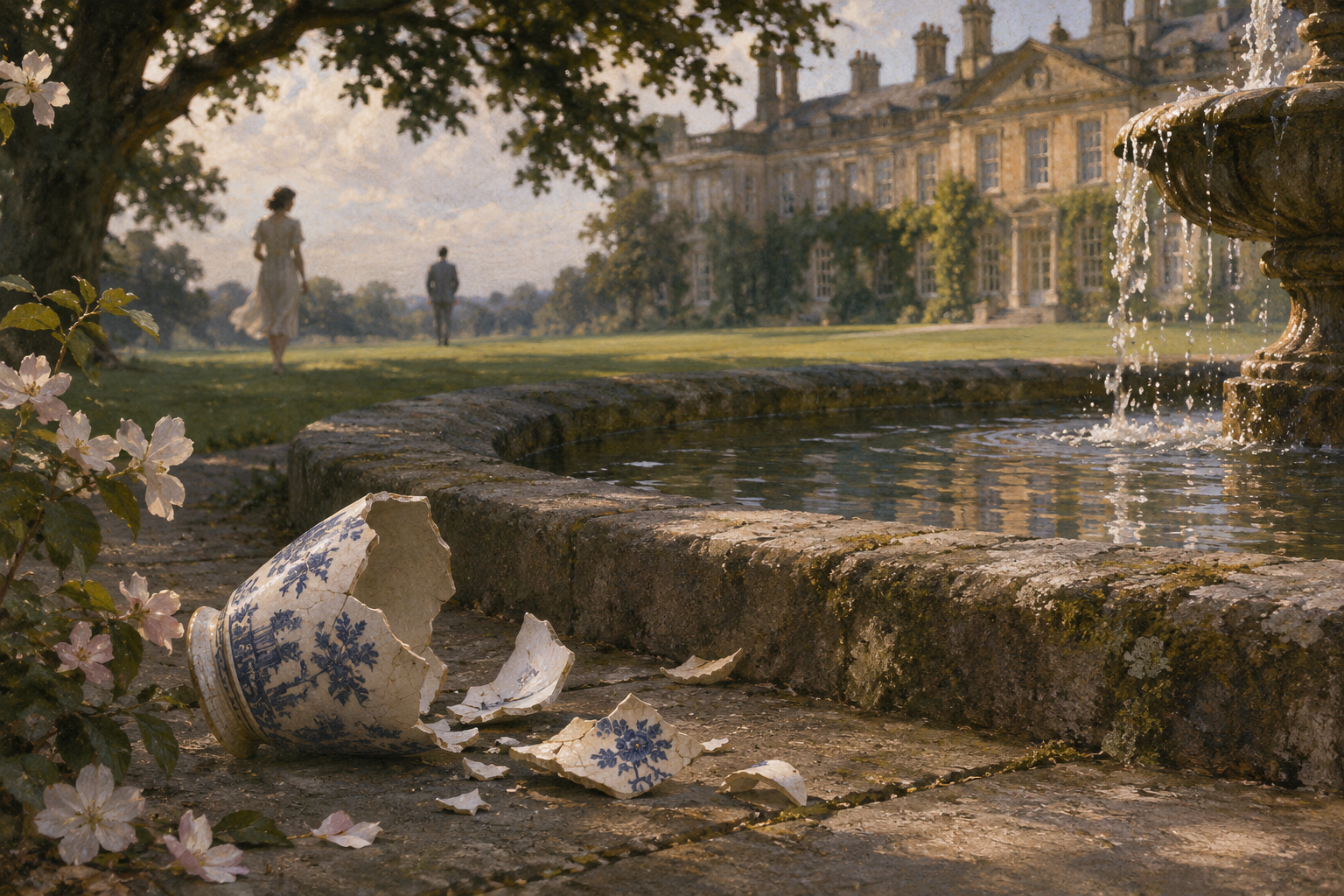
Cecilia is carrying flowers and a valuable family vase. At the fountain, Robbie offers to help. She resists, both take hold of the vase and a piece breaks off into the water. Cecilia strips to her underclothes and retrieves the fragments herself. Her action has an immediate purpose. It also allows her to express several feelings for which she has found no comfortable language. She is angry that he interfered, embarrassed by the damage and intensely conscious of him watching her.
Briony, at the window, can see bodies moving and clothes coming off. She cannot hear the exchange or see the piece of porcelain at the bottom. Robbie raises a hand. Cecilia undresses. Put those observations in a sentence and it sounds as though one person issued an order that another obeyed. Add the missing fragment of vase and the apparent command disappears. Robbie is the one left standing where he is, uncertain what to do. Cecilia is the one taking action.
McEwan gives us access to the encounter from different positions. The important difference is how little additional information it takes to transform its meaning. Briony need not have read a great deal about adult desire to discover why Cecilia entered the fountain. She could have gone downstairs and asked about the dripping clothes or the broken vase. Instead, the view from her window gives her a more exciting idea. A writer might tell the same event through several minds, giving each participant a private world as complete as her own.
It is a fine artistic discovery with an uncomfortable practical catch. In a story, Briony can write both sides. In life, the other two people retain the right to answer her back. She likes the discovery about fiction better than she likes being the youngest person in a house where adults routinely know things she does not. Before the day ends, a chance to supply the missing explanation herself will feel more attractive than another trip downstairs to ask.
How the Wrong Letter Reaches Cecilia
Robbie returns home and tries to compose an apology. He goes through possible versions, testing tones against a reader whose response he can only imagine. In one draft, he writes a startlingly explicit expression of sexual desire. He can set it down in private because he has no intention of sending it. When he leaves for dinner, he accidentally puts that draft into the envelope and asks Briony to deliver it to Cecilia.
Briony opens the envelope. What she reads appears to confirm that something alarming happened at the fountain. Her knowledge has increased in one narrow and consequential respect: Robbie thinks about Cecilia sexually. What the letter cannot tell her is how Cecilia feels about him, whether he has ever threatened her or why she got into the water. Briony has acquired authentic evidence and assigned it an evidential reach it does not possess.
She takes Lola into her confidence. Lola’s apparent sophistication carries weight because she is old enough to offer a vocabulary Briony lacks and young enough to be accessible. Together they begin to treat Robbie’s desire as evidence that he is dangerous. Discussing the letter also gives the cousins a relationship more interesting than squabbling over parts in a play. They share a secret, have a person to watch and can imagine that the adults have overlooked something the girls are clever enough to see.
Cecilia reads the same page quite differently. Its explicitness shocks her, but she knows Robbie, remembers the fountain from a few feet away and has been avoiding an admission about her own desire. What lands in her hands is humiliating for its author and clarifying for its recipient. She now has reason to risk an honest conversation. Briony’s interference has violated two people’s privacy without giving her anything like the understanding that each acquires in the course of speaking to the other.
In the library before dinner, Robbie and Cecilia acknowledge their love and have sex. Briony opens the door during the encounter. Once again she sees a physical arrangement without hearing the conversation that produced it. This time she already has a story into which the image fits. The man who appeared to command her sister and who wrote the ugly word now seems to have trapped her against the bookshelves. Cecilia has freely chosen something Briony believes she needs to be rescued from.
The library scene changes what it means to call Briony an unreliable witness. She is observant enough to remember details that would matter in another case. Her particular mistake is to assume the meaning of an encounter can be read off two bodies without asking either participant. She also has access to the one woman whose answer would contradict her. Believing herself Cecilia’s protector will shortly make it easier to disregard what Cecilia says.
What Can Briony See in the Dark?
Leon has brought a guest, Paul Marshall, a wealthy chocolate manufacturer. His standing in the household requires little explanation. He comes with the son of the family, can talk confidently about his business and is treated as an eligible, successful man. Earlier, in the nursery, he made a point of paying Lola attention. Marks on Lola’s body have also attracted notice, with the twins offered as an explanation. These particulars sit in different people’s knowledge. Nobody has put them together, and nobody at dinner has entered the room expecting to watch Marshall.
The twins run away. Their unhappiness, treated through much of the day as an inconvenience to other people’s arrangements, finally obliges the entire household to act. Search parties go out across the dark grounds. Briony comes upon Lola being sexually assaulted. A male figure moves away. Briony knows that an assault has taken place. The conditions do not allow her to make a secure identification of the attacker’s face.
This is the dividing line on which the novel turns. It would be unjust to say that Briony invented the assault. Lola has been attacked and needs protection. What Briony supplies is the name of a man she had already identified as dangerous. Lola does not give her a clear independent identification of Robbie. Briony’s belief hardens during the questioning until her account presents inference as sight. The people taking her statement receive something more useful for an accusation than the truth she could have told them: she saw a man leave, and she thought she knew who it must have been.
Robbie returns with the missing boys. He actually has performed the protective act Briony imagined herself performing for Cecilia. That fact establishes where he has been at some point in the evening, but it cannot answer an accusation whose supporting narrative now runs all the way back to the fountain. The letter is available, Briony describes the library encounter, and Robbie’s social position makes it easy for the family to imagine it has been generous to somebody it never properly knew. Cecilia’s insistence that she loves him counts for remarkably little beside a child’s insistence that she saw him.
The police take Robbie away. Grace Turner has spent years watching her son thrive under the Tallises’ patronage. When he is put in a police car, she can see exactly how far that patronage extends. Cecilia calls to him as he goes. The day began with a play intended to welcome a son home. It ends with one mother watching hers removed and with Cecilia making a choice about which side of the family door she means to stand on.
What Robbie Carries Through France
Five years later, Robbie is a British soldier retreating towards Dunkirk. He was convicted and imprisoned. Joining the army offered him a route out of prison, though the uniform has hardly restored the future he lost. Medical training, ordinary courtship and years in which he and Cecilia might have discovered what living together was actually like have contracted into a handful of letters and memories.
The change of setting does more than enlarge the scale of suffering. At the Tallis house, there was time to revisit a few seconds beside a fountain from several perspectives. In France in 1940, delay can prevent a man from reaching the coast. Robbie and his companions, Corporals Nettle and Mace, have to decide which roads remain passable, whether their information is current and when it is worth stopping. They often act on evidence quite as incomplete as Briony’s. The difference is that they know what they do not know and have urgent reasons for acting anyway.
Robbie’s education and French prove useful, although his companions outrank him. An officer’s confidence may inspire less trust than the judgement of the man beside him who can ask a local for directions. The retreat keeps exposing the gap between being entitled to speak and being in a position to know. A uniform, a loud voice or a story repeated by several exhausted men can all manufacture an appearance of authority. Robbie has unusually good reason to be wary of that appearance.
One of the most disturbing things he encounters on the march is a child’s severed leg caught in a tree. There is no adequate story to go with it. He cannot establish who the child was or recover the family to which the body belonged. At the country house, one missing piece of porcelain would have explained an apparently extraordinary scene. Here the visible fragment establishes terrible harm and almost nothing about the people who have suffered it. The reader has to bear the absence of an explanation rather than invent one that makes the image easier to leave behind.
Cecilia has broken with her family and become a nurse. She and Robbie have managed one meeting in a café after his release. They discover how many witnesses even an ordinary public room can seem to contain when two people need privacy. Their letters allow a different sort of closeness, but a letter exchanges news slowly and leaves the recipient alone with whatever he fears. On the road, Robbie holds on to her injunction to come back to her. It gives the long walk an imaginable endpoint more intimate than evacuation to England.
He is also carrying a shrapnel wound. As the retreat continues, infection, thirst and exhaustion affect his sense of time. France gives way in his mind to scenes from before the war. Reaching the evacuation area brings him within sight of a possible return without supplying the certainties the word Dunkirk can acquire in retrospect. Nettle can look after him for the night. Neither man has the reader’s comfortable ability to turn a page and call the campaign history.
What Briony Learns in the Hospital
Briony, now eighteen, has entered nurse training. It would be possible to see the decision as a gesture of penance or an attempt to follow Cecilia. On the ward, those explanations are of limited interest to anyone else. A probationer must carry out the next task correctly and respond to the name by which the institution calls her. A girl who once expected a cast of children to take instruction from her now learns how it feels to have somebody else assign every movement.
She still writes. A literary magazine returns a manuscript based on the fountain scene, accompanied by an encouraging editorial letter. The editor appreciates the experiment in presenting the encounter through different minds. He also sees that Briony has left a question hanging. What might the watching girl do as a result of what she thinks she has seen? It is excellent advice for improving the story and an alarming diagnosis of the part its author has found easiest to omit.
The distinction goes beyond confessing that she accused the wrong man. Revisiting the fountain in intricate prose allows Briony to demonstrate how perceptive she has become. Following her younger self downstairs, through the evening and into the police interview would require her to represent herself exercising power. Artistic sophistication can take her so far towards the truth and then provide a thoroughly respectable place to stop.
When wounded soldiers arrive in London, the hospital work changes. Briony sits with Luc Cornet, a gravely injured young Frenchman. He speaks as if he and Briony share acquaintances, memories and a possible life beyond the ward. She stays with him and allows him the comfort of being answered within the world he can still imagine. She cannot repair his injury. She can keep him company without demanding that he first understand where he is or who she really is.
The encounter places an awkward exception beside the lesson of 1935. Briony once caused catastrophic harm by allowing an invented relationship to take the place of the real one. Here a rigid insistence on factual correction would serve her own conscience better than it served the dying man. What has changed is who benefits from her invention, how much power she claims for it and whether the person beside her has room to answer. It is one of the few occasions on which her storytelling ability makes her genuinely useful to somebody who cannot repay her.
What the Wedding Makes Public
Briony attends Lola’s wedding. The groom is Paul Marshall. By this stage she understands that Marshall was the man who raped Lola. The marks that were explained away, his behaviour around the younger girl and the eagerness with which suspicion settled elsewhere can now be read together. An adult understanding of the afternoon corrects the identity Briony supplied at thirteen. It does not give her retrospective possession of a clear view in the dark.
The wedding lends the couple a public history very different from the one a truthful account of the assault would record. A respectable guest has become a respectable husband. Everyone knows how to behave at a wedding, and there is a particular moment in the service when a person with an objection might speak. Briony remains silent. Recognising that she once spoke beyond her knowledge has not taught her how to speak effectively now that she has good reason to do so.
It is worth leaving room around Lola’s motives. The marriage is an event Briony can report. The full private calculations of the fifteen-year-old who survived the attack, and of the woman she later became, are less securely available. Simply assigning Lola a motive that suits the observer would repeat one of the book’s oldest errors. What can be said with confidence is that the marriage protects Marshall’s position and makes the prospect of public correction more remote.
Briony then appears to visit Cecilia in London and finds Robbie there. The reunion the retreat left uncertain has apparently taken place. Robbie has survived to be furious on his own behalf. He and Cecilia tell Briony what a retraction would require: an accurate written account, an acknowledgement to the family and action directed towards correcting the record. An apology acquires some practical content. The person who benefited from being believed must take the risk of declaring publicly that her certainty was false.
The scene is difficult in a productive way. Robbie has no obligation to receive Briony’s remorse as proof that he is safe in her company. Cecilia can love her younger sister and refuse to relieve her of the consequences. For a while the novel allows the reader a consoling belief more modest than forgiveness. At least the people harmed have lived to speak, and at least the woman responsible has stood still long enough to hear them.
What Really Happened to Robbie and Cecilia?
The final section moves to London in 1999. Briony is a distinguished novelist turning seventy-seven. She has been diagnosed with vascular dementia and faces the loss of the faculty on which both her career and her private reckoning depend. Her family gathers at the former Tallis home, now a hotel. Younger relatives stage The Trials of Arabella. Sixty-four years after she assembled an unwilling cast in a nursery, Briony finally gets to see her first play performed.
She also identifies what we have been reading. The account of 1935 and 1940 is the latest version of a novel she has spent much of her life revising. She has researched the retreat and consulted records. The detail matters because the revelation is more uncomfortable than discovering that a careless narrator made things up. A conscientious writer can verify a soldier’s equipment and still give that soldier a future he never had.
Robbie died of septicaemia at Bray Dunes on 1 June 1940, before he could return to Cecilia. Cecilia died later that year when Balham Underground station was bombed. The meeting in the London flat never happened. Briony did not give the couple the chance to confront her. The café meeting after Robbie’s release assumes a different weight: an awkward interval in a public place was among the last opportunities these two people had to be together. The private future that once seemed to stretch beyond it belonged to Briony’s manuscript.
Why does Briony write the reunion? She wants to give Robbie and Cecilia some portion of the happiness her accusation helped take from them. She also recognises what readers want after following a wounded man through France. We have been made to long for a particular door to open. By opening it, she produces a powerful sensation of justice. The pleasure is real. Its recipients are the novelist and her readers. The two people in whose names she has arranged it died decades before the scene could be written.
Briony does exercise one restraint. She gives the lovers a life together in her account but stops short of making them forgive her. That leaves an important boundary visible. Yet she still wrote the speech in which Robbie holds her to account. Even the angriest reply an injured person gives her on the page is a reply whose wording she controls. This is the problem at the heart of the title. A novelist can make the accusation heard again, identify the protected man and let a reader understand the damage. She cannot use the powers of authorship to manufacture the independent consent that forgiveness would require.
Lola and Marshall are still alive in 1999, wealthy and able to contest publication. The completed manuscript has a future as testimony, although Briony cannot count on being alive or mentally able to supervise its reception. Readers of McEwan’s What We Can Know will recognise his interest in what a later investigator can retrieve from an uneven record. Here the problem is painfully personal. The witness in the best position to correct the archive is the person who first put the lie into it.
The book begins with a girl who wants the people she loves to gather and watch her play. It ends with a family doing exactly that, and with two people missing who might have remembered the first rehearsal. That absence sets the measure of what Briony achieves. She can make us go back to the fountain, notice the broken porcelain and understand why Cecilia took off her clothes. She can give Robbie a hearing. She cannot give him back the morning after it.
Sources
Atonement — Ian McEwan’s official website. Author’s page for the novel and its publication context. ianmcewan.com
Atonement Reading Guide — Penguin Random House. Publisher’s guide to the four-part structure, shifting viewpoints and 1999 coda. PenguinRandomHouse.com: Books
Atonement: Plot Summary — LitCharts. Reference for the country-house sequence, retreat, nursing episodes and final disclosure. LitCharts
Atonement: Full Book Summary — SparkNotes. Additional cross-check of the relationships and chronology. SparkNotes
