Faust Summary: Goethe’s Devil’s Bargain, and the Price of Wanting More
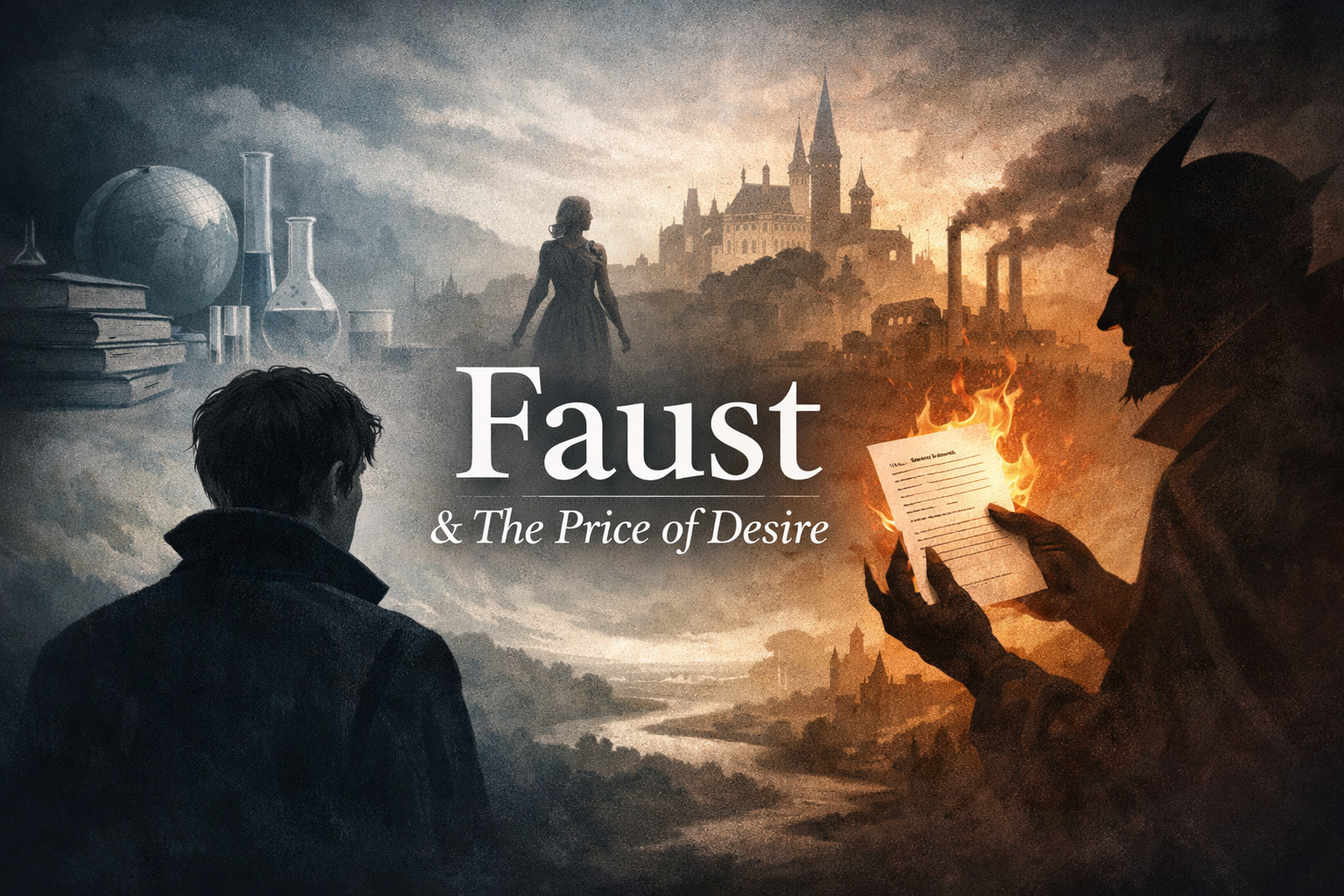
Faust Summary: Plot, Themes, and Ending Explained
Johann Wolfgang von Goethe’s Faust is a two-part tragedy published in 1808 (Part I) and 1832 (Part II). It is the most famous “deal with the devil” story in modern literature, but it is not really about sin as shock. It is about hunger. The hunger to know, to feel, to matter, and to escape the limits of a single human life.
At its center is a wager that treats the human mind like a test case. If a brilliant man can be offered the world, will he finally rest. Or will he keep reaching, even when reaching breaks other people.
Faust’s bargain is also a mirror. It asks what we sacrifice when we chase intensity, status, novelty, and control. It asks what we call “progress” when the costs land on someone else.
“The story turns on whether restless striving can ever become a life worth owning.”
Key Points
Faust is a two-part tragedy by Goethe about a scholar who makes a pact with Mephistopheles to escape despair and feel life at full volume.
The pact is structured as a wager: Faust loses if he ever becomes fully satisfied and chooses to stop.
Part I is a human-scale catastrophe centered on love, desire, social judgment, and the destruction of Gretchen.
Part II expands into satire and myth, moving through politics, money, power, and the dream of remaking the world.
Mephistopheles is not a monster with horns. He is a cold intelligence that understands weakness and mocks meaning.
The story is less about “temptation” than about what happens when a gifted person treats other lives as experiments.
The ending argues that striving alone is not enough, but that a human life is more than its worst consequences.
Full Plot
Spoilers start here.
Faust begins with a scholar who has learned “everything” and feels nothing. Faust has studied, argued, and mastered the respectable routes to truth. None of it cures the central ache. He wants direct contact with the real. He wants the kind of certainty that is felt in the body, not held in the mind. In that despair, he becomes vulnerable to a voice that offers escape.
Here is the full plot summary with spoilers. The story moves in two distinct movements. Part I is intimate and devastating. Part II is sweeping, symbolic, and obsessed with the machinery of power.
Act I: Setup and Inciting Incident
Faust is alone with his books and instruments, surrounded by proof of effort and absence. He tries to summon a deeper force, then recoils at what he cannot control. He considers ending his life, not from melodrama, but from a precise conclusion: the world will never open to him in a way that makes living feel honest.
At the same time, a wager frames the entire story from above. Mephistopheles is permitted to test Faust. He is not sent to torture him. He is allowed to tempt him, because temptation reveals what a person truly values.
Mephistopheles appears in Faust’s world and speaks like a man who has seen every human trick twice. He offers not a single sin, but a method. He will guide Faust through experience. He will make life vivid. The pact is shaped as a wager: Mephistopheles will serve Faust on earth, and Faust will belong to Mephistopheles afterward if Faust ever reaches a moment of complete satisfaction and chooses to stop.
Faust agrees. He signs the pact in blood. The choice is not only about pleasure. It is about refusing the limits of a single self. Mephistopheles immediately starts reducing the world into bait. He pushes Faust into crowds, taverns, and illusions, treating meaning as something you can purchase with sensation.
Faust is then steered toward transformation. Mephistopheles leads him to a witch who restores youth and intensifies desire. Rejuvenated and sharpened, Faust sees Gretchen and wants her. He does not want her slowly. He wants her as proof that life can finally be possessed.
What changes here is that Faust stops searching for truth and starts using other people as a bridge to feeling alive.
Act II: Escalation and Midpoint Shift
Faust courts Gretchen with Mephistopheles at his side, and the romance moves fast because it is not built on patience. Gretchen is not introduced as a symbol. She is introduced as a person embedded in a tight moral world. Her community watches. Her family structure has rules. Her reputation is real currency. Faust’s desire does not account for those stakes, because he is treating love as an escape hatch from his own emptiness.
Mephistopheles makes the affair possible by bending the world around it. Gifts appear. Meetings are arranged. Obstacles are mocked away. The romance becomes a kind of engineered outcome, and Gretchen becomes trapped between sincere feeling and a social order that will not forgive her.
Consequences arrive through the body. Gretchen’s mother is given a sleeping potion so Faust can enter unnoticed, and she dies. Valentine, Gretchen’s brother, confronts the dishonor and is killed in the fallout, leaving Gretchen with grief plus public shame. Gretchen becomes pregnant, isolated, and judged. The town’s moral certainty closes in around her like a wall.
The midpoint is not a twist. It is the moment when the romance reveals its true cost. Gretchen is now carrying more than a child. She is carrying the consequences that Faust refuses to hold. She is being punished by the world, while Faust continues chasing intensity as if he is still the only person at risk.
Faust is pulled into Walpurgis Night, a carnival of witches, masks, and grotesque pleasure that turns temptation into theater. The world becomes a spectacle designed to distract him from responsibility. But the illusions cannot fully drown out what has happened. Gretchen’s situation becomes unavoidable.
Gretchen, in despair and confusion, kills her child and is imprisoned. Faust goes to her cell with Mephistopheles urging escape. Gretchen recognizes Faust and also recognizes what stands behind him. She refuses to flee on Mephistopheles’s terms. In the final scene of Part I, she turns toward judgment and mercy rather than running. A voice declares her saved. Faust is forced to flee, leaving the wreckage behind him.
What changes here is that Faust learns experience is not freedom when the price is paid by someone else.
Act III: Climax and Resolution
Part II begins by widening the lens. Faust’s private crisis becomes a public one. Mephistopheles draws Faust into the world of rulers, war, and legitimacy, where people manage reality through theater. In the Emperor’s court, financial desperation is treated as a staging problem. Mephistopheles helps introduce a form of paper wealth that keeps the system moving, even as it reveals how easily a society can be hypnotized by symbols of value.
Faust is also driven into myth. The story moves through classical spaces and archetypes, as if Goethe is testing whether the old ideals still have power. Faust encounters Helen of Troy, the extreme image of beauty that Western culture has used as a measuring stick for centuries. Their union becomes a brief attempt to fuse the modern drive for mastery with the ancient dream of perfection. It does not last. The dream fractures, and what is born from it cannot stabilize into a livable life.
As the story advances, Faust’s appetite evolves. He no longer wants only sensation. He wants to make a world. He becomes obsessed with land reclamation and grand projects, imagining a future shaped by human will. This sounds like progress, and that is the danger. Faust’s dream contains a real idea: building a space where people can live freely. But the method is brutal. To clear the ground, an old couple is displaced and dies in the process. Faust claims he did not intend the outcome, but the structure of his ambition makes such outcomes predictable.
Near the end, Faust is old and blind. The outward powers he chased have not given him peace. But he reaches a moment that resembles meaning. He imagines a community living on reclaimed land, working and building a future. It is the closest he comes to a satisfaction that is not only personal pleasure. He speaks as if he can finally see a life that is worth more than his own cravings.
Then he dies. Mephistopheles moves to claim him, expecting the pact’s logic to hold. But the ending refuses a simple accounting. Angels intervene. Faust’s soul is lifted away from Mephistopheles. Gretchen appears in a transformed form and intercedes. The final choral voice frames the conclusion as a mystery of transformation and grace, insisting that human life cannot be reduced to a contract with evil.
The story ends with an argument rather than a verdict. Faust does not earn purity. He is not excused from harm. But he is not defined only by his worst acts, either. The ending claims that what saves is not flawless morality, but the movement toward something beyond the self, guided by love and drawn upward by a reality Mephistopheles cannot understand.
Analysis and Themes
Theme 1: The Hunger That Knowledge Cannot Feed
Claim: Intelligence can become despair when it is cut off from lived meaning.
Evidence: Faust begins surrounded by learning and still considers death, because mastery has not given him peace. His pact is not driven by greed, but by a craving for contact with life. He treats experience as medicine, then discovers it can become addiction.
So what: Modern culture sells information as salvation, but information does not automatically produce purpose. A person can “know everything” and still feel hollow. Faust warns that when knowledge becomes identity, emptiness feels like failure instead of a signal to change how you live.
Theme 2: The Devil as a Method, Not a Monster
Claim: Mephistopheles wins by reframing everything as a joke or a transaction.
Evidence: Mephistopheles rarely forces Faust’s hand. He offers shortcuts, setups, and distractions. He turns moral stakes into a clever game, then watches Faust accept the framing. Even in the final struggle, he relies on technical ownership rather than understanding.
So what: The most dangerous temptations do not look like obvious evil. They look like efficiency, cynicism, and a refusal to take anything seriously. In real life, that mindset can justify cruelty while keeping the self-image intact.
Theme 3: Desire Without Responsibility Creates Collateral Damage
Claim: When desire is treated as entitlement, someone else carries the cost.
Evidence: Faust’s romance with Gretchen begins with intensity and ends with death, shame, and imprisonment. Faust wants love as a portal out of his own despair, not as a shared life with consequences. The deaths around Gretchen are not “bad luck.” They are structural results of Faust’s impatience and Mephistopheles’s manipulation.
So what: This is the story’s moral core. The problem is not wanting. The problem is wanting without accountability. Faust shows how easily a powerful person can call destruction “a mistake” while a less powerful person is ruined.
Theme 4: Society Punishes the Vulnerable, Then Calls It Justice
Claim: The social order often protects its image more than its people.
Evidence: Gretchen is judged through reputation, purity, and honor. The community’s moral certainty tightens around her even as she unravels. Her suffering becomes public property, while the forces that shaped it remain partly invisible.
So what: The mechanism is familiar. Systems often punish the person who breaks the visible rule, not the person who engineered the situation. That dynamic shows up in workplace scapegoating, media pile-ons, and sexual double standards that still survive under new names.
Theme 5: Power Remakes Reality Through Symbols
Claim: Political legitimacy often runs on spectacle and shared belief, not truth.
Evidence: Part II moves into courts and empires, where money can be conjured through paper and loyalty can be staged through ceremony. The story treats governance like a theater that must keep running, even when it is hollow.
So what: Modern politics also runs on narrative infrastructure. Attention cycles, messaging discipline, and financial “confidence” can stabilize systems even when underlying conditions are fragile. Faust dramatizes how easy it is to build a world out of symbols, and how costly it is when the symbols collapse.
Theme 6: The Trap of Endless Optimization
Claim: If satisfaction becomes failure, you become unfree.
Evidence: The pact is designed around a poison idea: stopping means losing. Faust is driven to chase the next intensity, the next achievement, the next transformation. Even when he tries to build something lasting, the habit of domination travels with him.
So what: Many modern lives are structured like this wager. Always-on work, constant self-improvement, endless metrics, and algorithmic feeds reward motion without rest. Faust exposes the hidden violence in a life where “enough” is impossible.
Character Arcs
Faust begins believing that life is worthless unless it breaks open and gives him a total experience. He ends with a glimpse of meaning that is less about sensation and more about a future beyond his own appetite. The shift is forced by Gretchen’s collapse, by the emptiness of spectacle, and by the later realization that building a world still carries moral costs.
Gretchen begins as a person with ordinary hopes inside a strict moral world. She is pulled into a catastrophe she did not design, and she ends by refusing the devil’s exit. Her arc matters because it reveals a different form of strength than Faust’s. She does not dominate the world. She faces it.
Mephistopheles does not “grow,” and that is the point. He embodies a closed logic. He can analyze, mock, and bargain. He cannot understand why love, remorse, and grace would matter more than a signed pact.
Craft and Structure (What makes it work)
Faust works because it keeps changing shape while staying loyal to one core question. Part I is tight, emotional, and concrete. It uses scenes that feel like lived life: a room, a street, a relationship, a reputation. The language can turn lyrical, but the stakes stay human.
Part II is deliberately unstable. It moves through politics, economics, myth, and theology, treating the modern world as a collage of forces that no single person controls. That shift can feel strange, but it matches Faust’s evolution. His craving expands from private sensation to public power.
Goethe also makes the devil entertaining. Mephistopheles is funny, stylish, and observant. That craft choice is ethical. It shows how temptation operates. It does not arrive as a warning label. It arrives as relief, wit, and permission.
What Most Summaries Miss
Many summaries treat Faust as a simple morality tale about sin. The deeper structure is about a mind that refuses to accept the human limit. The pact is not “I want pleasure.” It is “I refuse to stop.” That is why it still feels modern.
Another overlooked point is that Gretchen is not just a subplot. She is the story’s moral measurement. If Faust’s striving is “noble,” why does it leave a trail of bodies. Gretchen reveals what Faust’s ambition costs when it is insulated by privilege and charm.
Finally, Part II is often dismissed as abstract, but its abstractions are sharp. It is obsessed with how societies maintain belief: money, authority, myth, and the stories people tell to keep going. That is not a detour. It is Faust’s bargain scaled up to the level of nations.
Relevance Today
Faust reads like a blueprint for modern intensity culture. The pact resembles a life built on constant stimulation, where boredom feels like death and rest feels like losing.
It also maps onto technology and media. Algorithms reward novelty and outrage, not wisdom. Mephistopheles would fit perfectly as the voice that says, “Don’t think too hard, just click again.”
In work culture, Faust is the person who cannot stop optimizing. Promotions, titles, side hustles, and personal branding become proof of life. The tragedy is that the proof never lasts.
In politics and power, Part II’s spectacle is familiar. Legitimacy is managed through narrative, financial confidence, and symbolic performance. Paper value can stabilize a system until it suddenly cannot.
In relationships, Faust is a warning about using love as medicine. When a partner becomes a cure for emptiness, the relationship turns coercive, even without obvious cruelty.
In inequality, the Gretchen story still lands. Consequences are not distributed fairly. A powerful person can “move on” while a less protected person is ruined by the same event.
In ethics, Faust is the problem of progress without consent. The land project in Part II resembles modern debates about massive infrastructure, climate intervention, and “solutions” that help one group while harming another.
Ending Explained
Faust ends with a refusal to let the devil have the final word. Mephistopheles expects the pact to function like a legal contract. Faust did agree. Faust did harm people. Faust did chase power. So Mephistopheles assumes the ending will be simple: ownership is ownership.
The ending instead argues that a human life is not a contract. Faust’s final movement is toward something beyond appetite, and the spiritual framework treats that movement as decisive. Gretchen’s presence matters because she represents love that is not transactional, and a conscience that survives shame.
The ending means Faust is not saved because he is innocent, but because his life cannot be reduced to cynicism and appetite. The story resolves the external wager, but it refuses to give the reader an easy moral comfort. Faust’s damage remains real. The ending insists that evil’s logic is limited, not that human behavior is clean.
The Last Word
Faust endures because it tells the truth about modern ambition without pretending ambition is simple. It understands the thrill of wanting more, and it understands the wreckage that “more” can leave behind.
This story is for readers who want a classic that still bites: a work that can handle desire, guilt, power, and the seduction of cleverness. It may not land for readers who want a single clean message or a straightforward plot, because Part II is symbolic and intentionally wide-angle.
Faust’s final challenge is still ours: if you refuse to ever stop, who pays for your motion, and what would it take to want the right thing.
