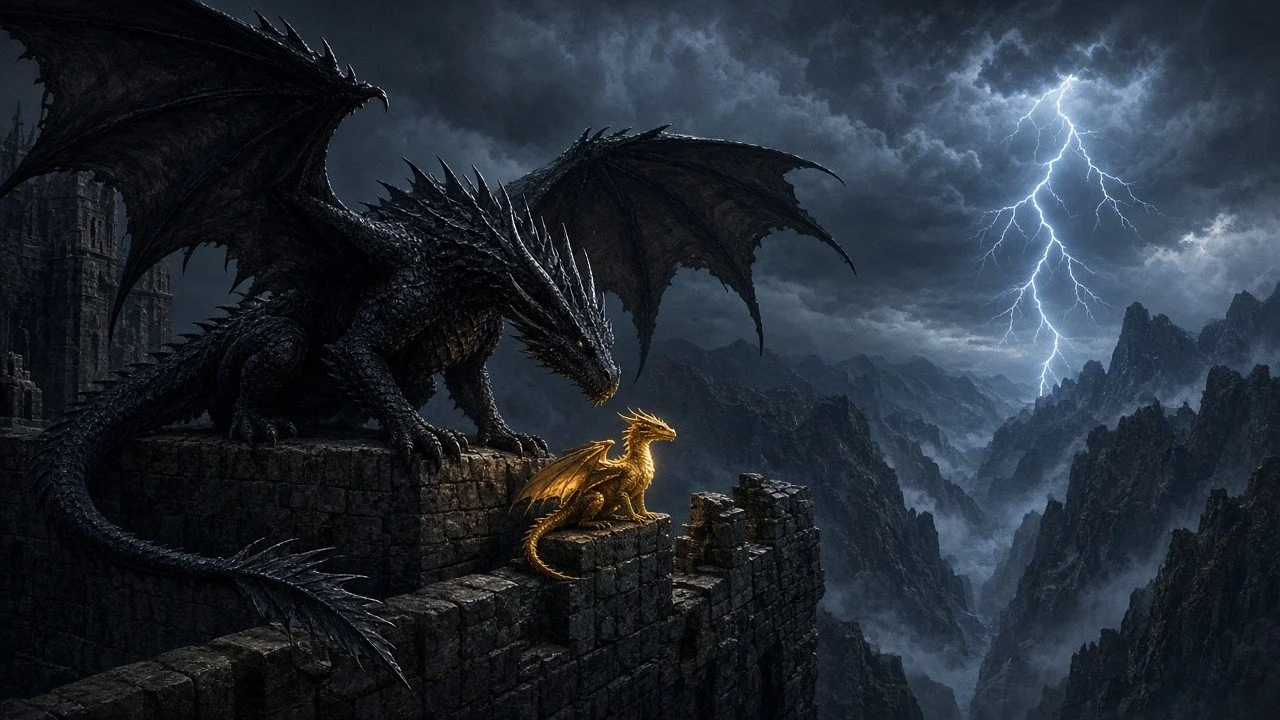
Violet Sorrengail was meant to be a scribe. Instead, her mother, the general who runs Basgiath War College, forces her into the Riders Quadrant, where cadets fight each other for the chance to be chosen by a dragon and many do not survive the year.
The War College Where Every Friend Could Be the Enemy
Fourth Wing is the novel that turned dragon-riding romance into a global publishing event. Rebecca Yarros's 2023 fantasy follows Violet Sorrengail, a young woman raised to be a scholar who is forced into a brutal military college where cadets compete for dragons, and where a failed bond, a fall or a rival's knife can kill you. It is a story about bodies that are underestimated, about loyalty under pressure, and about a country that lies to its own soldiers. This guide explains the set-up spoiler-free first, then walks through the whole plot in the order you discover it, before explaining the ending, the final twist and what it means for the Empyrean series, the Prime Video adaptation and the books that follow.
What Kind of Book Is Fourth Wing?
Fourth Wing is the first book in Rebecca Yarros's Empyrean series. It was published in the United States by Red Tower Books, an imprint of Entangled Publishing, on 2 May 2023, and in the United Kingdom by Piatkus on the same day. It is usually described as romantasy, the publishing label for books that give equal weight to a fantasy plot and a central romance, and it is written for adult readers, with explicit scenes and a great deal of violence.
The book is narrated mostly in the first person by Violet, which matters more than it first appears. Everything we learn about Navarre, its history and its enemies comes through a narrator who was trained to trust the official record. When that record begins to crack, the reader is as unprepared as she is.
The commercial story is well documented. In a November 2023 New York Times interview, the paper reported that Fourth Wing had sold more than two million copies in its first months, and the series has since become one of the defining fantasy franchises of the decade. Its spread on TikTok, where readers post reactions to its twists and its romance, is part of the reason it reached people who did not normally read fantasy.
The World: Navarre, Basgiath and the Riders Quadrant
The story is set in Navarre, a kingdom at war with the neighbouring kingdom of Poromiel. Navarre is protected by wards, magical defences powered by its dragons, and it trains its soldiers at Basgiath War College. The college is split into quadrants. Scribes record and preserve history. Healers, infantry and others train for their roles. The most prestigious and the deadliest is the Riders Quadrant, where cadets try to survive long enough to be chosen by a dragon.
Riders do not choose dragons; dragons choose riders. When a bond forms, the rider gains a channel to their dragon's power and, in time, a signet, a personal magical ability that reflects who they are. The stakes are blunt. If a dragon dies, its rider usually dies too. If a cadet fails, they often do not go home.
Running beneath all of this is the memory of a rebellion. Years before the novel opens, a group of Navarrian leaders from the province of Tyrrendor rose against the crown. The rebellion was crushed, its leaders were executed, and their children were forced into the Riders Quadrant. Those children are known as the marked ones because they carry a rebellion relic, a dark mark on their skin. Navarre presents this as mercy. The children see it as a sentence.
Conscription Day: Violet Is Forced to Choose Death or Glory
Violet Sorrengail is twenty and has spent years preparing to join the Scribe Quadrant, where her late father worked and where her love of books and history would be an asset. Her mother has other plans. General Lilith Sorrengail commands Basgiath and is herself a celebrated rider whose signet lets her wield storms. She orders Violet into the Riders Quadrant.
Violet's family history makes the order feel cruel. Her brother, Brennan, was a rider who is believed to have died during the Tyrrish rebellion. Her sister, Mira, is a serving rider who knows exactly how many cadets do not survive their first year, and she tries to stop it. Mira's advice is practical: keep your head down, use your mind, and assume nobody will save you.
The obstacle that makes this frightening is Violet's body. She lives with a chronic condition that leaves her small, prone to injury and slower to heal than most cadets. In interviews, Yarros has said she drew on her own experience of chronic illness in writing the character. The novel never treats this as a reason for Violet to quit. It treats it as a fact she has to plan around, and her planning becomes one of the most satisfying threads in the book.
The first test is the parapet, a narrow stone bridge high above a ravine that every would-be rider must cross. Many fall. Violet crosses by thinking rather than rushing, and on the way she helps another candidate, Rhiannon, by giving her a boot that grips better than her own. It is a small act, but it starts the friendship that anchors Violet's first year. On the same crossing, a hulking cadet called Jack Barlowe kills another candidate. He will become Violet's most persistent enemy.
Dain, Xaden and the Two Kinds of Danger
Violet has one apparent ally waiting on the other side. Dain Aetos is her childhood friend, the son of Colonel Aetos, and now a squad leader who wants to protect her. Dain's eventual signet lets him read a person's memories by touch, which seems a useful gift for an officer until the story reveals how it can be misused.
The other figure waiting for her is Xaden Riorson, a third-year cadet and the wingleader of Fourth Wing, the unit to which Violet is assigned. Xaden is the son of Fen Riorson, the rebellion's leader, who was executed after Lilith Sorrengail's forces crushed the uprising. Violet believes the rebellion killed Brennan. Xaden has every reason to hate her mother. The obvious conclusion, for her and for the reader, is that he wants her dead.
Yarros builds the first act around that suspicion. Xaden is cold, controlled and dangerous, and he says openly that he will not protect her. But his actions do not always match the threat. He keeps showing up at moments when Violet is in trouble, and he keeps refusing to finish what everyone expects him to start.
Violet's squad gives her a small community. Rhiannon becomes her closest friend. Ridoc supplies the jokes, and Sawyer brings a steady, practical presence. Together they form the core of a group that, by the end of the novel, has learned to protect one another rather than compete.
Surviving the First Year: Challenges, Poison and the Gauntlet
Basgiath encourages violence between cadets. In formal challenges, cadets fight each other on the mat, and deaths are tolerated as a cost of producing tough riders. Violet cannot win these fights by strength, so she uses what she knows. Her scribe training included herbs and medicine, and she uses that knowledge to weaken opponents before bouts. It is morally murky, and the book knows it, but it is also a clear statement of the novel's thesis: intelligence is a weapon too.
Xaden begins training her, partly because her death would cause him complications he cannot yet explain. The training scenes create the slow burn that romance readers expect, but they also have a story purpose. Violet becomes stronger, faster and more confident, and she learns to fight in a way that suits her body rather than imitating larger cadets.
The next hurdle is the Gauntlet, an obstacle course that tests climbing, balance and nerve. Violet survives it with help from her squad and by finding routes others ignore. By now she has shown that she is not the weak link the quadrant assumed, and the cadets who wanted her gone have noticed.
Threshing: Two Dragons Choose Violet
Threshing is the event at the centre of first year. Dragons come to a valley, cadets enter, and bonds are made, or not. Unbonded cadets may be killed by dragons or by each other.
In the valley Violet finds a small golden dragon, a feathertail, being cornered by Barlowe and his allies. Feathertails are considered useless for war, but Violet will not stand by while the young dragon is attacked. She defends it, and is badly hurt.
Her reward is extraordinary. A huge black dragon called Tairn, a morningstartail and one of the most powerful dragons in the valley, chooses her. Then the golden feathertail, Andarna, chooses her too. Violet becomes the first rider known to bond two dragons. It is a public triumph, and it instantly makes her more interesting to everyone, including the people who want her dead.
There is another twist inside the bond. Tairn's mate is Sgaeyl, Xaden's dragon. Because the dragons are mated, their riders are linked as well. If Violet dies, the consequences for Tairn and Sgaeyl could kill Xaden. That is the reason Xaden has been keeping her alive, and it explains much of his strange behaviour in the first act. It does not, however, explain everything.
After Threshing, Dain kisses Violet. She realises she does not feel the same way. The moment matters because it shows the gap between the Dain she remembers and the person he is becoming inside the system.
The Night Attack and What It Reveals
The violence of Basgiath is not limited to the mat. Early in the year, a cadet named Jeremiah is revealed to be an inntinnsic, someone who can read minds. Navarre treats that ability as too dangerous to permit, and Professor Carr executes him. The scene is short and shocking, and it tells Violet that the college will kill its own cadets to protect secrets.
Then seven unbonded cadets break into Violet's room at night to kill her. Andarna saves her by freezing time, a power no one should know she has. Xaden arrives, and Oren, one of the ringleaders, dies at his hands. Afterwards, Tairn shares a memory showing Amber Mavis fleeing the scene. Amber's guilt is confirmed and Tairn executes her with fire.
The attack changes the shape of Violet's year. Xaden assigns Liam Mairi, one of the marked ones, to guard her. Liam is warm, loyal and funny, and he quickly becomes one of her most trusted friends, which makes his place in the story's final act all the more painful.
Andarna's time-stopping is kept secret. Violet also learns something about how dragons work: every dragon begins life as a feathertail, which means Andarna is not a lesser dragon but a young one. That detail looks like world-building trivia, but it becomes important as the series continues.
Montserrat, Mira and a Bond That Cannot Stretch
Violet's squad wins the Squad Battle, a competition between first-year squads, and their prize is a tour of active outposts. At the Montserrat outpost, Violet sees her sister Mira serving on the front line. The visit shows the reader the war Navarre says it is fighting and gives Violet a glimpse of her future if she survives.
The tour also exposes a practical problem. Tairn and Sgaeyl cannot be apart for more than about three days without serious distress. That means Violet and Xaden have to stay near each other. Around the same time, they discover that they can speak to each other mind to mind. The romance shifts from rivalry to dependence, and both of them resist it because neither can risk trusting the other.
War Games: Lightning and a Line Crossed
The War Games are a sequence of exercises that test cadets in near-battle conditions. During one, Barlowe attacks Liam. Violet intervenes and uses Andarna's time-stopping power to save him. In the chaos, her own signet finally manifests: she can wield lightning.
Violet's lightning strikes Barlowe, and he appears to be killed. The scene matters for two reasons. First, it shows that Violet's signet is one of the most powerful in the quadrant, the opposite of the fragile rider her mother feared she would be. Second, it shows the cost of that power. Violet has to live with the knowledge that she has killed someone, even an enemy who tried to murder her friend.
The romance reaches its turning point here too. Violet and Xaden sleep together, and she sees his back. It carries 107 scars, which he explains as one for each child of the rebellion he took responsibility for. The detail changes how Violet sees him. The marked ones are not just enemies of Navarre; they are children who were punished for their parents' choices, and Xaden has made himself their shield.
Clues in the Margins: Her Father's Book
While the main action builds, Yarros plants a quieter clue. Violet's father left her a copy of Fables of the Barrens, a book of stories about creatures that drain magic from the land. Inside, Violet finds a note from him. Its message is that it takes only one desperate generation to change history, and even to erase it.
At first the note reads like a scholar's general warning about the fragility of archives. By the end, it reads like a confession. Violet's father worked in the Scribe Quadrant, where the official history of Navarre is kept. The fables he left her are not just fables.
The anniversary of Brennan's death, which coincides with Reunification Day, a public celebration of Navarre's version of the rebellion's end, adds to the tension. Violet grieves a brother she believes died in a war she was taught to understand one way. The novel is about to show her another way.
Athebyne: The Secret Xaden Has Been Keeping
During a night drill in the War Games, Xaden's squad of marked ones and Violet are sent beyond the wards towards the outpost of Athebyne. Violet follows Xaden and finds him meeting gryphon fliers, the riders of Poromiel, Navarre's enemy. She discovers that he has been smuggling weapons to them.
The explanation is the novel's biggest reveal. The monsters of her father's fables are real. They are called venin: people who draw magic directly from its source, without a dragon bond, and are corrupted by it. They create wyvern, dragon-like creatures they control. Navarre's wards block the venin's power, which keeps Navarre safe, while Poromiel, which has no comparable wards, is left exposed. The weapons Xaden has been sending are made from the same metal used in the ward stones, the only thing known to kill venin.
In other words, Navarre is not simply at war with Poromiel. Its leaders know about the venin and have kept that knowledge from their own people, while the border between the two kingdoms becomes a slaughterhouse. The rebellion led by Fen Riorson was, in part, an attempt to expose that truth.
Violet's sense of betrayal is layered. Xaden has lied to her. Tairn and Andarna knew about his secret and did not tell her. The college she was raised in has been teaching history as propaganda. And her father's note suggests he knew more than he said.
The Empty Outpost and Dain's Betrayal
When the cadets reach Athebyne, the outpost is empty. There is no relief force waiting. Instead there is a note that makes clear they have been sent into danger deliberately. Fan guides and recaps credit the note to Colonel Aetos, Dain's father, and present it as a test of whether the cadets will abandon the people they find or abandon the command. One widely used study guide attributes it instead to Professor Carr, so readers checking other summaries may find that detail described differently.
The reason the cadets were sent is the cruellest reveal in the book. Dain had used his signet to read Violet's memories without her consent and reported what he found. That is how the command learned that the marked ones were helping Poromiel. The childhood friend who claimed to be protecting her has handed her and her friends to the people who now want them dead.
Resson: The Battle That Ends First Year
The cadets learn that the nearby village of Resson is under attack by venin and wyvern. They can retreat, or they can fight for people Navarre treats as enemies. They fight.
The battle is costly. Soleil, a third-year rider, dies along with her dragon, Fuil. Then Liam's dragon, Deigh, is killed, and Liam dies with him. Before he dies, Liam asks Violet to look after his younger sister, Sloane. For many readers this is the moment the book stops feeling like an academy story and becomes a war story.
Violet is stabbed with a poisoned dagger by a venin. She kills the venin, and three wyvern fall from the sky with her, which confirms something important: when a venin dies, the wyvern it made die too. Violet then uses Andarna's power to stop time so she can aim her lightning, and she brings down more of the enemy. Xaden kills the last venin. Violet falls, poisoned and exhausted, and Andarna catches her.
The Ending: Aretia and the Return of Brennan
Violet wakes three days later in Aretia, the former capital of Tyrrendor that Navarre destroyed after the rebellion. It is being secretly rebuilt. Xaden and the marked ones have been creating a base for the fight against the venin, and Aretia is where the rebellion never really ended.
Violet is told why the plan has worked so far. General Melgren, Navarre's commanding general, has a signet that lets him foresee the outcome of battles. But he cannot see battles involving three or more marked ones. That blind spot has protected the rebels' operations.
Violet decides to join them. She will help fight the venin. But she refuses to trust Xaden again, at least for now. The romance ends on an open wound rather than a promise.
Then comes the final twist. Brennan walks into the room. Violet's brother, whom she has mourned for years, is alive. He is a mender, a rider whose signet heals, and he is the one who saved her from the poison. He welcomes her to the revolution. How Brennan survived the rebellion is not explained in Fourth Wing; that story belongs to the sequel.
The last chapter is told from Xaden's point of view, the first time the novel leaves Violet's head. It is a short but significant shift, inviting the reader to see that he, too, is carrying more than he has admitted.
Fourth Wing Ending Explained
The ending works because it changes the meaning of nearly everything that came before. The first act is a survival story. The second is a romance. The third reveals that both were happening inside a lie.
Start with the war. Violet was taught that Navarre fights Poromiel to protect itself. The ending shows that Navarre's leadership knows the real threat is the venin and has chosen to let other people die rather than admit it. The wards, which looked like a symbol of Navarre's strength, are also a wall that keeps the truth out. That is why her father's note matters so much. A desperate generation can erase history by teaching only what keeps the system stable.
Next, the marked ones. They were presented as the children of traitors. The ending reveals them as the people actually fighting the most dangerous enemy on the continent. Xaden's 107 scars stop being romantic mystery and become evidence of what he has carried for others.
Then Dain. He is the novel's most unsettling character because he believes he is doing the right thing. His memory-reading signet shows how a gift can become a tool of surveillance when used without consent. His betrayal also mirrors Navarre's: a protective relationship that becomes control.
The Brennan twist binds the political plot to Violet's personal story. She grew up believing the rebellion killed her brother. In fact he joined it. Every assumption she held about her family, her mother's authority and the rebellion's moral standing is now open to question. Readers often ask whether Lilith Sorrengail knew her son was alive. Fourth Wing does not answer that, and it is better to say so than to guess.
Andarna's time-stopping is another loose thread. It saves Violet more than once and helps her win at Resson, but its cost and its future are not fully explored in this book. Different recaps describe how Andarna has changed by the ending, so the safest reading is that the novel leaves her development as a question for later books.
Finally, the romance. Violet's refusal to trust Xaden at the end is not a manufactured obstacle. He lied about something that endangered her, her friends and her country. The novel ends with both of them committed to the same cause and further apart emotionally than they have been in hundreds of pages. That tension is the engine of the sequel.
What It Means for the Empyrean Series
Fourth Wing sets up a war on two fronts. Externally, Violet and her allies must fight the venin. Internally, they must survive Basgiath while knowing the college is complicit in the lie. Without spoiling the later books, the sequels follow those threads, widen the world beyond Navarre and test whether Violet and Xaden can rebuild trust.
The main series so far runs as follows. Fourth Wing was published on 2 May 2023. Iron Flame followed on 7 November 2023, picking up immediately after the Aretia ending. Onyx Storm was published on 21 January 2025 and takes the story beyond Navarre's borders. In September 2026, Yarros published Threshing Day, a collection of thirteen stories focused on dragon bonds. If you want to understand how that book reframes the bonding scenes in Fourth Wing, our guide to Threshing Day, all thirteen dragon bonds and Xaden's dark secret is the best next step.
As of 12 November 2026, the fourth main Empyrean novel has no confirmed title or publication date. Reports in 2026 said Yarros had begun writing it. Treat any specific release date you see online as unconfirmed unless it comes from the author or publisher.
A graphic novel adaptation is also on the way, with the first volume listed by UK booksellers for 6 April 2027.
The Prime Video Series: What Is Confirmed
Amazon announced a television adaptation in 2023, and the series was ordered in May 2026. In October 2026, Amazon confirmed the lead casting: Esther McGregor will play Violet and Emilio Sakraya will play Xaden. Meredith Averill is the showrunner and Lisa Joy is directing the pilot. Executive producers include Michael B. Jordan's company, Outlier Society, along with Yarros and Liz Pelletier of Entangled Publishing.
There is no release date. One entertainment outlet has reported that filming is expected to begin in April 2027, but that has not been confirmed by Amazon. The series will stream on Prime Video in more than 240 countries and territories when it arrives.
Adapting Fourth Wing will test how a series handles the book's interior voice. Much of the tension sits inside Violet's head, in her mind-to-mind conversations with Tairn and Xaden, and in her doubts about what she has been taught. How the show treats her chronic illness will also matter to readers who saw themselves in her.
Why Fourth Wing Connects with Readers
Fourth Wing is not subtle, and it does not try to be. It borrows the structure of a school story, the violence of a war novel and the escalating tension of a romance. What makes it work is the combination of a vulnerable narrator and a world designed to break her.
Violet's chronic condition is central to that appeal. Many readers have described the relief of seeing a heroine whose body does not cooperate and who still finds a way to win, not by being cured but by adapting. The book's emphasis on intelligence, preparation and friendship gives readers a version of strength that is not only about force.
The romance between Violet and Xaden follows the enemies-to-lovers pattern, a romance structure in which hostile characters slowly become partners. Yarros complicates it by making the hostility political. They are not just rivals. They are the children of people who tried to destroy each other.
If you enjoy the mix of fantasy politics and romance here, our Alchemised summary and ending explained covers another genre hit built on war, secrets and dangerous loyalty, and The Last King of Faerie: what to remember before reading is useful if you are reading across the wider romantasy boom. Readers comparing the biggest series of the moment can also look at our A Court of Splintered Harmony summary and ending explained.
Criticisms Worth Knowing
The book has critics as well as fans. Some readers find the world-building thin in places, with many terms introduced quickly and some institutions explained only as the plot needs them. Others feel the romance pulls attention from the political story, or that the modern-sounding dialogue sits awkwardly in a military fantasy setting. The level of violence among cadets also strikes some readers as hard to believe.
These criticisms are fair, but they do not account for the book's reach. Fourth Wing is designed for momentum. Short chapters, frequent cliffhangers and a twist-heavy final act are part of why so many readers finish it in days and move straight on to Iron Flame.
The Questions Fourth Wing Leaves Open
By the final page, the reader has as many questions as answers. How did Brennan survive? What did Violet's father know, and how much did her mother know? Can Violet stay at Basgiath while knowing the college hides? Will Dain face consequences for his betrayal? What will Andarna become? And can Xaden earn back the trust he lost?
Those questions are the reason the ending lands. Violet begins the book as a would-be scribe who trusts the official record. She ends it as a rider who knows the record is a weapon. She has power, but she also has a much harder task: deciding what to believe when the people closest to her have all lied, some to protect her and some to control her.
Fourth Wing ends with Violet alive, powerful and newly aware that her country's history is a lie. The venin are real, the marked ones are fighting them, Dain betrayed her, and Brennan is alive in Aretia. The romance survives in damaged form, and the war has barely begun. That is why the first book still pulls readers into the series: it rewards attention, punishes trust and leaves you wanting the truth as badly as Violet does.
Sources
Fourth Wing, Wikipedia (plot outline, publication, chart history)
How Rebecca Yarros Packed Dragons, Magic and Steamy Sex Into 'Fourth Wing', Alexandra Alter, The New York Times, 6 November 2023
Fourth Wing Ending Explained, Amanda Mullen, Screen Rant, 14 January 2025
Fourth Wing Ending Explained (Spoilers), BookExplained
SparkNotes Fourth Wing (its full summary misplaces Liam's death in the War Games; that point was not followed)
Fourth Wing Gets Amazon Series Order From Michael B. Jordan, Lisa Joy, Deadline, May 2026
Esther McGregor & Emilio Sakraya Officially Join Fourth Wing Series, Deadline, October 2026
Fourth Wing series cast announcement, About Amazon
Polygon Fourth Wing cast report (single source for the reported April 2027 filming start)
Fourth Wing: The Graphic Novel, Volume One, Hachette UK (ISBN 9780349449586)
Everything we know about Rebecca Yarros's fourth Empyrean series book, The Independent
Rebecca Yarros' Threshing Day Is Officially The Most Important Read While Waiting For Empyrean Book 4, Screen Rant
UK edition: Piatkus hardback, 2 May 2023, ISBN 9780349436999, checked on Bookshop.org UK and Hachette UK listings
