Harry Potter: The Full Saga Summary
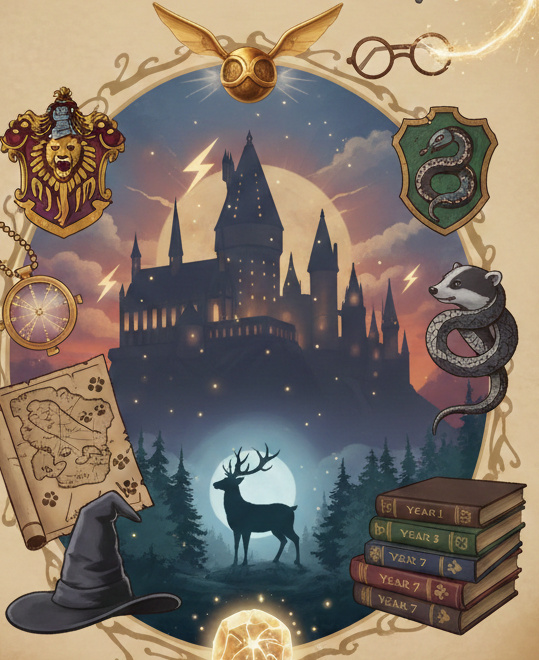
A boy grows up unwanted, then learns he is famous for something he cannot remember.
A world opens up. It offers belonging, skill, status, and a name that finally fits. It also offers a war that never really ended.
And the hardest part is not fighting a monster. It is deciding what kind of person you become when fear keeps asking for shortcuts.
This book turns on whether a child can refuse the same hunger for power that ruined the adults.
By the end of this episode, you will have the complete spine of the Harry Potter series: what changes in each phase, what escalates the war, and why the final victory costs what it costs.
You will also see the story’s working parts in plain language, so the series stops being “nostalgia” and starts being a map of loyalty, institutions, propaganda, and choice.
Key Takeaways
Power rarely arrives as a villain speech. It arrives as a rule change, a small exception, a quiet favour, and a promise that fear will go away.
Belonging is not automatically good. It can heal you, or it can train you to obey. Hogwarts does both, depending on who is holding the authority.
The series keeps asking the same question in new costumes: do you protect people by controlling them, or by trusting them?
Denial is a strategy, not an accident. When institutions admit the truth, they also admit failure, and many leaders would rather gamble with lives than lose face.
Friendship is seen as labour. It is not just affection. It involves being present, being honest, and remaining committed even when the benefits fade.
Identity is not destiny. The story repeatedly separates what you are told you are from what you choose to do next.
The most dangerous lie is “I am doing this for safety.” It excuses surveillance, cruelty, and pre-emptive violence.
Victory does not erase damage. It leaves survivors with memories, grief, and the responsibility to build something better than what came before.
The Plot
Set-up
Relatives raise Harry Potter as a problem to manage. On his eleventh birthday, he discovers he is a wizard and receives an invitation to Hogwarts, a secret school within a broader magical society.
He also learns the core fact that will shape everything: as a baby, he survived an attack from Voldemort, a dark wizard who pursued domination and killed without restraint. Voldemort vanished that night, and Harry grew up as the child everyone talks about but no one truly knows.
Hogwarts becomes Harry’s first real home. He forms a tight bond with Ron Weasley and Hermione Granger, and he meets the adults who will shape his moral education, especially Albus Dumbledore.
Inciting Incident
In Harry’s first year, the past pushes into the present. A secret surrounding the Philosopher’s Stone draws Harry into danger and shows him a pattern that will repeat: Voldemort is not gone, only reduced, and he will use any host, any loophole, any weakness in the system to return.
That early confrontation establishes the series’ rhythm. Hogwarts is a sanctuary, but it is also a battleground. Adults keep secrets “for protection”, and those secrets often make the children more vulnerable, not less.
Rising Pressure
Each year escalates the threat and widens the world.
The Chamber of Secrets opens, and the school becomes a place of fear and suspicion. The story exposes prejudice in the magical world and how quickly a community will turn on the outsider when panic takes over.
In the third year, a supposed murderer, Sirius Black, appears to be hunting Harry. The truth reframes Harry’s past: Sirius is tied to Harry’s parents, and the real traitor is closer than anyone expected. Harry learns that the official story is often wrong, and justice can be shaped by politics and fear.
Then the fourth year ruptures the series. Harry is forced into the Triwizard Tournament, a public spectacle of risk and reputation. The tournament ends with Voldemort’s return to full power and the first clear proof that the war is back. Voldemort regains a body, reasserts his ideology, and begins moving openly, not just through shadows.
The fifth year becomes a war over truth itself. The Ministry refuses to accept Voldemort’s return. It installs control at Hogwarts through Dolores Umbridge, turning the school into a laboratory for authoritarian rule: propaganda, punishment, surveillance, and the reduction of education into obedience. Harry and his friends form a student defence group, not out of rebellion for its own sake, but out of necessity. The year culminates in the revelation of a prophecy linking Harry and Voldemort, and in the death of Sirius, which breaks Harry’s remaining illusions about protection.
The sixth year moves into strategy. Dumbledore prepares Harry for what must come next and reveals that Voldemort anchored himself to life through Horcruxes, objects containing fragments of his soul. The war becomes a hunt. The year ends with Dumbledore’s death, which removes the stabilising adult force and leaves Harry with responsibilities he never asked for.
The Midpoint Turn
The series’ midpoint is not a calm pause. It is the moment the story stops being “school adventures with a dark shadow” and becomes open conflict.
Voldemort’s return turns private danger into public collapse. The ministry’s denial and then its fall show how quickly a society can be captured when it has already trained itself to prefer comforting stories over hard truth.
From this point on, the question no longer revolves around the existence of Voldemort. It is whether anyone can stop him before he remakes the world.
Crisis and Climax
In the final phase, Harry leaves Hogwarts to hunt Horcruxes with Ron and Hermione. The story becomes stripped-down: travel, scarcity, mistrust, courage under pressure, and the slow grind of making choices with incomplete information.
As Voldemort tightens control, the trio learn that resistance is not glamorous. It is exhausting. It requires patience, discipline, and the ability to keep going after mistakes.
The climactic convergence returns to Hogwarts. The school becomes a fortress for the final stand. Allies gather, losses mount, and the war reaches its most brutal point.
The final confrontation rests on accumulated moral choices: Harry’s refusal to seek power for its own sake, the meaning of sacrifice, and the unraveling of Voldemort’s core weakness. Voldemort cannot understand love as a real force because he cannot practise it. He mistakes dominance for safety and fear for loyalty.
Resolution
Voldemort is defeated, the war ends, and the surviving characters step into a quieter kind of challenge: rebuilding lives inside a world still marked by trauma.
The series closes with continuity rather than fantasy perfection. People carry scars, but they also carry each other. The point is not that evil disappears. The point is that it can be resisted, and that resistance has a cost worth paying.
The Insights
The story treats choice as the only form of identity that matters.
Harry is repeatedly told what he is: famous, dangerous, special, destined. Those labels would be enough to justify arrogance or despair. He refuses both.
A concrete example is Harry’s long pattern of choosing people over status, even when status would make him safer. He chooses friends, teachers, and strangers he thinks are being harmed.
The cost is constant pressure. You do not get to choose once. You have to keep choosing.
Institutions do not collapse because they are weak. They collapse because they defend themselves before they defend people.
The Ministry's response to Voldemort's return exemplifies self-preservation through tactics such as denial, smears, information control, and punishing messengers.
A concrete example is the installation of Umbridge at Hogwarts, turning education into a tool of compliance rather than competence.
The cost is lost time. Denial turns preventable damage into irreversible loss.
Fear makes people crave simple stories, and simple stories make cruelty feel responsible.
Blood purity ideology thrives because it provides anxious people a ladder: a promise that some are “better” and therefore safer.
A concrete example is how quickly suspicion spreads in the school when the Chamber opens and how marginalised students become targets.
The cost is moral degradation. People begin to call harm “order” and feel proud of it.
Secrecy is the series’ most recurring sin, even among “good” characters.
Adults hide information to protect children, to control outcomes, or to avoid pain. Occasionally they have reasons. Often they create disasters.
A concrete example is the way knowledge about Voldemort’s past and methods is rationed, leaving younger characters to improvise in life-or-death situations.
The cost is loneliness. Secrecy isolates people and makes them easier to break.
Loyalty is shown as something you do, not something you declare.
Friendships in the series survive jealousy, fear, humiliation, and grief. They survive because the characters keep returning to the work: apologising, listening, and acting.
A concrete example is the trio’s endurance during the Horcrux hunt, when stress and suspicion tear at their bond and still they persist.
The cost is pride. Loyal people pay with ego, not just time.
The villain’s flaw is not rage. It is a failure of imagination about other people.
Voldemort understands fear, leverage, and punishment. He cannot understand devotion that does not want a reward.
A concrete example is how often his plans depend on people behaving like him: selfish, transactional, eager to preserve themselves at any cost.
The cost is blindness. When you are unable to imagine decency, you misinterpret the world and ultimately succumb to it.
The Engine
The engine is simple: Voldemort fears death and tries to cheat it, and that fear pushes him to split himself, corrupt institutions, and demand total control.
Harry becomes the unavoidable counterweight. This is not because Harry is the strongest, but rather because he consistently rejects the same agreement.
Every time Voldemort tightens his grip, the story forces the characters to answer: will you be ruled by fear, or will you act anyway?
What This Looks Like in Real Life
A school under pressure changes its policies after a single scandal. The old approach is punishment and silence. The new approach is competence and transparency. The consequence is trust, or the lack of it.
A workplace sees declining performance, and then leadership starts measuring everything. The old approach is surveillance and threat. The new approach is clarity, real training, and honest ownership of mistakes. The consequence is either fear-driven compliance or durable performance.
A community group is hijacked by status games online. The old approach is shouting, pile-ons, and forcing public loyalty. The new approach is quieter boundaries and real accountability. The consequence is whether the group becomes a place of belonging or a theatre of control.
A Simple Action Plan
Where in your life are you accepting a comforting story because the truth would demand action?
What kind of "small exception" are you making that you would hate to see normalised?
Who are you protecting by withholding information, and who are you endangering?
When have you confused loyalty with obedience?
What would you do differently if you stopped trying to look safe and started trying to be useful?
Which part of your identity is inherited, and which part is chosen?
If fear disappeared for one day, what decision would you make immediately?
Conclusion
Harry Potter ends as a story about refusing corruption even when it would feel easier to join it. The cost is real: death, grief, broken families, and childhoods interrupted by war. The victory is not a clean wipe. It is the survival of a moral line that many people tried to erase.
If you want more episodes like this, follow the show on Spotify so you do not miss the next deep-dive. And if you want the written version, extra notes, and follow-on recommendations, you can find them on [WEBSITE_NAME].
The final lesson is not magic. It is the choice to stay human when fear offers you power.
Relevance Now
The series hits because the pressures it dramatises are now ordinary: performance culture, institutional mistrust, and identity shaped by reputation rather than reality.
Online life trains people to sort houses without thinking, to punish outgroup behaviour, and to confuse visibility with truth. That mirrors the way the wizarding world turns rumour into verdict, and how authority tries to control the story instead of fixing the problem.
Workplaces and institutions still fall into the Ministry pattern: deny, delay, discredit, and then overcorrect with control. The books show the price of that reflex in human terms, not just policy terms.
Be alert for instances when fear prompts you to exchange your values for a quick solution. That is where the story always starts to go wrong.
