The House That Hid Her Childhood
She Inherits a House and Someone Else’s Childhood Story
Maggie Holt has spent most of her life hearing about a childhood she cannot properly remember. Her father’s bestselling account says their family escaped a haunted house. Strangers know its rooms, its supposed ghosts and the frightened little girl at the centre of the story.
That girl is Maggie, and she does not believe the book.
Riley Sager’s Home Before Dark, first published in 2020, sends her back to Baneberry Hall after her father’s death. She intends to renovate the property and discover what happened there. The house presents a problem more unsettling than a straightforward choice between belief and disbelief: some details seem false, others appear disturbingly accurate, and the difference may determine what she understands about her own family.
Maggie’s Father Has Already Told the World Who She Is
Ewan Holt’s House of Horrors describes the family’s brief residence at Baneberry Hall and their flight from it.
The book has brought money and notoriety. It has also made Maggie’s childhood public property.
People approach her through the story before they know her as an adult. Her identity arrives preinterpreted.
That is the first form of haunting in Sager’s novel.
Maggie does not need to believe in ghosts to be pursued by a narrative she did not choose. The account follows her through questions, assumptions and the expectation that she can authenticate something she cannot remember.
Her father’s authorship also creates a particular imbalance. He has supplied a complete version of events. She has doubts and gaps.
A finished narrative often carries more authority than an incomplete objection, especially when the narrative has been repeated for years.
Maggie’s scepticism therefore has a personal force beyond intellectual disbelief.
Rejecting the haunting allows her to resist being defined by the frightened child in her father’s book.
But rejection does not supply an alternative history.
She knows what she doubts without knowing what should replace it.
The inheritance brings that problem into physical form. Ewan has left her the house itself, despite his warnings that she should not return.
The property contradicts the family’s apparent break with the place. If the escape was so final, why did he retain ownership?
Maggie’s mother, Jess, discourages a return and offers another way to dispose of the property.
Maggie nevertheless goes.
Her professional experience renovating houses makes the decision practical as well as emotional. She can approach Baneberry Hall through work: inspect it, repair it and sell it.
The difficulty is that the building contains a history that cannot be resolved through a straightforward renovation plan.
The Novel Gives the Reader Two Houses at Once
Sager alternates Maggie’s present-day investigation with passages from Ewan’s book.
The structure allows the reader to inhabit two versions of Baneberry Hall.
In one, a father records an escalating supernatural threat to his family. In the other, his adult daughter searches for evidence that can confirm or dismantle that account.
Neither strand can be read without affecting the other.
A detail in Ewan’s narrative becomes a question in Maggie’s. Something Maggie discovers may make an earlier passage seem more credible, more deceptive or simply more complicated.
The reader is therefore asked to compare accounts rather than passively receive a single history.
This creates a distinctive form of suspense. The question is not only what will happen next, but what a familiar event means when viewed from another position.
The published book possesses the smoothness of a completed story. Maggie’s investigation is untidy and provisional.
That difference should not be mistaken for a difference in reliability.
A confident account can be wrong. An uncertain investigator can be moving towards the truth.
The structure also lets Sager use the pleasures of a haunted-house narrative while examining how such a narrative is made.
Ewan’s book has ominous patterns, memorable figures and dramatic escalation. Those features make it compelling.
They also encourage the reader to ask whether the need for a compelling story has shaped what Ewan chose to include and explain.
Maggie cannot simply discard everything because some of it seems theatrical.
A false explanation can incorporate real events.
That possibility is central to the novel’s design. The truth will not emerge through deciding that one entire account is accurate and the other entirely mistaken.
It requires separating observation, interpretation, omission and invention.
The house has been turned into a story. Maggie has to work backwards from the story to the people and actions beneath it.
Baneberry Hall Comes With a History Ready to Be Used
Ewan’s account places the Holts inside a house already associated with tragedy.
The previous family, the Carvers, suffered the deaths of a father and daughter. Earlier history also supplies material connected to the house’s original owners and the fate of Indigo Garson.
These accounts make Baneberry Hall an unusually suggestive setting.
New residents do not encounter unexplained events without expectations. They enter knowing that other people have already attached violence and loss to the rooms.
That knowledge influences what later experiences seem to mean.
A noise in an ordinary house may prompt a search for plumbing or loose timber. The same noise in a house associated with death can become evidence of recurrence.
Sager uses that difference without assuming that expectation explains everything.
The building still has a material reality. People have lived there, worked there and moved through spaces the Holts may not understand.
The local history also belongs to living people.
For them, the house’s reputation can mean humiliation, intrusion or the transformation of a family tragedy into entertainment.
Maggie arrives carrying a surname associated with the account that made those consequences worse.
She may reject the book, but others can still see her as its beneficiary.
That tension prevents her from becoming a neutral investigator. Her search for personal truth takes place among people whose lives have been affected by her family’s public story.
The distinction between ownership and authority becomes important.
Maggie owns the building. That does not mean she owns every memory connected to it or can expect every resident to help her understand the past.
Her practical task becomes more difficult as the property’s history acquires names and relationships.
The house is no longer merely the setting in which her childhood happened.
It is a place where several families’ losses have been forced into one bestselling explanation.
The Child in the Book Sees What Adults Cannot Explain
In Ewan’s narrative, five-year-old Maggie reports frightening visitors.
The most memorable are Mister Shadow and Miss Pennyface.
Their names belong to a child’s attempt to describe what she perceives. They are specific enough to feel recognisable, but they do not establish what the figures actually are.
That distinction becomes essential later.
Adults can make two opposite mistakes with a child’s account. They can dismiss an experience because its explanation sounds impossible, or accept the explanation without testing what produced it.
Young Maggie has language for appearances, not a complete understanding of causes.
Ewan’s book gives those appearances a supernatural framework.
The adult Maggie inherits that framework alongside her lack of clear memory. She cannot easily distinguish what she once experienced from what she has repeatedly read.
The problem is therefore not simply forgetting.
It is remembering through an account supplied by someone else.
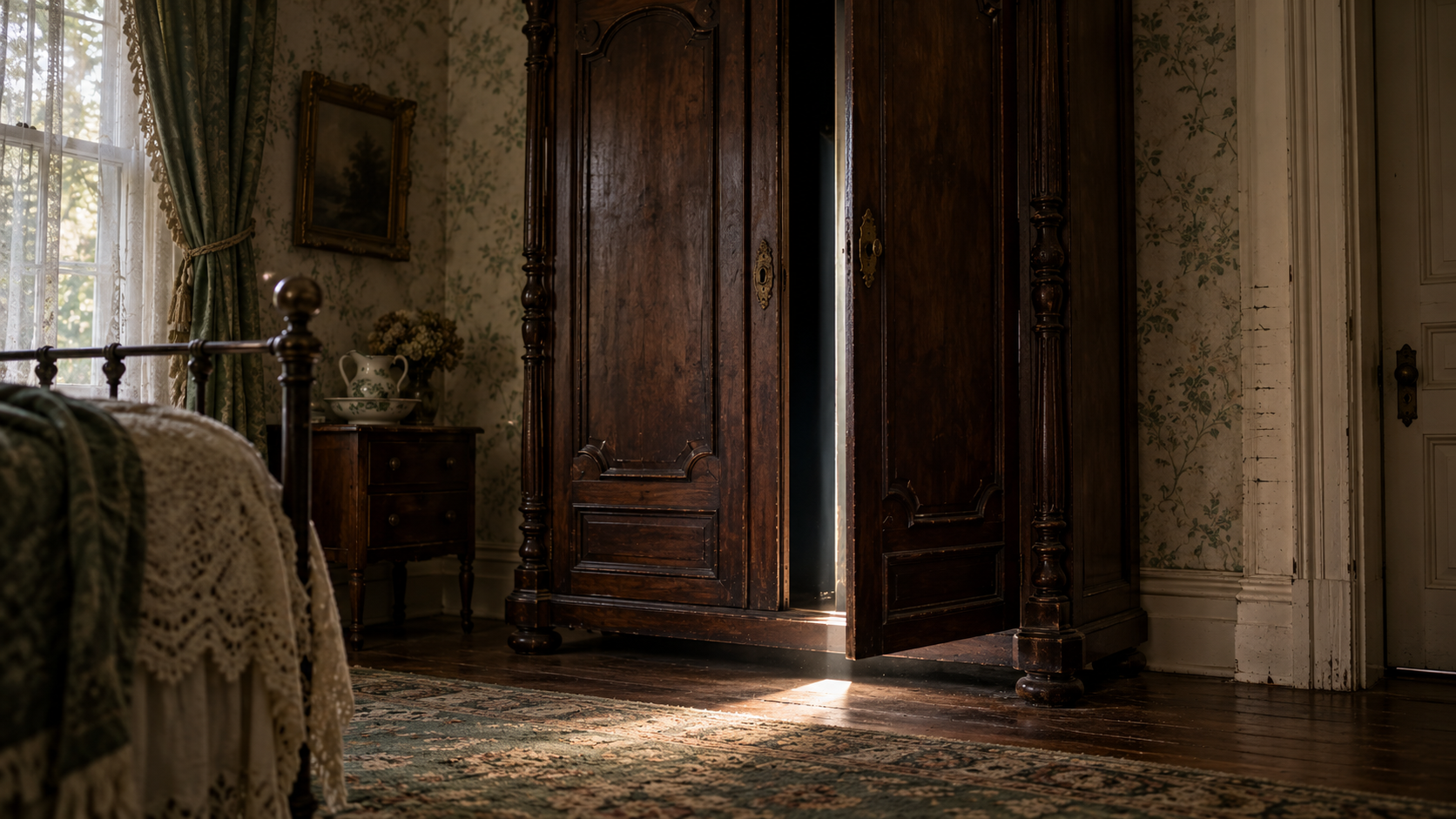
The armoire in her childhood room becomes a focal point because the figures seem connected to it. A piece of furniture is transformed into a threshold between ordinary domestic space and the frightening unknown.
Sager makes the object effective by keeping it physically ordinary. It belongs in a bedroom. Its doors should conceal clothes and storage.
The suggestion that something else might emerge from it makes familiar architecture uncertain.
Ewan’s account also includes disturbances such as noises, music and an alarming episode involving snakes in the kitchen ceiling.
These incidents create a pattern of invasion.
The home fails to remain a controlled enclosure. Something enters from places the residents do not properly see.
Maggie’s present investigation will return repeatedly to that issue of access.
Before the reader can decide whether the visitors were supernatural, another question has to be answered: who could move through the house without the family understanding how?
The Present Begins to Resemble the Story Maggie Rejects
As Maggie stays at Baneberry Hall, disturbances seem to echo Ewan’s account.
Sounds, music and missing objects make her certainty harder to maintain.
The effect is not that she immediately becomes a believer. Rather, her preferred explanation has to accommodate observations she cannot simply deny.
That is a more interesting pressure than a sudden conversion.
She wants to treat the house as a building with identifiable problems. Its resemblance to the published story threatens to place her back inside the childhood role she has resisted.
Dane, who has connections to the house and its former caretaker, helps with the renovation.
Hannah Ditmer also belongs to the property’s living history. Her mother, Elsa, worked for the Holts, while her sister Petra disappeared around the time the family fled.
Petra’s disappearance introduces a different kind of unresolved event.
A missing teenager cannot be treated as atmosphere in a ghost story. Her absence belongs to a family still living with its consequences.
Maggie also learns that Ewan returned to the property repeatedly.
Those visits contradict the idea that he permanently abandoned a place he believed too dangerous to enter.
The contradiction does not immediately establish why he returned.
It does establish that the public story is incomplete.
Maggie’s investigation now has several distinct problems: what caused the disturbances, why her father retained and revisited the house, and whether the family’s departure was connected to Petra.
Keeping those questions separate is important.
One explanation may account for the music without accounting for the disappearance. A hidden entrance may explain access without identifying who used it on a particular night.
The novel’s suspense depends on the tendency to treat a partial solution as if it resolves everything.
Maggie repeatedly gains an answer and discovers that the answer opens another question.
A Discovery Forces the House Out of the Realm of Legend
During the renovation, human remains are discovered above the kitchen.
They are Petra’s.
The discovery changes the investigation’s centre of gravity. The house now contains direct evidence of a concealed death.
The earlier ceiling episode in Ewan’s book acquires a new significance because the same part of the building contains something his public account does not explain.
The novel’s parallel structure becomes especially effective here. The reader has already been trained to recognise the location, but recognition now produces a different understanding.
A dramatic feature of the supposed haunting becomes connected to material concealment.
Maggie must confront the possibility that her father was involved.
That possibility is more painful than simply proving he exaggerated a ghost story for profit. It threatens the moral identity of the parent whose account has shaped her life.
Her scepticism has prepared her to consider him a fabricator. It has not necessarily prepared her to imagine him concealing a body.
The difference matters.
A person can distrust one part of a loved one’s behaviour while remaining deeply invested in another part of their character.
Maggie’s investigation therefore becomes a test of what she is willing to know, not merely what she is able to discover.
The remains also restore Petra to the story as someone whose fate requires an answer.
Ewan’s account placed the Holts’ fear at the centre. The discovery makes that arrangement harder to sustain.
Another family’s loss has been physically hidden beneath the story of their escape.
The house’s reputation can no longer be examined solely as a problem of Maggie’s identity.
Whatever happened to her as a child, someone died, someone concealed the death, and people were allowed to continue living without that knowledge.
The mystery has become an argument about whose suffering received a narrative and whose suffering was buried.
Explaining the Disturbances Does Not Explain the Death
Maggie identifies Hannah as the source of some present-day disturbances.
Hannah has been entering the house, taking objects and using elements of its reputation to frighten Maggie away.
The revelation supplies an ordinary explanation for experiences that seemed to support the haunting.
It also shows how the published story can become a practical tool. Someone who knows what visitors expect can reproduce those expectations.
Fear becomes easier to generate when the audience already knows the script.
Hannah’s conduct has motives rooted in her own circumstances, but it does not solve Petra’s death.
The novel deliberately separates those questions.
Discovering that one frightening incident was staged does not prove that every unexplained event was staged by the same person.
Hannah also provides information about concealed access to the house.
The passage behind the armoire changes the meaning of young Maggie’s reports. A visitor could appear to emerge impossibly while using a route the child did not understand.
The architectural explanation is powerful because it preserves the possibility that Maggie saw something real.
Her childhood account need not be dismissed merely because the interpretation was wrong.
Maggie then focuses suspicion on Dane, whose earlier connection to Petra gives him a concealed place in the history.
He acknowledges their relationship but denies killing her. Their confrontation becomes physical, and he is injured.
This development shows the danger of assembling a convincing accusation too quickly.
Maggie has identified secrecy and opportunity. Those facts make Dane relevant, but they do not by themselves establish guilt.
Her determination to stop being controlled by another person’s story does not make her immune to constructing a mistaken story herself.
The investigation has brought her closer to the truth while also revealing the limits of confidence.
She needs an explanation for Petra’s death.
The next account she receives will seem to provide one—and will again require correction.
Her Mother Offers an Answer Maggie Cannot Remember
Jess tells Maggie that she was responsible for Petra’s death.
According to the parents’ understanding, Petra had been babysitting. They returned to find her dead after a fall down the stairs, with signs suggesting a confrontation involving Maggie.
Ewan and Jess believed their daughter had caused the death.
They concealed Petra’s body and left the house.
The haunting story became an explanation for their departure, eventually developing into the book that defined Maggie’s life.
This revelation gives the parents’ behaviour a coherent motive. Their secrecy, Ewan’s continued ownership and his return visits can now be understood in relation to the concealed body and their fear for Maggie.
But coherence is not the same as correctness.
The parents reached a conclusion from what they encountered after the event. They did not possess a complete account of what happened.
That distinction keeps the revelation from becoming the final solution.
It also exposes the damage created by protective certainty. Ewan and Jess acted as though they knew what their daughter had done, while refusing to allow the event to be investigated.
Their attempt to protect her depended on treating their interpretation as fact.
Maggie has consequently spent years living with the consequences of an accusation she was never allowed to hear.
The book made her famous for surviving a haunting. Beneath it, her parents carried another account of her as a child who had killed.
Both stories were written around her.
Neither gave her the opportunity to understand or challenge the event.
The emotional force lies in that double dispossession. The public story was false in crucial ways, but the private family explanation may also be wrong.
Maggie must now reconsider not only what happened in the house but the basis on which the people she trusted decided what sort of protection she needed.
The Visitor From the Armoire Supplies the Missing Event
Marta Carver emerges through the concealed passage associated with the armoire.
Maggie recognises the connection to Miss Pennyface. Reflected light on Marta’s spectacles helps explain the child’s description.
Marta had been entering the house to watch Maggie sleep because the girl reminded her of her dead daughter, Katie.
During one of those visits, Petra discovered her. A confrontation followed, and Petra fell down the stairs.
Marta was responsible for the fatal encounter.
Ewan and Jess had concealed the aftermath of an event they misunderstood.
The distinction between the person who caused the death and the people who hid the body is finally established.
Marta’s grief explains why she entered the room, but it does not give her a right to Maggie’s childhood or excuse what followed.
Her longing had become an intrusion into another family’s life.
When she discovered that the Holts believed Maggie responsible, she benefited from their mistake. Their concealment protected her from exposure.
The present threat repeats that pattern of self-preservation.
Marta has given Maggie a pie containing poisonous baneberries and attempts to kill her before the truth can emerge.
The house’s name, previously part of its atmosphere, becomes connected to a practical means of harm.
Maggie struggles to escape and falls down the stairs.
Elsa intervenes, pushing Marta to her death. For a moment, Maggie perceives something that seems connected to Petra, but Elsa’s physical intervention is the established action that saves her.
The ending therefore resolves the principal mystery through human acts.
It does not require the reader to accept the haunting as Ewan described it.
At the same time, Maggie’s fleeting experience leaves a small space for supernatural interpretation. That space should not be enlarged into certainty that a ghost committed the decisive act.
The people, the passage and the concealed history explain the central crimes.
The Truth Separates Several Different Kinds of Responsibility
The final revelations also identify Elsa as Mister Shadow.
Her earlier visits were intended as warnings, shaped by her own fear of the house.
Young Maggie had perceived real intrusions without understanding who the visitors were or why they came.
That resolution is more complicated than saying the child imagined everything.
It also prevents the two figures from being treated as interchangeable. Their appearances became part of the same frightening childhood account, but their motives differed.
The aftermath preserves similar distinctions among the adults.
Marta caused Petra’s death and later attempted to kill Maggie. Ewan and Jess concealed Petra’s body because they believed Maggie responsible. Hannah staged present-day disturbances. Maggie wrongly accused Dane.
Each act belongs to its own person.
The revelation of the principal culprit does not erase everyone else’s conduct.
Jess’s confession exposes her to consequences for the cover-up. Maggie’s growing understanding of her parents’ fear allows forgiveness, but forgiveness does not make the concealment harmless.
Hannah and Elsa have lived with Petra’s disappearance for years. A corrected explanation cannot return that time or provide the life Petra lost.
Dane’s departure also prevents Maggie’s mistaken suspicion from disappearing without cost.
The novel’s resolution is therefore strongest when read as clarification rather than total repair.
People can finally understand what happened while still carrying damage produced by the years in which it was hidden.
The distinction matters for Maggie’s relationship with her father.
She can recognise love and fear within his actions without accepting the public account he created or excusing the decisions that made it possible.
A parent’s intention may help explain a lie. It does not determine how the child must experience living inside it.
Maggie’s recovery depends on being allowed to make that judgement herself.
Writing Her Own Account Changes What She Inherits
Maggie begins writing the truth about Baneberry Hall.
The ending returns to the act that shaped the problem: telling a story about the house.
Her father’s book organised frightening events into an account that protected one family while concealing another family’s loss. Maggie’s proposed account can restore distinctions that his narrative suppressed.
The change is not simply that the daughter becomes a writer like her father.
She gains the ability to decide how her experience will be represented.
That is why authorship offers a more meaningful conclusion than merely leaving the house.
She could sell Baneberry Hall and still remain the girl from House of Horrors in other people’s imaginations.
Writing allows her to contest that identity directly.
The choice also contains an unresolved responsibility. A true account can still expose other people’s pain to an audience. Accuracy matters, but so does recognising that the story belongs to more than its most famous participant.
Petra must remain a person whose death requires recognition, rather than becoming another dramatic device in the Holt family’s narrative.
The novel’s final movement therefore invites a distinction between using a story to control the past and using it to acknowledge what happened.
The house’s physical secrets can be closed off or repaired. Its public reputation may prove less manageable.
Some people will continue wanting ghosts because ghosts provide the kind of story they came to hear.
Maggie no longer has to accept that demand as the measure of her own experience.
The central revelation is that her childhood fear was attached to real events, even when the explanations surrounding those events were false.
She was neither simply the haunted girl of her father’s bestseller nor the dangerous child her parents privately imagined.
The ending gives her something more valuable than a spectacular supernatural answer.
It gives her the right to describe what happened in her own name.
Sources
Home Before Dark — Publisher’s Book Page — premise and edition information.
Home Before Dark: Summary and Study Guide — narrative and character relationships.
Home Before Dark: Summary, Spoilers and Review — corroborating plot and ending account.
Home Before Dark: Chapter Forty-One to Epilogue — final revelations and aftermath.
Home Before Dark: Publication and Narrative Overview — first-publication details and structure.
