On the Origin of Species (1859) Summary
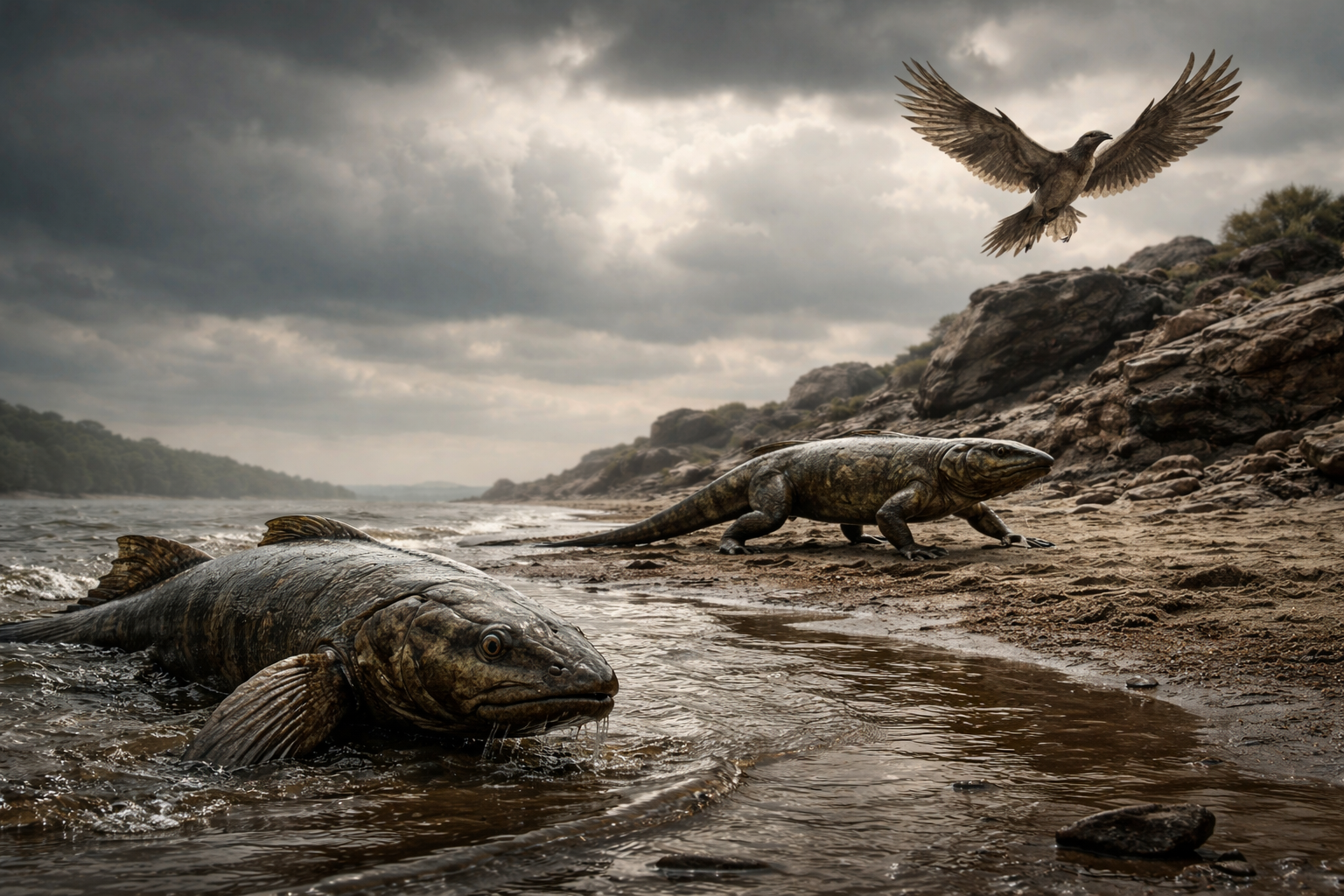
The Single Idea That Rewired Life on Earth
Imagine a world where every creature looks “made” for its place. Imagine a world where each creature has its own unique features, such as wings for air or gills for water. Imagine a world where each creature has its own unique features, such as wings for air or gills for water. They use camouflage to avoid danger. It feels like design because it works.
Darwin’s book begins by tugging at a quieter fact: living things are not fixed. Farmers and breeders can reshape a species in a few generations just by choosing which individuals reproduce.
Then he turns that small, familiar trick into a brutal question. If humans can change life by selection, what happens when nature does the selecting, every day, everywhere, at scale?
This book focuses on whether natural selection can explain the fit between life and its world without a guiding hand.
By the end, you will understand Darwin’s core mechanism, how he builds his case, and why he spends so much time dealing with objections.
You will also see the real tension inside the book: he argues for a clean engine while admitting the messy parts he cannot fully explain.
Key Takeaways
Evolution in this book is not a ladder. It is a branching tree shaped by pressure, chance, and time.
Small differences matter when resources are tight. Survival is often decided by margins, not miracles.
Natural selection does not aim for “better” in general. It favours what works here, now, under these conditions.
Extinction is not an exception to the story. It is one of the main ways the story moves.
The same process that fine-tunes a trait can also trap a lineage, because yesterday’s advantage can become tomorrow’s cost.
The hardest parts of the argument are not the bold claims. They are the missing intermediates, the gaps in the record, and the limits of what we can observe.
Darwin wins ground by conceding uncertainty where it is real, then showing the mechanism still holds under imperfect knowledge.
Classification starts to look less like filing and more like genealogy: resemblance becomes a clue to shared history.
The book’s real emotional punch is this: order can emerge without intention, but the price is relentless competition.
Darwin starts with variation you can see with your own eyes. Within any species, individuals differ. Under domestication, those differences can be pushed in a direction. Over time, selection by breeders can produce forms that would look strange, even unnatural, if you found them in the wild.
That is the opening move. It makes change feel ordinary, not mythical. Then he widens the frame from farms and gardens to the whole living world.
Inciting Incident
The argument pivots on a simple premise: more individuals are born than can survive. Food, space, safety, and mates are limited. That means life is lived under constraint, even when it looks abundant.
Once you accept that, a second idea snaps into place. If individuals vary, and if not all survive, then the traits that help survival and reproduction will tend to spread through a population.
Rising Pressure
Darwin builds momentum by linking many small observations into one chain. He shows how selection can work with tiny advantages because it is continuous and patient. He leans on the sheer number of lives lived and lost, generation after generation.
He also pushes against a comforting assumption: that species were separately created and then stayed stable. He points to patterns that look less like separate acts and more like descent with modification. Why do distinct species share deep similarities in structure? Why do embryos, across different animals, show striking resemblances? Why do island species resemble the nearest mainland forms while still being distinct?
Each question is a weight added to the same side of the scale.
The Midpoint Turn
Natural selection becomes the book’s central engine. It is not a single event. It is a constant sorting process driven by the struggle for existence.
From there, Darwin moves to divergence. If selection favours different traits under different conditions, then lineages can split. Over long periods, this branching creates the spread of forms we call biodiversity. The “tree” is not a metaphor for style. It is the shape the argument demands.
Crisis and Climax
Darwin does not pretend the case is neat. He confronts the parts most likely to break it.
Where are the countless intermediate forms if species change gradually? Why does the fossil record often look jumpy? How can complex organs arise without being useless at the start? What about instincts that seem too intricate to be assembled step by step? What about sterile worker insects, where the individuals doing the work do not reproduce?
These are not side notes. They are pressure tests. His response is consistent: the world we can sample is small, the record is incomplete, and selection can act through functional stages that look different from the final form. He argues that apparent leaps often reflect missing evidence rather than true discontinuity.
He also admits what he cannot settle cleanly: the exact source of variation and the laws of inheritance are not fully known within the book’s framework. He treats that ignorance as a gap in explanation, not a reason to reject the mechanism.
Resolution
The ending is not a “gotcha”. It is a quiet consolidation.
Darwin brings together geology, distribution, classification, morphology, and the logic of selection into one picture: species are related by descent, shaped by natural selection, and constantly pruned by extinction.
The final impression is not merely that evolution happens. It is that a single, steady process can generate both the beauty and the brutality of the living world, without needing to be steered.
The Insights
Breeders Reveal the Trick
Darwin starts where the reader has leverage: deliberate selection under domestication. You can watch humans change traits by choosing who breeds, even without understanding every detail of heredity.
That does two things. It proves that species contain hidden range. And it shows that selection can shape that range into distinct forms.
The concrete example is domesticated varieties that diverge far beyond what most people expect from a “fixed” species.
The cost is that once change is ordinary under selection, permanence stops being the default assumption.
The World Runs on Shortages
The struggle for existence is the book’s grim heartbeat. It is not only about predators and prey. It is about numbers.
When more are born than can live, survival becomes a filter. That filter does not need to be dramatic. It only needs to be consistent.
Darwin’s argument here is deliberately plain: scarcity turns small differences into life-or-death outcomes over time.
The consequence is that nature does not need to “try”. The arithmetic does the work.
Tiny Advantages, Giant Outcomes
One of Darwin’s strongest moves is patience. He treats selection as an accumulation problem.
A small edge, repeated across countless trials, becomes transformation. The organism does not have to change in a single leap. It changes in increments, each one tested against the environment.
In the book’s logic, this is why subtle traits matter so much. Selection can tune the minor features we overlook because it never stops tuning.
The cost is that the process is hard to see directly, because its power lives in long spans, not in spectacles.
Complexity Without a Planner
Darwin knows the obvious objection: some features look too intricate to be built gradually.
His reply is not to deny complexity. It is to argue that the path to a complex organ can pass through useful stages that are not the same as the final design. Function comes first. Refinement follows.
He treats this as a principle rather than a one-off defence: if a structure offers any advantage, selection can keep it and modify it.
The consequence is unsettling: “designed” appearance becomes an output of filtering, not evidence of intent.
Extinction Is Part of the Mechanism
Darwin does not frame extinction as tragedy alone. He frames it as a structural feature of how life changes.
If selection favours certain forms, others will lose ground. As conditions shift and competitors rise, lineages vanish. This clearing creates space for new branches and new experiments.
The book repeatedly leans on this pruning to explain why we do not see endless gradations between forms today.
The cost is that progress, in this model, is inseparable from loss.
The Fossil Record Is a Broken Mirror
Darwin’s critics can point at gaps and say, “Where are the intermediates?” He answers by pointing at the nature of preservation and discovery.
Most organisms never fossilise. Most fossils are never found. Most found fossils are fragments. Geological time is vast, and what we hold is thin.
He does not pretend this solves every difficulty. He argues that the incompleteness is expected and that the broader pattern still supports descent with modification.
The consequence is a humbler kind of certainty: strong claims built on partial evidence, with the missing pieces openly acknowledged.
Classification Becomes Family History
Once descent is on the table, resemblance changes meaning. Similar structures across different animals are not just convenient patterns for human filing systems. They become clues to shared ancestry.
Darwin reframes “natural” classification as a map of relationships, not a catalogue of separate creations.
The example is the way broad structural plans recur across groups, even when the surface details differ.
The cost is that categories stop feeling fixed. They become snapshots of a moving tree.
The Engine
The engine is constantly filtering under constraint. Variation supplies differences. Scarcity forces competition. Selection preserves what reproduces. Time amplifies the results.
Everything else in the book plugs into that loop, including divergence, adaptation, and extinction.
What This Looks Like in Real Life
A hiring panel in a mid-sized firm keeps picking “safe” candidates who match the last successful hire.
Old approach: choose familiarity and reduce immediate risk.
New approach: define the actual pressures of the role, then select for traits that meet those pressures, even if the candidate looks unfamiliar.
Consequence: you stop breeding a narrow workforce that only thrives under yesterday’s conditions.
A local council rolls out performance metrics that reward speed over quality.
The old approach: staff optimise for the measured target and quietly drop the unmeasured work.
New approach: redesign incentives so the “fitness test” matches the real mission, not the easiest proxy.
Consequences: You prevent selection from producing behaviours that look beneficial on paper but fail in reality.
A creator builds an online audience and starts chasing whatever gets the quickest spike.
Old approach: copy what the algorithm rewards today, repeat until burnt out.
New approach: select for what your audience retains and trusts over time, even if growth is slower.
Consequence: you trade short-term “fitness” in attention for longer-term stability and identity.
A Simple Action Plan
Where do you keep trying to win by copying what worked for someone else?
What is the real constraint in your situation: time, money, status, trust, energy, or attention?
Which small advantage would compound most if you repeated it for a year?
What trait are you rewarding in yourself that is useful now but damaging later?
Where have you mistaken “looking successful” for “actually working”?
What would you keep if you were forced to simplify to the few habits that truly help you survive and grow?
What are you refusing to let go of, even though it is clearly being selected against by your environment?
Conclusion
Darwin’s book makes one move and then refuses to let you look away. If variation exists, and if life is lived under scarcity, then selection is unavoidable. Over time, that simple filter can build astonishing fit, and it can also erase whole lines of life without mercy.
The cost of the story is the loss of comfort. Beauty is still there, but it is no longer guaranteed by a plan. It is carved out by pressure, survival, and time.
Follow the show on Spotify to catch the next episode. And if you want the written version and extras, you can find more on Taylor Tailored.
The last feeling it leaves you with is clarity and a slight chill.
Relevance Now
Modern life runs on selection pressures we did not choose. Workplaces reward what they can measure. Online spaces reward what gets noticed. Money squeezes decisions into the short term. Institutions shape behaviour through rules that feel neutral until you live under them.
That is Darwin’s dynamic in a different outfit. Small advantages compound. Misaligned incentives breed strange outcomes. A system can produce “fit” that looks impressive while quietly narrowing what survives.
Watch out for this: when the test becomes the goal, selection starts shaping you into something optimised for the wrong world.
The pressure is the point.
