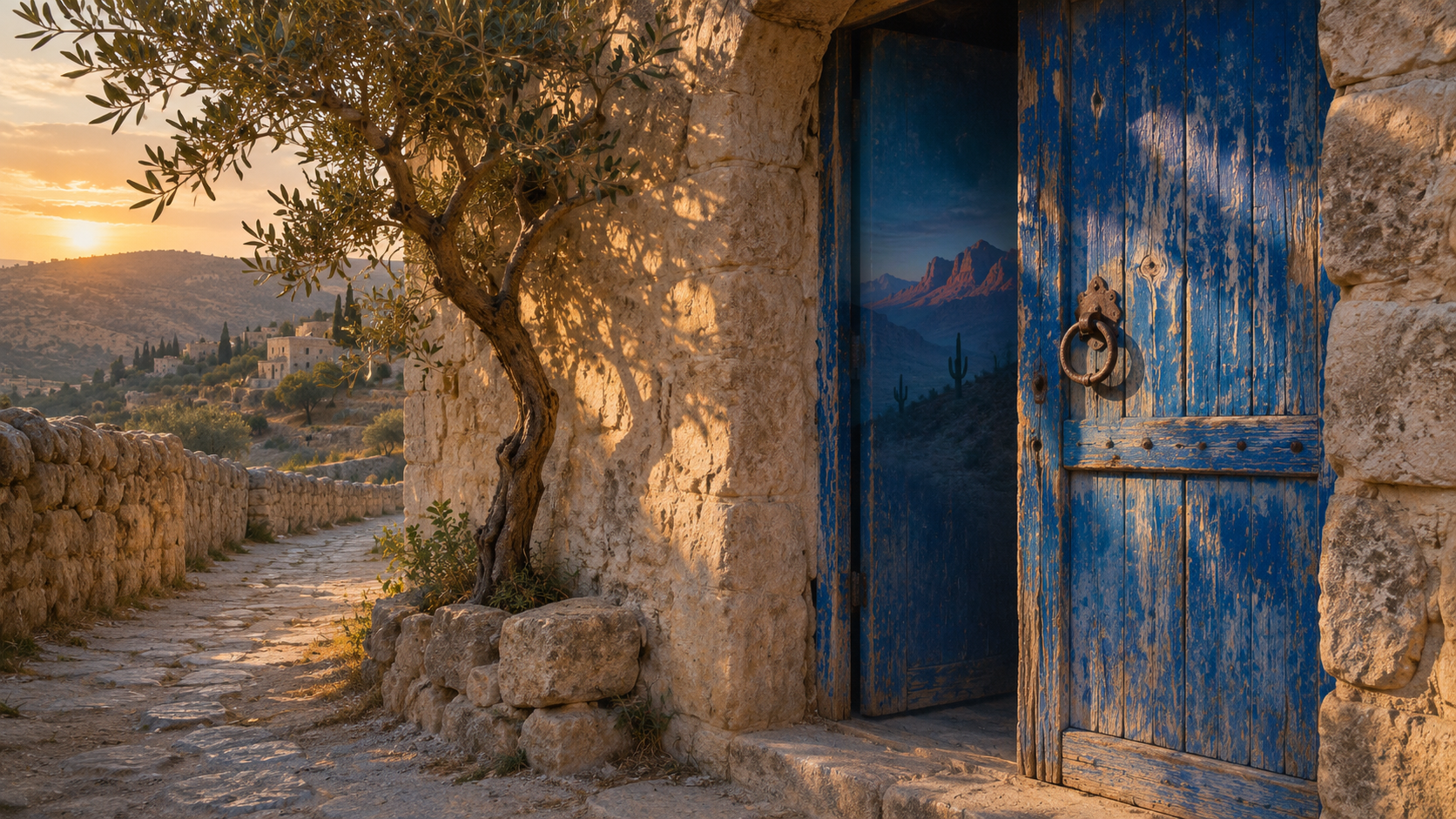
The Blue Door, Dante and a Palestinian Father
Sufien Remembers the Colour of His Front Door
Ask Sufien where he comes from and he could give you a town, a country or the name of the hill where his family lived. The answer that would tell you most about him is a colour. The front door of his childhood home in Safad was blue. He was a small boy when his family had to leave Palestine in 1948, young enough for the paint on a door to make a stronger impression than the reasons adults could give for leaving it. In Paradiso 17, Hannah Lillith Assadi follows that boy into adulthood, through Italian market stalls, New York taxi rides and an Arizona marriage, until his American daughter has a reason of her own to remember the door.
The Father Who Comes to Layla in a Dream
Layla sees her father again after he has died. In her dream, Sufien can look like the man who raised her and then like the desperately ill man whose body she watched grow thin. She knows both faces. As he changes again, she has to recognise him by something other than his appearance. It is an immediate, intimate way into a novel that will ask quite a lot of a daughter. How much would Layla recognise of the young man her father used to be if she met him on the street?
Father and daughter have a great deal to say to each other in the dream. Waking takes most of it away. What survives is an impression of her father dancing and of his pleasure in the dance. Imagine the frustration of being given another night with someone you love and finding in the morning that you have come away with scarcely a sentence. Assadi puts the reader in a privileged position. We get to spend the next several decades in the company of somebody Layla has already lost.
The premise grew out of something Assadi’s own father said as he was dying. Looking back on his life, he felt he had wasted it. His daughter began writing while he was still alive and continued after his death, often at night after her children were asleep. Sufien is a fictional character inspired by him. That distinction matters particularly in a book about a father’s judgement of himself. A daughter might answer him by listing his virtues. A novelist can give him his youth back and see what he does with it. Some of Sufien’s choices would be awkward to mention in a eulogy. They belong here.
What a Child Carries Out of Safad
One of the first things we learn about the young Sufien is that he believes he can fly. A jinn encourages him, he jumps from a roof, and an olive tree breaks his fall. It is a good family story, the sort whose emphasis might shift with the teller. A child could come away impressed by the jinn. A parent might have rather more to say about the distance between the roof and the ground. For a little while the tree has a simple job in Sufien’s life. It catches him.
The family also has a story about his birth. His mother remembers hearing extraordinary music around the time he came into the world. The midwife has a more practical interest in the difficult delivery. There is room in that household for a mother who hears the heavens welcoming her child and for a woman whose main concern is getting him out safely. Those voices give Safad a life of its own before it becomes the object of anyone’s longing. Once the family is scattered, who will be left in the room to contradict a favourite story?
In 1948 the Nakba, the mass displacement of Palestinians, reaches the family’s house. Sufien’s father is away. His mother has recently given birth to his younger brother Firas and is still recovering when she has to get her children out. The distance between mother and son is especially painful here. He is old enough to retain a few pictures of home. She knows what it took to make a life there and must leave carrying a newborn. What he will spend years trying to remember is what she has to make an immediate decision to abandon so that the children survive.
They reach Syria and live in a refugee camp. Looking back, Sufien can remember being happy there. That feeling deserves to be taken seriously on its own terms. A child sleeping within earshot of other families hears music and company as well as distress. Someone is awake. Something is happening. A wedding can occupy a child’s attention even when every adult at it would prefer to be celebrating somewhere else. His memories preserve part of the work the displaced families did for one another. Under conditions that gave them little privacy or control, they still made occasions a boy would want to remember.
The camp also supplies an unexpected measure for the homes he will acquire later. A private room, a good address and a secure income are all things Sufien has reason to want. Each can be had in almost perfect silence. The older he gets, the more striking it becomes that one of the materially poorest places he ever lived offered a kind of company he will have considerable difficulty finding again.
Kuwait Gives Him Someone to Leave
His father’s engineering work takes the family to Kuwait. Sufien does well at school and falls for a Palestinian girl named Nefisa. She presents him with what ought to be an easy opportunity. He can walk her home. Faced with the actual prospect of being alone with her, he loses his nerve. For a novel about journeys across continents, this is a particularly good journey to leave unmade. He will travel thousands of miles on the strength of much less encouragement. Here the girl already likes him and he can hardly manage the first step.
Nefisa gives Kuwait a place in his life independent of its place in his family’s itinerary. His father came for work. Sufien will remember the embarrassment of being young in front of someone whose opinion mattered to him. They share enough of a background for a walk together to require relatively little explanation. Later he will discover the pleasures of introducing himself to people who know nothing about him. The price of that freedom is easy to miss until one thinks of Nefisa. Nobody he meets in Florence or New York will remember this boy unless he chooses to tell them about him.
At seventeen he leaves to study in Italy. This departure belongs to him in a way the first one never could. There is a future occupation to aim at, a language to learn and the considerable attraction of being beyond the reach of people who remember every foolish thing he has done. Yet the trip also depends on his father’s ability to pay for it. Sufien can set off feeling that he has taken charge of his future while the practical means of keeping him there remain in Kuwait. In Italy he will find out exactly how far the money stretches.
Who Is Franco Leone?
In Perugia, Sufien tries an Italian name, Franco Leone. He has scarcely begun to learn the language, which makes the confidence of the introduction rather endearing. There is an interval, however brief, in which he gets to decide what another person hears first. Sufien the Palestinian student is likely to be asked where he comes from. Franco Leone might get as far as a flirtation, a joke or a sale before anyone asks him to account for his presence. For a young man who has spent much of his life being explained by circumstances decided before he understood them, that interval is worth having.
His relationship with Lila, a young Italian woman, brings out a different ambition. He paints her. The portrait is the only painting he ever finishes, a fact that changes the way we read the episode. A biography organised around occupations might reasonably call Sufien a trader or a cab driver. It would have little reason to call him a painter. Yet for the time it takes to finish a picture, painting someone he desires is precisely what he wants to do with his life. Knowing that he will never complete another gives this particular pleasure its place in the record.
He moves to Florence to study engineering. When his father’s money runs out, the university career ends and Sufien finds work selling leather goods with Malik, a Palestinian from Nazareth. The change has consequences far beyond a lost qualification. In the market he acquires a trade he can take abroad, a friend who will matter to his family years later and the opportunity to meet a wealthy Jewish American named Bernard. Bernard, too, likes an Italian name. He becomes Bernardo. Each young man can appreciate the other’s pleasure in the performance.
There is a difference between them that an afternoon together at a market stall need never bring to the surface. Bernardo has family money and a country to which he can readily return. Selling leather can be an episode in the story of his Italian youth. Sufien needs the sales. One of the more perceptive things Assadi does with their friendship is allow its initial delight to stand. The young men enjoy each other for reasons that have little to do with what either can provide. Money becomes difficult precisely because they have enough affection for each other to keep the friendship going when their lives take very different turns.
Then the war of June 1967 enters Sufien’s relationship with Eden, an Israeli woman. His Palestinian acquaintances condemn the relationship. As the news from Jerusalem comes in, Sufien directs his anger at Eden and hurts her. His conduct is especially ugly because he knows what it is to have an entire political history arrive ahead of you whenever you meet someone. With Eden he does it to another person. The violence belongs in the same account as the frightened boy’s flight from Safad. Remembering one makes the other harder to bear.
Two Friends Take the Same Flight to Different Americas
Bernardo offers Sufien a way to New York. For Bernardo, the flight takes him back into a country where he has family, money and every expectation of being allowed to stay. Sufien looks down at Manhattan and feels lost before he has even landed. They can sit beside each other for the whole journey and be making fundamentally different trips. That is the first thing to understand about the help Bernardo gives him. He can pay another person’s fare. Everything that makes the destination familiar to him is considerably harder to share.
Sufien works in a bodega and lives in precarious accommodation. There are people in the city who offer more immediate forms of welcome. Paulette opens a door onto a social circle in which it is possible to spend an evening among people who have made room for one another. Such hospitality can change the character of a city for someone arriving alone. It takes a familiar voice at a particular address to turn a collection of streets into somewhere a person can imagine going on a bad evening. Sufien also experiences homelessness, sleeping in Central Park. Knowing generous people offers little certainty about where he will sleep next month.
Meanwhile his father dies in Kuwait. Weeks pass before the news reaches him. This is among the cruellest consequences of distance in the book because there is no decision left for Sufien to make once he knows. While he has been getting through ordinary days in America, his position in the family has already changed. The man whose earnings sent him to Europe is gone. The son has continued, for a little while, to inhabit a world in which his father is alive and might still be spoken to.
Eventually Bernardo helps him again. It is possible to feel the full value of that help and still understand why Sufien hesitates to ask for it. Each rescue invites the two men back into the same roles. Years can pass in which Sufien acquires skills, looks after other people and becomes a resourceful New Yorker. The moment he needs money, he risks becoming the young man his friend once brought across the Atlantic. For Bernardo there is a quieter loss. A person who can solve the urgent difficulty by paying may never discover what his friend would have asked of him if money were unavailable.
Driving a taxi changes Sufien’s relationship with the city. He likes the work. A stranger gives him an address in the expectation that he can find it, a pleasing reversal for someone who arrived unable to say where he belonged. There is an intimacy peculiar to a cab ride, too. Passenger and driver can share an observation or a confidence, then go their separate ways with the fare settled. Much of Sufien’s life involves debts whose emotional terms nobody has agreed. He has good reason to enjoy an occupation in which the money and the pleasure of a conversation can coexist so comfortably.
What Sufien Means When He Marries Sarah
Sarah is a Jewish American woman from Alabama. Sufien meets her in a New York bar and is remarkably sure that he wants to marry her. The boy who could scarcely walk Nefisa home has grown into a man capable of announcing an intention almost as soon as he feels it. At their wedding in Alabama, members of his family come from Kuwait. Emotion overwhelms him during the vows. The word he manages to get out is home.
For once, the word describes something the people present can actually see. His family and Sarah’s have gathered in one place. People who know him as their son or brother can look across and see the woman who knows him as the man she wants to marry. Soon enough the guests will go their separate ways, the two of them will have bills to pay and Sarah will have her own ideas about the life they ought to build. One can understand why, in the brief interval when everyone is there, Sufien finds it difficult to finish a sentence.
Their daughter Layla is born in New York. Parenthood gives him a new interest in the future and a new capacity for fear. So long as his livelihood supported one person, he could assess a job in terms of how it felt to do it. Sarah is embarrassed by the taxi work he enjoys, and the couple have a child whose security depends on what they earn. Seen from the driver’s seat, the cab is evidence that a man who arrived lost has mastered the city. Seen from inside the household, it raises the question of how far that mastery will get the three of them.
He opens a leather goods shop. There is a sad plausibility to the venture. Sufien knows the merchandise, has sold it before and possesses the ease with strangers that a shopkeeper needs. Owning a business might also give Sarah the confidence in their prospects that driving has failed to inspire. When the shop fails, it is tempting to look backwards and decide he should have stayed in the cab. That judgement is available only to people who know the outcome. For Sufien, the business is a serious attempt to make his past experience pay for his daughter’s future. Bankruptcy leaves the family having to look elsewhere. Malik’s connection to Phoenix gives them a direction.
The Second Blue Door Belongs to a Different Family
Arizona suits Sufien far better than Sarah initially expects. He recognises something in the desert, in its distances and the room it gives the eye. The funny corrective comes from his mother. She can remember the country the family lost in far greater detail than he can, and Arizona strikes her as thoroughly too hot. If the American landscape were simply a convincing copy of Palestine, she ought to be the first to say so. Her independent verdict leaves Sufien free to have discovered a place he loves for reasons peculiar to himself.
Sarah’s publicity work helps the family prosper. Their Scottsdale house has an olive tree and a blue door. Think what it would mean to enter that house as each of its three occupants. Sufien approaches a colour he remembers from early childhood. Sarah comes home to a property her earnings have helped make possible. Layla walks through the front door of the house in which she is growing up. Years later she might long to return to precisely the place her father once chose because he longed for somewhere else. A family can share an address for years before discovering how differently each person sees it.
Sufien also has a long affair with Donna. His betrayal of Sarah complicates the satisfaction of having seen the family through its financial troubles. Sarah moved reluctantly to a state that suited her husband, built a business and helped provide the stability he had spent so long seeking. She is entitled to make decisions about her marriage with some knowledge of what is happening in it. By keeping the affair secret, he takes that opportunity from her. Even a sympathetic account of his loneliness has to reckon with the loneliness of a spouse living alongside an intimacy she knows nothing about.
Layla eventually heads to New York for university. From her end, leaving Arizona opens up the future. Her parents have given her a sufficiently settled childhood for departure to feel like a choice. Sufien now occupies the position his own father held when a seventeen-year-old son set off for Italy. He has experience of how quickly a young person’s life elsewhere can fill with people and commitments a parent has never seen. For once, the reward for his efforts is a freedom that belongs entirely to somebody else. Layla gets to go, and her father gets to miss her.
Why the Park Matters in Sufien’s Last Days
Cancer takes Sufien back to New York, this time to be near Layla and receive treatment. His daughter can now offer her parents a destination, a connection to medical care and practical help. There is a particular tenderness in watching these capacities change hands. The man who once made a living taking New Yorkers wherever they needed to go must let other people arrange how he gets around. Treatment gives him time with his granddaughter Najla. As his illness progresses, his experience of the city begins to diverge from what the people beside him can see.
At Prospect Park he speaks about seeing women he knew in his youth. Nefisa belongs to Kuwait and Lila to Italy, yet he can point towards a Brooklyn lake and recognise their presence. For a moment his daughter’s city accommodates a part of his life that she could otherwise know only through stories. He also worries about whether his family knows where he is. A wife or daughter might quite reasonably think the question has already been answered by her presence. The man asking it can still feel himself to be somebody’s missing son.
Layla and her partner, James, marry beside the lake. Sufien attends in a wheelchair and manages the part of the marriage service about sickness and health. At his own wedding he could barely speak because so many people he loved had come together. At his daughter’s, his failing body makes speech difficult. The words he can contribute have acquired the force of first-hand testimony. Around him are people finding out what caring for a sick person requires on an ordinary afternoon. For the length of a wedding vow, he gets to give something back to them.
A reader of The Death of Ivan Ilyich might recognise the importance of such small acts at a bedside. In Assadi’s novel, James helps Sufien take a last smoke. There is affection in remembering that a person whose days have come to revolve around treatment still has tastes, habits and a capacity to enjoy something mildly disreputable. The gesture also lets the two men have a relationship of their own. In a family preoccupied with keeping a dying father comfortable, his son-in-law can still be the person who knows what might make him smile.
Does Sufien Get Home at the End of Paradiso 17?
Sufien dies in New York without physically returning to Palestine. As he approaches death, he travels back in his mind through the places he has lived and reaches the road to the blue door in Safad. Beside him in New York is Layla. He speaks to her in Italian, calling them friends, and she answers in Italian that they always will be. He can approach his childhood home, speak the language of his European youth and be understood by his American daughter in the same moment. For once, none of those attachments requires him to leave another behind.
He is buried in Alabama, the place Sarah brought to their marriage. Bernardo pays for the funeral and stays away. It is a painfully apt last contribution from a friend whose generosity Sufien has repeatedly relied upon. The bill is real and somebody has to meet it. So is the absence. Assadi leaves enough room for a reader to be grateful on the family’s behalf and angry on Sufien’s. Layla later calls her baby Leone. What began in Italy as a name her father chose for himself becomes a name someone else chooses in order to remember him.
The final homecoming takes place in Layla’s dream. She encounters her father restored, hosting a feast. They have time to walk together before she must return to her children. When she looks back, he has passed through the blue door. Assadi has described this as a supernatural return. Giving the encounter to Layla allows it to answer two wishes that might once have seemed incompatible. The daughter gets to see her father well again. The father gets to reach a place where his daughter has no obligation to accompany him.
His place at the feast is an especially generous detail. For so much of his life Sufien has needed a room, a fare, a job or a favour that somebody else was in a position to grant. Here he can welcome people to his table. It recalls the company he loved in the Syrian camp and the welcome he once found among strangers in New York. A private paradise containing all the right scenery would have left out one of the most persistent facts about this particular man. Given somewhere beautiful to be, Sufien would want people over.
Why Is the Novel Called Paradiso 17?
Seventeen is the number on the door of Sufien’s lost house, his age when he leaves for Italy and the canto of Dante’s Paradiso in which an ancestor tells the poet that exile awaits him. Dante’s ancestor describes dependence through ordinary experiences, right down to eating another household’s bread and using somebody else’s stairs. Bernardo gives those images a modern social setting. His kindness makes a life possible for Sufien at moments when the need to accept it also hurts. Florence itself changes meaning between the two works. The city Dante will lose becomes one of the cities in which a Palestinian exile discovers what he can do.
Assadi originally considered a different title drawn from her father’s pen name, Frank Leone. The change alters where a reader places the emphasis. A man’s name on the cover invites us to ask who he was. An address invites us to imagine going somewhere, perhaps even to picture who might answer if we knocked. The title also leaves a small discovery for the reader who has never opened Dante. Long before the literary reference becomes clear, seventeen means something because a family once lived behind a particular door.
There is a revealing difference here from The Odyssey. Odysseus has a household in Ithaca whose fate depends on whether he can get back to it. By the time Sufien approaches his door, he has a daughter and grandchildren whose lives continue elsewhere. Layla’s decision to turn towards her children gives the ending much of its emotional precision. To follow her father indefinitely would mean leaving people who now depend on her. She can love him, walk part of the way with him and still have somewhere else she needs to be.
Assadi began with a father who looked at the years behind him and saw waste. She gives that judgement a surprisingly practical answer. A daughter knows enough Italian to answer him when he needs her. A child carries a name he once tried out half a world away. A reader who never knew him can picture the colour of his door. The final kindness is that Layla need never know exactly what her father sees on the other side. For years he had to explain to strangers how he came to be wherever they found him. This time, he can simply go inside.
Sources
Hannah Lillith Assadi discusses her father, the origins of the novel and her understanding of Sufien’s homecoming in her interview with the Women’s Prize. Women's Prize : Women's Prize
Assadi explains the original working title, the Dante epigraph and the significance of seventeen in her conversation with Lincoln Michel. countercraft.substack.com
The US publisher records the March 2026 publication and the novel’s National Book Award for Fiction on the Penguin Random House book page. PenguinRandomHouse.com: Books
Lauren LeBlanc discusses Sufien’s friendship with Bernardo, his family and his physical separation from Palestine in “Memory House” for Alta. altaonline.com
Christoph Irmscher examines Sufien’s sense of family and Layla’s final vision of the blue door in his review for On the Seawall. On the Seawall
The sequence of the weddings, Sufien’s illness, his burial and Layla’s dream is detailed in the SuperSummary plot guide. SuperSummary
Dante’s encounter with Cacciaguida and the prophecy of exile appear in Canto XVII of Paradiso. divinacommediaonline.it
