Memory, Identity and the House
When the Whole World Fits Inside One House
Piranesi knows the tides, the statues and the halls. He knows where to find food and which places become dangerous when the waters rise. What he cannot explain is why certain things in his world do not quite belong.
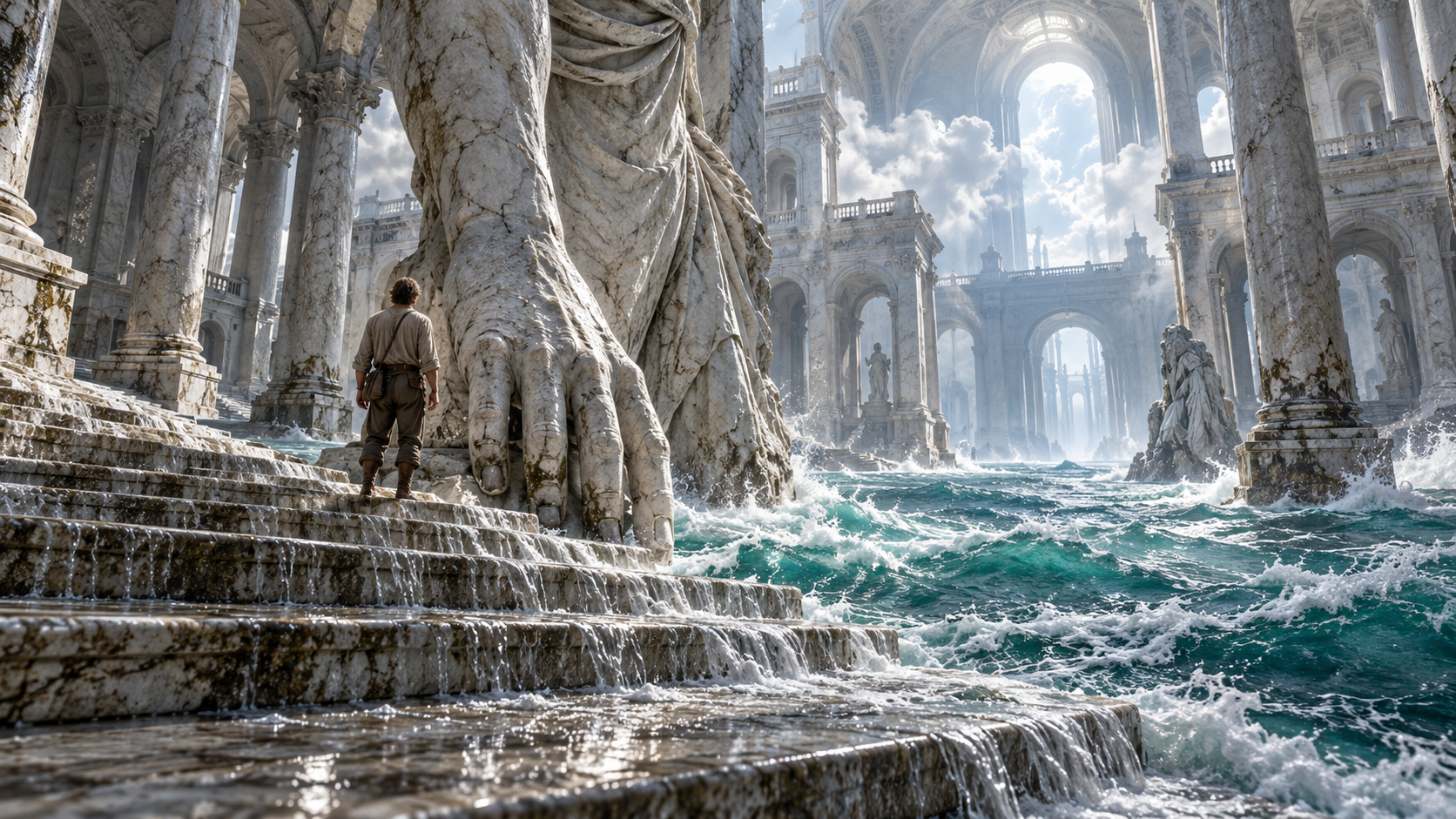
Susanna Clarke’s Piranesi, published in 2020, follows a man living inside an immense House whose rooms contain an ocean, clouds and thousands of statues. His only regular human companion is someone he calls the Other.
For Piranesi, this existence is meaningful and complete. For the reader, small inconsistencies create an increasingly uncomfortable question: how much can someone understand about their circumstances when another person controls the information available to them?
The novel’s mystery concerns the House, but its emotional force comes from the person who has learned to call it home.
A Life Built Around Statues, Tides and Care
Piranesi introduces his surroundings with the confidence of someone describing a familiar landscape. The House contains immense halls, connecting passageways and staircases. Statues occupy its spaces in extraordinary numbers, depicting people, animals and scenes whose significance he studies closely.
The lower levels belong to the sea. Clouds gather above. Between them lies the territory in which he makes his life.
His survival depends on careful attention. He fishes, gathers what he needs and records the movements of the tides. The water follows patterns, but those patterns require interpretation. An error can turn an expedition into a struggle to avoid being swept away.
This establishes something essential about him: his innocence does not make him incompetent.
He possesses practical knowledge acquired through experience. He can navigate a setting that would overwhelm an outsider. His life requires planning, physical effort and an ability to notice changes.
He also considers himself a scientist. His journals preserve observations, record discoveries and organise what he knows. He approaches the House as a place that rewards patient study.
Yet his understanding includes a profound sense of belonging. He treats the House as generous and sustaining. When he survives danger, he understands that survival through his relationship with the place.
The reader can recognise a tension here without resolving it immediately. The House provides food and shelter, but it can also kill. Piranesi’s gratitude does not mean that its dangers are imaginary.
His concern extends beyond himself.
He knows of thirteen dead people whose remains lie within the House. Alongside himself and the Other, these constitute the human population for which he has evidence. He tends the dead, gives them identifying names and treats their remains with care.
This devotion has no obvious practical reward. The dead cannot assist his research or improve his circumstances. His behaviour therefore reveals a principle that precedes the novel’s mystery: another person’s value does not depend on their usefulness.
The same attention shapes his relationship with birds and statues. He inhabits a community much larger than the number of living humans around him.
Clarke lets this life become substantial before its apparent foundations begin to shift. That matters because the House must become more than an elaborate puzzle. We need to understand why someone could love it before we can understand what leaving it might cost.
The Other Wants Something Different From the House
The Other visits Piranesi twice a week. He is better dressed, better supplied and more impatient than the man who lives among the statues.
He recruits Piranesi into a search for what he calls a Great and Secret Knowledge. The House, he believes, contains access to powers that have been lost.
Their collaboration initially appears to provide Piranesi with friendship and purpose. The Other gives him useful items and treats his observations as contributions to an important undertaking.
Nevertheless, the relationship contains an imbalance.
Piranesi supplies extensive labour and local knowledge. The Other defines the objective, directs the work and decides which explanations deserve consideration. He occupies the position of authority without demonstrating the same intimacy with the House.
Their different attitudes become clearest when Piranesi questions the search itself.
For Piranesi, the House already offers things worth knowing. Its creatures, patterns and forms do not need to conceal a greater prize to justify his attention. The Other treats these features primarily as clues to something more valuable.
This disagreement concerns the purpose of knowledge.
One person studies his surroundings because he belongs to them. The other wants a discovery that will increase his power. Both can use the vocabulary of research while pursuing fundamentally different relationships with the world.
The Other also tells Piranesi that his memory is unreliable. Apparently, they have discussed matters that Piranesi cannot recall.
Such a claim is difficult to challenge from inside a memory gap. If Piranesi remembers nothing, the absence can be presented as confirmation that the Other is right.
The reader, meanwhile, notices objects and habits that seem to imply a wider context. The Other possesses supplies that Piranesi cannot explain through his own way of life. His visits are limited. His familiarity with unfamiliar terms suggests knowledge that he does not share.
Clarke does not require Piranesi to become foolish for the mystery to work. He reasons from an incomplete set of facts.
His mistake is understandable: he assumes that a person offering assistance is broadly committed to his welfare. The developing unease comes from the possibility that material help and honest friendship may not be the same thing.
A Warning Makes Contact Feel Dangerous
The Other warns Piranesi about another person who may enter the House.
This possible newcomer becomes known as 16. According to the Other, contact with this person could damage Piranesi’s mind. He must avoid them and resist what they try to communicate.
The warning changes the conditions of discovery.
Previously, encountering another human might have seemed remarkable or welcome. Now curiosity has been attached to danger. Reading a message could become an act of self-destruction.
The Other’s account is especially effective because it uses a vulnerability Piranesi already recognises. He has difficulty explaining parts of his memory. A warning about losing his sanity therefore does not arrive in an emotional vacuum.
It attaches itself to something frightening and unresolved.
Piranesi subsequently meets an elderly stranger whom he calls the Prophet. This man possesses information that does not fit the Other’s version of events.
He identifies the Other as Ketterley and speaks about places and people beyond Piranesi’s understanding. He also discusses the possibility of other worlds.
His explanation of the House describes it as a world formed through ideas passing out of another reality. The House may preserve the shapes left by knowledge and imagination rather than contain the usable secret Ketterley hopes to extract.
This is an account offered by a character, and the novel does not turn every part of it into an independently demonstrated scientific law. Nevertheless, it introduces a framework in which the House is connected to something beyond itself.
The Prophet is no uncomplicated source of reassurance. He dislikes Ketterley and wants to unsettle him. His willingness to direct 16 towards the House emerges from that hostility.
Piranesi therefore faces conflicting informants whose motives he cannot fully assess.
The situation demands a more difficult response than choosing whichever speaker sounds most confident. He needs evidence that can be compared, revisited and tested.
Fortunately, he has spent years producing exactly the kind of record that might help.
His journals, originally intended to preserve knowledge of the House, begin to acquire another purpose. They may contain evidence about the person doing the observing.
The Journals Describe a World He Cannot Remember
Piranesi’s notebooks do not all fit comfortably into his present understanding.
Some use conventional numerical dates. Others organise years around events meaningful within the House. Earlier entries contain unfamiliar names and references that seem disconnected from the world he knows.
The handwriting is his. The experiences do not feel like his.
This creates a disturbing division between authorship and recognition. A journal normally allows someone to encounter a younger version of themselves. Piranesi encounters writing that appears to come from a stranger using his hand.
Initially, unfamiliarity can be mistaken for proof that something was wrong with the writer.
If the House is the whole world, references to places outside it seem nonsensical. The assumption that makes his present life coherent also makes evidence of another life difficult to interpret.
As he works through the records, a history involving Laurence Arne-Sayles emerges.
Arne-Sayles is an intellectual and occult investigator whose ideas attract followers. He argues that ancient ways of understanding reality involved possibilities modern thought has lost. His circle includes Valentine Ketterley.
The record also contains disturbing material about disappearance, captivity and the treatment of other people.
One important figure is James Ritter, whose account of confinement describes a place recognisably like the House. Arne-Sayles has been imprisoned for kidnapping him.
These details begin to connect the apparently separate worlds of Piranesi’s daily existence and the strange material in his notebooks.
The House is becoming legible within a history of human actions.
That discovery changes the kind of question the novel asks. The mystery is no longer confined to the nature of an extraordinary building. It now concerns what people have done with access to it.
Arne-Sayles’s intellectual authority also deserves scrutiny. An impressive explanation of reality does not establish the moral character of the person giving it.
His followers’ fascination with exceptional knowledge creates opportunities for domination. A person who claims to see beyond ordinary limits can encourage others to regard ordinary objections as signs of inferior understanding.
Piranesi’s records make those claims examinable. Names, actions and consequences can be placed beside the grand theories.
The notebooks are therefore valuable partly because they resist charisma. They preserve details that a forceful personality might otherwise explain away.
As Piranesi continues reading, the distance between the historical investigator and his own present circumstances becomes increasingly difficult to maintain.
Messages Challenge the Story He Has Been Told
Contact with 16 develops through messages rather than an immediate conversation.
That distance gives the Other’s warning time to operate. Piranesi can approach a message, hesitate over it and fear what reading it might do.
At one point, he erases a communication rather than fully engaging with it.
The act shows how thoroughly the warning has entered his behaviour. The Other does not need to stand beside every message. Piranesi has been persuaded to police his own access to information.
Yet his concern for other people complicates that obedience.
When he learns that the Other intends violence against 16, he does not simply accept that the supposed enemy deserves it. He tries to communicate a warning.
His moral response begins moving ahead of his factual understanding.
He does not yet possess a complete explanation, but he knows enough to recognise that someone may be harmed. Uncertainty becomes a reason to take care rather than permission to abandon another person.
Eventually, a message asks whether he is Matthew Rose Sorensen.
The name provokes a response that the Other’s explanations cannot contain. It suggests a connection between Piranesi and a specific person beyond the House.
Further investigation of the journals leads him towards entries concerning Ketterley. Crucial pages are missing.
However, fragments recovered from a gull’s nest preserve material that appeared to have been lost. Piecing them together allows Piranesi to read an account of a meeting between Matthew Rose Sorensen and Valentine Ketterley.
The evidence matters because the emerging truth does not rest solely on a stranger declaring who he is.
A message provides a lead. His own records allow him to pursue it. The missing pages become significant within an accumulating pattern rather than functioning as an isolated trick.
There is also an important consequence of the journal form itself.
Piranesi has been recording information without always recognising its implications. The reader can notice discrepancies before he does, but we remain dependent on his patient work to understand how they connect.
His ability to revise a belief becomes more valuable than the appearance of having understood everything immediately.
The person who trusted the Other is also the person capable of discovering why that trust was misplaced.
An Earlier Meeting Changes the Meaning of Everything
The recovered account reveals that Matthew Rose Sorensen was researching Arne-Sayles.
His investigation led him to Ketterley, whom he visited in the ordinary world. During their meeting, Ketterley offered to demonstrate access to another world.
Matthew did not understand the danger. He approached the proposed ritual sceptically and participated without believing that it could deliver him into an actual alternative reality.
It did.
Ketterley trapped him in the House. Prolonged residence gradually eroded his memories of the life outside it.
Piranesi is the identity that developed under those conditions.
This explains the Other’s advantage. Ketterley can travel between worlds and limit his exposure to the House. Matthew remains inside, losing the knowledge that would allow him to understand his captivity.
The partnership was built on an abduction.
Ketterley needed someone to explore and gather information while he pursued his own ambitions. Piranesi’s competence made him useful; his forgetting made him easier to control.
Even the name Ketterley gives him carries an unequal joke. It evokes Giovanni Battista Piranesi, the artist associated with imaginary architectural prisons. The reference is available to the person who understands the outside world and inaccessible to the person being named.
This makes the naming an assertion of power.
Ketterley can place another man inside a story whose meaning he withholds from him. Piranesi is expected to answer to an identity while remaining unable to understand why it was chosen.
The revelation also clarifies the warnings about 16.
Information that might restore Piranesi’s understanding has been presented as a threat to his mind. The Other has described the route towards freedom as the route towards collapse.
That reversal is central to his control.
Piranesi now recognises the betrayal, and his response includes anger and distress. His previous generosity does not mean that violation leaves him emotionally untouched.
However, recovering the truth does not simply erase the person he has become.
Matthew’s history explains how he arrived. It cannot make the years inside the House unreal. The skills, attachments and habits developed there remain part of him.
The mystery has provided an answer to his origins. It has opened a harder question about identity.
Meanwhile, the danger is immediate. An exceptional convergence of tides is approaching, and the person trying to reach him may be caught in it.
The Rising Water Tests What Each Person Knows
Piranesi prepares for the flood using the knowledge he has accumulated through daily survival.
He protects important belongings and the remains of the dead. He tries to warn 16, but Ketterley interferes with the messages.
The approaching water brings the novel’s competing forms of knowledge into direct conflict.
Ketterley has the advantages associated with the outside world: equipment, a firearm and access between realities. Piranesi understands the environment in which the confrontation will take place.
The difference is practical. An ambition to possess extraordinary power does not substitute for knowing where the water will go.
When Piranesi confronts Ketterley, he demonstrates that he has recovered the account of their earlier meeting. Ketterley can no longer rely on the assumption that his captive does not understand their relationship.
He reaches for his gun. Piranesi kicks it away.
Then 16 appears, calling for Matthew. Piranesi helps her climb towards safety while Ketterley fires at them.
The sequence gives Piranesi an active role in his own escape. The person arriving from outside brings crucial knowledge and a route out, but she also needs his expertise.
As the flood rises, Piranesi even warns Ketterley to use his boat. Ketterley nevertheless fails to escape the surge and drowns.
His death does not result from Piranesi becoming a more effective version of his captor.
Piranesi resists him, protects someone else and attempts to warn him. The distinction matters because the novel has repeatedly measured people through how they respond to vulnerability.
The flood can be read symbolically as the collapse of Ketterley’s control. It should not automatically be described as proof that the House consciously judges and executes him.
The established mechanism is sufficient: dangerous tides arrive, and Ketterley’s violence and failed response leave him exposed.
Once the immediate danger passes, the visitor identifies herself as Raphael, a police officer investigating disappearances connected with Arne-Sayles.
She has entered the House to find him.
Her presence confirms that the world outside is populated by people capable of seeking him rather than merely exploiting him. But when she offers to take him home, the meaning of that word is no longer straightforward.
Leaving Requires More Than Finding a Door
Raphael explains that Matthew has been missing for six years. His family exists beyond the House, and his disappearance has mattered to them.
From their perspective, a lost person can now return.
From Piranesi’s perspective, someone is asking him to leave the place that contains his familiar life.
Both perspectives are real.
The novel refuses to make his hesitation evidence that captivity was acceptable. Ketterley’s actions remain abusive. Equally, it refuses to treat everything Piranesi values as a symptom that must be discarded.
The House and the imprisonment are connected through what happened to him, but they are not identical.
Ketterley exploited the House’s properties and controlled Piranesi’s access to the truth. That does not make every experience of beauty, companionship or competence within it fraudulent.
This distinction prevents the ending from becoming a simple return to normality.
A rescue can remove someone from another person’s control without restoring their former identity in an instant. The outside world contains relationships he needs to rediscover and assumptions that no longer feel natural.
Raphael’s response matters because she allows room for that difficulty.
She does not resolve his uncertainty by treating him as an object that has been found and must now be delivered to its proper address. She returns, talks with him and helps make departure possible.
Eventually, he chooses to leave with her.
The choice is meaningful because it follows the recognition of his attachments. Leaving does not require him to declare that the House was worthless or that the person who lived there never truly existed.
His continuing care for the dead also extends to Ketterley.
That care does not erase the crime or imply that reconciliation occurred. It preserves a boundary between recognising someone’s wrongdoing and deciding that their remains deserve contempt.
Piranesi’s ethical life survives the destruction of his trust.
He can know that Ketterley was his enemy without allowing Ketterley’s behaviour to determine every action he takes afterwards.
The Ending Holds Two Lives Together
After returning, the narrator does not experience himself as a perfectly restored Matthew Rose Sorensen.
Nor is he simply the Piranesi who believed the House contained the whole world.
He must live with knowledge and experience drawn from both identities. The ending presents this as an ongoing condition rather than a temporary inconvenience resolved by one final recovered memory.
His difficulties with ordinary life make that condition concrete. Social arrangements that other people take for granted can appear strange after years organised around tides, food, shelter and care.
An address in the outside world cannot by itself restore a sense of belonging.
Crucially, he can return to the House. Raphael teaches him how to travel there, and his later visits take place under circumstances fundamentally different from his imprisonment.
He has knowledge, companionship and a choice.
He also brings James Ritter back. Ritter’s response demonstrates that a place associated with exploitation can still contain experiences someone longs to recover.
However, the narrator recognises that longing does not automatically make permanent residence safe. Ritter’s wish to remain must be weighed against his ability to survive there.
This is a more mature form of care than either forcing someone to reject their attachment or treating every desire as sufficient justification for action.
The novel also settles an important factual question: the House is not presented as merely a dream or a private hallucination.
Other people enter it. Their experiences connect. Travel between worlds continues after the central mystery has been resolved.
Its precise origin remains less certain than its existence within the story. Arne-Sayles supplies an explanation involving ideas flowing between worlds, but his account does not require readers to regard him as an infallible authority.
Clarke resolves the human crime more fully than the metaphysical mystery.
That balance allows the House to remain strange without making Ketterley’s responsibility ambiguous. We do not need an exhaustive theory of its creation to understand what he did.
In the closing movement, the narrator notices people in the ordinary world who recall statues from the House.
These recognitions allow the two worlds to illuminate each other. Figures once encountered as marble forms help him perceive significance in living strangers.
The effect is especially moving because the direction of recognition has changed.
Earlier, statues offered him a way to understand a world from which much human context had disappeared. Now his knowledge of those statues helps him look more attentively at the people around him.
The House has become part of how he sees.
This does not prove that every statue corresponds to one identifiable person, or that the novel supplies a complete code waiting to be solved. The connection can be understood through resemblance, imagination and recognition without turning it into a rigid supernatural system.
The ending’s affirmation of the House’s beauty and kindness has also changed meaning.
At the beginning, Piranesi’s faith coexists with ignorance about his circumstances. By the end, he knows that someone used those circumstances to harm him.
His gratitude survives the discovery.
That survival is not an endorsement of the harm. It is a refusal to grant Ketterley ownership over everything that happened during those years.
The captor controlled access and information. He did not create every meaning Piranesi found, every creature he cared for or every skill he learned.
This is why the novel’s resolution reaches beyond identifying the villain.
Piranesi gains the ability to distinguish the person who injured him from the world in which he nevertheless lived. He can mourn what was stolen while retaining what became valuable.
The House remains part of his home because he can finally return to it freely.
Sources
Piranesi — Bloomsbury Publishing — Publication details and the publisher’s account of the premise.
Piranesi: Plot Summary and Detailed Section Guides — LitCharts — References for the journals, changing knowledge, central revelations and aftermath.
Piranesi: Part 6 Summary and Analysis — SuperSummary — Corroboration of the flood, confrontation and conversations with Raphael.
Infinite Quarantine — James Walton — Independent discussion of the captivity, memory loss and meaning of home.
Beloved Child of the House: Susanna Clarke’s Piranesi and the Renaissance Memory Palace — Critical context for the House’s images, language and relationship with memory.
Piranesi (Novel) — Supplementary cross-check of the plot, title reference and concluding events.
