Prometheus and the Theft of Fire: A Complete Myth Summary and Meaning
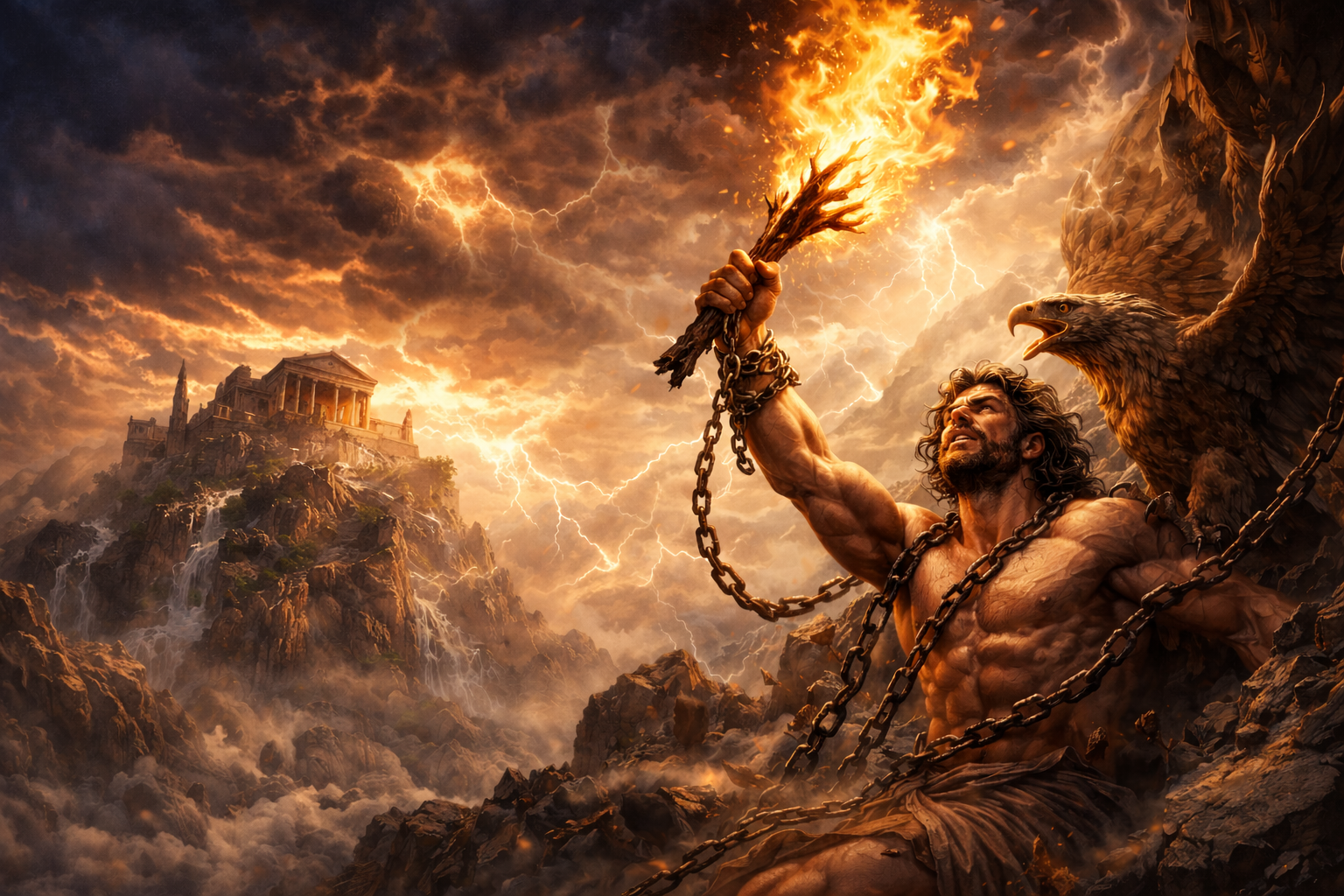
Prometheus theft of fire explained with a full plot summary, major themes, and modern relevance—power, technology, punishment, and the cost of progress.
The Thet of Fire, and Why It Still Burns.
“Prometheus and the theft of fire” is one of the oldest stories we have about power, technology, and punishment. It survives from ancient Greece in early poetic tellings (most famously in Hesiod) and later dramatic treatments (most famously in the tragedy Prometheus Bound, traditionally attributed to Aeschylus). The core of the myth remains consistent across all versions: a cunning Titan defends the vulnerable humans, the king of the gods acts as a ruler safeguarding an empire, and the aftermath is the world we live in, filled with work, suffering, desire, and hope.
The myth matters because it does not treat progress as clean or innocent. Fire is not just warmth. Fire is a tool that changes what humans can do. Once humans have it, they can cook, build, forge, and plan. That turns the human species into a rival kind of force. The story asks a sharp question: if knowledge is power, who gets to own it?
Prometheus is not a saint in these tellings. Prometheus is a strategist. Prometheus uses deception. Prometheus provokes a confrontation he cannot fully control. Yet the story refuses to make the conflict simple. Zeus is not wrong to fear disorders. Prometheus is not wrong to fear tyranny. The myth lives in that tension, where the same act can be both liberation and escalation.
The story turns on whether a gift meant to free humanity can be given without triggering a punishment that reshapes human life.
Key Points
“Prometheus and the theft of fire” explains progress as a stolen advantage, not a granted blessing.
The myth links technology to political power: fire is treated as controlled infrastructure.
Prometheus uses a sacrifice trick to force a new bargain between gods and humans, and the bargain turns hostile.
Zeus answers the theft of fire with a “gift” that looks beautiful but carries hidden harm.
The story frames human suffering as fallout from a power struggle above human heads.
In later tragedy, Prometheus becomes a symbol of resistance and a critic of divine rule.
The myth’s most unsettling insight is that knowledge often arrives bundled with new forms of pain.
The story endures because it describes the emotional logic of modern systems: control, retaliation, and the cost of disobedience.
Full Plot
Spoilers start here.
Act I: Setup and Inciting Incident
Prometheus (a Titan associated with forethought and cunning counsel) lives in a world where the Olympian gods have secured power under Zeus (the new ruler who enforces order through authority). Humans exist in a fragile state. In some strands of the tradition, Zeus’s rule includes a willingness to erase humans and start again. Prometheus opposes that outcome, not by open war, but by steering the rules that govern humans.
Prometheus’s first major move is political theater disguised as ritual. At Mekone, gods and humans gather to settle how sacrifice will work, meaning how honor and resources will flow between the mortal world and the divine. Prometheus sets a trap with an ox. Prometheus divides the animal into two piles. One pile looks rich but is mostly bones hidden under glossy fat. The other pile is the edible meat, concealed in an unappealing wrapping.
Zeus understands the trick, but Zeus plays along. Zeus chooses the pile that looks best, the fat-wrapped bones, and Zeus uses that choice to justify a new arrangement: humans will keep the meat, but the gods will take the symbolic portion burned on altars. It is a settlement that looks fair on the surface and bitter underneath. Prometheus has forced a rule that favors humans at the table, but Prometheus has also humiliated the ruler who now gets to write the enforcement mechanisms.
Zeus retaliates by controlling a resource humans cannot replace. Zeus hides fire from humanity. Without fire, humans lose more than comfort. Without fire, humans lose cooked food, crafted tools, hardened materials, and the ability to gather in safety at night. Zeus’s aim is not merely to punish Prometheus. Zeus’s aim is to push humans back into dependence.
Prometheus responds with escalation. Prometheus steals fire and returns it to humans, concealing the stolen flame inside a hollow fennel stalk. In a single act, Prometheus breaks the monopoly. Humans regain the tool that makes civilization possible. Zeus now has proof that Prometheus will not simply bargain. Prometheus will sabotage.
Zeus chooses a form of revenge that will travel through human life rather than strike Prometheus alone. Zeus orders the creation of Pandora (the first woman in this mythic framework, crafted as a “gift” designed to function as a trap). Hephaestus (the divine smith, carrying out an order he may not admire) forms Pandora from earth and water. Athena gives Pandora skill in weaving and craft. Aphrodite gives Pandora beauty and desire. Hermes gives Pandora persuasion and deception, the ability to speak in ways that charm and mislead.
Pandora is delivered to Epimetheus (Prometheus’s brother, whose name marks him as “afterthought,” the man who understands too late). Prometheus warns Epimetheus not to accept gifts from Zeus. Epimetheus accepts anyway. The warning is clear. The temptation is stronger.
Pandora arrives carrying a sealed jar. Pandora opens the jar, and the contents—evils, suffering, disease, and relentless hardship—spill out into the human world. Pandora tries to close the jar, and Hope remains inside. Humans now have fire, but humans also have a new condition: life is filled with work, pain, and uncertainty, yet humans are not stripped of the capacity to keep going.
Prometheus’s inciting act has succeeded. Humans have fire. But the cost is now systemic, not personal. Zeus has converted a dispute over power into the permanent texture of human existence.
What changes here is that a stolen tool becomes a new world order, with consequences that cannot be recalled.
Act II: Escalation and Midpoint Shift
Zeus turns to Prometheus. In the early poetic account, Zeus punishes Prometheus for the theft of fire and the earlier act of deception. In the later tragedy, Zeus punishes Prometheus for a broader rebellion: for protecting humans, for undermining Zeus’s authority, and for teaching humans how to survive and think.
Prometheus is seized and bound to a remote mountainside in the Caucasus region. The binding is not framed as a quick execution. It is framed as spectacle and message. In the tragic telling, Kratos (the personification of Power) and Bia (the personification of Force) oversee the punishment. Hephaestus performs the physical work—hammering and fastening Prometheus to the rock—while showing reluctance. Prometheus endures without pleading, but Prometheus speaks in a way that makes the punishment feel like a moral trial for the entire regime.
The midpoint shift in the story is not a new event. It is a change in what the conflict is really about. Prometheus is not only being punished for theft. Prometheus is being punished for refusing to accept Zeus’s definition of justice.
In Prometheus Bound, visitors arrive, and each visitor tests a different lever of control. Oceanids (a chorus of sea nymphs, daughters of Oceanus) appear first, drawn by the sound of suffering. The Oceanids offer sympathy but also caution. Oceanus (an older divine figure, cautious and politically adaptive) arrives with advice: yield, soften, negotiate. Prometheus refuses. Prometheus treats submission as the only true defeat.
Prometheus then reframes the theft of fire as part of a wider rescue. Prometheus claims Prometheus gave humans the arts that make life livable: knowledge of seasons, mathematics, writing, medicine, building, metalwork, and interpretation of signs. The claim is not modest. Prometheus positions Prometheus as a civilizational benefactor. That raises the stakes because it implies Zeus is not merely punishing theft. Zeus is resisting human advancement.
Then Io arrives (a mortal woman transformed and tormented because Zeus desired Io and Hera punished Io). Io wanders in pain, pursued by a stinging frenzy that keeps Io moving. Io is not a subplot for decoration. Io is proof that Zeus’s power reaches into the intimate body and that innocence does not protect a person from becoming collateral.
Prometheus recognizes Io’s story and speaks prophecy as a form of solidarity. Prometheus tells Io that Io’s suffering has an end and that a future descendant of Io will play a role in Prometheus’s eventual release. The prophecy does two things at once. It comforts Io with direction. It also signals that Zeus’s rule is not eternal.
Pressure escalates because Prometheus has one advantage Zeus cannot take by force: information. Prometheus knows something about Zeus’s future, a secret tied to Zeus’s sexual desire and the risk of producing an heir who could overthrow Zeus the way Zeus overthrew earlier powers. Prometheus does not reveal the secret. Prometheus uses it as leverage.
Zeus responds with a direct ultimatum. Hermes (Zeus’s messenger, acting as enforcement rather than diplomacy) arrives to demand the secret. Hermes does not ask gently. Hermes threatens total annihilation: burial under rock, storms, the tearing of flesh. The demand is simple: tell Zeus what Zeus must avoid, or suffer consequences beyond the current chains.
Prometheus refuses again. Prometheus calls Zeus a tyrant. Prometheus treats Zeus’s threats as proof that Zeus lacks moral legitimacy. Prometheus chooses suffering over surrender, not because Prometheus enjoys pain, but because Prometheus believes yielding will turn humans and gods into permanent subjects of fear.
The punishment intensifies. In the mythic tradition outside the play’s ending, an eagle comes to feed on Prometheus’s liver each day, and Prometheus’s body regenerates each night, making the torment renewable and endless. In the tragic arc, the immediate climax is cosmic violence: thunder, earthquake, and a violent shift of earth and sky. Zeus’s power becomes the environment itself.
What changes here is that the conflict becomes openly ideological: not fire versus no fire, but obedience versus conscience.
Act III: Climax and Resolution
The endgame is a standoff between authority and refusal. Zeus wants the prophecy because Zeus fears the loss of power. Prometheus refuses because Prometheus believes Zeus’s rule is unjust and because Prometheus needs leverage to protect humans and secure a future bargain.
Hermes delivers the final terms. Hermes demands the secret and mocks Prometheus’s defiance as pride. Prometheus rejects Hermes’s framing and rejects Zeus’s definition of justice. Prometheus does not claim innocence. Prometheus claims purpose. Prometheus accepts the cost.
The climax answers the myth’s core question: can a liberating gift be taken from power without being paid for? The answer is that the price is not optional. The price will be extracted. The only choice left is who pays and what kind of world the payment creates.
In the tragedy’s final movement, Zeus unleashes a storm and a convulsion of the landscape. Prometheus calls on the natural world to witness the injustice. The Oceanids refuse to abandon Prometheus, choosing loyalty over safety. The scene ends in overwhelming force, with Prometheus plunged away under divine violence.
Outside the play’s endpoint, the broader myth continues. Prometheus remains bound and tormented until Heracles (a future hero, acting within Zeus’s larger plan) kills the eagle and releases Prometheus. The release is not framed as Prometheus being proven wrong. It is framed as the system eventually making room for a settlement, whether out of necessity, strategy, or the slow softening of rage.
The resolution is therefore double. Humans keep fire. Humans also inherit suffering released through Pandora’s jar, with Hope contained as a complicated remainder—either a comfort preserved or a promise deferred. Prometheus pays personally, and humanity pays collectively, for the same act of theft.
Analysis and Themes
Theme 1: Power Controls Infrastructure
Claim: The myth treats fire as infrastructure and infrastructure as political control.
Evidence: Zeus hides fire to force dependence, and Prometheus steals fire to break the monopoly. Pandora’s “gift” functions as policy: it distributes suffering across the population rather than targeting one offender.
What this means is that modern power frequently operates in a similar manner. When a resource is essential—energy, compute, networks, platforms—control over access becomes a lever for discipline. The myth warns that “progress” is never only technical; it is always about who gets to decide what others can do.
Theme 2: Progress Arrives With a Price Tag
Claim: The story refuses the fantasy of pure innovation without fallout.
Evidence: Fire returns to humans, but Zeus’s counterstrike reshapes human life through hardship and disease. Prometheus’s cleverness wins a tool but provokes a permanent escalation.
So what: Every major tool changes the balance of risk. New capabilities create new vulnerabilities. The myth’s realism is psychological: once power is challenged, punishment can become structural, not personal.
Theme 3: The Gift as a Weapon
Claim: The most dangerous weapon in the myth is not lightning; it is the “gift” that carries hidden harm.
Evidence: Pandora is designed as something humans will welcome. Epimetheus accepts what looks harmless and beautiful despite clear warning. The jar’s opening spreads harm without a clear villain to fight afterward.
So what: Harm often arrives through packaging that looks beneficial. Incentives, perks, “free” products, and convenient systems can smuggle long-term costs. The myth nails the way consent is engineered: people accept the shiny surface, then live inside the consequences.
Theme 4: Suffering as a Governance Tool
Claim: Zeus’s retaliation implies that suffering can be used to stabilize rule.
Evidence: By releasing hardship into the world, Zeus ensures humans must work, struggle, and age under pressure. By chaining Prometheus, Zeus turns dissent into a warning sign others can see.
So what: Systems often manage populations by shaping conditions rather than issuing constant commands. Scarcity, bureaucracy, and uncertainty can keep people too exhausted to rebel. The myth is blunt about it: punishment is not always about justice; it is about control.
Theme 5: Defiance, Pride, and Moral Clarity
Claim: Prometheus’s refusal is both admirable and costly, and the myth keeps that ambiguity alive.
Evidence: Prometheus deceives Zeus at Mekone and steals fire, then refuses to reveal the prophecy even when threatened. In the tragedy, Prometheus frames defiance as fidelity to a higher justice, not personal ego.
So what? Resistance can be principled and still produce collateral damage. The myth does not let a listener pretend otherwise. It asks a harder question: when is defiance worth the price, and who has the right to decide what others must endure?
Character Arcs
Protagonist: Prometheus begins as a strategist who believes cleverness can bend power. Prometheus ends as a figure who accepts suffering rather than concede moral authority. The pivot is the realization that Zeus will not treat the dispute as a negotiable quarrel; Zeus will treat it as a threat to sovereignty. The second pivot is Prometheus’s choice to endure torment rather than trade the prophecy for relief, making Prometheus’s inner stance the one territory Zeus cannot conquer.
Secondary arc: Epimetheus moves from careless acceptance to late understanding. Epimetheus embodies the human tendency to learn only after the consequences arrive. That matters because it shifts the myth from cosmic politics to personal psychology: systems can warn you, and you can still choose wrong because desire feels like certainty.
Structure
The myth’s structure is a chain of retaliations, and that is the point. One cunning act creates a political response. The response creates a counter-response. The escalation ends only when the conflict becomes permanent condition: human life becomes defined by labor, suffering, and hope.
The latter tragedy makes a bold craft choice: it starts after the decisive act. The theft has already happened. The audience meets Prometheus in punishment, then is forced to reconsider the original “crime” through argument and memory. That shifts the experience from adventure to courtroom. The drama is not whether Prometheus will steal fire. The drama is whether the audience believes Zeus’s rule deserves obedience.
The myth also compresses huge ideas into physical objects: fire, a fennel stalk, chains, an eagle, and a sealed jar. Each object is simple enough for a child to imagine and heavy enough to carry a worldview. That is why the story travels across centuries and keeps its bite.
What Most Summaries Miss
Many summaries flatten Pandora into “Pandora’s box” and move on. The myth is sharper than that. The container is a jar in early accounts, and the later “box” phrasing is a historical drift that changes the feel of the story. A jar suggests storage, household life, provisions, something integrated into daily routine. The horror is not a cursed artifact from a dungeon. The horror sits in the house.
Another missed element is Zeus’s choice at Mekone. Zeus is not simply fooled like a comic victim. Zeus is portrayed as seeing the trick and using it anyway, turning humiliation into justification. That is a ruler’s move: accept the loss in one moment to win the narrative that legitimizes punishment afterward. The myth is not only about Prometheus’s cleverness; it is about how power converts embarrassment into law.
Relevance Today
Fire is the myth’s ancient stand-in for transformative technology. In modern life, the equivalent is not one tool but a cluster: electricity grids, semiconductors, cloud computing, AI models, and the networks that move information. When a few actors can restrict access, they can shape what everyone else is allowed to build.
The story maps cleanly onto workplace culture, too. Prometheus breaks a rule to help “the humans,” and the response is not just discipline; it is deterrence. Organizations often punish a whistleblower more harshly than the offense itself because the real fear is precedent. The myth understands that control depends on making an example.
Politically, Pandora reads like a lesson in engineered consent. A “gift” arrives with a smile, and it locks in new conditions of life. Modern parallels include surveillance framed as safety, convenience framed as inevitability, and “free” services that trade autonomy for access.
In relationships and identity, the myth captures a familiar trap: attraction can override good counsel. Epimetheus is warned and accepts anyway. That is not stupidity. That is the human habit of choosing the emotionally vivid over the strategically wise, then narrating the choice as fate.
In war and violence, Prometheus Bound shows how regimes use spectacular punishment to stabilize rule. Public examples, fear of association, and the crushing of dissent are not ancient only. The myth is honest about the psychology: terror is meant to isolate the rebel and intimidate the bystander.
On inequality, the myth’s core cruelty is that the powerful can make everyone pay for a dispute among elites. Zeus is angry at Prometheus, yet human life changes. That mirrors how ordinary people absorb the costs of power struggles—economic shocks, policy whiplash, and instability—while the decision-makers remain insulated.
Ending Explained
The ending depends on which Prometheus story you treat as “the ending.” In the early mythic chain, the ending is that humans keep fire but inherit suffering, and Prometheus is punished until a later release becomes possible. In the tragic ending of Prometheus Bound, the ending is the refusal itself: Prometheus will not give Zeus the secret, even at the edge of annihilation, and Zeus answers with overwhelming force.
The ending means that power can punish bodies but still fail to conquer moral autonomy.
What the ending resolves is the immediate question of whether threats will break Prometheus. They do not. What the ending refuses to resolve is whether Prometheus’s strategy ultimately helps humans more than it harms them, or whether Zeus’s rule can ever be just. The story leaves behind an argument rather than a neat verdict: technology can free you, authority can retaliate, and the only lasting control you might keep is your refusal to accept someone else’s definition of justice.
Why It Endures
Prometheus endures because it is an origin story for modern life without pretending modern life is clean. It does not say suffering is noble. It says suffering is what power distributes when power feels challenged.
This myth is for readers who like stories where ideas have teeth: where a gift can be a weapon, where progress can trigger backlash, and where a hero can be both benefactor and provocateur. It may not land for readers who want a simple moral fable with a single villain and a single lesson.
The final note is the same pressure that starts the story: once a tool changes what humans can do, the world reorganizes around who gets to control it.
