

The Communist Manifesto Explained: The Tiny Book That Promised Liberation And Helped Reshape The World
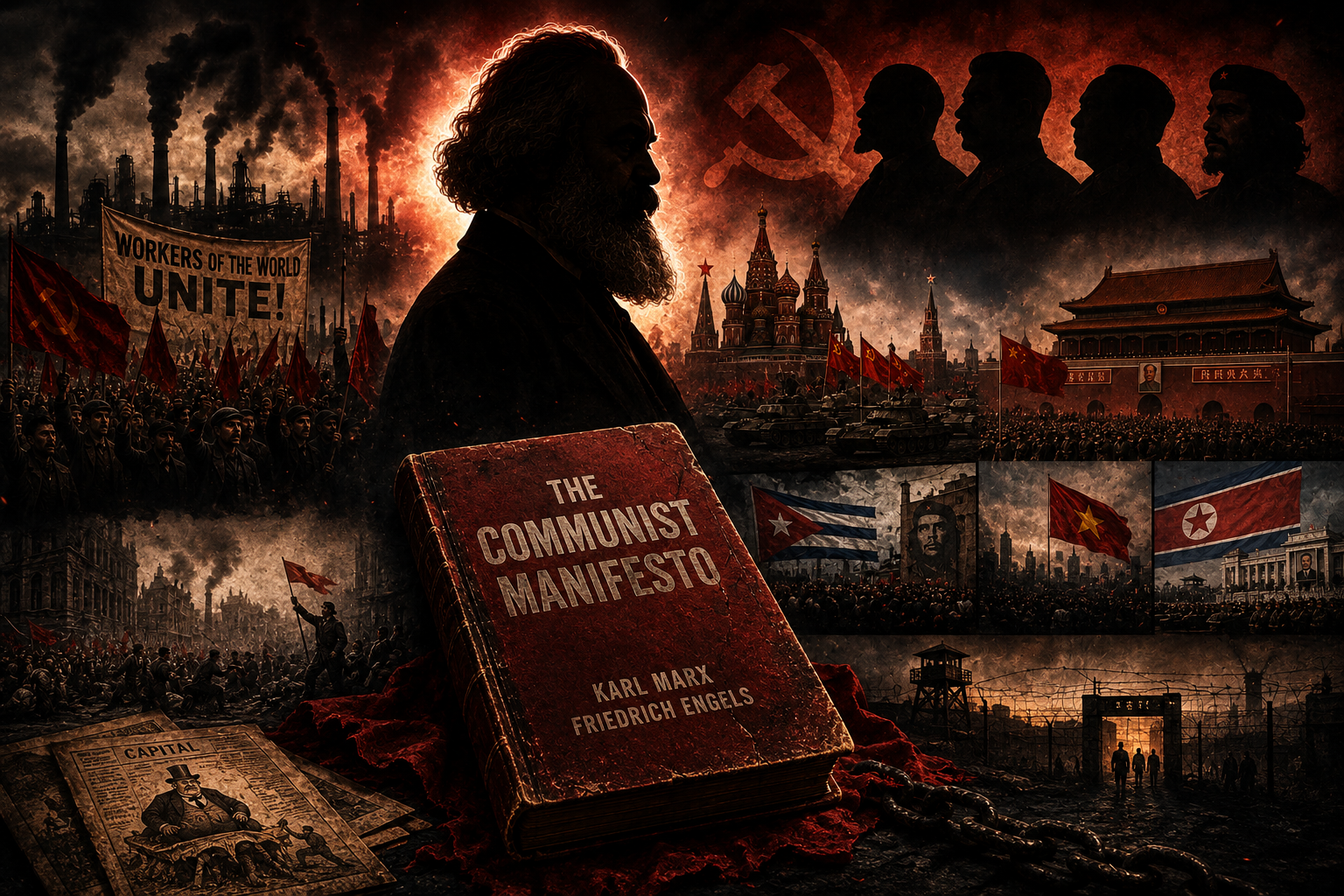
The Communist Manifesto Summary: The Book That Turned Class Rage Into A Global Ideology
The Pamphlet That Turned Class Anger Into A World-Historical Weapon
A book does not need to be long to become dangerous. The Communist Manifesto is barely a pamphlet, yet it helped give the modern world one of its most explosive political languages: class struggle, capitalist crisis, worker power, revolution, and the promise of a society beyond private ownership.
That is why it still matters. Not because every line came true. Not because every regime that claimed Marx deserves moral cover. It matters because Marx and Engels named a pressure that never vanished: the feeling that the people who work are not the people who control the wealth, the rules, or the future.
The result was one of the most influential political texts ever written—a short, furious, theatrical document that became a scripture for revolutionaries, a warning sign for capitalists, and a battlefield for historians. First published in February 1848 as the platform of the Communist League, it compressed an entire theory of history into a weaponized political message.
The background was a Europe that was already close to detonating.
The Communist Manifesto did not appear in a calm world. It arrived in a Europe being transformed by factories, railways, urban labor, political unrest, and the rising power of industrial capitalism. Old feudal structures were weakening. New commercial classes were gaining power. Workers were crowding into cities where wages, hours, housing, and survival were becoming political questions.
Marx and Engels wrote in the language of crisis because they believed capitalism itself was a crisis machine. The central argument was brutally simple: history was not mainly a story of kings, constitutions, heroes, or national destiny. It was a story of classes fighting over production, property, and power.
That makes the book easier to misunderstand. It is not a calm economics textbook. It is not a neutral history survey. It is a political intervention designed to make workers see themselves as a collective force. In that sense, it belongs beside the wider question of capitalism, socialism, and communism as competing systems of ownership and control, not as abstract labels but as rival answers to who is entitled to command economic life.
The timing mattered. The year 1848 became a year of revolutions across Europe. Marx and Engels did not create that unrest by themselves; they gave one wing of it a sharper vocabulary. The Communist League wanted a public statement of aims. Marx and Engels delivered something more potent: a theory of history written like a courtroom prosecution.
The Book Summary: Four Sections, One Relentless Accusation
The structure of The Communist Manifesto is tighter than its reputation suggests. It opens with a dramatic preamble, then moves through four main sections: “Bourgeois and Proletarians,” “Proletarians and Communists,” “Socialist and Communist Literature,” and “Position of the Communists in Relation to the Various Existing Opposition Parties.”
The first section is the engine of the book. Marx and Engels argue that class conflict has shaped every major historical order. Ancient society had masters and slaves. Feudal society had lords and serfs. Industrial capitalism, they argue, has simplified the struggle into two giant camps: the bourgeoisie, who own the means of production, and the proletariat, who sell their labor to survive.
What makes the argument striking is that Marx and Engels do not describe capitalism as weak. They describe it as astonishingly powerful. The bourgeoisie, in their telling, smashed feudalism, transformed production, expanded world markets, urbanized society, and dragged the globe into a new system of exchange. Capitalism is not treated as lazy or static. It is treated as revolutionary — but revolutionary in a way that eventually turns against itself.
That is the first key twist. The Manifesto attacks capitalism while also recognizing its power to transform history. It sees capitalism as dynamic, creative, globalizing, and destructive. The bourgeoisie breaks old worlds open, but in doing so, it creates the modern working class that Marx and Engels believe will one day overthrow it.
The second section turns from diagnosis to program. Marx and Engels argue that communists do not stand apart from the working class but represent its broader historical interest. Their immediate aim is the formation of the proletariat into a class, the overthrow of bourgeois supremacy, and the conquest of political power by workers.
Then comes the line that made the book infamous: communism means abolishing bourgeois private property. That phrase is often flattened into “Marx wanted to take everyone’s toothbrush.” That is not the argument. Marx and Engels distinguish personal possessions from capital—property used to command the labor of others. Their target is not ordinary personal use. Their target is ownership as class power.
The Manifesto then lists transitional measures that include land reform, progressive taxation, abolition of inheritance rights, state control of credit, state control of transport and communication, expansion of state-owned production, equal obligation to work, and free public education for children. These are not presented as the final form of a communist society. They are presented as steps in the revolutionary transformation of production.
The third section attacks rival socialist movements. Marx and Engels were not simply arguing against capitalism; they were also fighting other anti-capitalist schools they considered sentimental, reactionary, utopian, or insufficiently grounded in class struggle. This matters because the Manifesto is not “left-wing politics” in general. It is a very specific claim: that the working class, organized politically, is the force capable of ending class society.
The fourth section ends with political positioning. Communists, Marx and Engels argue, should support revolutionary movements against existing social and political orders while pushing those movements toward a wider proletarian struggle. The famous closing appeal turns the book from theory into mobilization. The point is not merely to understand class conflict. The point is to organize it.
The Key Lessons That Still Hit Hard
The first lesson is that economics is never just economics. For Marx and Engels, ownership shapes law, culture, family life, morality, politics, and even the ideas people treat as common sense. The ruling class does not only own factories; it helps define what society calls normal.
That remains the Manifesto’s most durable intellectual move. It asks readers to look beneath surface arguments and ask who benefits from the structure. Who owns the platform? Who captures the margin? Who takes the risk? Who writes the contract? Who calls a system “freedom” because it works for them?
The second lesson is that capitalism is revolutionary before it is conservative. Marx and Engels saw that capitalism does not leave society alone. It disrupts customs, destroys old professions, globalizes markets, changes cities, reorganizes family life, and turns almost everything into a transaction. That insight still explains why capitalist societies can feel permanently unstable even when they are materially successful.
The third lesson is that class is not just income. Class, in the manifesto, is about a person’s relationship to production. Do they own capital, or must they sell labor? Do they command, or are they commanded? That framework is why the book remains relevant in debates about wages, landlords, gig work, automation, platform monopolies, and asset ownership.
The fourth lesson is darker: revolution does not solve the problem of power by magic. The Manifesto imagines the proletariat taking political supremacy in order to abolish class domination. But once a revolutionary party captures the state, the crucial question becomes unavoidable: who controls the controllers?
That is where the book’s historical afterlife becomes so explosive. A movement can begin by attacking domination and end by creating a new form of it. The danger is familiar far beyond Marxism; a revolution without a clear and accountable target can become permission to harm anyone, especially when the movement can always claim history is on its side.
The fifth lesson is that ideology can provide a narrative for pain. Workers suffering low wages and insecurity may feel exploited before they can explain the system. The manifesto offers an explanation. It tells them their condition is not personal failure but historical design. That is politically electrifying. It converts grievance into identity, identity into solidarity, and solidarity into a promise of victory.
The Analysis Most People Miss: Marx Was Better At Diagnosis Than Prescription
The strongest version of the manifesto is diagnostic. Marx and Engels understood that industrial capitalism was not just producing goods; it was producing a new society. They recognized globalization even before it had a modern name. They saw that markets dissolve traditions. They saw that technology changes labor. They saw that capitalism can generate enormous wealth while leaving many workers feeling disposable.
That diagnosis still has force because many of the pressures they identified are still visible. Work can still feel insecure. Wealth can still concentrate. Housing can still become a class divider. Technology can still increase productivity without making workers feel more powerful. Global trade can still enrich consumers while destroying local industries. Politics can still become a fight over whether economic pain is personal, structural, or deserved.
But the prescription is where the danger begins. Marx and Engels assume that seizing political power and centralizing production can create the conditions for emancipation. The twentieth century exposed the brutal weakness winthat assumption. Centralization does not automatically mean democracy. State ownership does not automatically mean worker control. A one-party system does not automatically dissolve class power; it can relocate class power to the party, bureaucracy, security apparatus, and planning elite.
That distinction is essential. The Manifesto’s dream is a classless society where coercive political power fades. The historical reality of many communist states was almost the reverse: stronger states, tighter surveillance, fewer independent institutions, and new hierarchies controlling access to jobs, housing, speech, travel, and truth.
This history is why the Manifesto cannot be judged only as a book. It must be judged as a diagnosis, a myth, a mobilizing script, and a seedbed for political systems that often departed from its promised destination.
Why It Refuses To Die
The Communist Manifesto endures because inequality keeps giving it oxygen. Every generation that watches wealth concentrate, work become insecure, rents rise, wages stagnate, or elites escape consequences finds something in Marx’s anger that feels less like history and more like recognition.
It also endures because capitalism keeps changing. Marx and Engels described a system that constantly revolutionizes production and expands across borders. That is one of the reasons the text feels strangely modern. A reader can move from nineteenth-century factories to twenty-first-century platforms, algorithms, supply chains, and financial markets without losing the basic question: who controls the machinery of value?
Its language endures because it is dramatic. The manifesto does not merely argue; it stages history as a conflict with villains, victims, weapons, betrayals, and a final reckoning. That makes it emotionally stronger than most policy documents. It provides people a role. It tells them they are not isolated individuals fighting a private battle. They are members of a historical class.
That is also the danger. The same emotional clarity that makes the book powerful can make it simplistic. Once politics becomes a total war between oppressor and oppressed, compromise can look like betrayal, pluralism can look like weakness, and dissent inside the movement can be treated as sabotage.
Modern politics still struggles with that temptation. Many voters no longer argue only about policy; they argue about identity, legitimacy, betrayal, and who counts as the real people. That helps explain why Western politics can feel so confused, moralized, and unstable, even when the old class categories no longer map neatly onto modern life.
The manifesto endures because it asks the most uncomfortable question in politics: what if the system is working exactly as designed for its owners? That question does not require someone to become a communist. It does require them to stop pretending that economic systems are neutral machines.
Where the manifesto was implemented—and why the results split so violently
No country has ever fully implemented the final communist vision described by Marx and Engels: a classless, stateless, moneyless society based on common ownership. What history produced instead were states ruled by communist parties, usually with state ownership, central planning, restricted political competition, and security systems designed to protect the revolution from internal and external enemies.
That difference matters. When people ask whether the Manifesto “worked,” the honest answer is layered. Some communist-led states achieved rapid industrialization, mass literacy, public health gains, land redistribution, or anti-colonial mobilization. Many also produced famine, terror, censorship, economic stagnation, prison camps, personality cults, and one-party repression.
The results depend on what is being measured: education, equality, economic output, state power, food security, political freedom, human rights, innovation, military strength, or personal dignity.
The Soviet Union: The Industrial Triumph With A Human Catastrophe Inside It
The Soviet Union became the most important attempt to build a Marxist-Leninist state. It did not simply copy the Manifesto; it transformed Marxist theory through revolution, civil war, party rule, central planning, and the strategic demands of survival in a hostile international system.
Its successes were real in narrow but significant ways. The Soviet system built enormous state capacity, industrialized at speed, expanded education, and became a military and scientific superpower. Economic historian Mark Harrison argues that the Soviet era was less distinguished by ordinary consumer prosperity than by the use of the economy to build national power; he also notes that education and child survival improved many lives, while the system remained harsh and unequal in daily experience.
The human cost was staggering. Stalin’s first five-year plan emphasized heavy industry and collectivized agriculture, while consumer goods collapsed and collectivization contributed to terrible famines that killed millions. The Gulag system held political prisoners and ordinary criminals across a network of forced-labor camps; at its height it imprisoned millions, with Western scholarly estimates placing total deaths between 1.2 million and 1.7 million from 1918 to 1956.
So did Soviet communism succeed? It succeeded in building a powerful state from a poor agrarian base. It succeeded at mobilizing resources for industry, war, education, and science. It failed catastrophically at political freedom, consumer welfare, agricultural humanity, open truth, and protection from state violence. It proved that a command economy can build tanks, dams, and rockets. It also proved that when the state owns the future, the citizen may own very little of himself.
Mao’s China: Revolutionary Mobilization Turned Into Disaster, Then Market Reform Changed The Story
China under Mao became another defining communist experiment, shaped by peasant revolution, party rule, land reform, collectivization, ideological campaigns, and intense suspicion of bourgeois restoration.
The Great Leap Forward is the central warning. Launched in 1958, it aimed to rapidly industrialize China and reorganize agriculture through mass mobilization, communes, and backyard steel production. Its consequences were catastrophic: production failures, agricultural collapse, and famine. Britannica places starvation deaths at about 20 million between 1959 and 1962, while other historical estimates run higher.
The Cultural Revolution deepened the sense that ideological purification could become a weapon against society itself. Mao launched it in 1966 to renew revolutionary spirit and attack perceived bureaucratic degeneration, but it threw cities and institutions into turmoil and became a decade of persecution, factional violence, fear, and intellectual destruction.
Yet China’s later story complicates any simple verdict. The world’s most dramatic poverty reduction did not come from pure Manifesto-style communism. It followed reforming and opening from 1978, when China retained one-party rule while introducing market mechanisms, global trade, private enterprise, foreign investment, and pragmatic development policy. The World Bank states that, over four decades, China lifted close to 800 million people out of extreme poverty, accounting for nearly three-quarters of the global reduction in extreme poverty during that period.
So China’s greatest economic success came not from abolishing markets but from selectively reintroducing them under party control. That is the paradox. Communist political rule survived by abandoning much of communist economic purity.
Cuba: Social Gains Trapped Inside Political Repression And Economic Scarcity
Cuba offers a more mixed case. After the 1959 revolution, the Cuban state built a one-party socialist system with major emphasis on education, health care, social services, and anti-imperialist identity.
Its literacy campaign remains one of the strongest examples cited by defenders of revolutionary socialism. UNESCO describes Cuba’s 1961 National Literacy Campaign as a major cultural and educational event that became a benchmark for mass literacy movements in Latin America. Cuba’s health and education indicators have often looked unusually strong relative to its income level, and those achievements are part of why the Cuban model still attracts defenders.
But the cost is also central to the story. Cuba has not been a pluralist democracy with free political competition. Freedom House describes Cuba as a one-party communist state that outlaws political pluralism, bans independent media, suppresses dissent, and restricts basic civil liberties. Human Rights Watch states that the Cuban government continues to repress dissent and public criticism while Cubans endure a severe economic crisis affecting access to health and food.
So Cuba succeeded in specific social domains, especially literacy and basic health provision. It failed badly on political freedom, open speech, economic dynamism, and the right to oppose the ruling system without fear. It shows the central trade-off that defenders and critics still fight over: whether social guarantees can justify authoritarian control and whether those guarantees can survive long-term scarcity.
Vietnam: The Communist State That Grew By Moving Toward Markets
Vietnam is one of the clearest examples of a communist-led state achieving major development gains through reform rather than ideological purity. After war and central planning, Vietnam launched Đổi Mới reforms in 1986, moving from a closed, centrally planned agrarian economy toward a more open, export-driven, market-oriented system.
The results were substantial. The OECD states that Vietnam was one of the world’s poorest countries in 1985 and that Đổi Mới laid the foundation for rapid growth, turning it into a major exporter and foreign investment destination. It also notes that per-capita incomes rose 5.7 times between 1990 and 2023, poverty declined sharply, and life expectancy rose from 69 to 75 years. The IMF states that Vietnam lifted 40 million people out of poverty between 1993 and 2014, while the poverty rate fell from almost 60 percent to 14 percent.
Vietnam’s case is not a triumph of the Communist Manifesto in its pure form. It is a triumph of adaptation: one-party rule combined with markets, trade, private initiative, foreign investment, and state-guided development. Politically, it remains highly restricted. Economically, its success came from loosening central planning rather than intensifying it.
Cambodia’s Khmer Rouge: The Nightmare Version Of Revolutionary Purity
If the Soviet Union shows the terror of forced industrial centralization, Cambodia under the Khmer Rouge shows the horror of revolutionary purification taken to genocidal extremes.
The Khmer Rouge ruled Cambodia from 1975 to 1979 after winning power through guerrilla war. Under Pol Pot, the regime attempted a radical agrarian transformation, emptying cities, destroying professional classes, forcing labor, and treating perceived enemies as contaminants to be eliminated. Britannica states that an estimated 1.5 million to 3 million people — roughly a quarter of Cambodia’s population — died through execution, forced labor, starvation, and disease.
This was not simply “poor management.” It was a vision of social cleansing attached to revolutionary ideology. The Khmer Rouge treated history, education, religion, urban life, markets, and individuality as threats to the new order. It is one of the strongest warnings against any politics that tries to remake humanity through terror.
North Korea: The Permanent Fortress State
North Korea is another case where communist origins hardened into dynastic authoritarianism, militarization, isolation, and extreme state control. It is not a classless society in any meaningful Marxist sense. It is a hereditary security state built around party rule, ideological mythology, military priority, and restricted access to information.
Its famine in the 1990s remains one of the clearest failures of a closed authoritarian political economy. Britannica states that severe food shortages caused widespread starvation in the 1990s, with hundreds of thousands dying and a UN study finding major declines in life expectancy and rising infant mortality. The country later accommodated some aspects of market economics, including more open trading policies.
North Korea demonstrates the consequences of revolutionary legitimacy evolving into a permanent siege mentality. The state does not wither away. It expands into everything.
Where It Succeeded — And Where It Failed
The most honest assessment is not “communism worked” or “communism failed.” The historical record is sharper than slogans.
Communist-led systems sometimes succeeded at mass mobilization. They could rapidly build infrastructure, expand literacy, redistribute land, coordinate public campaigns, and channel resources toward national priorities. In poor agrarian societies, that could produce visible gains, especially when compared with corrupt oligarchies, colonial domination, or pre-revolutionary inequality.
They also sometimes succeeded at dignity politics. They told peasants, workers, and colonized populations that they were not backward, disposable, or naturally subordinate. That emotional power mattered. It helped revolutionary movements win loyalty not only through fear but also through meaning.
But communist systems repeatedly failed where unchecked power usually fails: accountability, pluralism, truth, incentives, and limits. When the party claimed to represent history itself, opposition became treason. When private ownership was destroyed without real democratic control, the state became the owner. When markets were crushed, shortages and black markets often followed. When targets mattered more than reality, officials lied upward and citizens suffered downward.
The fatal pattern was not merely state ownership. It was state ownership without political competition, free speech, independent courts, open data, civil society, and the right to say the plan is failing before the famine starts.
That is the hidden lesson of the Manifesto’s afterlife: exploitation can exist under capitalism, but domination can also exist under anti-capitalism. Changing who owns the factory does not automatically change who fears the knock on the door.
The Warning Buried Inside The Book’s Survival
The Communist Manifesto survives because it is partly right about the pain that unequal systems create. It survives because capitalism still produces winners who call the system natural and losers who suspect that the game was rigged before they arrived. It survives because work, ownership, debt, rent, automation, and global supply chains still shape ordinary life with a force that feels bigger than individual choice.
But its legacy is stained because the road from class liberation to party domination was not accidental in enough places to ignore. The twentieth century showed that revolutionary certainty can become a machine for excusing cruelty. Once a movement believes it represents the future, it can treat living people as raw material for history.
That is why the manifesto should be read seriously, not worshipped or dismissed. It is too powerful to caricature and too dangerous to romanticize. Its diagnosis of capitalism’s restless disruption remains one of the most influential critiques ever written. Its political afterlife shows how easily a promise of freedom can become a structure of command.
The book still haunts the world because the question underneath it has never gone away: who owns the system, who works inside it, and what happens when millions decide the answer is intolerable?
That question is why a pamphlet from 1848 still feels alive. It is also why the history written in its name should make every reader uneasy.
