The Crucible Summary: A Town That Confuses Fear for Truth
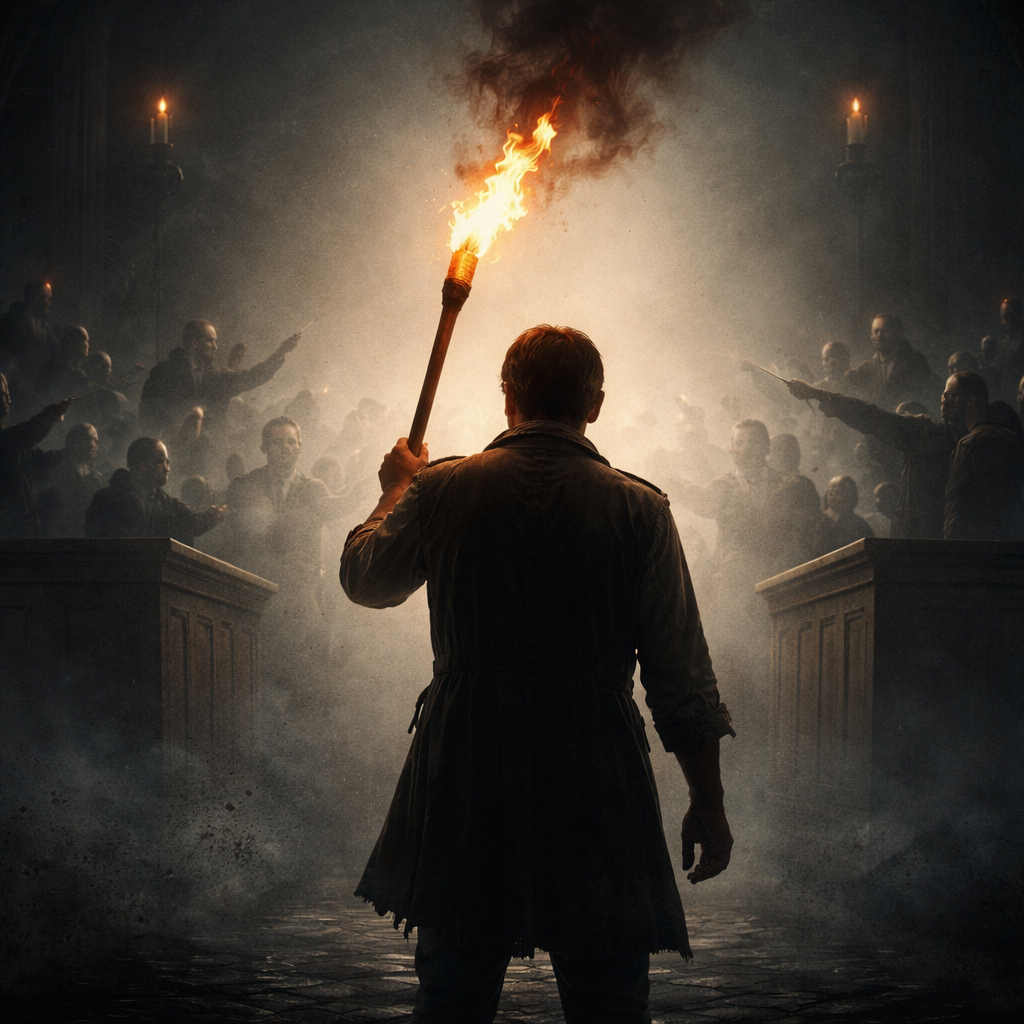
The Crucible summary of Arthur Miller’s 1953 play, with full spoilers, themes, and modern relevance—how fear and power turn accusation into “truth.”
This The Crucible summary explains Arthur Miller’s 1953 play as a chain reaction: a private panic becomes a public system, and that system keeps growing because admitting error would collapse the people running it.
Miller sets the story in Salem, Massachusetts, in 1692, when a theocratic community treats religious authority as civic authority, and suspicion can become evidence if enough people repeat it.
At its center is a human problem, not a history lesson. What happens when fear gives ordinary people a shortcut to power, revenge, and protection? And what happens when institutions reward accusations more than facts?
Miller’s achievement is that the play does not rely on villains with twirling mustaches. It shows how a courtroom can be sincere and still be wrong, how a community can call itself moral while doing immoral things, and how “saving the town” can become an excuse to destroy the people in it.
The story turns on whether John Proctor can live with a lie that saves his life.
Key Points — The Crucible Summary
The Crucible (1953) uses the Salem witch trials to show how moral panic becomes an engine that runs on fear, status, and self-preservation.
A group of girls faces punishment for breaking strict social rules, so the girls turn suspicion into a shield by accusing others.
John Proctor tries to keep his private failings private, but the crisis drags his marriage, reputation, and conscience into public view.
The court’s logic makes denial look like guilt and confession look like truth, creating a trap that is hard to escape.
People who challenge the trials are treated as threats to the community, not as defenders of justice.
The play’s tension comes from a clash between integrity and survival, especially when the system demands public submission.
Miller shows how lies spread fastest when they offer something people want: safety, control, or a way to hurt rivals without consequences.
Full Plot: The Crucible Summary
Here is the full plot summary with spoilers. The story unfolds across four acts as Salem’s fear turns into a legal machine, and that machine forces characters to choose between truth, reputation, and survival.
Act I: Setup and Inciting Incident
The play opens in Salem, Massachusetts, in 1692, where community life is governed by Puritan religion and the minister’s authority reaches into homes. Reverend Samuel Parris (Salem’s minister, anxious about reputation) discovers his daughter Betty Parris (a child, suddenly mute and inert) in a strange state after an incident in the woods. Rumors of witchcraft spread because Salem already expects evil to hide inside ordinary life.
Abigail Williams (Parris’s niece, determined to stay powerful and unpunished) is in the room with Betty, along with a circle of girls who were seen dancing in the forest. The girls are terrified of being punished for breaking rules that are not negotiable in their world. Abigail understands something simple: if Salem believes in witches, then witchcraft can be used as an explanation that shifts blame away from the girls.
Ann Putnam (a grieving mother, desperate for meaning) arrives with Thomas Putnam (a wealthy landowner, hungry for influence) and presses the witchcraft narrative. The Putnams have personal reasons to want invisible enemies because invisible enemies cannot defend themselves. The talk in the house shows how quickly fear becomes social currency: people gain attention by sounding certain.
John Proctor (a farmer, privately ashamed, openly independent) enters the orbit of this crisis as someone who dislikes Parris and distrusts the town’s moral performance. Proctor’s conflict is not only political. Proctor carries guilt from a past affair with Abigail, who once worked for the Proctor household and was dismissed by Elizabeth Proctor. Abigail sees the panic as a chance to regain control and possibly remove obstacles in her way.
Parris calls Reverend John Hale (a minister from Beverly, proud of expertise) because Hale studies witchcraft and believes learning can fight evil. Hale arrives with books and confidence, treating the situation like a solvable problem. This is the first pivot: once an “expert” names the threat, the town begins acting as if the threat is proven.
Under pressure, the girls realize that the safest position is the accusing position. Abigail claims to see spirits and to know names. Tituba (Parris’s enslaved servant from Barbados, vulnerable and scapegoated) is singled out because Salem already treats her as an outsider. When the adults demand a confession, Tituba understands the court’s hidden rule: a confession is rewarded because it supports the system’s story.
Tituba confesses to witchcraft and, to survive, names others. The room fills with the exhilaration of “discovering” evil. Abigail joins in, naming names and escalating the spectacle. Betty follows, and the group of girls becomes a chorus of accusation.
This is the inciting incident in practical terms: a private act of rule-breaking becomes a public witch hunt because confession and accusation are the only ways the vulnerable can avoid punishment.
What changes here is that Salem stops asking what happened and starts asking who to blame.
Act II: Escalation and Midpoint Shift
The setting shifts to the Proctor home, where the crisis becomes intimate. John Proctor and Elizabeth Proctor (his wife, honest but wounded) live with the aftermath of his betrayal. Their marriage is tense because trust has been damaged, and in Salem, a damaged reputation is not a private inconvenience. It is a danger.
Mary Warren (the Proctors’ servant, eager to matter) has become an official of the court, working with the girls. Mary’s new authority changes the household’s balance: a teenager now has the power of the state behind her. Mary brings news that people are being arrested, and she speaks with the inflated certainty of someone who has discovered a role that protects her from being overlooked.
Elizabeth urges John to expose Abigail’s lies because Elizabeth sees Abigail’s power growing. John resists at first because exposing Abigail requires exposing himself. John knows he has a personal motive to challenge Abigail, and Salem will twist personal motives into proof of guilt.
When Reverend Hale arrives to question the Proctors, the play shows how institutions expand: the court’s logic enters the home and begins testing morality. Hale asks about church attendance and religious knowledge, treating spiritual conformity as civic loyalty. John’s bluntness makes him look suspicious, not because he is wrong, but because the town equates dissent with danger.
The midpoint shift arrives when the witch hunt reaches directly into the Proctor household. Officials come with a warrant for Elizabeth Proctor, accusing Elizabeth of witchcraft. The accusation is anchored in a small physical object: a poppet, a doll Mary made. A needle is found in it, and Abigail has staged a matching injury to claim supernatural attack. The court prefers this story because it supports what the court already believes it is doing.
John Proctor sees the trap clearly. If the court can turn a doll into proof, then anyone can be convicted if the right people want it. John forces Mary to admit that Mary made the poppet and put the needle in it herself, which should logically collapse the accusation. But logic does not matter as much as momentum.
Elizabeth is arrested anyway. The system has reached the point where it cannot back down without admitting it has been wrong. Hale begins to doubt, but doubt is weak against a legal process that rewards certainty.
John decides to go to court with Mary and challenge the girls publicly. This choice commits him to conflict with the town’s most powerful institution and with Abigail’s most dangerous leverage: the secret of his affair.
What changes here is that John Proctor moves from private guilt to public confrontation, and Salem’s court becomes his enemy.
Act III: Climax and Resolution
Act III takes place in the courtroom, where the play becomes a study of how power protects itself. Deputy Governor Danforth (the chief judge, committed to the court’s authority) and Judge Hathorne (a magistrate, quick to believe accusers) run proceedings that look formal but operate on a belief system that cannot tolerate contradiction.
Francis Nurse (a respected landowner, trying to save his wife Rebecca Nurse) and Giles Corey (a stubborn farmer, trying to stop the court) bring petitions and arguments that should matter. They have signatures, character witnesses, and practical doubts. But the court treats opposition as subversion. Danforth believes that questioning the process threatens the community’s survival, so he reads doubt as a form of attack.
John Proctor arrives with Mary Warren and presents a new narrative: the girls are lying, and Mary can testify to it. Danforth’s response exposes the institutional logic. Danforth does not ask, “Is this true?” first. Danforth asks, “Why should the court believe you over them?” In a moral panic, credibility flows toward the accusation because accusation matches the official story.
Proctor presents a deposition supporting the good character of the accused. The court turns it against him by treating support as suspicious coordination. Giles Corey tries to introduce evidence that Thomas Putnam has used accusations to grab land, but Giles refuses to name his source because he fears retaliation. The court demands names as the price of being heard. Giles’s refusal is treated as contempt, showing that the system is less interested in truth than in control.
Proctor pushes toward the core issue: Abigail. Proctor confronts Abigail directly, forcing her into a public test. Abigail answers by performing certainty. She claims moral purity, and she exploits Salem’s fear of sexual sin by implying Proctor is a lecher who cannot be trusted. Proctor realizes he cannot win while his secret remains hidden because Abigail’s power depends on it.
In a desperate gamble, Proctor confesses his affair with Abigail in open court. He offers the confession as proof that Abigail is motivated by revenge and desire, not by spiritual vision. This confession is both a moral attempt at honesty and a strategic move: Proctor trades reputation for truth.
Danforth brings Elizabeth Proctor in to confirm the affair, believing Elizabeth will tell the truth. Elizabeth, unaware that John has already confessed, lies to protect John’s name. The lie is small and personal, but its consequence is massive. The court treats the lie as proof that Proctor is lying and that Abigail is trustworthy. A private act of love becomes fuel for public injustice.
Mary Warren begins to break under the pressure of the courtroom. Abigail and the girls turn the court into a theater by pretending to see spirits and by mimicking Mary’s reactions. Danforth, unwilling to admit uncertainty, accepts performance as proof. Mary is cornered: if Mary sticks with the truth, Mary becomes the next target. If Mary returns to the group, Mary is safe.
Mary collapses and accuses John Proctor of witchcraft. The court immediately accepts this because it restores the story the court prefers: dissent is evidence of guilt. Proctor is arrested. Reverend Hale, finally seeing the court’s corruption, denounces the proceedings and quits, but Hale’s moral clarity comes too late to stop the machine.
Act IV takes place months later, in a Salem that is cracking. The jail is full, the town is tense, and some people begin to see that the trials have created chaos, not purity. Parris is frightened because public sentiment is shifting, and Abigail has fled, stealing money. The authorities fear rebellion, but they still fear admitting error more.
Reverend Hale returns, transformed from confident expert to desperate persuader. Hale begs prisoners to confess to save their lives, even if the confessions are false. Hale’s shift is morally complicated: Hale no longer believes the court is just, but Hale believes survival is worth compromise. Hale has moved from pursuing truth to minimizing harm.
John Proctor is brought in to consider confessing. Elizabeth Proctor, now separated by imprisonment and trauma, is asked to speak with him. Their meeting is stripped of romance. It is about what kind of life can be lived after surrendering integrity, and what kind of death can be faced without surrendering it.
Proctor wrestles with the desire to live. Proctor also wrestles with the knowledge that the court will use a confession as propaganda. Proctor agrees to confess, but Proctor refuses to name others. Danforth insists on a signed statement, because a signature can be posted publicly and used to validate the system.
Proctor signs, then realizes what the signature means. The signature is not only a lie. The signature is the public theft of Proctor’s name, turned into a tool to condemn others and to justify the court’s past actions. Proctor refuses to let the confession be used. Proctor tears it up.
Danforth orders the executions to proceed. Proctor goes to death with Rebecca Nurse (a respected elder, refusing to confess) and others, while Hale and Parris are left with the consequences of a system they helped power. The play ends on the image of integrity chosen at the cost of life, and on a community that has forced goodness into a corner and called it rebellion.
Analysis and Themes
Theme 1: Hysteria as a Social Technology
Claim: Fear becomes a tool that organizes people faster than truth can.
Evidence: The girls shift from frightened rule-breakers to protected accusers as soon as accusation is rewarded. Tituba’s confession models the survival logic: confess, accuse, and live. The courtroom later treats mass performance as evidence, showing that collective certainty can substitute for proof.
So what: Modern societies still build fast-moving systems of belief when anxiety is high and authority wants clarity. Hysteria is not only irrational emotion. Hysteria can be an informal technology for decision-making, one that trades accuracy for speed and social unity.
Theme 2: Reputation as a Currency
Claim: In Salem, “a good name” is not self-image; it is social survival.
Evidence: Parris fears scandal more than spiritual failure. Proctor hesitates to confront Abigail because Proctor’s reputation is fragile. The court demands public confessions because public humiliation is the point: it locks people into roles the system can control.
So what: Reputation still functions like currency in workplaces, communities, and online platforms. Once reputation becomes an external score, people start making moral choices that are optimized for visibility, not truth.
Theme 3: Power Protects Itself by Redefining Reality
Claim: Institutions under threat often redefine truth to preserve authority.
Evidence: Danforth treats questioning the court as attacking the community. Depositions and petitions are reframed as conspiracies. Mary’s credibility is judged by whether Mary supports the system, not by whether Mary tells the truth.
So what: When legitimacy is fragile, systems become allergic to uncertainty. The result is a feedback loop: the more wrong the institution becomes, the more violently the institution must insist it is right.
Theme 4: Private Sin Becomes Public Weapon
Claim: Personal guilt is exploitable when a society is obsessed with moral purity.
Evidence: Abigail uses Proctor’s affair as leverage because Salem treats sexual sin as proof of deeper corruption. Proctor’s attempt to tell the truth backfires when Elizabeth lies to protect him, showing how private shame can distort public outcomes.
So what: Societies that demand perfection create blackmail markets. The more punitive the culture is about human weakness, the more power is gained by people who can expose it.
Theme 5: Confession as Violence
Claim: Forced confession is a form of control that turns language into a cage.
Evidence: Tituba is rewarded for confessing and naming others, which trains the town to see confession as truth. Danforth needs signed confessions because a paper trail turns human beings into exhibits. Proctor’s crisis centers on whether Proctor will let the state own Proctor’s words.
So what: Confession culture appears wherever institutions demand symbolic submission: political loyalty tests, coerced workplace “admissions,” and public apologies designed to satisfy a crowd rather than repair harm.
Theme 6: Integrity as the Last Freedom
Claim: When everything else is taken, choice over one’s own name becomes a final form of agency.
Evidence: Proctor’s final decision is not framed as bravery for its own sake. It is framed as refusing to let a lie become Proctor’s legacy. Rebecca Nurse refuses confession because confession would make her complicit in condemning others.
So what: The play argues that integrity is not abstract virtue. Integrity is the boundary that keeps a person from being fully absorbed by an unjust system.
Character Arcs
Protagonist: At the start, John Proctor believes survival means keeping private shame private and staying outside public conflict. By the end, John Proctor believes that a life purchased by public lying is a different kind of death, and John Proctor chooses ownership of his name over physical survival. The forcing moments are Elizabeth’s arrest, Proctor’s courtroom confession, Mary’s betrayal, and the demand that Proctor sign a lie for public display.
Reverend Hale: At the start, Hale believes expertise and procedure can identify evil and protect the community. By the end, Hale believes the court is corrupt and tries to save lives by urging false confessions, accepting moral compromise as damage control. Hale’s turning points are seeing decent people accused, watching the court punish doubt, and realizing that performance has replaced proof.
Elizabeth Proctor: At the start, Elizabeth Proctor believes moral clarity should protect a person, and Elizabeth struggles to trust John after betrayal. By the end, Elizabeth sees that purity cannot control outcomes in a broken system, and Elizabeth lets John choose his own path without forcing forgiveness or demands. Elizabeth’s key moment is choosing not to judge John’s final decision as selfish or heroic, but as his alone.
Structure
Miller builds escalation by moving from rumor to home to court to jail, narrowing space as freedom narrows. Each setting reduces what characters can control: first gossip, then family, then law, then the body. This compression makes the moral stakes feel inevitable because every attempt to “stay out of it” is punished.
The play uses plain, forceful dialogue that can flip from domestic realism to ritualized accusation. That contrast matters. Salem’s ordinary talk gives way to courtroom language that sounds official while functioning like theater. The effect is claustrophobic: truth has fewer words available than fear does.
The motif of “name” functions as a symbolic center. A name is reputation, identity, and inheritance, but it also becomes a document that the state can hang on a wall. The play turns paperwork into a moral battlefield, which is why the signing scene hits so hard.
What Most Summaries Miss
Many summaries treat the story as a simple warning about “mass hysteria,” as if fear is the only driver. The play is sharper than that. The hysteria spreads because it gives people incentives: protection for the girls, authority for the judges, and opportunities for rivals to settle scores. The crisis is not only emotional. It is transactional.
Another overlooked element is how the court’s logic is internally consistent once its premises are accepted. If the devil is real, if spirits can harm people, and if the court exists to save souls, then doubt becomes immoral. Miller is showing how dangerous a closed belief system is, not only how cruel individual people can be.
Finally, the story is also about shame. John Proctor’s private guilt is not incidental. It is the lever that lets Abigail turn a town’s moral language into a weapon. The tragedy is not only that Salem lies. The tragedy is that Salem builds a world where truth arrives too late to be believed.
Relevance Today
The play maps cleanly onto online dynamics where accusation can be safer than careful truth. Platforms reward certainty, outrage, and moral theater, which can make group belief feel like proof. A pile-on can function like Salem’s courtroom: dissent reads as complicity.
In work culture, The Crucible captures what happens when institutions prioritize “protecting the process” over examining outcomes. Investigations can become self-justifying if admitting error threatens leadership credibility. The court’s obsession with public confessions resembles modern demands for performative compliance.
In politics and power, the play shows how fear becomes a shortcut to legitimacy. Leaders who promise to identify hidden enemies can build authority quickly, especially when complexity feels unbearable. The “either you are with the court or against it” logic resembles modern loyalty framing.
In relationships and identity, the story shows how private wrongdoing can be exploited when a culture treats purity as identity. People become vulnerable to blackmail when communities punish imperfection more than harm. Shame becomes a lever, not a teacher.
In technology and media, misinformation spreads fastest when it reduces uncertainty and offers clear villains. Salem’s narrative is a template: a single story that explains everything, protects the in-group, and removes the need for nuance.
In inequality, scapegoating often targets outsiders and the socially weak because they are easiest to isolate. Tituba is accused first for structural reasons, not mystical ones. The play warns that the “least protected” will be the first sacrificed when a community panics.
Ending Explained
The final movement of The Crucible is a contest over ownership of language. The court needs a signed confession not because the court needs truth, but because the court needs legitimacy. A paper with a respected man’s name on it becomes a tool to quiet doubt and to justify the blood already spilled.
John Proctor’s decision turns on what kind of future Proctor can imagine for his children. Proctor can survive by cooperating with a lie, but survival would require surrendering the one thing Proctor can still control: Proctor’s name as a symbol of what Proctor stood for when it mattered most.
The ending means the last freedom a person has under tyranny is the power to refuse the story the system wants to tell with that person’s life. The play resolves the external conflict by showing the court proceed, but it refuses to resolve the deeper wound: Salem’s moral order has been exposed as fragile, and repair will require admitting that “justice” was used as camouflage.
Why It Endures
The Crucible endures because it is not comfort reading. It does not flatter the audience into thinking only monsters do monstrous things. It shows how quickly good intentions can be recruited by bad systems, and how easily fear can make cruelty feel like duty.
This play is for readers who want moral stakes that are concrete, not abstract: marriage under strain, reputations traded like coins, and institutions that punish doubt as if doubt were treason. It may not satisfy readers who want clean heroes and obvious villains, because Miller keeps revealing how everyone is entangled.
The last thing the play leaves you with is a question that does not go away: when the crowd demands a lie, do you survive by giving it what it wants, or do you insist on the truth and pay the cost?
