

The Giver Explained: The Dystopian Classic Where Safety Becomes A Prison
The Giver Turns Childhood Into A Warning About Control, Memory, And Freedom
The Giver Exposes The Terrifying Price Of A Perfect World
One announces itself with violence, hunger, police, war, surveillance, and fear. The other smiles politely, organises the family unit, removes bad weather, assigns your job, monitors your language, and tells you that everything has been arranged for your own good.
That is the horror of The Giver. Its world does not look broken at first. It looks clean, calm, efficient, safe, and rational. Nobody is starving. Nobody is unemployed. Nobody appears lonely. Nobody has to make unbearable choices.
Then Jonas is chosen to receive the memories everyone else has been spared.
And the perfect world begins to look like a prison.
Book Covered
The Giver by Lois Lowry.
The novel was published in 1993 and won the 1994 John Newbery Medal. The American Library Association describes the story as following twelve-year-old Jonas in an ordered society where his selection as the new Receiver leads him to uncover the truth beneath that world.
The Big Idea Of The Book
The Giver asks one brutal question: what would humanity lose if it tried to eliminate suffering completely?
The answer is not just pain. It is colour, memory, love, desire, risk, family, grief, morality, freedom, and the ability to know when something is evil.
Lowry’s world has not solved human suffering. It has hidden suffering behind rules, euphemisms, medication, obedience, and ignorance. Jonas’s story is the story of a child discovering that comfort without truth is not innocence. It is captivity.
The Plot In One Flow
Jonas begins the novel as an eleven-year-old boy living in what appears to be a perfectly ordered community.
His society is calm, structured, and intensely regulated. Families are carefully assigned. Children are placed with approved parents. Jobs are selected by the Elders. Language is corrected. Emotions are managed. Rules govern daily behaviour with terrifying precision, although the people inside the community rarely experience those rules as terrifying.
They experience them as normal.
Jonas lives with his father, his mother, and his younger sister Lily. His father works as a Nurturer, caring for infants before they are assigned to family units. His mother works in the Department of Justice. Lily is talkative, energetic, and still young enough to say things carelessly. Jonas is more thoughtful. He notices details, worries about precision, and tries to understand his feelings accurately.
At the beginning, Jonas is anxious about the upcoming Ceremony of Twelve.
In this society, childhood is divided into age-based milestones. At each Ceremony, children receive new privileges, responsibilities, or symbols of development. Ones are named and assigned to families. Nines receive bicycles. Other age groups receive clothing changes, volunteer responsibilities, or markers of maturity. But the Ceremony of Twelve is different. At Twelve, children receive their life assignments.
They do not choose careers. The community chooses for them.
The Elders observe each child for years. They watch their volunteer hours, habits, temperament, interests, and abilities. Then they decide where each child belongs. The system is presented as wise and compassionate. Nobody has to panic about the future. Nobody has to compete. Nobody has to fail at choosing a life.
But this also means nobody owns their life.
Jonas worries about what his Assignment will be. His friends Asher and Fiona are also approaching the Ceremony. Asher is funny, impulsive, and often imprecise with language. Fiona is calm, gentle, and caring. Jonas has affectionate feelings toward her, although he does not fully understand them yet. In his world, emotions are not allowed to develop freely.
The community’s surface order depends on constant correction. Children are taught to apologise formally. They are trained to speak with exactness. They must report dreams. They must follow ritualised family conversations where feelings are shared, processed, and neutralised. Language becomes not just communication but control.
One early sign of this control appears in the community’s treatment of difference.
When Lily notices a visiting child who seems different, she speaks too bluntly and is corrected. The community claims not to tolerate rudeness or prejudice. But what it actually does is eliminate visible difference almost entirely. People are made similar. Not merely equal in dignity, but similar in appearance, behaviour, opportunity, emotion, and expectation.
This is Sameness.
Sameness is the central system behind the community. It has removed unpredictability. There are no hills, no dangerous weather, no deep poverty, no visible war, no major disorder, and no strong personal choice. The result is a world of stability. The cost is everything that makes life vivid.
Jonas does not know this yet. He only senses that something about him is unusual.
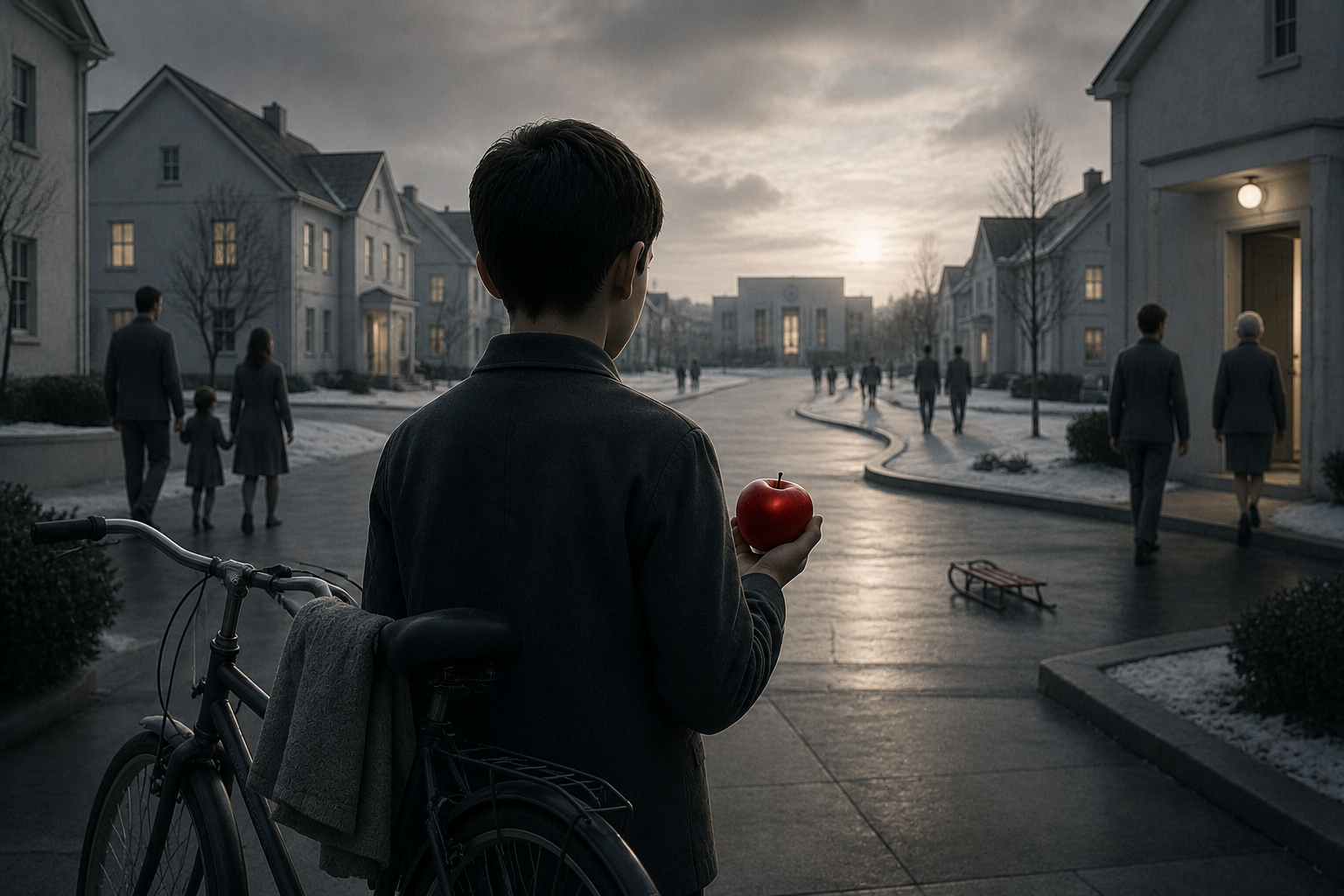
He has strange moments where objects seem to change. An apple appears different for a second while he is playing catch with Asher. Later, he notices something unusual in Fiona’s hair. He cannot name what he sees because his society has removed the concept from ordinary experience. He is beginning to perceive colour, especially red.
The community has largely eliminated colour as part of Sameness. Jonas’s ability to see it is a sign that he can receive what others cannot.
Another important plot thread begins with Gabriel, a struggling infant in Jonas’s father’s care.
Gabriel is not developing as expected. He does not sleep well at night and risks being labelled inadequate. In this society, infants who do not meet developmental standards may be “released.” At first, the word seems gentle. Release sounds like transfer, mercy, or removal from responsibility. The community uses soft language to hide hard realities.
Jonas’s father receives permission to bring Gabriel home at night for extra care. Jonas becomes attached to the child. Gabriel is vulnerable, restless, and different. He has pale eyes like Jonas, which suggests a deeper connection. In a society built on control, Gabriel’s inability to settle makes him dangerous simply because he does not fit.
The Ceremony of Twelve arrives.
The ceremony proceeds in numerical order. Each child is called and given an Assignment. Asher is assigned to be Assistant Director of Recreation, a fitting role for his playful nature. Fiona is assigned to work as a Caretaker of the Old, which suits her patience and tenderness.
Then Jonas is skipped.
The Chief Elder moves from Eleven to Thirteen without naming him. For Jonas, it is humiliating and terrifying. In a world where public order matters so much, being skipped feels like being erased. He wonders if he has done something wrong. The audience also reacts with confusion.
Only later does the Chief Elder explain.
Jonas has not been assigned. He has been selected.
His role is rare, honourable, and deeply burdensome. He is to become the next Receiver of Memory. The current Receiver is aging, and the community needs a successor. The position requires intelligence, integrity, courage, wisdom, and a special capacity called the ability to “see beyond.”
The community treats this as a great honour. But the reaction in the room is not simple celebration. There is awe, distance, and fear. Jonas’s selection separates him from everyone else.
For the first time, Jonas is no longer just a child moving through the system. He is becoming the one person allowed to know what the system hides.
After the Ceremony, Jonas receives his training instructions. They are shocking because they break the rules that have governed his entire life.
He is allowed to ask rude questions. He is allowed to lie. He is prohibited from discussing his training. He is exempt from dream-telling. He is not allowed to apply for release. He must report to the Receiver every day after school.
The instruction allowing him to lie disturbs him most.
Jonas has been raised in a society where precision and truth appear sacred. If he is allowed to lie, he wonders whether others are allowed to lie too. That thought destabilises everything. If rules can contain secret exceptions, then the community’s moral certainty is not certainty at all. It is theatre.
Jonas reports for training and meets the man who will become known to him as The Giver.
The old Receiver lives in a room unlike ordinary community spaces. It has books, which Jonas has barely encountered. The room feels private, heavy, and full of knowledge. The man is tired, burdened, and deeply human in a way Jonas cannot yet understand.
He explains that Jonas’s job is not to receive advice or technical records. He must receive memories.
These are not personal memories from the old man’s own life. They are the stored memories of humanity: pain, pleasure, war, colour, weather, music, love, hunger, loneliness, sunshine, snow, grief, family, celebration, terror, and death. The community removed these memories from ordinary people so they could live peacefully under Sameness. But the memories still have to exist somewhere, because the Elders occasionally need wisdom from the past.
The Receiver carries the burden for everyone.
The Giver begins with a gentle memory. He places his hands on Jonas’s back and transmits the experience of snow.
Jonas feels cold for the first time. He feels a sled beneath him. He experiences a hill, speed, air, movement, and physical delight. It is astonishing. He has never known snow because climate has been controlled. He has never known hills because terrain has been flattened or regulated. Something as simple as sledding becomes a revelation.
This first memory opens a door.
Jonas learns that the world was once bigger, stranger, and more alive. He receives sunshine. He learns warmth. He receives more colour. He begins to understand that the strange quality he saw in the apple was red. Once he can name colour, he begins to see the poverty of a world without it.
At first, memory feels like a gift.
Jonas wants others to experience what he experiences. He wants Asher to see colour. He wants Fiona to understand beauty. He wants his family to know that life can contain more than safe routines and approved language. But he cannot share his training. And even when he tries to hint at what he is learning, others cannot truly receive it.
The separation grows.
Jonas’s friendships begin to feel thinner. Asher still plays games, but the games now seem disturbing. Children pretend to shoot each other without understanding war or death. Jonas, after receiving memories of real violence, can no longer treat the game as harmless. Asher becomes irritated when Jonas tries to stop it. To Asher, Jonas seems too serious. To Jonas, Asher seems dangerously innocent.
This is one of the novel’s sharpest emotional turns. Jonas is not becoming superior. He is becoming awake. But waking up makes ordinary life with sleeping people almost impossible.
The Giver then transmits pain.
At first, it is manageable: sunburn, discomfort, injury. Then it becomes worse. Jonas receives memories of broken bones, hunger, loneliness, warfare, and death. One of the most devastating memories is a battlefield, where Jonas experiences the agony of a wounded young soldier begging for water among the dying.
This changes the meaning of his role.
The Receiver is not simply a wise advisor. He is a human container for the pain everyone else refuses to carry. The community’s peace is purchased by concentrating suffering inside one person. Everyone else lives lightly because the Receiver lives heavily.
Jonas begins to understand why the old Receiver looks so exhausted.
He also learns about the previous failure: Rosemary.
Rosemary was selected as Receiver before Jonas. She was The Giver’s daughter, though this is revealed with devastating weight later in the story. She began training, received memories, and was deeply affected by pain, loneliness, and loss. After only a short period, she applied for release.
Because a Receiver-in-training cannot simply be reassigned, her release had consequences. When she died, the memories she had received returned to the community. The people were overwhelmed by feelings they had no training to handle. The incident became a communal trauma. The Elders feared such instability happening again.
This explains why Jonas is forbidden to request release.
It also reveals something darker: even the community’s leaders do not truly understand the memories. They fear them as disorder, not as truth.
As training continues, Jonas’s emotional life deepens.
He receives a memory of family at Christmas: grandparents, warmth, lights, closeness, and intergenerational love. This memory is almost more destabilising than pain. Jonas sees a family structure unlike his own. His family unit is functional but temporary. Parents raise children assigned to them, then later live separately. The old are cared for institutionally. Couples do not form around deep romantic love. Children do not belong biologically to parents. The system has removed the dangerous attachments that make grief possible.
But it has also removed love.
Jonas asks his parents whether they love him. They react with mild discomfort and correction. “Love” is imprecise, they tell him. He should use more accurate language. They say they enjoy him and take pride in him, but the word love is treated as obsolete, almost embarrassing.
For Jonas, this is devastating.
He now knows that his family’s comfort is not the same as love. Their kindness is real in a limited way, but it is emotionally shallow because the society has removed the depth that would make love possible. They care for him according to role, duty, and approved feeling. They do not know what he is asking.
This is where Jonas begins to rebel inwardly.
He stops taking the daily pills that suppress Stirrings. Earlier, after an erotic dream involving Fiona, Jonas had been instructed to take medication to control those feelings. The pills are normal in the community. Everyone takes them once sexual desire begins. But after receiving memories, Jonas recognises that the Stirrings are part of human aliveness. He quietly refuses the medication, allowing feeling to return.
This matters because the rebellion is not dramatic at first. He does not immediately attack the system. He begins by preserving his own inner life.
Meanwhile, Gabriel becomes increasingly important.
Jonas discovers that he can transmit memories to the baby. When Gabriel struggles to sleep, Jonas gives him calming memories. This comforts the child and strengthens their bond. It also shows that Gabriel has the same capacity to receive memory. He is not defective in the way the community thinks. He is special, sensitive, and alive.
That makes the threat against him more horrifying.
The novel’s central horror fully reveals itself when Jonas asks to see a release.
Until this point, “release” has remained ambiguous. The community uses the word in several contexts. The elderly are released after ceremonies. Rule-breakers can be released as punishment. Infants who fail to thrive can be released. People speak of it calmly. Jonas’s father, as a Nurturer, participates in releases of infants.
Jonas watches a recording of his father releasing a newborn twin.
The scene is devastating because it is so clinical. Two identical babies have been born, and the community does not allow identical twins. One must be selected to live and one to be released. Jonas’s father weighs them, chooses the smaller one, injects the baby, watches him die, places the body in a carton, and sends it away through a disposal chute.
He does not rage. He does not tremble. He does not recognise murder.
He speaks gently to the baby while killing him.
This is the moment Jonas’s world breaks.
The horror is not only that the community kills infants. It is that Jonas’s father, who appears kind and caring, can kill a baby without understanding the moral meaning of what he is doing. Sameness has not made people evil in the ordinary sense. It has made them morally numb. They can commit evil because the language, memory, and emotional knowledge required to recognise evil have been removed.
Jonas is shattered.
He refuses to go home. The Giver comforts him and explains the truth. Release means death. Rosemary did not simply leave the community. She was killed by release, although she requested it. The old are killed. Some rule-breakers are killed. Inadequate infants are killed. All of it is hidden under a word soft enough to make murder sound administrative.
Now Jonas understands that the society’s peace is built on ignorance and death.
He also realises that his own father lied, or at least participated in a lie. Earlier, his father had spoken about release in harmless terms. Now Jonas has seen what the word means. The allowance to lie in his training instructions becomes even more disturbing. The entire community may be structured around authorised falsehood.
The Giver and Jonas begin to plan.
They decide that the community cannot continue as it is. If Jonas escapes, the memories he has received will return to the people. The effect will be painful and chaotic, but it may also be the only way to restore humanity. People cannot become moral adults while shielded from memory. They cannot choose rightly if choice has been removed. They cannot love if love has been classified as imprecise.
The original plan is careful.
Jonas will leave during the December Ceremony, when the community is distracted. The Giver will stay behind to help people process the returning memories. This is a painful choice. The Giver loves Jonas, but he believes his duty is to help the community survive the shock. He also hopes, in some sense, to be reunited with Rosemary after death.
The plan changes suddenly when Jonas learns Gabriel is scheduled for release.
Gabriel has failed to sleep properly through the night at the Nurturing Center. The decision is made: he will be released the next morning. For Jonas, this is no longer abstract moral rebellion. It is immediate. If he waits, Gabriel dies.
Jonas acts.
He steals his father’s bicycle, takes Gabriel, and escapes into the night. He does not have the careful supplies planned for the later escape. He does not have the staged cover story. He is a child fleeing a controlled society with a baby who has been marked for death.
The escape transforms the book from philosophical dystopia into survival story.
Jonas rides through darkness, fear, and exhaustion. Search planes look for him. He uses memories to hide from heat-seeking technology by transmitting cold to himself and Gabriel. He moves farther from the community than he has ever been. The landscape begins to change. The controlled world gives way to terrain, weather, hunger, and danger.
Freedom is not romanticised.
Outside the community, Jonas suffers. He becomes cold, starving, and weak. Gabriel cries. Food runs low. The weather worsens. Jonas begins to experience the truth the community tried to remove: freedom includes pain. Choice includes risk. Love includes terror, because someone you love can die.
But the novel does not suggest the community was right.
It shows that suffering is not the opposite of life. Suffering is part of a life deep enough to contain love, beauty, memory, and moral responsibility. The community removed pain by removing reality. Jonas chooses reality, even when it hurts.
As the journey continues, Jonas becomes weaker.
He falls. He struggles to keep Gabriel alive. He uses memories of warmth to protect the baby from freezing. He remembers sunshine, comfort, and love. Each memory costs him, but he gives what he has to Gabriel. This is the moral opposite of the community’s release system. The community kills the vulnerable to preserve order. Jonas suffers to preserve the vulnerable.
That is his transformation.
At the beginning, Jonas is a rule-following child waiting to be assigned a life. By the end, he is a moral actor. He chooses danger over obedience, love over safety, and truth over comfort.
The final sequence is deliberately mysterious.
Jonas reaches a snow-covered hill. He recognises it from the first memory The Giver gave him: the sled, the slope, the cold, the motion. He finds a sled waiting, or believes he does. He takes Gabriel and rides downward. In the distance, he sees lights. He hears music. He senses warmth, people, and welcome.
The ending can be read in more than one way.
One reading is literal: Jonas has reached Elsewhere, a real place beyond the community where people still live with memory, weather, music, family, and love. He and Gabriel are saved.
Another reading is tragic: Jonas is dying from cold and hunger, and the final lights and music are a memory, hallucination, or spiritual vision. The sled returns as a circle from the first memory, but perhaps not as a physical object. Perhaps the boy’s last act is to give Gabriel comfort as they die.
The novel refuses to close the door completely.
What matters is that Jonas has crossed the moral boundary. Whether he physically survives or not, he has rejected the lie. He has carried memory out of captivity. He has chosen love even when love exposes him to grief.
The final emotional consequence is larger than Jonas alone. If his escape works as The Giver believed, the memories return to the community. The people he left behind must finally feel what they have been protected from. They will suffer. They may panic. They may grieve. But they may also become human again.
The Main Characters Inside The Plot
Jonas is the emotional centre of the story because he begins as a sincere believer.
He is not a rebel by temperament. He is obedient, careful, and thoughtful. That makes his awakening more powerful. He does not reject the community because he wants chaos. He rejects it because he discovers that obedience has made people complicit in hidden violence.
The Giver is the keeper of everything the community cannot face.
He is mentor, historian, priest, witness, and prisoner. He knows beauty and horror. He carries humanity’s emotional archive, but that knowledge has isolated him from everyone. His tragedy is that he understands too much to belong to the community, yet remains bound to serve it.
Gabriel is the innocent test of the system.
He cannot argue. He cannot rebel. He cannot explain himself. His only crime is not fitting the community’s standards. Because of that, the society decides he can be killed. Jonas’s rescue of Gabriel turns abstract moral knowledge into action.
Jonas’s father is one of the most disturbing figures because he is kind and monstrous at the same time.
He cares for infants. He speaks gently. He seems loving by the community’s standards. Yet he kills a baby without moral recognition. He proves that evil does not always look cruel. Sometimes it looks professional, cheerful, and compliant.
Fiona and Asher represent the human cost of innocence without memory.
They are not villains. They are ordinary products of the system. Fiona’s tenderness is limited by obedience. Asher’s playfulness is limited by ignorance. Jonas loves them in different ways, but his awakening separates him from them because they cannot understand the world he now sees.
The Central Conflict Inside The Plot
The central conflict is not simply Jonas versus the Elders.
It is truth versus managed innocence.
The community believes that human beings are safer when they do not choose, remember, desire, grieve, compete, or love too deeply. Jonas discovers that this safety has turned life into a controlled simulation. People behave well because they have been prevented from becoming fully human.
The external conflict is Jonas against a system that controls every stage of life.
The internal conflict is Jonas deciding whether truth is worth pain. At first, memories feel wonderful. Then they become unbearable. The real test is whether he still believes in memory after memory wounds him.
By saving Gabriel, Jonas answers that question.
The Turning Points Inside The Plot
The first major turning point is Jonas being selected as Receiver.
This removes him from ordinary life and gives him access to forbidden truth. Until then, his unease has no language. After the Ceremony, his difference becomes destiny.
The second turning point is his first experience of colour and memory.
The apple, the sled, the snow, and the warmth reveal that his world is not complete. He realises that what he thought was reality is only a narrowed version of reality.
The third turning point is the memory of real pain.
Once Jonas experiences injury, hunger, war, and death, he understands why the community feared memory. But he also sees that wisdom without pain is impossible.
The fourth turning point is the discovery of release.
The infant’s death destroys Jonas’s last trust in the community. It turns unease into moral certainty. After that, staying would mean knowingly accepting murder.
The fifth turning point is Gabriel’s scheduled release.
This forces Jonas to act before the plan is ready. The rebellion becomes personal, urgent, and dangerous.
The final turning point is the escape into snow.
Jonas leaves the controlled world and enters reality: hunger, cold, fear, beauty, love, and possible death. The ending completes the book’s deepest argument. A real life is not painless. It is chosen.
The Emotional Journey Inside The Plot
The emotional movement of The Giver is from comfort to disturbance, from disturbance to knowledge, from knowledge to horror, and from horror to moral action.
At first, Jonas feels anxious but safe. His world seems strict, but not evil. Then he begins to see cracks: colour, strange rules, emotional thinness, and words that do not quite mean what people pretend they mean.
His training gives him wonder first. Snow, colour, sunshine, and love make life larger. Then pain, war, hunger, and death make life heavier. The genius of the story is that Jonas must accept both. He cannot keep the beauty and reject the suffering because both come from the same restored humanity.
By the end, Jonas is exhausted but awake.
He has lost innocence, but gained conscience. That is the emotional trade the book asks readers to understand.
The Ending Explained
The ending shows Jonas escaping with Gabriel and reaching a snowy hill that echoes his first received memory.
He rides a sled toward lights, music, and warmth. The scene may be literal rescue, dying vision, memory, or symbolic arrival. Lowry leaves enough ambiguity for the reader to feel both hope and danger.
Emotionally, the ending means Jonas has chosen love over safety. Philosophically, it means humanity cannot be preserved by deleting pain. The cost of moral life is exposure to suffering, but the cost of avoiding suffering completely is the death of freedom.
If Jonas survives, he reaches a world beyond Sameness.
If he dies, he still dies as a free moral being, protecting Gabriel rather than surrendering him to a system of polite murder. Either way, his escape releases memory from containment.
The Story Anchor
The strongest scene is Jonas watching his father release the smaller twin.
That moment anchors the whole book because it reveals the full horror behind the community’s language. Before that scene, the society may seem merely overcontrolled. After it, the reader understands that the system’s calm surface depends on death hidden behind procedure.
The father’s gentleness makes the scene worse.
He does not behave like a villain. He behaves like a trained professional doing approved work. That is the warning: when language is corrupted and memory is removed, people can commit atrocities without feeling like they are doing anything wrong.
If You Only Remember Three Ideas
First, a painless life is not automatically a good life.
The community eliminates suffering, but it also eliminates love, colour, family, desire, risk, and moral choice. The result is not paradise. It is emotional sterilisation.
Second, language can hide violence.
“Release” is the key example. The word allows people to discuss killing without confronting death. Once a society controls language, it can make horror sound kind.
Third, memory is painful because it creates responsibility.
Jonas suffers because he knows. But his knowledge also gives him the ability to act morally. Ignorance protects comfort; memory creates conscience.
The Sentence That Explains The Entire Book
A society that removes pain to protect people may end by removing everything that makes them human.
Why This Book Still Matters
The Giver remains relevant because modern societies still struggle with the same temptation: trade freedom, discomfort, emotional depth, and moral complexity for safety, efficiency, and managed behaviour.
The novel speaks to surveillance culture, bureaucratic language, emotional numbing, algorithmic sameness, and the modern desire to avoid offence, risk, and pain at all costs. It also remains influential as a young adult dystopian novel; Lowry’s own site lists her Newbery recognition, including the 1994 medal for The Giver.
If written today, the mechanisms might look more technological: biometric monitoring, mood regulation, AI assignment systems, predictive policing, algorithmic compatibility, and digital censorship. But the deeper warning would stay the same. Control rarely sells itself as control. It sells itself as care.
Where The Book Is Weakest
The book’s greatest strength is also a limitation: the community is more symbolic than fully political.
Readers looking for detailed economics, governance mechanics, or technological explanation may find the world underdeveloped. The novel is not interested in how every institution works. It is interested in the moral consequence of a society that chooses comfort over truth.
The ending may also frustrate readers who want certainty.
But that ambiguity is part of the design. The book is less concerned with whether Jonas physically survives than with whether he makes the human choice.
What Most People Misunderstand About This Book
Many people reduce The Giver to a simple message about individuality.
That is too shallow.
The book is not merely saying “be different” or “rules are bad.” It is saying that moral life requires memory, pain, choice, and emotional risk. Difference matters, but only because difference allows love, responsibility, and truth to exist.
What The Internet Gets Wrong About This Book
Online summaries often flatten the story into a standard dystopian rebellion.
That misses the quiet horror.
There is no cartoon tyrant dominating every scene. The most disturbing people are ordinary, polite, and sincere. The system works because people do not understand what they are doing. The book is not just about oppression from above. It is about how a whole society can become harmless-looking and morally dead.
The Taylor Tailored Interpretation
The Giver is a story about the danger of outsourcing your conscience.
Jonas’s community has delegated memory to one man, choice to the Elders, family to committees, reproduction to Birthmothers, emotion to medication, and death to euphemism. Nobody has to carry the full burden of being human. That is exactly why the society becomes inhuman.
The Taylor Tailored reading is this: comfort becomes dangerous when it removes the friction that teaches people how to judge reality.
Pain is not good by itself. Trauma is not noble by itself. But a life engineered to avoid all pain will eventually need someone else to make every hard decision. Once that happens, freedom does not disappear in one dramatic moment. It disappears through convenience.
The Real-Life Test
The real-life test of The Giver is simple: where are you choosing numbness over truth?
In careers, it appears when people accept meaningless roles because the salary is safe. In relationships, it appears when couples avoid honest conflict until affection becomes performance. In leadership, it appears when organisations use soft language to hide layoffs, failures, bullying, or bad decisions.
The lesson is not to chase suffering.
The lesson is to notice when comfort is being used to stop you seeing clearly.
How To Apply The Lessons Without Turning Them Into A Fantasy
Do not romanticise pain.
Use it as information.
Ask what your routines are preventing you from feeling. Ask what your language is softening. Ask where you have accepted someone else’s assignment for your life because choosing for yourself would create risk.
Then make one concrete change.
Have the difficult conversation. Read the document. Look at the number. Admit the pattern. Stop taking refuge in words that make the truth sound cleaner than it is.
Who Should Read This Book
This book is ideal for readers who want a short, powerful dystopian story with a strong emotional core.
It is especially useful for people interested in control, conformity, education, childhood, memory, ethics, and the hidden violence of bureaucracy. It also works well for younger readers encountering dystopian fiction for the first time, because the prose is accessible while the ideas are serious.
Professionally, leaders should read it as a warning about overmanaged cultures.
A workplace without conflict, dissent, or emotional honesty may look healthy from a distance. Up close, it may simply be a place where people have learned not to speak.
Who Should Ignore This Book
Readers who need heavy world-building, complex political systems, or adult-level psychological detail may find it too spare.
Anyone expecting a violent action dystopia may also be disappointed. The book’s force comes from quiet revelation, not spectacle. Its horror is procedural, emotional, and moral.
It should also be read carefully by people who misinterpret freedom as selfishness.
Jonas does not become free by doing whatever he wants. He becomes free by accepting responsibility for another life.
Five Questions To Test Whether You Actually Understood This Book
Why is Jonas’s father more disturbing than an obviously cruel villain?
What does the word “release” reveal about the community’s relationship with truth?
Why does Jonas need painful memories as well as beautiful ones?
Is the community peaceful, or has it simply removed the conditions required to recognise violence?
What would you choose: a painless life without freedom, or a painful life with love and memory?
The Final Lesson
The Giver endures because it understands one of the oldest human temptations: the desire to be protected from life itself.
Jonas’s world removes danger, but it also removes the soul. It removes grief, but also love. It removes conflict, but also courage. It removes choice, but also meaning.
The final lesson is not that pain is good.
The lesson is that a life without pain can become a life without truth, and a life without truth is not peace. It is a beautiful cage.
