The Midnight Library Summary And Analysis: Plot, Ending, Characters, Themes, And Meaning
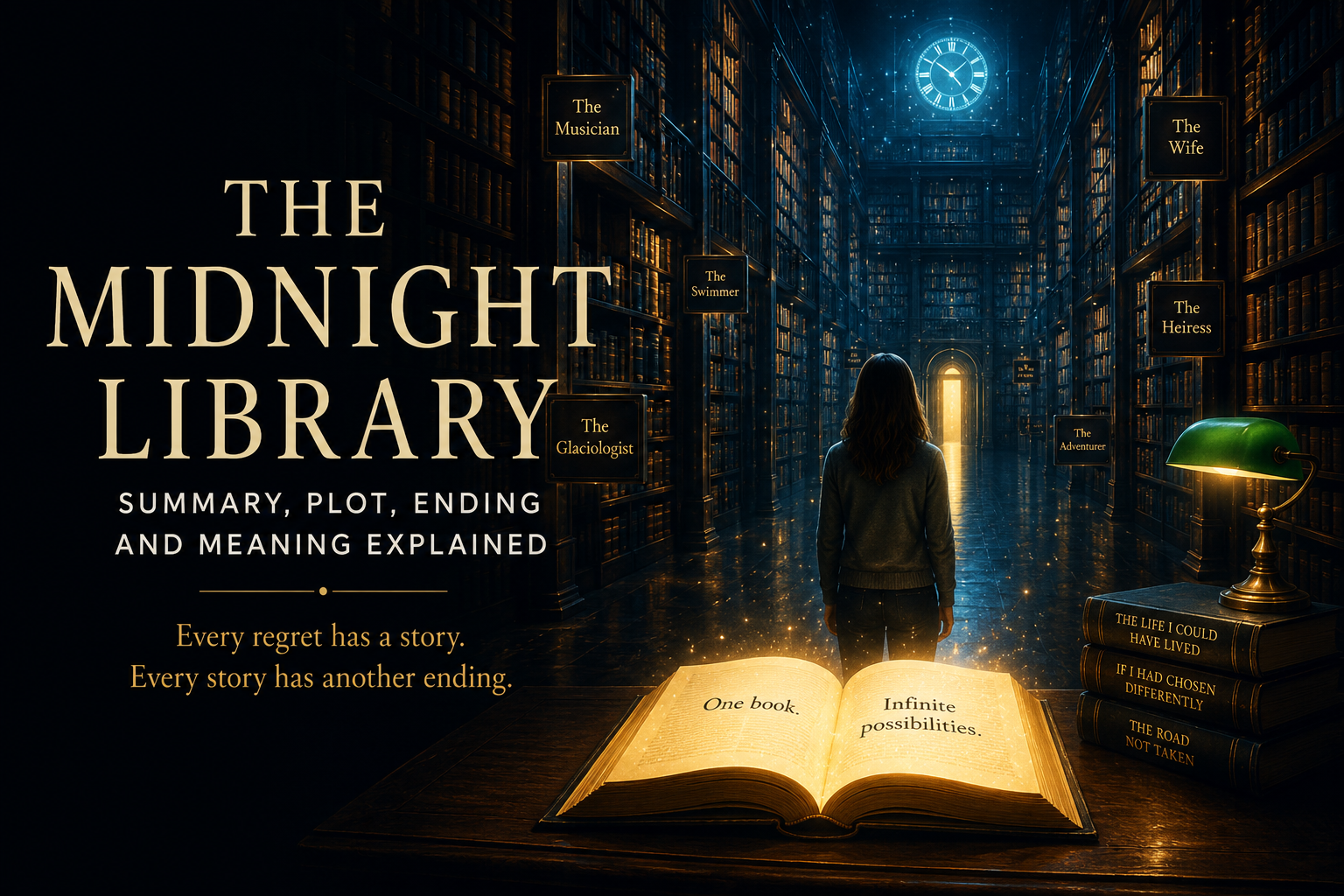
What Happens, Why It Matters, And What Most Readers Miss
Nora Seed’s Choices, Regrets, And Ending Explained
The Midnight Library is a 2020 speculative literary novel by British author Matt Haig, first published in hardcover in Great Britain by Canongate Books. The novel follows Nora Seed, a woman whose despair leads her into a strange library between life and death, where every book offers a different version of the life she might have lived.
The book became a major international success. Canongate describes it as a “worldwide phenomenon” and lists it as the winner of the Goodreads Choice Award for Fiction, while Penguin Random House identifies Matt Haig as the author of The Humans, How to Stop Time, The Midnight Library, and several works of non-fiction, including Reasons to Stay Alive and The Comfort Book.
The Big Idea Of The Book
The central idea of The Midnight Library is simple enough to feel almost like a fable: between life and death, there is a library containing every life a person could have lived. Each book gives Nora Seed a chance to undo a regret and inhabit an alternative version of herself.
The deeper idea is less comforting. Nora does not merely have regrets. She has built an identity out of them. She believes every disappointment proves she made the wrong choice, hurt the wrong person, missed the correct path, wasted her talents, and became a burden to everyone around her.
The library challenges that belief by turning fantasy into evidence. Instead of imagining that another life would have saved her, Nora has to live inside those alternatives. She sees what happens when she marries the man she left, follows her father’s ambitions, keeps her band alive, pursues childhood dreams, moves abroad, chooses success, chooses love, or chooses escape.
Each life answers one regret, but none of them gives her the clean answer she expects. The novel’s force comes from that repeated collapse. Nora is not saved because she finds the perfect life. She is changed because she discovers that the perfect life was the wrong thing to search for.
The Story In One Flow
Nora Seed begins the novel in Bedford, England, living a life that appears to have narrowed into failure. She works in a music shop called String Theory, teaches a little piano, lives alone, and feels cut off from the people who once gave her life shape. Her brother Joe is distant. Her former bandmate Ravi resents her. Her best friend Izzy is far away in Australia. Her ex-fiancé Dan belongs to a future she abandoned.
The novel quickly piles pressure onto her. Nora loses her job at the music shop. Her piano student no longer needs lessons. Her elderly neighbour, Mr Banerjee, says he no longer needs her help with medication. Her cat Voltaire dies. These events are not large in the public sense, but to Nora they feel like final evidence. She believes she is not needed, not loved, not useful, and not connected.
That first movement matters because the book does not present Nora’s despair as one dramatic catastrophe. It shows a mind interpreting ordinary losses as a verdict. Every disappointment becomes part of a case against her own existence. A dead pet becomes proof she failed as a carer. A lost job becomes proof she failed as an adult. A cancelled lesson becomes proof she has no purpose.
Nora’s life is also haunted by people who wanted different versions of her. Her father wanted her to pursue swimming at a serious level. Her brother wanted her to stay in their band, The Labyrinths. Dan wanted her to marry him and run a pub. Izzy wanted her to go to Australia. Nora wanted, at different times, to study philosophy, become a glaciologist, play music, swim, love, escape, and matter.
The pressure becomes unbearable. Nora attempts to end her life, and the novel moves into its central fantasy. She wakes not in death, but in a vast library where the clock is stuck at midnight. The place is neither life nor afterlife. It is an in-between space built out of possibility.
The librarian is Mrs Elm, Nora’s old school librarian. That choice is important. Mrs Elm is not a random guide. She is linked to one of Nora’s formative memories: the day Nora learned that her father had died. Mrs Elm had once been a steady adult presence at a moment when Nora’s real life broke open.
In the library, Mrs Elm explains the rules. Every book on the shelves contains a different life Nora could have lived. The Book of Regrets contains the regrets Nora has carried with her. If Nora chooses a book, she enters that life as if she had always lived it. If she becomes disappointed, she returns to the library.
At first, Nora does not approach the library as an adventure. She is not excited by possibility. She is exhausted by existence. That is one reason the premise works. A weaker version of the story would turn the library into wish fulfilment. Haig turns it into a test of despair.
Nora’s first major alternative life addresses one of her most obvious regrets: Dan. In her root life, she left him shortly before their wedding. She has carried that decision as proof she ruined both their futures. The library lets her enter the life in which she married him and followed his dream of owning a pub.
At first, this life seems to confirm what she had imagined. She and Dan have the pub. The fantasy has become real. Yet the details quickly poison the dream. Dan is not the ideal partner Nora preserved in memory. Their relationship carries resentment, disappointment, and emotional distance. The pub is not a romantic sanctuary. It is work, pressure, and compromise.
The Dan life teaches Nora one of the novel’s earliest lessons: regret edits the past. It deletes the reasons a decision was made and preserves only the fantasy of the road not taken. Nora did not simply abandon paradise. She left a relationship that already contained problems.
The second major correction comes through Voltaire, her cat. Nora regrets letting him out, believing that if she had kept him indoors he might have lived. The library gives her a life in which she made a different choice, but Voltaire still dies. Mrs Elm explains that the cat had an underlying condition. Nora’s guilt collapses because the imagined control was false.
This is one of the book’s sharpest early moves. Nora is not only regretting choices. She is claiming responsibility for outcomes she could not fully control. That is how despair traps her. It does not merely tell her she failed. It tells her she caused everything painful around her.
From there, the library expands. Nora tries life after life, each one built around a different lost possibility. The structure becomes episodic, but the episodes are not random. They gradually dismantle Nora’s assumptions about success, love, ambition, family, and identity.
One alternative life takes her to Australia, where she explores the road she might have followed with Izzy. Nora had imagined that leaving England might have saved her, but the Australia path brings its own pain. In that life, Izzy dies in a car accident. The escape fantasy becomes another grief.
The point is not that Australia is bad, or that leaving home is always wrong. The point is that no geography removes mortality, conflict, or consequence. Nora had treated elsewhere as a moral solution. The library shows her that elsewhere is still life, and life still contains loss.
Another life lets Nora become the swimmer her father wanted her to be. In this version, she becomes an Olympic champion. She has public admiration, achievement, status, and the external shape of success. She stands before people as someone who appears to have mastered discipline and purpose.
Yet the successful life is not simple salvation. Her father’s approval comes at a cost. Her mother’s life unfolds differently. Nora feels the loneliness inside the achievement. She realises that winning the life someone else wanted for her does not automatically create peace inside herself.
This section attacks one of the most common forms of regret: the belief that status would have solved everything. Nora’s swimming life gives her applause, but it does not restore wholeness. The medal does not erase the self that still has to live after the race.
Then comes the glaciologist life, one of the novel’s most important alternative paths. Nora had once dreamed of studying glaciers and the Arctic. In this life, she inhabits that serious scientific version of herself, travelling to Svalbard and working in a remote environment.
The glaciologist life matters because it gives Nora something different from social success. It gives her intellectual purpose, danger, and a confrontation with the physical world. When she faces a polar bear, the threat of death becomes immediate rather than abstract. For the first time, she feels a clear impulse to survive.
That moment shifts the book. Nora had entered the library wanting non-existence. In the Arctic, when death becomes a real external force, she discovers resistance inside herself. She wants to live. Not theoretically. Not because someone persuaded her. Her body and mind reach for survival.
In that same broad movement, Nora also encounters Hugo, another person moving between lives. Hugo expands the novel’s metaphysical frame. Nora is not the only person in this kind of in-between state. Others, too, are travelling through possible lives, testing reality, and trying to understand whether any life can feel final.
Hugo’s presence does two things. First, it prevents Nora’s experience from feeling purely private. The library belongs to a larger mystery. Second, Hugo tempts the reader with the idea that endless possibility might itself become addictive. If you can keep moving, why choose? If every life has faults, why land anywhere?
That question becomes increasingly important as Nora continues. She enters the life in which The Labyrinths, the band she once had with Joe and Ravi, became successful. This is the rock-star life: fame, music, attention, public recognition, and the artistic path she abandoned.
Again, the life looks glamorous from a distance and painful from the inside. Nora discovers scandal, loneliness, pressure, and damage. Most devastatingly, she learns that Joe is dead in this version of reality. The dream of fame has taken her into a world where one of her deepest relationships has been destroyed beyond repair.
The rock-star life is one of the novel’s strongest answers to nostalgia. Nora had carried guilt over leaving the band and damaging her relationship with Joe. The alternative life shows that staying in the band would not necessarily have saved him, saved their bond, or created a clean artistic destiny. Fame is not a repair mechanism. It magnifies pressure.
Across these lives, Nora’s regrets begin to change. Some disappear because she learns they were based on false assumptions. Some become more complicated. Some remain painful, but no longer absolute. She starts to understand that the Book of Regrets is not a book of truth. It is a book of interpretation.
That is the key to the middle of the novel. Nora’s life is not transformed because she discovers that all her regrets were silly. Some choices did hurt people. Some opportunities were lost. Some relationships were damaged. The transformation comes because she stops treating every regret as proof that another life would have been better.
The library gives her a wide range of selves. She becomes successful, married, famous, scientific, ordinary, admired, loved, and geographically displaced. She tries lives with money, meaning, and public recognition. She tries lives closer to what others wanted and lives closer to what younger versions of herself wanted.
The more lives she enters, the less convincing the fantasy of perfection becomes. Each life contains trade-offs Nora could not see from outside. Each version of herself has inherited consequences from earlier decisions. Each world gives something and withholds something. Every gain carries a cost.
This is where The Midnight Library becomes more than a sentimental second-chance story. Its central mechanism does not prove that every life is equally good. It proves that comparison is often dishonest. A person compares the worst-known facts of the life they have with the best-imagined features of the life they rejected.
Nora’s despair depends on that unfair comparison. She knows every pain of her real life, but she only imagines the highlights of the alternatives. The library corrects the imbalance by giving the alternatives full texture. They have arguments, deaths, lies, illnesses, loneliness, awkwardness, boredom, guilt, and unresolved history.
Eventually, Nora finds a life that appears far closer to genuine happiness. In this life, she is married to Ash, a kind man she only lightly knew in her root life. She has a daughter named Molly. She has meaningful work, domestic warmth, and a sense of emotional belonging.
This life is different from the others because it does not immediately collapse under its own contradiction. It is not a false achievement fantasy or a poisoned romantic dream. Nora feels love there. She experiences the ordinary intimacy of family. She looks at Molly and feels the terrible pull of a life she wants to keep.
For a while, this seems like the answer. Nora has found the life that contains love without obvious ruin. The reader feels the same temptation she does. If the library exists to help her choose a better life, surely this is the one.
Yet this life contains a deeper problem. Nora has not lived it. She loves Molly, but she did not become Molly’s mother through the years of care, sacrifice, memory, and responsibility that motherhood would have required in that reality. She has entered a finished intimacy without earning its history.
That does not make her feelings fake. It makes her position unstable. She cannot fully inhabit a life built by another version of herself. She can feel the beauty of it, but she is also a visitor inside it. She has arrived at love without the continuity that gives love its roots.
The Ash and Molly life forces Nora to confront the final weakness of the library itself. The library can show her lives. It can correct false regrets. It can open doors. It cannot give her an identity without time. It cannot remove the need to live forward.
As Nora begins to understand this, her connection to the Midnight Library changes. The library starts to break down. Books burn. The clock moves. Mrs Elm tells her that something is happening in her root life. Nora may be dying.
The collapse of the library is also the collapse of indecision. Nora can no longer treat possibility as a safe space. She must choose. Not between a perfect life and an imperfect life, but between life and death, between endless comparison and one unfinished reality.
In the decisive moment, Nora returns to the book of her root life. She writes that she is alive. The act is simple, but it is not a slogan. It is a declaration against the logic that brought her to the library. She no longer wants to be erased. She wants to return.
Nora wakes in her original life on the brink of death and seeks help. She survives. The return does not magically fix everything. She is still Nora Seed. Bedford is still Bedford. Her losses have not been reversed. Her job has not become glamorous. The world has not rearranged itself into proof that she matters.
But her interpretation has changed. She reaches out. She reconnects with Joe. She hears from Izzy. She recognises that Mr Banerjee valued her more than she understood. She sees that even small acts had consequences. She visits Mrs Elm in the real world, where the older woman is in care, and they play chess.
The chess image matters because it returns the book to one of its most grounded metaphors. A life is not understood by staring at one move in isolation. A bad move does not necessarily lose the game. A strong position can still deteriorate. A weak position can still be played. The only way to know is to continue.
The Main Characters Inside The Story
Nora Seed is the centre of the novel because every world is a variation of her choices. She is intelligent, musically gifted, philosophically minded, emotionally wounded, and paralysed by comparison. Her deepest problem is not lack of talent. It is lack of permission to live imperfectly.
Nora wants relief from pain, but she also wants proof that her life can matter. At the start, she believes those two desires are incompatible. If life hurts, she thinks it must be evidence against life. The library teaches her that pain is not proof of failure. It is part of any life deep enough to contain attachment.
Mrs Elm is the guide, but she is more than a fantasy librarian. She represents memory, patience, and the part of Nora’s life where books once gave her safety. In the library, Mrs Elm can explain rules, but she cannot choose for Nora. Her power is guidance, not rescue.
Joe Seed, Nora’s brother, carries the pain of a relationship damaged by abandonment, misunderstanding, and pride. In Nora’s root life, he is distant partly because The Labyrinths collapsed and partly because neither sibling knows how to repair the emotional gap. In the alternate lives, especially the rock-star path, Joe becomes a measure of what ambition and fame cannot protect.
Dan Lord represents the romantic life Nora nearly chose. He is not simply villainous, and the book is better for that. He is the man attached to one version of Nora’s regret. When she enters the pub life, she sees that marrying him would not have erased incompatibility. It would have forced both of them to live inside it.
Izzy represents escape, friendship, and the fantasy of a new life elsewhere. Nora’s regret about Australia is not only about geography. It is about loyalty and courage. The alternative path shows that escape can be meaningful, but it cannot guarantee safety or happiness.
Ash represents the quiet possibility Nora overlooked in her root life. His importance grows because he is not linked to one of her loudest regrets. He belongs to a subtler path, one she barely noticed. Through him and Molly, Nora experiences a form of ordinary love that feels more convincing than status or fame.
Molly is the most emotionally dangerous figure in the book because she makes the good life feel real. She is not an idea, trophy, or achievement. She is a child Nora can love. That love makes the return to the root life painful, because Nora has to give up not a fantasy of success but a felt relationship.
Ravi, the former bandmate, carries resentment from the failed music path. His role is smaller than Joe’s, but he helps show the social cost of Nora’s earlier choices. To Nora, quitting the band was one regret among many. To the people around her, it was part of their lives too.
Mr Banerjee looks minor at first, but he becomes one of the book’s quietest moral anchors. Nora thinks her help with him is insignificant until she sees how small acts can matter. The novel uses him to argue that usefulness is often hidden from the person being useful.
The Moment Everything Changes
The decisive turn is not the first time Nora enters the library. It is the moment in the glaciologist life when she faces danger and realises she wants to live.
Until then, Nora has been moving through alternatives mainly to test regret. She is asking whether another life would have been better. The polar bear encounter changes the question. Suddenly the issue is not whether life can be optimised, but whether she wants existence itself.
That moment matters because the desire to live arrives before the perfect life appears. Nora does not need Ash, Molly, success, fame, or total forgiveness to discover that she wants to survive. The will to live comes in a cold, frightening place, inside a life that is not her final answer.
The book’s emotional logic depends on that sequence. If Nora wanted to live only after finding the best life, the novel would become a fantasy about selecting happiness. Instead, she wants to live before she knows where she belongs. Survival comes first. Meaning is rebuilt afterwards.
The Ending Explained
The ending of The Midnight Library is deliberately modest. Nora does not stay in the life with Ash and Molly. She does not become an Olympic swimmer, a rock star, a glaciologist, a pub owner, or an Australian version of herself. She returns to the life she wanted to leave.
That return is the meaning of the ending. The book refuses the fantasy that salvation is a different timeline. Nora’s root life was not secretly perfect, but it was still alive. It still contained people, choices, repairs, conversations, and possible futures.
The library burns because Nora’s suspended state cannot continue. Infinite options become useless once she understands that living requires limitation. To be alive is to be in one life, not all of them. Choosing one path means accepting the grief of every path not taken.
When Nora writes that she is alive, she claims the life she had rejected. She does not claim it because it is easy. She claims it because she finally sees that a life’s value cannot be measured only by its current pain, failed ambitions, or imagined alternatives.
Her hospital recovery grounds the ending in reality. She has survived a crisis, but she must still rebuild. The book does not pretend that regret disappears. It shows a woman whose relationship to regret has changed. Regret is no longer a court judgment. It is information, memory, and sometimes illusion.
The final chess scene with Mrs Elm reinforces that meaning. Life is not a solved equation. It is a game in progress, full of positions that can change. Nora’s mistake was believing she already knew the final result.
What The Book Is Really About
The Midnight Library is really about the cruelty of imaginary evidence. Nora does not suffer only because her life is difficult. She suffers because she treats imagined lives as proof that her real life is worthless.
The novel understands regret as a form of distorted storytelling. A person takes one decision, cuts away the unknown consequences, polishes the fantasy, and uses it to punish the life they actually have. Nora does this with Dan, swimming, music, Australia, science, family, friendship, and work.
The book is also about the difference between possibility and reality. Possibility feels clean because it has not been lived. Reality feels messy because it contains detail. The library’s gift is not that it gives Nora infinite possibilities. Its gift is that it makes possibility dirty with consequence.
Most importantly, the novel argues that meaning is not found by eliminating pain. Meaning is found by participating in a life where pain, love, effort, error, care, and uncertainty coexist. Nora cannot choose a life without suffering. She can choose to keep playing.
What Most Summaries Miss
Most summaries focus on the premise: Nora enters a library and tries other lives. That is accurate, but incomplete. The real engine of the book is not choice. It is interpretation.
Nora’s problem is not that she made the wrong choices. Some of her choices were wise, some were flawed, and many were unknowable. Her deeper problem is that she interprets every painful outcome as proof of personal failure.
Another detail often missed is that the library does not simply comfort Nora. It defeats her fantasies. The pub life exposes romantic nostalgia. The swimming life exposes status. The rock-star life exposes fame. The Australia life exposes escape. The Ash and Molly life exposes the impossibility of stealing a completed life without its history.
The book also gives real weight to small usefulness. Mr Banerjee, the piano student, the cat, the music shop, the neighbourly errands, and the minor connections of Nora’s root life are not decorative details. They are evidence that a person’s impact is often invisible to them.
What Most People Misunderstand
A shallow reading says The Midnight Library is about choosing the life that makes you happiest. That misses the point. Nora does not win by finding the best alternative life. She wins by rejecting the fantasy that a best alternative can rescue her from being human.
Another misreading treats the book as pure optimism. It is more disciplined than that. The novel does not say everything happens for a reason. It says people often invent reasons to hate themselves, then mistake those reasons for truth.
The book is not anti-ambition either. It does not say swimming, science, fame, travel, love, or family are empty. It says no achievement can carry the full burden of making existence painless. When Nora asks one life to solve everything, every life fails.
The Strongest Scene, Chapter, Or Idea
The strongest idea is the Book of Regrets. It gives Nora’s mental state a physical form without reducing it to a lecture. Regret becomes something she can read, challenge, and watch change.
That image works because regret often feels permanent. People carry old decisions as if they were fixed facts. The Book of Regrets shows that many regrets depend on missing information. When Nora learns that Voltaire would have died anyway, the regret changes because the story behind it changes.
The book’s best insight sits there. We do not only regret events. We regret interpretations of events. Change the interpretation and the emotional weight can alter, even when the past remains untouched.
The Taylor Tailored Interpretation
The Midnight Library is not a book about second chances. It is a book about the danger of auditing a life before it is finished.
Nora treats her life like a failed account. Losses are counted. Missed paths are counted. Disappointed people are counted. What she cannot count are the unknown harms avoided, the small good she has done, the future moves still available, and the hidden costs of the lives she envies.
The library corrects the audit. It shows that every life has liabilities. Marriage has liabilities. Fame has liabilities. Achievement has liabilities. Escape has liabilities. Even the beautiful family life has the liability of not truly being hers.
The final lesson is not “be grateful for what you have.” That is too small. The sharper lesson is this: never compare a fully known life with an imaginary one. The imaginary one has not paid its bills yet.
Why This Book Matters
The Midnight Library remains relevant because modern life has made comparison almost constant. People do not only compare themselves with neighbours, siblings, colleagues, ex-partners, or friends. They compare themselves with imagined selves that could have existed if they had moved sooner, stayed longer, chosen differently, studied harder, left earlier, married someone else, taken the risk, avoided the risk, or become someone more impressive.
The novel gives that private habit a story. Nora’s library is an extreme version of the mental library many people carry every day. Every shelf contains a life not lived. Every book can become a weapon.
Its usefulness lies in how it handles regret without denying consequence. Some choices do matter. Some doors do close. Some relationships are harmed. Yet a life cannot be judged fairly from inside one bad chapter.
The book also matters because it treats ordinary life as worthy of defence. Not glamorous life. Not optimised life. Not the life that photographs well. A life with neighbours, phone calls, apologies, imperfect work, music lessons, chess, and another morning.
If You Only Remember Three Ideas
Regret Is Often Bad Evidence
Nora’s regrets feel factual, but many are built on incomplete knowledge. The book shows that a painful outcome does not automatically prove a wrong choice. Sometimes the imagined alternative would have hurt too.
No Life Escapes Consequence
Every alternative life gives Nora something and takes something away. Fame costs privacy and safety. Success costs intimacy. Escape carries risk. Love requires history. A life without trade-offs is not a life; it is a fantasy.
The Life You Have Is Not Finished
Nora’s root life looks over because she views it from inside despair. The ending reframes that life as unfinished rather than failed. The next move still matters.
The Sentence That Explains The Book
The Midnight Library is about a woman who searches infinite lives for proof that she chose wrongly, then discovers that no life can be judged until it has been lived from the inside.
The Real-Life Test
The practical test of The Midnight Library is simple: notice when you are comparing your real life with an edited fantasy.
If you think you should have taken another job, ask what pressures that job would have brought. If you regret a relationship ending, remember the reasons it became unliveable. If you envy a successful version of yourself, price in the loneliness, discipline, luck, compromise, and hidden costs that version would have faced.
The book’s lesson is not to stop making changes. Nora’s return to life does not mean passivity. It means change should come from evidence, not self-punishment. Improve the life you are in before declaring it worthless.
That applies to work, relationships, ambition, health, status, and family. Do not use regret as a personality. Do not mistake exhaustion for truth. Do not demand that one achievement, one partner, one move, or one public success make life permanently painless.
Five Questions To Test Whether You Understood The Book
Why does Nora believe her life has failed before she enters the Midnight Library?
Which alternative life most clearly exposes the difference between fantasy and consequence?
Why can Nora not simply stay in the life with Ash and Molly?
What does the Book of Regrets reveal about the way Nora has been interpreting her past?
Why does the ending matter more because Nora returns to her original life rather than escaping it?
The Final Lesson
The Midnight Library ends where it began, but Nora is no longer reading the same life. Before the library, she saw her existence as a closed case. After it, she sees it as a position still in play.
That is the book’s strongest lesson. A life can be painful, narrowed, embarrassing, disappointing, and still not be over. Regret may tell you that another version of you would have lived better. The harder truth is that no version of you is free from consequence, and the only life you can still move is this one.
