The Most Disturbing Books Ever Written: What Lolita, Blood Meridian And The Trial Reveal About Human Nature
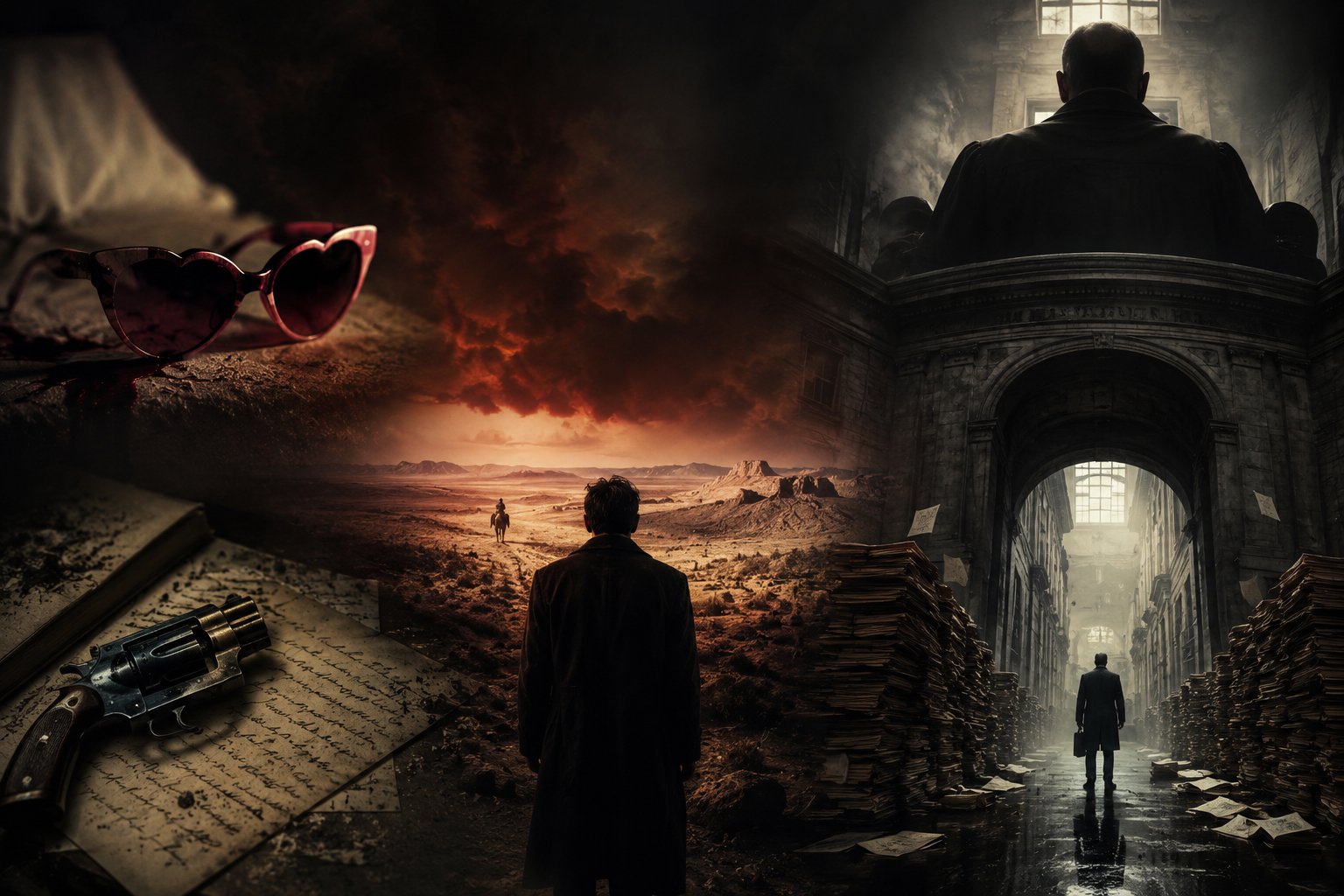
The Most Disturbing Books Ever Written Are Not About Evil — They Are About The Lies Humans Tell Themselves
Three Books That Drag Human Nature Into The Light
Some books disturb because of what happens in them. Others disturb because they make the reader realise that what happens in them is not as alien as it should be.
Lolita, Blood Meridian and The Trial do not belong together because they are similar stories. They belong together because each one strips away a different layer of civilisation. One exposes the violence hidden inside desire. One exposes the violence hidden inside history. One exposes the violence hidden inside institutions.
Read together, they form a brutal map of human nature. Nabokov shows how language can beautify abuse. McCarthy shows how violence can become a worldview. Kafka shows how power can destroy a person without ever explaining itself.
These are not comforting books. They are not easy books. They are not books that allow the reader to remain morally lazy.
They ask one unbearable question from three different directions.
What happens when a human being, a group, or a system no longer needs to justify what it does?
Books Covered
Lolita by Vladimir Nabokov
Blood Meridian by Cormac McCarthy
The Trial by Franz Kafka
Lolita was published in 1955 and is framed as the posthumous memoir of Humbert Humbert, a predatory narrator whose language attempts to seduce the reader while concealing the abuse of Dolores Haze.
Blood Meridian was published in 1985 and follows a teenage runaway known as “the kid” through the violent world of the Glanton gang on the U.S.–Mexico borderlands.
The Trial was published posthumously in 1925 and follows Josef K., a man arrested by an opaque legal authority without being told the nature of his crime.
This article follows the supplied Taylor Tailored multi-book synthesis structure, including plot reconstruction, character arcs, ending explanations, cross-book comparison and Spotify-first long-form analysis.
The Big Idea Connecting These Books
The hidden link between these novels is not simply evil. It is justification.
In Lolita, Humbert Humbert uses beauty, wit and literary intelligence to turn exploitation into a performance of tragic romance. In Blood Meridian, Judge Holden turns violence into philosophy, treating war as the deepest law of existence. In The Trial, the legal system does not bother to justify itself at all; its power is so complete that explanation becomes unnecessary.
That is the progression.
First, evil explains itself beautifully. Then evil explains itself grandly. Finally, evil stops explaining itself.
That is why these books remain so disturbing. They do not merely show bad people doing bad things. They show how language, ideology and systems can make harm feel inevitable, refined or untouchable.
The deepest human truth underneath them is this: people rarely experience themselves as villains. They build stories around their appetites, violence and cowardice. They make excuses. They invent philosophies. They hide inside institutions. They turn victims into obstacles, abstractions or evidence.
These books force the reader to look at the machinery behind that transformation.
Lolita Summary
Lolita is one of the most morally dangerous novels ever written because its horror arrives through beauty.
The story is narrated by Humbert Humbert, a cultivated, self-conscious, highly literary European intellectual who presents his life as a confession. He tells the reader about his early romantic fixation on a childhood love, Annabel, and implies that this lost adolescent experience shaped his later obsession with young girls.
This is part of the trap. Humbert does not simply confess. He frames. He arranges. He pleads. He performs.
When he arrives in America, he rents a room from Charlotte Haze, a lonely widow who lives with her daughter, Dolores. Humbert gives Dolores the nickname “Lolita” and turns her into an object of obsession. The novel’s central horror is that the reader receives events almost entirely through Humbert’s language, while the actual child at the centre of the book is repeatedly buried beneath his fantasies.
Charlotte falls in love with Humbert and marries him. Humbert does not marry her out of love. He marries her because it gives him access to Dolores. When Charlotte discovers his true feelings through his diary, she is horrified. She runs into the street and is killed by a car.
That death removes the last adult barrier between Humbert and Dolores.
Humbert then collects Dolores from summer camp and begins the long, grim road journey that defines the middle of the novel. He controls her movement, money, social contact and emotional reality. He presents their travels with irony, cleverness and observational brilliance, but underneath the prose is a story of captivity.
The most disturbing part of Lolita is not only what Humbert does. It is how persistently he tries to make the reader admire the way he describes it.
Eventually Dolores escapes with Clare Quilty, another predatory figure who shadows the story. Years later, Humbert finds Dolores again. She is older, pregnant, poor and no longer available to his fantasy. This meeting is devastating because the false image collapses. Dolores is not the myth Humbert created. She is a damaged human being who survived him.
Humbert kills Quilty, is arrested and writes his account before dying in prison.
The ending matters because Humbert finally appears to recognise some part of Dolores’s humanity, but the recognition comes too late. The damage has already been done. His late remorse does not redeem him. It exposes the full scale of what he stole.
The Plot In One Flow
Humbert begins by presenting himself as a man shaped by lost youth and impossible longing. He arrives in America, enters the Haze household, becomes obsessed with Dolores, manipulates Charlotte, and uses marriage as a means of access.
After Charlotte dies, Humbert takes Dolores on the road, turning America into a landscape of motels, evasions and control. His narration decorates the abuse with jokes, literary games and verbal brilliance, but the emotional reality underneath is a child being trapped by an adult who controls every exit.
Dolores eventually escapes. Humbert spends years haunted by possession, jealousy and loss. When he finds her again, he discovers not the fantasy “Lolita” but Dolores Haze: older, tired, poor, pregnant and separate from him.
His final act of violence against Quilty does not solve anything. It merely confirms the world of exploitation he helped create. Humbert’s confession becomes both evidence and self-defence, a document that reveals him most clearly when he thinks he is explaining himself.
If You Only Remember Three Ideas
The first idea is that language can be used as camouflage. Humbert’s intelligence does not make him safer. It makes him more dangerous, because he can turn horror into style.
The second idea is that the victim can be erased even while being constantly described. Dolores is everywhere in the book, yet Humbert’s fantasy keeps replacing her with an invented figure.
The third idea is that late regret is not the same as moral repair. Humbert’s final understanding may be emotionally powerful, but it cannot undo the life he damaged.
The Sentence That Explains The Entire Book
Lolita is the story of a man who uses beauty to hide the fact that he is destroying a child.
Why This Book Still Matters
Lolita matters because modern culture still struggles with the difference between charisma and truth.
The book is not merely about one predator. It is about how audiences can be manipulated by eloquence, irony, charm and aesthetic brilliance. It asks whether readers can detect evil when evil speaks beautifully.
That question has become more important, not less. Public life is full of people who narrate their own wrongdoing in seductive language. Lolita remains a warning about the glamour of self-justification.
Where The Book Is Weakest
The danger of Lolita is also its weakness. Because Humbert’s voice is so powerful, some readers may become more fascinated by him than horrified by what he does.
The book depends on the reader’s moral alertness. A shallow reading can mistake Humbert’s performance for truth. That does not make the novel weak as art, but it does make it vulnerable to misuse.
Who Should Ignore This Book
Readers who do not want to engage with child abuse as a central subject should avoid it. So should anyone looking for a simple moral lesson, a conventional thriller, or an emotionally safe classic.
This is not a book to consume casually. It requires a reader willing to distrust the narrator from the first page to the last.
How This Compares To Blood Meridian
Lolita is intimate evil. Blood Meridian is historical evil.
Nabokov traps the reader inside one man’s manipulative consciousness. McCarthy throws the reader into a world where violence has become environmental, almost atmospheric. Humbert hides cruelty behind romance and language. Judge Holden announces cruelty as a cosmic principle.
The emotional experience is different too. Lolita feels claustrophobic because the reader is trapped in Humbert’s narration. Blood Meridian feels apocalyptic because the whole landscape seems infected by violence.
One asks how a person corrupts reality through language. The other asks whether reality itself has always been more violent than civilisation admits.
Blood Meridian Summary
Blood Meridian is not a western in the comforting sense. It is an anti-western: a book that drags the mythology of the frontier into the dirt, blood and sun.
The central figure is the kid, a teenage runaway from Tennessee. He is not presented as innocent in any simple way. He is violent, rootless and already marked by brutality. But compared with the world he enters, he still contains traces of human ambiguity.
The kid drifts into the borderlands and eventually becomes connected with the Glanton gang, a group of scalp hunters operating in the violent chaos of the U.S.–Mexico frontier. Their supposed purpose is to kill Native Americans for bounty. In practice, their violence expands beyond any political or military logic. They kill, raid, exploit and destroy.
The gang moves through a landscape that feels both historical and mythic. Desert, blood, horses, dust, fire and massacre merge into a vision of civilisation as a thin story told over a much older reality of force.
At the centre of the novel stands Judge Holden, one of the most terrifying figures in modern literature. He is huge, hairless, learned, eloquent, playful and monstrous. He sketches, lectures, dances, manipulates and kills. He appears to know everything and fear nothing.
The judge is not merely violent. He is philosophical about violence. He argues that war is the ultimate truth, that existence is domination, and that anything outside human control must be brought under it or destroyed.
The kid survives much of the gang’s collapse, but survival is not redemption. As the Glanton gang degenerates, the book becomes less a plot of adventure than a descent into metaphysical horror. The question is not whether the kid will escape danger. The question is whether any human being can escape the judge’s worldview.
The ending is famously disturbing. Years later, the kid, now referred to as the man, encounters the judge again. The judge has not aged. He appears in a saloon, still dancing, still declaring that he will never die. The man later enters an outhouse, where something horrific and deliberately obscured occurs.
The ending matters because McCarthy refuses the reader the comfort of clean moral closure. The judge remains. Violence remains. The dance continues.
The Plot In One Flow
The kid leaves home and enters a brutal frontier world where violence is ordinary. He joins military and paramilitary chaos, drifts through conflict, and eventually becomes part of the Glanton gang.
At first, the gang’s violence appears to have a political or economic purpose. They are scalp hunters, paid for killing. But as the novel progresses, that purpose dissolves. Killing becomes habit, appetite and ritual.
Judge Holden rises above the gang as its intellectual demon. He records the world, interprets it, dominates conversations and turns bloodshed into doctrine. He does not simply participate in violence; he gives it a theology.
The gang eventually collapses under the weight of its own brutality. The kid survives, but the judge continues to pursue him spiritually and physically. Years later, their final meeting suggests that the kid’s refusal to become fully absorbed into the judge’s vision may not be enough to save him.
The final image of the judge dancing is one of literature’s bleakest statements: evil does not always need victory in the ordinary sense. Sometimes it only needs endurance.
If You Only Remember Three Ideas
The first idea is that civilisation often sanitises violence after the fact. Blood Meridian tears away the heroic frontier myth and reveals conquest as terror, profit and domination.
The second idea is that evil becomes more dangerous when it becomes philosophical. Judge Holden does not lose control. He explains control as the meaning of life.
The third idea is that survival is not the same as escape. The kid lives through much of the horror, but the judge’s world remains waiting for him.
The Sentence That Explains The Entire Book
Blood Meridian is the story of a violent world trying to prove that mercy is an illusion.
Why This Book Still Matters
Blood Meridian matters because modern societies still prefer clean myths about dirty origins.
Nations, institutions and families often tell stories that make violence seem necessary, noble or distant. McCarthy refuses distance. He presents violence as intimate, physical and foundational.
The book also matters because Judge Holden feels terrifyingly modern. He is the intellectual who can explain away anything. He is the charismatic theorist of domination. He is what happens when intelligence detaches itself from conscience.
Where The Book Is Weakest
Blood Meridian can feel so relentless that some readers experience numbness rather than insight. Its violence is not incidental, but the sheer accumulation can overwhelm emotional distinction.
The novel also offers little conventional interiority. Characters often feel mythic rather than psychologically accessible. That is part of its power, but it can make the book difficult for readers who need emotional closeness.
Who Should Ignore This Book
Readers who want a redemptive western, a sympathetic hero, clear moral victory or gentle pacing should avoid it.
So should anyone who finds extreme violence unreadable. Blood Meridian is not shocking for decoration. It is built from brutality at the sentence level, the scene level and the philosophical level.
How This Compares To The Trial
Blood Meridian shows power in its most physical form. The Trial shows power in its most abstract form.
In McCarthy, power rides on horses, fires guns, takes scalps and leaves bodies in the desert. In Kafka, power appears through offices, documents, procedures, messengers, hearings and locked rooms.
Judge Holden explains the world too much. Kafka’s court explains almost nothing.
That difference is crucial. Blood Meridian terrifies because violence has a philosophy. The Trial terrifies because authority does not need one.
The Trial Summary
The Trial begins with one of the most quietly horrifying situations in literature: Josef K. wakes up and is arrested without being told what crime he has committed.
He is not taken away in the ordinary sense. He is allowed to continue parts of his life. He still goes to work. He still moves through the city. But his life has been invaded by a legal process that no one can clearly explain.
This is Kafka’s genius. The nightmare is not dramatic at first. It is administrative.
Josef K. tries to respond rationally. He assumes there must be a mistake, a procedure, a person in charge, a way to clarify the accusation. But every attempt to understand the court only pulls him deeper into confusion.
He attends a strange hearing in a crowded building. He encounters officials, assistants, lawyers, women connected to the court, and people who speak as though the system is both absurd and unquestionable. The court seems everywhere and nowhere. It is powerful but evasive. It humiliates people without revealing its rules.
Josef K. hires a lawyer, but legal representation becomes another form of paralysis. The lawyer speaks in delays, influence and obscure strategy rather than resolution. Other figures tell Josef about different forms of acquittal, but none offer true freedom. The system can postpone, suspend or absorb. It does not release.
The emotional arc of the novel is a movement from outrage to exhaustion. Josef begins by resisting the absurdity of the accusation. Over time, the accusation becomes the organising fact of his life. Even without knowing the charge, he becomes psychologically colonised by the trial.
The famous parable “Before the Law” becomes the novel’s central key. A man waits his whole life before a gate of the law, hoping for admission, only to learn at the end that the gate was meant for him alone and is now being closed. The meaning is devastating: people can spend their lives waiting for permission from systems that never intended to explain themselves.
At the end, Josef K. is taken by two men to a quarry and executed. He dies “like a dog,” ashamed, confused and stripped of dignity.
The ending matters because Josef never receives the clarity he seeks. There is no revelation. No crime. No final argument. No satisfying exposure of corruption. The system wins by remaining opaque.
The Plot In One Flow
Josef K. wakes into accusation. He is arrested but not imprisoned, accused but not informed, threatened but not properly confronted.
He tries to treat the situation as an error. He attends hearings, challenges officials, seeks legal help and searches for someone who can translate the system into ordinary human logic. But the harder he tries, the more the court expands around him.
The legal process enters his work, relationships, imagination and sense of self. He is not physically locked in a cell, but his life becomes organised around invisible judgment.
Eventually, the possibility of defence collapses. Josef is taken away and killed without ever learning the accusation. The trial ends not with truth, but with disposal.
If You Only Remember Three Ideas
The first idea is that power becomes terrifying when it is unreadable. A visible tyrant can be opposed. An invisible process is harder to fight.
The second idea is that accusation changes a person even before guilt is proven. Josef K. begins as a man defending himself and becomes a man shaped by the fact of being judged.
The third idea is that bureaucracy can destroy dignity without appearing emotional, cruel or even personally hostile. Its coldness is the cruelty.
The Sentence That Explains The Entire Book
The Trial is the story of a man destroyed by a system that never has to tell him why.
Why This Book Still Matters
The Trial remains brutally modern because contemporary life is full of systems that affect people without making themselves understandable.
Algorithms, institutions, HR processes, courts, platforms, banks, regulators and bureaucracies can all produce Kafka-like experiences when people face decisions they cannot see, challenge or decode.
The novel’s horror is not that the system is chaotic. It is that the system’s chaos has authority.
Where The Book Is Weakest
The Trial is unfinished, and that incompleteness can feel frustrating. Some episodes feel circular because Josef’s condition does not develop in a conventional plot-driven way.
But that weakness is also part of the effect. The book feels unresolved because the world it depicts is unresolved. Kafka does not offer the reader the structure Josef himself is denied.
Who Should Ignore This Book
Readers who need plot closure, psychological realism or clear explanations may struggle with The Trial.
It is not a conventional legal thriller. It is a nightmare of process, guilt and institutional fog. Its power lies in atmosphere and implication rather than resolution.
The Common Themes Running Through All These Books
The first shared theme is the abuse of power.
Humbert has personal power over Dolores. The Glanton gang has physical power over the vulnerable. Kafka’s court has institutional power over Josef K. Each book asks what happens when power stops recognising limits.
The second theme is distorted language.
Humbert uses language to beautify exploitation. Judge Holden uses language to elevate domination into metaphysics. Kafka’s officials use language to obscure reality rather than reveal it.
The third theme is the disappearance of the victim.
Dolores is buried beneath Humbert’s fantasy. The murdered and conquered in Blood Meridian are swallowed by history’s violence. Josef K. becomes less a person than a case.
The fourth theme is the failure of moral rescue.
No clean saviour arrives. No institution restores order. No final truth repairs the damage. These books deny the comforting idea that reality naturally bends toward justice.
The Hidden Pattern Across All These Books
The hidden pattern is that each novel shows a different stage in the death of conscience.
In Lolita, conscience is negotiated away. Humbert knows enough to disguise himself. He still needs rhetoric because some moral boundary remains.
In Blood Meridian, conscience is attacked directly. Judge Holden does not apologise for violence. He declares it sacred.
In The Trial, conscience becomes irrelevant. The system does not need to argue. It simply proceeds.
That is the terrifying sequence: seduction, doctrine, machinery.
First, evil charms. Then it explains. Then it administers.
This is why the three books feel larger than their plots. They show how human beings move from private wrongdoing to collective violence to impersonal systems of destruction.
Where The Books Quietly Disagree
Lolita suggests that evil hides behind individual self-deception. It is intimate, psychological and manipulative.
Blood Meridian suggests that evil may be woven into history, conquest and the human appetite for domination. It is not hidden in one mind; it rides through civilisation itself.
The Trial suggests that evil may not even require passion. It can become procedural, faceless and automatic.
They also disagree about language. Nabokov treats language as a weapon of seduction. McCarthy treats language as prophecy and judgment. Kafka treats language as a locked door.
The result is a powerful contradiction. Is the worst human evil emotional, violent or bureaucratic?
The answer these books collectively offer is darker: it can be all three.
What Most People Misunderstand About These Books
Many people misunderstand Lolita as a story about forbidden desire. That is the shallowest possible reading. The deeper reading is about coercion, narrative control and the theft of another person’s reality.
Many people misunderstand Blood Meridian as merely “the violent western.” But the violence is not the point by itself. The point is the philosophical and historical machinery that makes violence feel eternal.
Many people misunderstand The Trial as simply a story about bureaucracy being annoying. It is far worse than that. It is about the terror of being judged by a power that never becomes accountable to the person it judges.
The surface readings reduce these books to controversy, brutality and absurdity.
The deeper readings reveal manipulation, domination and institutional helplessness.
What The Internet Gets Wrong About These Books
The internet often turns difficult books into aesthetic badges.
Lolita becomes reduced to controversy, style or misunderstood romance. Blood Meridian becomes a test of literary toughness. The Trial becomes a meme for paperwork and modern admin.
All three reductions are failures.
Book-summary culture can also flatten them into “themes.” But these books are not powerful because they contain themes. They are powerful because they create experiences. The reader does not merely learn that manipulation is bad, violence is ancient or bureaucracy is dehumanising. The reader is made to feel those truths from the inside.
That is why shortcuts struggle with these novels. Their meaning depends on discomfort.
The Three Masks Of Human Cruelty
These books reveal a framework for recognising cruelty before it becomes obvious.
The first mask is beauty.
This is cruelty that speaks well. It flatters, jokes, intellectualises and charms. It asks to be admired before it asks to be judged. Humbert is the model here: the abuser as stylist.
The second mask is philosophy.
This is cruelty that turns itself into a worldview. It says domination is natural, war is eternal, mercy is weakness, and conscience is childish. Judge Holden is the model: the monster as theorist.
The third mask is procedure.
This is cruelty with no face. It hides behind forms, processes, delays, committees and rules no one can explain. Kafka’s court is the model: the machine as executioner.
The practical warning is simple.
When harm arrives beautifully, grandly or administratively, do not be distracted by the form. Look at the consequence.
Who loses freedom? Who loses dignity? Who loses their voice? Who benefits from confusion? Who is being asked to accept the unacceptable?
That is the real test.
The Real-Life Test
In careers, the Lolita pattern appears when charismatic people use language to reframe selfishness as vision, urgency or emotional complexity.
The Blood Meridian pattern appears when aggressive cultures worship dominance and call it excellence. People are praised for winning, even when the method corrodes everyone around them.
The Trial pattern appears when organisations create processes so unclear that accountability disappears. The individual is trapped not by one villain, but by a system of evasions.
In relationships, the same framework applies. Beware the person who narrates harm beautifully, justifies cruelty philosophically, or hides behind process instead of answering directly.
In leadership, the lesson is sharper. A healthy system makes power explainable. An unhealthy system makes people beg for clarity.
How To Apply These Lessons Without Turning Them Into Another Self-Help Fantasy
Do not turn these books into vague advice about “seeing darkness” or “understanding evil.”
Use them more practically.
Watch how people explain harm. Watch who gets erased from the story. Watch whether language clarifies reality or decorates it. Watch whether power accepts limits. Watch whether systems can answer simple questions.
The lesson is not to become paranoid. The lesson is to become harder to manipulate.
A serious reader should come away with one behavioural shift: stop judging people and institutions by their explanations alone. Judge them by the pattern of consequences they create.
Which Book Should You Read First?
Start with The Trial if you want the most immediately recognisable modern nightmare. It is the cleanest entry point for readers interested in bureaucracy, power and helplessness.
Start with Lolita if you want the deepest study of unreliable narration, manipulation and moral seduction. It is the most psychologically dangerous of the three.
Start with Blood Meridian if you want the most overwhelming literary experience. It is the hardest, bleakest and most mythic.
Read all three together if you want the full descent: private corruption, historical violence, institutional annihilation.
Five Questions To Test Whether You Actually Understood These Books
Can you separate Humbert’s beautiful language from the reality of what he does to Dolores?
Can you explain why Judge Holden is more frightening as a thinker than as a killer?
Can you identify why Josef K.’s lack of information is not a plot gap, but the centre of the horror?
Can you see the difference between evil that seduces, evil that dominates and evil that administers?
Can you recognise these patterns in modern life without turning every difficult person or institution into a cartoon villain?
The Final Lesson
The most disturbing books are not disturbing because they invent darkness. They are disturbing because they remove the excuses that usually protect us from seeing it.
Lolita shows that cruelty can speak beautifully. Blood Meridian shows that cruelty can become a religion. The Trial shows that cruelty can become a process.
Together, they reveal the deepest warning in serious literature: human beings do not need to become monsters all at once. Sometimes they only need a story, a theory, or a system that lets them stop seeing the person in front of them.
