The Munich Affair by James Patterson and David Ellis: Plot Summary, Hitler's Secret Murder and the Shocking Ending Explained
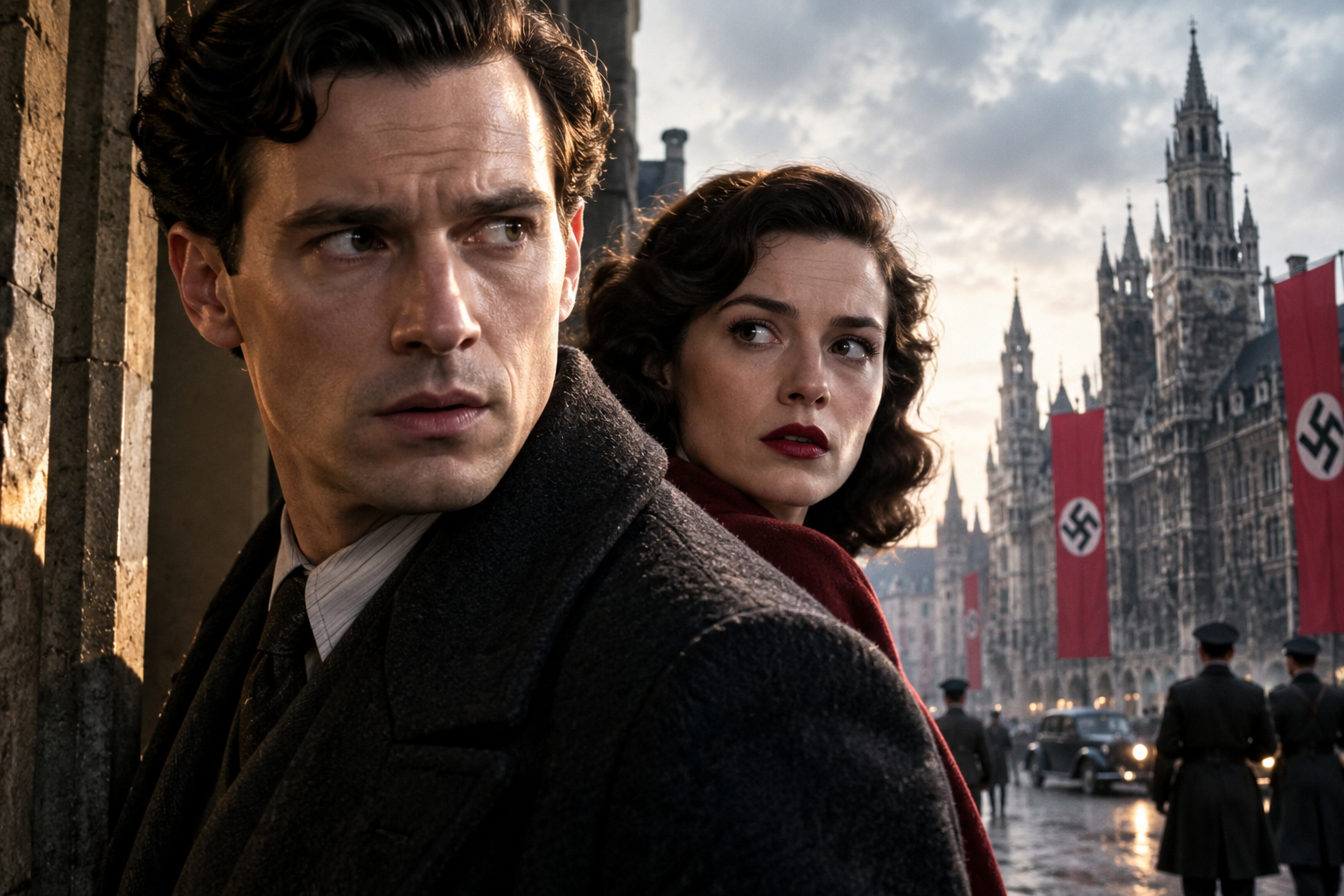
Geli Raubal's Death, the Nazi Cover-Up and Hitler's Fate
Hitler's Secret
The Munich Affair by James Patterson and David Ellis begins with a young woman found dead inside Adolf Hitler's Munich apartment in September 1931. The official verdict is suicide. But Detective Inspector Thomas Bauer believes the evidence points to murder, and that powerful men are determined to prevent him from proving it.
What begins as a criminal investigation develops into a historical thriller spanning the rise and collapse of Nazi Germany. Bauer's search for the truth threatens his career, his family and eventually his life. Decades later, American historian Eleanor Robbins follows the traces of evidence that survived the dictatorship.
Based around the real death of Hitler's half-niece, Geli Raubal, the novel combines historical events with fictional investigations, conspiracies, resistance operations and an alternative ending to the Second World War.
This summary explains the central plot, Bauer's pursuit of Hitler, the hidden evidence, the modern investigation and the extraordinary final confrontation.
The Munich Affair: How Geli Raubal's Death Begins the Story
Munich, September 1931.
Adolf Hitler is not yet Germany's dictator. He is the increasingly influential leader of the Nazi Party, whose movement is exploiting economic despair, political instability and public anger to push towards national power.
His political future depends partly on the image his followers have created around him. He must appear disciplined, commanding and destined for greatness.
Yet behind that public personality lies a private relationship that threatens the reputation he has carefully cultivated.
Angela Maria Raubal, known as Geli, is Hitler's twenty-three-year-old half-niece. She lives in his Munich apartment and wants a future beyond his control.
Geli has ambitions of becoming a singer. She wants independence, relationships of her own and the ability to make decisions without seeking her uncle's approval.
Hitler, meanwhile, exercises a possessive influence over her.
Their relationship is presented as controlling and abusive. His financial and social power allows him to dictate important aspects of her life, while his emotional possessiveness makes her independence increasingly intolerable to him.
The opening establishes this conflict through Geli's singing performance at a Munich cabaret.
For Geli, performing offers a glimpse of the life she might build outside her uncle's shadow. She attracts the audience's attention through her own talent rather than because of her association with Hitler.
What should be a personal triumph becomes another source of tension.
Hitler resents the attention she receives. The admiration directed towards Geli challenges his expectation that he should dominate every room.
The disagreement follows them back to his apartment.
There, the underlying conflict becomes explicit. Geli wants to leave Munich and pursue a different future in Vienna. Hitler refuses to accept that she might escape his influence.
Their confrontation turns violent.
In the novel's account, Hitler assaults Geli and shoots her.
By the following morning, she is dead, and the people surrounding Hitler are already working to control the explanation.
The public will be told that Geli committed suicide.
That distinction establishes the entire novel's conflict.
One explanation preserves Hitler's political reputation. The other threatens to expose him as a murderer before he can obtain absolute power.
The immediate question is whether an honest police investigation can survive when its principal suspect is politically untouchable.
For Thomas Bauer, the answer will determine the course of his life.
Thomas Bauer Investigates the Death and Discovers a Cover-Up
Thomas Bauer is a Munich police detective who believes that physical evidence should determine the conclusion of an investigation.
He is also a First World War veteran and a family man. His wife, Amalie, is Jewish, making his opposition to Hitler increasingly dangerous as Nazi antisemitism intensifies.
When Bauer arrives at the apartment with his younger assistant, Peter Helldorff, he quickly notices details that trouble him.
The appearance of Geli's body does not fit comfortably with the official suggestion of suicide.
There are signs of violence, and the condition of the room raises questions about whether the scene has been altered.
The position of blood and physical injuries suggest that events may have unfolded differently from the account being offered by Hitler's associates.
A missing mirror becomes particularly significant.
Bauer suspects that evidence has been removed or cleared away, making the apartment appear more consistent with a self-inflicted death.
Instead of treating these concerns as reasons for additional investigation, senior officials apply pressure to close the case.
Heinrich Müller, a powerful police figure, becomes part of the institutional obstruction Bauer encounters.
Rudolf Hess and other members of Hitler's political circle have a direct interest in ensuring that no damaging criminal allegation reaches the public.
The argument is no longer about forensic interpretation alone.
It is about who possesses the authority to decide what the evidence means.
Bauer wants an investigation, including the procedures necessary to establish whether Geli was murdered. Hitler's supporters want an uncomplicated suicide verdict.
They have influence over the institutions that Bauer must use to obtain justice.
The case is closed, despite his objections.
For another investigator, the professional consequences might be sufficient reason to abandon it.
Bauer refuses.
His decision becomes increasingly dangerous because he understands something that the authorities would rather ignore: if the people responsible for a possible murder can prevent an investigation through political pressure, they are already operating beyond the effective reach of the law.
He begins pursuing the case independently.
That choice transforms him from a detective working inside the justice system into an investigator whose own colleagues and superiors may now be enemies.
Bauer cannot know how far Hitler will rise.
But the cover-up surrounding Geli's death gives him an early indication of what political power might look like in the hands of a man who refuses accountability.
Fritz Gerlich, Hitler's Inner Circle and the Evidence Hidden in Plain Sight
Bauer's investigation brings him into contact with Fritz Gerlich, a journalist willing to challenge the Nazi movement publicly.
Gerlich occupies a different position from Bauer.
The detective seeks evidence that could establish criminal responsibility. The journalist understands that exposing misconduct can also undermine the political mythology protecting the accused.
Both men recognise the danger of Hitler's growing influence.
They also understand that allegations against him will not be evaluated neutrally.
His supporters have already decided that his political mission justifies defending him from damaging scrutiny.
Bauer's search leads towards people who know more about Hitler's private conduct.
Among them is Emil Maurice, a former member of Hitler's close circle whose knowledge offers a possible route into the events surrounding Geli's death.
The information Bauer encounters reinforces the picture of a young woman living under intense personal control.
It also suggests that Geli's death cannot be separated from Hitler's fear of losing his authority over her.
But witness testimony presents serious difficulties.
People who knew the relationship may be frightened, compromised or reluctant to testify. Others have reasons to protect their own positions within the Nazi movement.
Bauer therefore needs more than accusations.
He needs evidence that Hitler and his associates cannot dismiss as the inventions of political enemies.
The investigation eventually reaches Hitler's private documents.
With assistance, Bauer obtains material from a safe associated with the Nazi Party's Munich headquarters.
The contents are politically and personally damaging.
They include evidence relating to Hitler's private behaviour and documents pointing towards the methods through which the Nazis intend to consolidate power.
The discovery broadens Bauer's understanding of the threat.
He is no longer confronting an isolated criminal suspect who happens to lead a political party.
He is confronting an organisation preparing to dismantle the institutions that might hold its leader accountable.
The stolen material could damage Hitler.
But possession of evidence does not guarantee that it can be published, authenticated or used against him.
That becomes the weakness of Bauer's position.
His enemies control more institutions, possess greater resources and are prepared to use violence against anyone who resists them.
Then the investigation suffers a serious betrayal.
Peter Helldorff, the younger police officer who accompanied Bauer at the original crime scene, compromises the operation.
Evidence is returned to Nazi authorities, and Bauer's attempt to expose Hitler is disrupted.
Yet Helldorff makes a decision that becomes essential to the novel's later mystery.
He secretly retains an additional item.
It is a film canister, concealed rather than surrendered.
The significance of that decision will not become fully apparent until decades later.
For the moment, the immediate result is disastrous.
Bauer has challenged an increasingly powerful political organisation and failed to secure the public reckoning he wanted.
Hitler continues his rise.
The machinery that suppressed the investigation grows stronger.
And the men who attempted to expose the truth become targets.
Hitler Takes Power and Bauer's Family Faces a New Danger
The political developments following Geli's death steadily transform the conditions under which Bauer must operate.
In January 1933, Hitler becomes German chancellor.
The appointment changes the threat confronting Bauer.
Before Hitler entered government, political influence could interfere with an investigation. Now the Nazi movement can use the authority of the state itself.
The distinction is fundamental.
Police powers, emergency measures, surveillance and political repression increasingly serve the interests of the regime.
For an investigator who has already accused Hitler of murder, that shift is potentially fatal.
Bauer's professional standing deteriorates.
His determination to pursue the original case does not earn admiration from the authorities. Instead, he faces demotion and exclusion from the work he once considered his duty.
The loss of his position also reflects the wider destruction of institutional independence.
A detective can investigate only while the state permits investigation. Once the leadership of the state has an interest in suppressing a crime, the ordinary safeguards of criminal justice become vulnerable.
Bauer continues gathering information through less conventional methods.
His activities eventually include surveillance directed at Hitler's inner circle, as he attempts to understand the movement's intentions and expose wrongdoing.
But his family faces a more immediate danger.
Amalie is Jewish.
As the Nazis introduce antisemitic measures and intensify persecution, her background becomes a threat to her freedom and safety.
Their children are also exposed to the regime's racial ideology.
Bauer is forced to recognise that his determination to challenge Hitler has consequences beyond himself.
His wife and children did not choose to become part of a political struggle.
Yet association with him, combined with their Jewish identity, places them in growing danger.
A personal crisis therefore emerges alongside the wider historical one.
Bauer can abandon his investigation, attempt to protect his family by remaining silent, or continue resisting a regime that increasingly treats opposition as a crime.
None of these options offers certainty.
He eventually arranges for Amalie, their children and her father to escape Germany and reach the United States.
The decision protects them from immediate persecution but divides the family.
Bauer remains behind.
He has escaped neither the original murder investigation nor his conviction that Hitler must be stopped.
The stakes have changed.
He once wanted to prove that an individual criminal offence had been concealed.
Now he sees an entire government built around the principle that the Führer's will stands above legal accountability.
The pursuit of one murder suspect has become opposition to a dictatorship.
Fritz Gerlich's Fate and the Destruction of Opposition
The novel's treatment of Fritz Gerlich gives the political transformation a deeply personal consequence.
Gerlich continues to represent the possibility that public exposure might restrain authoritarian power.
His journalism challenges Hitler's reputation and the movement's claims to legitimacy.
But the political environment becomes increasingly hostile to independent criticism.
The techniques once used to discredit opponents develop into systematic repression.
Journalists can be arrested. Political organisations can be broken. Opponents can be detained without meaningful legal protection.
The creation of concentration camps introduces a new level of state terror.
Gerlich is arrested and imprisoned at Dachau.
His position as a critic of Hitler makes him particularly vulnerable.
During the violent Nazi purge known as the Night of the Long Knives in 1934, he is killed.
His death marks one of the novel's most important changes.
The public route to justice has effectively collapsed.
Bauer can no longer rely on the possibility that a determined journalist, an honest judge or an independent police investigation might bring down Hitler.
The regime has demonstrated that its opponents can be physically eliminated.
Peter Helldorff also meets a violent fate.
His earlier betrayal does not ultimately protect him from Nazi violence.
The hidden evidence he retained nevertheless survives as a potential challenge to the official account.
This distinction matters to the wider mystery.
Individuals can be murdered, frightened or silenced. Documents and recordings may survive their owners, provided somebody keeps them beyond the reach of those attempting to destroy them.
For Bauer, the deaths of people connected to the original investigation intensify the moral cost of his failure.
He has lost allies, his career and his family life in Germany.
Hitler remains in power.
And the crime that started everything is still officially unresolved in any meaningful sense.
The Resistance: Thomas Bauer and Erich von der Haas Fight Back
As Germany moves towards war, Bauer's struggle changes character.
He increasingly operates outside the formal institutions that once defined his life.
His resistance brings him together with Erich von der Haas, a man with military and intelligence experience who becomes an important partner in the effort to undermine the Nazis.
Their alliance gives Bauer capabilities he could never have possessed while working alone as a police detective.
Intelligence, planning, technical knowledge and access to useful contacts become essential to their operations.
The partnership also brings together different experiences of Nazi violence.
For Bauer, the struggle began with the suspicious death of Geli Raubal and the deliberate obstruction of justice.
For von der Haas, the regime's crimes eventually become devastatingly personal through the destruction of his Jewish family.
The men do not need identical motivations to recognise a common enemy.
They understand that Hitler's survival in power means the continuation of an increasingly murderous political system.
Bauer and von der Haas participate in resistance activities that extend beyond the original investigation.
Their work includes attempts to sabotage German military capabilities and plots directed towards Hitler himself.
The range of operations reflects the transformation of the central conflict.
An investigator who initially wanted an arrest now participates in efforts to disrupt the war machine.
The moral and practical questions become more difficult.
Resistance operations may prevent further atrocities, but they also involve danger, uncertainty and the possibility of killing.
The partners must make decisions without the protections or standards of certainty that Bauer once expected from criminal procedure.
They are also confronting an enemy with enormous institutional resources.
Hitler's security arrangements, the reach of the Gestapo and the atmosphere of suspicion make assassination attempts extremely difficult.
A failed operation can result in execution, not merely imprisonment.
Despite their determination, the regime survives repeated challenges.
The years continue passing.
Germany invades other countries, war spreads across Europe, and Nazi persecution develops into genocide.
The scale of destruction makes the original investigation appear almost impossibly distant.
Yet Bauer does not abandon it.
Geli's death remains important because it revealed a pattern he recognised before the world saw its full consequences.
A powerful man committed violence, his associates concealed it, and the institutions responsible for accountability failed to act.
That failure became an early warning of the much larger abuses to come.
By the final years of the war, Bauer and von der Haas have endured far more than either could have imagined in 1931.
But Hitler is still alive.
And the possibility of a final confrontation remains.
Eleanor Robbins and the Mystery That Survives Into the Present
Alongside Bauer's wartime struggle, the novel follows a separate investigation set decades later.
Eleanor Robbins is an American history professor who becomes involved in research concerning Geli Raubal's death and the original Munich police investigation.
Her work connects the reader to a different kind of threat.
She is not confronting the Nazi state at the height of its power.
Instead, she encounters people and networks invested in preserving secrets long after the regime itself has disappeared.
The investigation develops from material associated with earlier researchers and the descendants of people involved in the original case.
One important connection concerns the family of Peter Helldorff.
Although Helldorff compromised Bauer's investigation, his decision to conceal the film canister created a surviving trail.
That possibility becomes crucial.
The evidence that might establish what happened in Hitler's apartment was not necessarily destroyed when the original investigation collapsed.
It may have passed into private hands, been concealed among family possessions or survived through instructions left for later generations.
Eleanor follows clues linking the old investigation to contemporary Germany and Austria.
Her work is dangerous because the material she seeks could expose a secret guarded by people who remain sympathetic to Nazi ideology.
Violence against individuals connected to the research demonstrates that the threat is not purely historical.
The danger also raises a wider question.
Why would anybody risk murder to protect the reputation of a dictator whose crimes against humanity have already been established beyond doubt?
The answer lies partly in the role that historical narratives play in extremist identity.
For people who continue to defend Hitler, a new and potentially devastating revelation about his private conduct threatens the mythology they have constructed around him.
Controlling evidence becomes a way of controlling memory.
Eleanor's work therefore mirrors Bauer's investigation.
He tried to expose a crime while the perpetrator's political power was expanding.
She tries to establish what happened long after that power has been destroyed, but while its ideological defenders remain.
Her investigation eventually draws closer to the elusive film reel.
The existence of the recording suggests that the original police evidence may be only part of the truth.
If the material is authentic, it could show what happened rather than leaving investigators dependent on conflicting testimony and reconstructed physical evidence.
That possibility gives the modern storyline its central importance.
Bauer's conclusions have survived as allegations, suspicions and hidden records.
Eleanor may finally be able to transform them into documented proof.
The Munich Affair Ending Explained: The Final Confrontation in Berlin
The historical storyline reaches its climax in April 1945.
Nazi Germany is collapsing.
Soviet forces are advancing through Berlin, the capital is being destroyed, and Hitler has retreated into the bunker complex beneath the Reich Chancellery.
The military and political movement he built is facing defeat.
For Bauer and von der Haas, the collapse creates a final opportunity.
After years of failed attempts and resistance activity, they move towards the bunker as the regime disintegrates around them.
The novel now departs decisively from recorded history.
In the familiar historical account, Hitler and Eva Braun die by suicide in the bunker.
But Patterson and Ellis imagine a different sequence.
Hitler intends to preserve the appearance of suicide while secretly escaping.
Eva Braun dies, but Hitler prepares a deception involving another body.
A dead man resembling him will serve as the substitute.
The proposed escape depends on the confusion of the collapsing capital and the possibility of leaving Berlin by aircraft.
Instead of accepting the death he has publicly prepared for, Hitler attempts to survive while the political order he created falls apart.
This is the novel's final expression of his relationship with power.
He has demanded sacrifice and obedience from others, but when confronted by his own destruction, he looks for a private exit.
Bauer and von der Haas anticipate the deception.
They reach the location where Hitler expects to escape.
The confrontation brings the long investigation to its conclusion.
Von der Haas faces the man whose regime destroyed his family.
After everything he has endured, he finally has an opportunity to kill Hitler.
But he hesitates.
The moment distinguishes the resistance fighter from the dictator he despises.
Von der Haas cannot simply execute a defenceless man, even one responsible for monstrous crimes.
Hitler, however, attempts to use the hesitation to his advantage.
He reaches for a concealed pistol.
Bauer shoots him.
In the novel's alternative history, Adolf Hitler dies not by suicide inside the Führerbunker but from a gunshot fired by the detective who first suspected him of murdering Geli Raubal.
The resolution brings the story back to its beginning.
The man whose influence prevented Bauer from securing justice in 1931 is finally stopped by the investigator whose career he helped destroy.
But the ending is not a straightforward legal victory.
Hitler has not faced a public murder trial.
There has been no judicial finding concerning Geli's death.
Bauer has killed him during a final armed confrontation, after fourteen years in which the original crime remained concealed.
The difference matters.
Bauer can stop Hitler, but he cannot reverse what happened because the original investigation was suppressed.
Geli remains dead.
Gerlich and other opponents have been murdered.
Bauer's family has spent years separated from him.
Millions have suffered or died under the regime.
One final gunshot does not restore those losses.
The story nevertheless grants Bauer something he had been denied for most of his life: the chance to act decisively against the man who escaped accountability.
The two resistance partners leave Berlin, while the public account of Hitler's supposed suicide can still survive.
Bauer's personal quest is resolved.
The historical record, however, has not yet been corrected.
That task belongs to Eleanor Robbins.
The Final Film Reel: Who Really Murdered Geli Raubal?
The contemporary storyline supplies the novel's second resolution.
Eleanor eventually obtains the surviving film evidence connected to Hitler's private safe and the material concealed after Bauer's investigation.
The recording provides a visual account of Geli's treatment and death.
It confirms that Hitler subjected her to abuse and that their final confrontation ended with him shooting her.
The film therefore establishes what Bauer suspected from the beginning.
Geli Raubal was murdered.
The apparent suicide was a cover story.
The evidence that once disappeared into the machinery of Nazi secrecy has survived long enough to challenge the accepted narrative.
For Eleanor, the discovery represents an extraordinary historical breakthrough.
But the novel does not treat possession of the recording as automatically sufficient.
The film must be examined and authenticated.
The distinction between finding an artefact and establishing its credibility is essential, particularly when the revelation contradicts a long-established account.
The modern ending points towards examination by major American archival and investigative institutions.
It also supplies information about Bauer's life after the war.
He survives the final confrontation and eventually lives in the United States with Amalie.
His family life, interrupted by persecution and political resistance, continues beyond the defeat of Germany.
That survival gives the story a measure of personal closure.
But the wider meaning of the epilogue is more troubling.
Bauer was right, yet the proof arrives almost a century after the crime.
The detective's professional instincts could have exposed a murderer when Hitler's political movement was still struggling for power.
Instead, the investigation was shut down.
By the time the evidence becomes available to the wider world, the consequences of that original failure have already become part of history.
The novel leaves the reader with two different forms of justice.
The first is personal and immediate: Bauer kills Hitler during the attempted escape.
The second is historical and delayed: Eleanor obtains evidence capable of vindicating Bauer's conclusions.
Neither can undo the crimes committed during the intervening years.
The ending therefore offers vindication without pretending that vindication amounts to repair.
Was The Munich Affair Based on a True Story?
The historical foundation of The Munich Affair is real.
Geli Raubal was Hitler's half-niece. She died from a gunshot wound in his Munich apartment in September 1931, and the circumstances of her death became the subject of controversy.
Her death was officially ruled a suicide.
Hitler's possessive relationship with Geli, the restrictions she faced and the political sensitivity surrounding her death have been discussed by historians.
However, the novel's central accusation should not be confused with established historical fact.
There is no conclusive historical proof that Hitler murdered Geli Raubal.
The fictional story chooses a particular explanation and then builds a thriller around the consequences of suppressing it.
Thomas Bauer's investigation, his resistance partnership, the hidden film recording and the final killing of Hitler are fictional narrative devices.
Hitler's death on the Berlin airstrip is also an alternative-history ending, not a newly established account of the Second World War.
The real historical consensus remains that Hitler died by suicide in Berlin on 30 April 1945.
The novel's ending deliberately overturns that account.
These distinctions are especially important because fiction based on unresolved historical events can make an invented explanation feel definitive.
In September 2026, renewed historical discussion arose over documents that appeared to challenge the accepted timeline of Geli's death.
Those questions may justify further historical investigation, but they do not establish the novel's murder scenario as fact.
The book should therefore be understood as historical fiction drawing inspiration from a genuine mystery.
Its narrative certainty belongs to the fictional world.
The historical question remains separate.
What the Ending Means: Power, Silence and the Failure of Justice
The strongest idea in The Munich Affair is that the collapse of accountability begins before the most spectacular abuses of power become visible.
When Bauer investigates Geli's death, the immediate obstacles appear to concern one politically important suspect.
Superiors interfere. Evidence is removed. Witnesses face pressure. The official explanation is protected.
Each act can be presented as a limited exception made for political convenience.
But exceptions accumulate.
Once powerful people can decide which laws apply to them, the possibility of impartial justice becomes weaker.
Bauer's experience provides a fictional illustration of that process.
The institutions he initially trusts gradually become instruments of the people he is trying to investigate.
His response also changes.
He starts as a detective seeking lawful accountability.
He ends as a resistance fighter who kills the man he once hoped to bring before a court.
That transformation is both the central achievement and the central tragedy of his story.
He remains committed to justice, but the destruction of the justice system forces him towards methods he would never have considered acceptable at the beginning.
The relationship between Bauer and von der Haas adds a further complication.
Von der Haas's hesitation at the final confrontation demonstrates that even overwhelming moral outrage does not necessarily eliminate a person's reluctance to kill.
The dictator and his enemies do not operate according to identical ethical rules.
That difference becomes decisive when Hitler attempts to seize the opportunity created by his opponent's restraint.
Bauer's intervention ends the immediate threat.
The modern storyline develops a different argument about evidence and power.
Eleanor does not need to confront the Nazi state.
She confronts the long afterlife of its lies.
Documents can disappear. Witnesses die. Official accounts become familiar through repetition.
And once a particular version of history becomes established, correcting it may require exceptional evidence.
The surviving film reel therefore represents more than a sensational final revelation.
It symbolises the possibility that suppressed evidence can outlast the people who attempted to destroy it.
Yet the novel refuses to make that survival an uncomplicated triumph.
The recording arrives too late to help Geli.
It arrives too late to save Gerlich.
And it arrives too late to prevent the atrocities committed during Hitler's dictatorship.
The truth can still matter after justice becomes impossible.
But knowing what happened is not the same as preventing it.
That is the unsettling conclusion of The Munich Affair.
The detective was right about the crime.
The historian eventually finds the evidence.
And the political system that once refused to investigate has already inflicted its damage.
For all its conspiracies, sabotage and alternate-history twists, the novel's final question is about the moment when society still has the chance to act.
What happens when evidence is available, but the people responsible for enforcing the law are prevented from doing their jobs?
In Patterson and Ellis's fictional history, the answer is fourteen years of escalating destruction before the murderer is finally stopped.
Sources
The Munich Affair — James Patterson and David Ellis, Official Author and Publisher Listing
Hitler Had an Intense, Mysterious Relationship With His Half-Niece — Smithsonian Magazine
