The Real Pirate Queen Behind Ariel Lawhon's Bestseller
The Girl Who Cut Off Her Hair to Claim the Sea
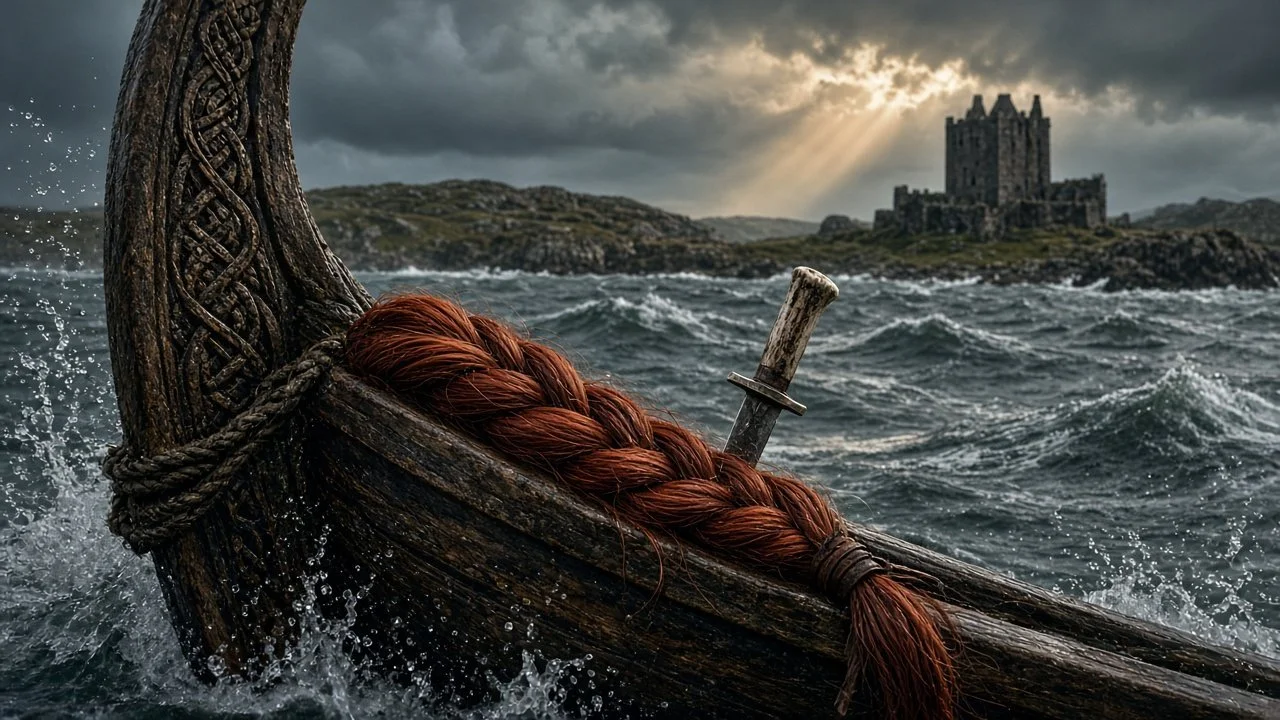
Grace O'Malley is five years old when she takes a kitchen knife to her own braid. Her father has said that long hair could tangle in a ship's rigging, so she removes the excuse. He still sails without her. The Pirate Queen, Ariel Lawhon's novel about the sixteenth-century Irish chieftain Gráinne Ní Mháille, spends the next 500 pages on that refusal to stay ashore.
Published by Doubleday in the US on 8 September 2026, it reached No. 9 on the New York Times hardcover fiction list for 22 November. This guide follows Grace's story from Clare Island to the court of Elizabeth I, explains the ending, and separates what the record supports from what Lawhon invented or borrowed from legend.
How the Novel Is Built: Maiden, Mother, Matriarch
Lawhon does not tell Grace's life in order. She braids three timelines, labelled Maiden, Mother and Matriarch, so that a chapter in which Grace is 56 can be followed by one in which she is eight. The author has said the design came from a practical problem: covering a whole life without the story feeling episodic. Several men in Grace's life, including both husbands, her brother, her loyal soldiers and her great enemy, also get viewpoint chapters.
The summary below untangles the threads into chronological order, which is how most readers try to reconstruct the book after finishing it.
Maiden: Clare Island, the Sense and the Fosterage
Grace is the daughter of Eóin O'Malley, chieftain of a clan that lives by land and sea from Clew Bay in County Mayo. Her older half-brother, Donal, is better placed to inherit the fleet, despite being violently seasick. When Eóin finally takes Grace on a trading voyage to Galway at eight, he puts her in the prow during a gale, apparently to frighten her. She loves it.
At ten she senses a storm coming before anyone else and gets the crew ashore in time. Eóin recognises "the Sense", an instinct for danger he shares, and understands that it will pull her towards a dangerous life. At thirteen she is knocked unconscious when her father's men confront a Portuguese ship, and Donal kills her attacker.
Grace and Donal are then sent to foster at Rockfleet Castle with David Bourke, The MacWilliam, the overlord of the Mayo Bourkes. Fosterage, raising children in an allied household, was how Gaelic families bound themselves together. There Grace meets the people who will shape her life. Richard Bourke, a younger son later known as Richard in Iron, secretly teaches her knife-fighting and accidentally leaves a scar under her chin. A priest, Father MacKenna, teaches her Latin and forces her to hide her left-handedness. She also takes the O'Malley motto, Terra Marique Potens, "powerful by land and sea", as her own.
A Trap Disguised as a Betrothal
At sixteen Grace is caught kissing Richard. His mother, Finola, wants her son to become The MacWilliam, and she makes a secret bargain with Donal O'Flaherty, heir to the neighbouring O'Flaherty clan: if he kills Richard's older brother, Walter, she will help him win Grace. Richard overhears the plot and asks Grace to elope.
He never gets the chance. Eóin rules out Richard because he is not an heir, the O'Flahertys offer their whole fleet for Grace's hand, and Finola sends Richard away on a hunting trip. Grace walks into what she believes is a betrothal dinner and finds a priest waiting. It is 1546, and she is married to Donal O'Flaherty that night.
At Bunowen Castle, her new husband rides off to fight and leaves orders that she may not leave without guards. Grace draws her knife on the steward until he moves aside. The scene wins her three lifelong allies: her guard, Finn, who falls in love with her; his twin, Murray; and a kitchen boy called Gutty.
The marriage produces three children: Young Eóin, Margaret and Merrick. It ends in all but name in 1554, when Grace learns that her husband has murdered Walter Bourke, as Finola wanted. She banishes him from her bed for good.
Hen's Castle and the O'Malley Fleet
Donal O'Flaherty dies in 1565, ambushed by the rival Joyce clan, who then attack his island fortress on Lough Corrib. Grace takes command of the defence, rallies the archers and pours molten lead onto the Joyce boats. The attackers retreat, and the castle once called the Cock's is renamed Hen's Castle in her honour.
Her dying father then gives her what she wanted at five: command of the O'Malley fleet. When an O'Flaherty cousin tries to seize Bunowen and force her into marriage, she invokes Brehon law, the native Irish legal code, claims the share of her husband's property owed to her and leaves with her followers.
The Dark Lady of Doona and Richard in Iron
In 1566 Grace rescues a shipwrecked sailor, Hugh de Lacy, and takes him as her lover. When the MacMahon clan murders him, her revenge is savage: she attacks the killers in a church and seizes Doona Castle, earning the name "the Dark Lady of Doona".
She then goes back to the man who has been waiting since their youth. Grace proposes a trial marriage to Richard Bourke for a year and a day. In 1567 she goes into labour aboard her ship, Niamh, just as an Algerian corsair attacks. She gives birth to their son, Tibbot, then gets up, shoots the enemy captain and helps capture his ship. On the 366th day of the marriage she stands on Rockfleet's ramparts and declares, "Richard Bourke, I divorce you!" The divorce protects her legal and financial independence. The couple carry on as partners anyway.
Her fame grows. When Lord Howth's household refuses her hospitality in 1577, she abducts his young grandson and returns him only once Howth promises that his castle will always feed travellers who arrive at mealtime.
Then the Mother timeline takes a darker turn. In 1579, during the Desmond Rebellion, Grace is imprisoned in the Bermingham Tower at Dublin Castle. The Lord Deputy, William FitzWilliam, offers her freedom if she will report Spanish ship movements to the Crown. Desperate, she signs. He remarks that there is only one pirate queen, and she sits on England's throne.
In 1583 Richard dies of a lung illness in her arms at Rockfleet. Before he goes, Grace has a Brehon record their combined wealth, which she claims as her own, and Richard asks Finn to protect her. His last words are the promise from a letter he once sent her: "Ego te expectabo", Latin for "I will wait for you".
Bingham's War on Grace's Family
The novel's villain is Sir Richard Bingham, the English governor of Connaught, the western province that includes Mayo. Lawhon writes him as sadistic and relentless. In 1586 his brother John murders Young Eóin. When Grace seeks revenge, Bingham imprisons her and makes her watch two of her nephews hanged. Her son-in-law, Richard "Hook" Bourke, and Gutty secure her release with a warrant from Elizabeth's spymaster, Sir Francis Walsingham.
From then on, Grace backs the resistance. She ferries Scottish mercenaries known as gallowglass to Mayo and, after a storm wrecks Niamh in Ulster, learns that the northern lords Hugh O'Neill and Hugh O'Donnell are secretly allied with Spain. In 1588, when a ship from the Spanish Armada, El Gran Grin, wrecks near Clare Island, she hides Spanish survivors and tells Bingham to his face that everyone aboard died. Later she leads a raid on the Aran Islands.
The war also splits her own family. Merrick retakes Bunowen and swears loyalty to Bingham, the man behind his brother's murder. Grace disowns him.
Why Does Grace Sail to England?
In 1593 the Matriarch thread reaches its crisis. Twelve English warships enter Clew Bay and burn two of Grace's ships. Bingham arrests her brother Donal and her son Tibbot on false treason charges, framing Donal by killing one of his own soldiers and blaming him, and holds both men at Athlone Castle facing execution. He also claims her lands.
Grace has hidden Niamh, which is small enough to slip out of the bay at night. With every Irish channel closed, she sails for London to petition Elizabeth I in person.
At Cecil House, Elizabeth's chief minister, Lord Burghley, gives her eighteen written questions about her family, marriages and piracy. Grace answers in Latin, writing with the left hand she was once made to hide, and uses the answers to document Bingham's abuses.
What Happens When Grace Meets Elizabeth I?
Grace wins. Summoned to Greenwich Palace, she surrenders the knife she has carried for decades to the guards and walks in wearing green silk with her hair loose. She refuses to bow, saying her own people consider her a queen too. The two women speak in Latin, a language most of the court cannot follow, and discuss her old intelligence work for Walsingham. Grace asks for her brother and son to be freed, her lands returned, her freedom at sea and Bingham's removal. Bingham, who is present, accuses her of treason and of sheltering the Spanish.
Elizabeth rules that the confiscated lands belong to Grace's sons and must be returned, with part of the income set aside for Grace's keep. She orders Bingham to release his prisoners and warns that his governorship is under review. On the way out, Grace collects her knife, presses it to Bingham's throat and promises to mutilate him if she ever sees him again.
How Does The Pirate Queen End?
The novel ends in June 1603 at Rockfleet Castle. Grace is 73 and dying, and Finn brings news that Elizabeth died three months earlier. Margaret, Hook, Tibbot, her brother Donal, her oldest men and Gutty gather around her. Merrick never comes.
Grace hands on what she wants to survive her. Margaret receives Grace's mother's fede ring, a betrothal ring of clasped hands, keeping it in the female line. Tibbot gets Grace's compass and the aquamarine ring Lord Howth gave her. As dusk falls, she senses Manannán, the Irish sea god, coming for her. She draws the small knife from her boot, cuts off her long silver braid and throws it into the water. Then she dies peacefully.
The Ending Explained: Why the Braid Comes Back
The last scene answers the first. At five, Grace cuts off her braid to claim the sea from the men who controlled it. At 73, she cuts it again and gives herself back to the sea. The same knife, the same gesture, opposite meanings: the first is a demand, the second a release.
That is why the final "surrender" does not read as defeat. Grace has resisted two husbands, prison, a governor and a queen. Nobody conquers her at Rockfleet. She chooses the moment she stops fighting, and her gifts to Margaret and Tibbot show her deciding which parts of herself go on. The compass and Howth's ring are the two skills that defined her: navigating the sea and navigating power.
The braided structure strengthens this. Each thread ends a section at a low point, a forced marriage or a spy's contract, that the reader already knows will be overturned in another timeline. Only the Matriarch thread delivers a true ending, so the novel's three Graces converge in one room. Lawhon's author's note says the Maiden, Mother and Matriarch design was inspired by the Celtic trinity knot.
The structure also has a cost. Some reviewers have argued that the time-jumping trades momentum and clarity for little gain, and Lawhon's own author's note suggests readers might reread the book in chronological order. Readers who find the first third disorienting are not misreading it; it asks a lot.
Brehon Law Versus English Law: The Quieter Battle
Beneath the sea fights, the novel runs a second contest between two legal systems, and it explains several of Grace's choices. Under Brehon law, a married woman kept control of the property she brought to the marriage and could acquire more in her own right: ships, cattle, fighting men. Under English common law, a wife's property passed to her husband.
That is why Grace's tools are so often legal. She invokes Brehon law to leave Bunowen with her share. The public divorce from Richard protects what she owns, and when he is dying she has a Brehon record their joint wealth so it cannot be taken from her. Bingham's war, in this light, is not only violence. It is an attempt to replace a system that let a woman like Grace exist.
Read that way, her victory at Greenwich is more ambiguous than it first appears. Elizabeth gives her almost everything she asks for, but on English terms: the lands are ruled to belong to her sons, and Grace receives a share of the income for her keep. She wins the argument and loses the framework. The novel lets the triumph land, but the detail is there for readers who notice it.
Grace, Gráinne or Granuaile?
Readers meet the heroine under several names, and the novel uses more than one. In Irish she is Gráinne Ní Mháille, Gráinne of the O'Malleys. Folklore calls her Gráinne Mhaol, anglicised as Granuaile, a name tied to the story of the cropped hair. English officials of her day spelled her name a dozen ways, including Grany O'Mally and Grainy O'Maly, and never as "Grace O'Malley", which is a later anglicisation.
The haircut that opens the book comes from local oral tradition rather than any document: the girl who wanted to sail with her father, was told her hair would catch in the ropes, and cut it off. Lawhon moves it to the first page and returns to it on the last, turning a folk anecdote into the novel's spine.
Is The Pirate Queen a True Story?
Partly. Gráinne Ní Mháille was real, born around 1530 and the daughter of Eoghan Dubhdara Ó Máille, lord of Umhall in Mayo. She married Dónal an Chogaidh Ó Flaithbheartaigh, "Donal of the War", in 1546; he was killed by the Joyces around 1565. Her second husband, Richard-an-Iarainn Bourke, died of natural causes in April 1583. In 1576 the Lord Deputy, Sir Henry Sidney, met "a most feminine sea captain" who offered him three galleys and two hundred fighting men.
The darkest parts of the Bingham story are also documented. Her eldest son, Owen, was killed in 1586 by men under John Bingham; Grace later testified that he had been "cruelly murdered having twelve deadly wounds". Her son Murrough sided with Bingham, and she raided his lands in return. In 1593 Tibbot was imprisoned and charged with treason, and her half-brother, Dónal na Píopa, was arrested and charged with killing English soldiers, the real charge behind the novel's frame-up. Grace went to London, answered Burghley's "eighteen articles of interrogatory", and in September 1593 Elizabeth ordered both men released and provision made for her from her sons' estates.
Much of the rest is legend or invention. Hen's Castle, the birth at sea and the Howth kidnapping come from tradition, though Howth Castle's own records name Grace. Historians have found no evidence for a "year and a day" trial marriage in Gaelic law. The meeting at Greenwich itself rests on tradition rather than written records, and her biographer Anne Chambers argues that the two women would have spoken English, not Latin. Bingham was not removed in 1593: he obstructed the Queen's orders, and only fled to England in 1595, where he was imprisoned. Lawhon's author's note acknowledges that the spy deal is her theory to explain Grace's unexplained releases from prison. Grace probably died at Rockfleet around 1603, though the date and place are disputed.
The novel's real argument is about the record itself. Contemporary Irish annals ignored her, while English state papers cast her as a villain. Lawhon fills that silence with a heroine who outlives the queen who judged her, and ends with Grace deciding, for once, exactly how her own story finishes.
Sources
Ariel Lawhon: The Pirate Queen (author's book page). The publisher's premise and review quotes.
Kirkus Reviews: The Pirate Queen (15 June 2026). Publication details, the braided timeline and the critique of its structure.
BookPage: The Pirate Queen review. Premise corroboration.
Historical Novel Society: Maiden, mother, matriarch. Lawhon on the structure and on mixing fact with myth.
SuperSummary: The Pirate Queen, Chapter 25 to Author's Note. The later plot, the ending and the author's note.
Spill the Plot: The Pirate Queen (2026) full spoiler summary. The full chronological plot.
Girl About Library: how did The Pirate Queen end? (22 September 2026). Independent corroboration of the ending.
Manhattan Public Library: New York Times hardcover fiction bestsellers, 22 November 2026. No. 9 on the list.
History Ireland: Gráinne Mhaol, pirate queen of Connacht. The real history and which episodes are tradition.
National Maritime Museum of Ireland: Grace O'Malley. The family motto, and Anne Chambers on English rather than Latin.
Wikipedia: Grace O'Malley. The 1593 arrests and release, her names and the hair-cutting tradition, cross-checked with History Ireland.
Next Reads
Elizabeth I and Modern Britain: What Would the Virgin Queen Make of Today's UK?. The other queen in Grace's story.
If Britain Had Lost to the Spanish Armada: How an Alternate Britain Might Look Today. The fleet whose wrecks wash up on Grace's coast.
The Nightingale Explained: Vianne, Isabelle, the Resistance and the Ending. Another bestselling novel about women resisting an occupying power.
The Women Summary: The War Story That Turns Heroism Into Abandonment. Women written out of the official record.
