The Poison Daughter Summary And Analysis: What Really Happens To Harlow And Henry
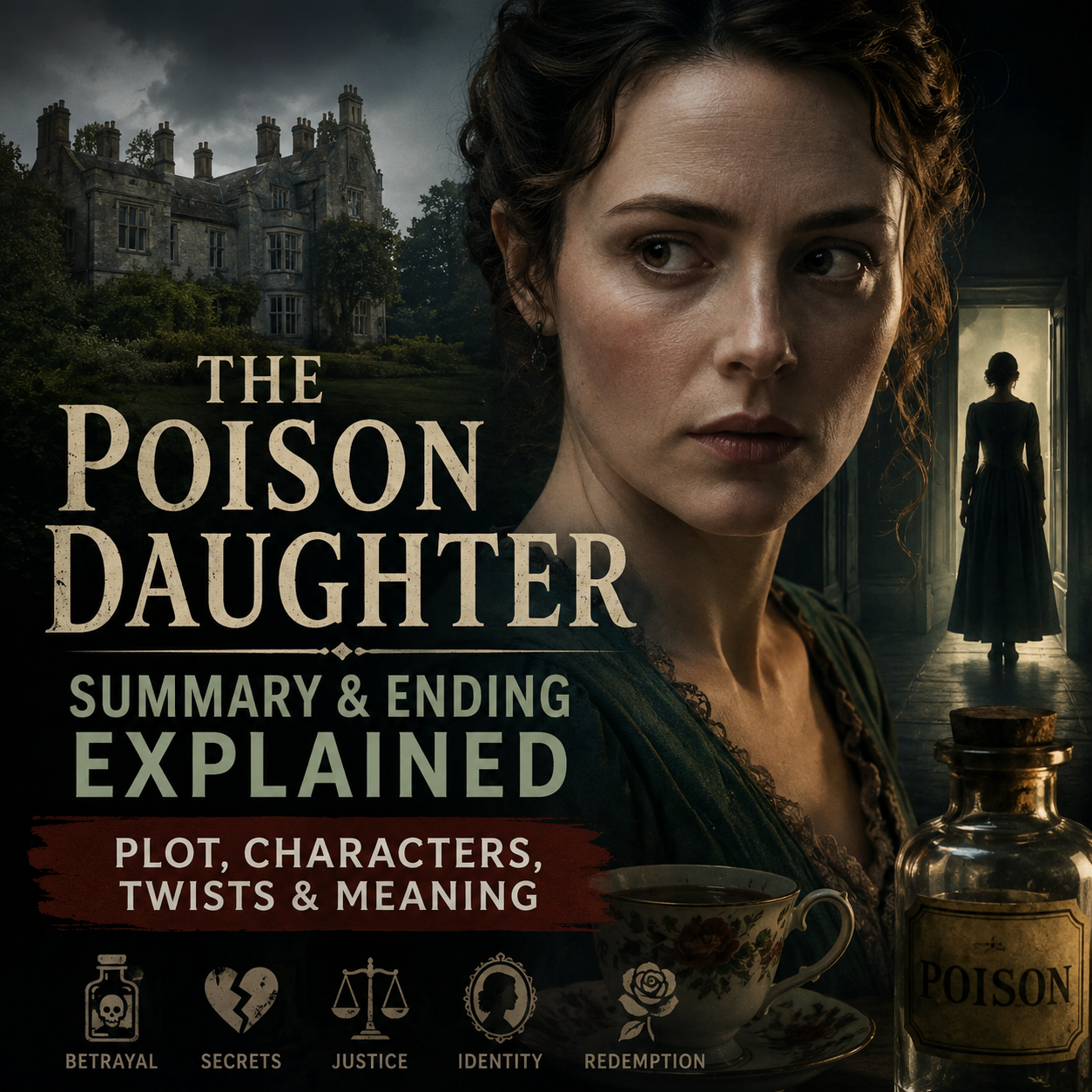
Harlow, Henry, The Ending And Every Major Twist
Aidia, Henry, Rochelli And Harlow’s Final Choice
The Poison Daughter is a standalone dark fantasy romance by Sheila Masterson.
The novel combines enemies-to-lovers romance, an arranged political marriage, forced proximity, magical family dynasties, vampires known as the Drained, vigilantism and a deliberately dark treatment of abuse and revenge. The publisher describes Harlow Carrenwell as the youngest daughter of one of Lunameade’s founding magical families: a woman whose kiss is lethal to almost everyone she touches.
It is also unusually long and structurally ambitious for a standalone romantasy. Rather than keeping the conflict contained inside the Harlow-Henry relationship, Masterson gradually connects their romance to political corruption, inherited trauma, religious magic, family violence and the machinery keeping two isolated settlements frightened of each other.
The Big Idea Of The Book
Harlow Carrenwell believes power is the only reliable form of safety.
That belief makes perfect sense in her world.
Her family rules Lunameade. Her magical ability makes her poisonous. Her parents have repeatedly treated their children as strategic resources. Her sister Aidia is trapped in an abusive marriage. Outside the walls roam the Drained, monstrous creatures that have helped keep the city permanently afraid.
Harlow therefore builds an identity around making herself dangerous.
She kills for her family when ordered.
Secretly, she also kills abusive men as the masked vigilante known as the Poison Vixen.
Then Henry Havenwood enters her life.
He is supposed to become another target.
Instead, Harlow kisses him and discovers something impossible:
Henry does not die.
That single failure dismantles the rules by which Harlow has survived.
Her body can no longer guarantee distance. Her poison cannot protect her from him. Worse, Henry discovers what she is doing.
The resulting romance therefore isn't simply about two enemies becoming attracted to each other. It is about a woman whose entire concept of safety depends upon being dangerous meeting a man she physically cannot frighten away.
And Henry has secrets just as serious as hers.
The Story In One Flow
Harlow Carrenwell And The City Of Lunameade
Harlow belongs to the Carrenwells, the powerful family at the centre of Lunameade.
There are nine Carrenwell siblings, but Harlow is particularly attached to Aidia. Their relationship gives Harlow one of the few emotional connections she genuinely values.
Lunameade itself is protected from the surrounding wilderness by walls. Beyond them are the Drained, predatory creatures whose attacks maintain an atmosphere of constant insecurity.
Magic is closely connected to religion.
The world recognises seven Divine figures associated with different domains, including pleasure, fortune, darkness, endings, malice, protection and strength. Magical blessings manifest differently between individuals and families, while magical wells help sustain those powers.
Harlow's blessing is particularly frightening.
She can poison people.
Her kiss can kill.
Her family has found this incredibly useful.
Harlow has already killed her first husband, and death has become entwined with how others perceive her and how she perceives herself. Killing is something done to her, through her and eventually by her own choice.
The distinction becomes important.
Because Harlow has secretly begun choosing victims of her own.
The Poison Vixen
Away from her family's political assassinations, Harlow operates as a vigilante.
She targets abusive men.
She approaches them, draws them close and uses the weapon nobody can easily take away from her.
Herself.
The murders are connected to Harlow's frustration over Aidia.
Aidia is married to Rafe Mattingly, a powerful and vicious man capable of magical manipulation. Harlow believes Rafe is abusing her sister, yet the Carrenwell hierarchy tolerates him because political usefulness matters more to them than Aidia's suffering.
Unable to save the person she loves most, Harlow redirects her rage.
If she cannot stop one particular abuser, she can stop others.
The Poison Vixen therefore becomes more than a secret identity.
She is Harlow's attempt to create justice inside a system in which conventional justice has failed.
That doesn't make her behaviour morally uncomplicated. She appoints herself investigator, judge and executioner. But Masterson deliberately builds Harlow around this contradiction: she is both victim and killer, exploited daughter and autonomous vigilante, protector and threat.
Her ability to kill becomes the only language of power she completely trusts.
Then she meets Henry Havenwood.
The Man Harlow Cannot Kill
Harlow is arranged to marry Henry, heir to the Havenwood family of Mountain Haven.
The Havenwoods have been largely absent from Lunameade's political world for years.
Their return immediately raises questions.
Why now?
What do they want?
What happened during the catastrophe that devastated Mountain Haven years earlier?
And why should Harlow's family suddenly want an alliance?
Before Harlow has the answers, someone sends her toward a target.
She attempts to kill the man.
She kisses him.
Nothing happens.
The target is Henry.
The discovery changes everything.
Henry now knows there is considerably more to his future wife than the Carrenwells have admitted.
Harlow has an equally urgent question:
How did he survive?
Publisher descriptions establish this as the novel's central opening confrontation: the supposedly lethal Harlow discovers that her intended husband is inexplicably immune to the very power that has defined her life. (Penguin Random House)
Neither trusts the other.
Both are attracted to the other.
And both immediately understand that the marriage is hiding a larger political game.
Rafe, Aidia And Harlow's Real Motivation
The situation becomes more dangerous during the formal events surrounding the alliance.
Rafe makes it clear that he knows more about Harlow than he should.
His magical ability allows him to manipulate people, making his relationship with Aidia even more disturbing.
Harlow believes that if she completes the Havenwood mission demanded by her family, she can acquire access to a secret passage out of Lunameade.
Then she can take Aidia and disappear.
Freedom, not romance, is Harlow's real plan.
Henry is initially an obstacle.
Potentially a temporary husband.
Possibly someone she will eventually kill.
But certainly not someone she intends to love.
During a gathering, an explosion shatters that assumption of control.
Henry reacts quickly enough to protect Harlow, while Harlow's brother Kellan is injured.
The attack pushes the Havenwoods to accelerate their departure.
Harlow is taken toward Mountain Haven.
Her bodyguard, Gaven, accompanies her.
And the marriage shifts from political abstraction into physical captivity: Harlow is now travelling away from the city she understands, toward a fortress controlled by people she doesn't.
The Journey Through The Drained Wood
The route between Lunameade and Mountain Haven exposes the reality outside the walls.
The travelling party is attacked by the Drained.
Harlow discovers that she has an unusual ability to perceive the absence associated with them, effectively helping her anticipate where the creatures are moving. Henry reveals another useful piece of Havenwood knowledge: water connected to their private well can be weaponised against the creatures.
These episodes begin changing the balance between them.
Until now, Harlow and Henry have largely interacted through secrets, threats and sexual tension.
Survival requires cooperation.
Each sees evidence that the other is more capable than expected.
Harlow also suffers one of the agonising physical episodes she has concealed from almost everyone.
Henry sees her vulnerability.
And instead of exploiting it, he helps her.
That matters enormously because Harlow has been taught that vulnerability creates opportunities for other people to hurt you.
Henry repeatedly sees weakness without automatically turning it into leverage.
At least, that is what Harlow initially believes.
Henry Havenwood Is Deathless
Mountain Haven brings the first enormous explanation.
Henry has died before.
The Havenwoods were devastated in an attack by the Drained approximately a decade earlier. Henry and his sister Holly were among those attempting to defend the settlement.
Henry was fatally injured.
Holly unleashed holy fire against the attackers, sacrificing herself in the process.
Their mother, Evangeline, resurrected Henry.
The resurrection transformed him into something extraordinary: Henry is Deathless.
Once something has killed him, that method cannot kill him again.
Poison is among the things he has previously survived.
That is why Harlow's kiss fails.
The weapon Harlow assumed made intimacy impossible is useless against the one man she is being forced to marry.
Henry's immortality is not absolute. The book later establishes an important exception.
But for now, Harlow learns the reason she cannot simply remove him from her life.
She also learns something more dangerous.
She can kiss Henry safely.
For perhaps the first time, physical intimacy does not automatically carry the threat of killing the person touching her.
The romantic significance is obvious.
The psychological significance is greater.
Harlow Begins Allowing Henry Inside
Henry's revelations encourage Harlow to reveal some of her own history.
Her recurring attacks of pain are real and severe.
The scars on her body originate in childhood abuse.
Harlow reveals markings across her back connected to Aidia, who covered evidence of those injuries with star-shaped branding.
Their father, Harrick, was responsible for much of the violence surrounding their upbringing.
For Harlow, these details explain why love and pain have become tangled together.
Family protection has always contained coercion.
Obedience has been labelled duty.
Violence has been described as preparation.
Henry's willingness to listen threatens her defensive worldview.
She needs him to be an enemy because enemies are simple.
Enemies can be killed.
An enemy who becomes kind is much harder to manage.
The Political Marriage Becomes Personal
Their wedding and the rituals surrounding it intensify the attraction and hostility between them.
Harlow still suspects the Havenwoods are hiding the true purpose of the marriage.
Henry admits that Mountain Haven desperately needs protection and stability.
The fort has lost people.
Its military resources are stretched.
The alliance could strengthen it.
But that is not the complete truth.
Harlow senses it.
She tells Henry that helping Aidia escape is central to what she wants.
He agrees to help her.
For perhaps the first time, Harlow begins imagining Henry not merely as the man standing between her and freedom, but as someone who could participate in creating it.
Their relationship shifts.
Not cleanly.
Not gently.
The sexual relationship retains the novel's dark-romance dynamics of pursuit, power exchange and negotiated control.
During one of Mountain Haven's ritualised hunts, Henry eventually claims Harlow through a sexual and blood-drinking ritual.
The scene is deliberately aggressive and possessive.
Yet the emotional result is different from what Henry expects.
Possessing someone's body does not mean possessing their trust.
The following morning, Harlow remains emotionally distant.
Henry begins to understand that their rituals cannot solve the deeper problem between them.
The Carrenwells Are Hiding Something Worse
Meanwhile, evidence accumulates that the respectable political story surrounding Lunameade is false.
Henry learns that Harlow's father has been murdering children who possess holy fire.
Those children potentially threaten the Carrenwell monopoly on protection and magical authority.
The family that presents itself as the city's defence has therefore been eliminating alternative sources of power.
This is the political heart of the novel.
Fear of the Drained helps justify Carrenwell control.
Control of magical strength reinforces dependence.
Dependence makes opposition dangerous.
And children whose abilities could weaken that dependency become threats.
Henry also learns that a rebellion exists inside Lunameade.
Its leader is known as Rochelli.
The question of Rochelli's identity runs through the book.
Meanwhile, Harlow remains focused on rescuing Aidia.
Then Kellan tells Henry something that makes no sense.
Aidia is dead.
The Moment Everything Changes
This is the novel's decisive reversal.
Henry initially assumes Harlow has deceived him.
She has repeatedly spoken about saving Aidia.
She has discussed Aidia as though she were alive.
She has structured her entire plan around getting her sister away from Rafe.
If Aidia actually died months earlier, then Henry concludes that Harlow must have been manipulating him.
He confronts her.
And takes her to a grave.
The name on it is Aidia's.
Harlow's reaction immediately tells Henry that the situation is not what he thought.
She was not consciously lying.
Her mind had buried what happened.
According to the revealed history, Aidia has been dead for six months. Harlow's apparent interactions with her sister have been manifestations of trauma and dissociation rather than real encounters. (SuperSummary)
Then the memory returns.
And the truth is considerably worse than Harlow simply failing to save her sister.
What Really Happened To Aidia
Harlow and Aidia endured Harrick's abuse from childhood.
Their father used punishment to force magical obedience.
At times he forced the sisters to participate in each other's suffering.
Aidia tried repeatedly to protect Harlow.
She ultimately married Rafe partly to prevent Harlow from being subjected to him instead.
But Rafe's ability makes ordinary resistance extraordinarily difficult.
He can compel people.
On the day Aidia died, Rafe used that power against both sisters.
He forced them to hurt each other.
Then he forced them onto a balcony.
Finally, Harlow was compelled to push Aidia.
Aidia fell to her death.
Rafe then commanded Harlow to jump as well.
Harlow survived because her fall was interrupted by branches.
The psychological damage was catastrophic.
Unable to process that she had physically pushed the person she loved most to her death, even though she was magically coerced, Harlow buried the event.
Her mind reconstructed Aidia as still being present.
The woman Harlow has spent the novel trying to rescue is already gone.
Her entire escape plan has been built around a grief she cannot consciously remember.
It is the book's strongest twist because it does more than change a fact.
It changes the meaning of almost everything Harlow has done.
Her vigilantism becomes displaced vengeance.
Her obsession with rescuing abused women becomes an attempt to save Aidia repeatedly through other people.
Her hostility toward vulnerability becomes survivor guilt.
Even her relentless movement toward escape makes new psychological sense.
Harlow has effectively been running from a memory.
Henry Finally Understands Harlow
Henry initially approached Harlow as an adversary and political problem.
After Aidia's truth emerges, he finally comprehends the scale of what she survived.
Another disturbing conclusion follows.
Gaven, Harlow's bodyguard, possessed resistance to manipulation.
If he could not easily be compelled by Rafe, then why didn't he stop what happened?
The implication is devastating.
Harlow's parents knew.
More than that, they allowed the violence as a method of controlling their daughters.
Harlow's family did not merely fail to protect Aidia.
They permitted the conditions that destroyed her.
For Harlow, that destroys the last plausible justification for Harrick and Liza's behaviour.
They cannot be excused as ruthless rulers doing horrible things for the survival of the city.
Their cruelty reached directly into their own children's lives.
Henry watches Harlow's rage erupt.
And something changes inside him too.
He sees colour.
Henry has been unable to experience the world normally since the traumatic events surrounding Mountain Haven.
Now Harlow's violet eyes become among the first colours he perceives.
He realises he loves her. (SuperSummary)
Harlow Judges Her Parents
Harlow arranges a confrontation with Harrick and Liza.
Her parents still treat their history of violence as necessary discipline.
Her mother minimises what happened.
Her father refuses meaningful remorse.
Their responses confirm something Harlow has gradually begun accepting:
She cannot obtain the apology capable of repairing what they did.
So she stops asking for one.
She poisons them.
Harlow incapacitates her parents and brings Kellan into the confrontation.
Under pressure, the truth becomes explicit.
Harrick and Liza allowed Rafe to attack Harlow and Aidia.
Their daughters' suffering was useful.
It was a warning.
A mechanism of obedience.
Harlow then reverses the structure of her childhood.
Instead of powerful parents controlling helpless children, Harrick and Liza become helpless.
Kellan uses magical compulsion to force them to turn their cruelty upon one another.
Then Harlow kills them.
She kills Harrick.
She kills Liza.
This time, unlike Aidia's death, nobody is controlling Harlow's body.
The killings are her choice.
It is the culmination of the revenge narrative — but Masterson refuses to make revenge emotionally miraculous.
Harlow doesn't emerge healed.
She experiences sorrow.
The people responsible for destroying much of her life are dead.
Aidia is still dead too.
Revenge can alter the balance of power.
It cannot rewrite history.
Kellan's Secrets
Kellan reveals further betrayals inside the family.
Other siblings knew parts of what had happened.
Able and Electra helped hide the truth.
Kellan himself knew more than Harlow realised.
His wife Libby had received enough warning to understand that something terrible might happen, although Kellan did not reach the sisters in time.
Harlow cannot instantly forgive him.
Masterson is effective here because Harlow's liberation does not produce a neat division between innocent allies and guilty enemies.
Everyone exists inside compromised systems.
Kellan will soon become enormously important to Lunameade.
But his role doesn't erase what Harlow has lost.
Harlow leaves the family home with the tunnel key she once believed would allow her and Aidia to escape together.
Now it symbolises a freedom that arrived too late for the person she intended to share it with.
Harlow Chooses Henry
When Henry finds her again, their relationship finally stops being purely political.
Harlow tells him she killed her parents.
Henry's response is not horror.
He wishes he had killed Harrick himself.
They connect through the grief of losing sisters.
Henry lost Holly.
Harlow lost Aidia.
And for one brief period, Harlow allows herself to believe their relationship can become something chosen rather than imposed.
Henry asks Harlow to remain with him.
Not because their families negotiated it.
Not because the city requires it.
Not because the marriage ceremony demands it.
Because he wants her.
Harlow agrees.
It appears that the central romantic conflict has resolved.
Then she discovers Henry's final secret.
Henry Has Been Able To Manipulate Her
Harlow sees something inside Henry's magical aura that she had previously missed.
Another colour.
Another blessing.
Henry is twice-blessed.
Alongside his other abilities, he possesses a connection to Polm, the Divine associated with Malice.
That gives him emotional manipulation powers.
The implication horrifies Harlow.
Rafe destroyed Aidia using compulsion.
Now Harlow learns that the husband she has finally trusted possesses a related ability — and concealed it.
Henry admits more.
He used the magic on Harlow.
He also admits responsibility for Gaven's death. (SuperSummary)
For Harlow, this strikes at the single most sensitive point imaginable.
The issue isn't simply that Henry lied.
It is consent.
Harlow has spent her life surrounded by people who decide what she should feel, who she should marry, what violence she should commit and what sacrifices she should make.
She believed Henry was becoming different.
His hidden ability means she can no longer be completely certain which feelings were hers.
So she leaves.
Crucially, she uses their agreed safe word.
Henry honours it.
He lets her go.
That small act becomes important later.
Rochelli Is Revealed
The Dark Star Festival becomes the stage upon which Lunameade's political system begins collapsing.
Henry uses his manipulation power publicly against Rafe.
Rafe is forced to admit his betrayal involving Mountain Haven.
Then the mysterious rebel Rochelli reveals himself.
It is Kellan.
Harlow's brother has been working from inside the Carrenwell system against their parents.
He exposes the deeper truth about Harrick's rule.
Children possessing holy fire were being killed because their gifts threatened the family's grip on power.
The old leadership had also manipulated the danger posed by the Drained and redirected catastrophe toward Mountain Haven.
The supposed guardians of Lunameade were not merely protecting people from fear.
They were governing through fear.
Kellan proposes a different system.
The population accepts him as the new leader.
The Carrenwell dynasty does not entirely disappear, but its basis of legitimacy changes.
The family can no longer pretend Harrick's regime represented unquestionable protection.
Henry's Revenge On Rafe
Henry then brings Harlow to Rafe.
Rafe has been beaten.
Henry has reproduced injuries corresponding to the suffering inflicted on Harlow and Aidia.
He gives Harlow the opportunity to participate.
She refuses.
That decision matters.
Earlier Harlow would have expected revenge to cure something.
Now she already understands its limitation.
She wants Rafe gone.
Not prolonged emotional communion with his pain.
Henry compels Rafe onto the balcony.
The symmetry is deliberate.
Rafe once used magical control to place Harlow and Aidia in exactly this position.
Now his own method is turned against him.
Rafe begs.
Henry ultimately forces him to jump.
He dies in a reflection of Aidia's death. (SuperSummary)
For Harlow, however, killing Rafe cannot solve her problem with Henry.
The man who avenged Aidia still possesses the kind of power that destroyed her.
Henry therefore does something far more meaningful than another apology.
The One Thing That Can Kill Henry
Henry gives Harlow a weapon capable of permanently killing him.
Holy fire.
Deathless does not mean invulnerable to everything.
Henry's previous deaths have made him extraordinarily resistant, but holy fire provides Harlow with ultimate leverage.
He hands her the means to end his life.
Symbolically, the relationship reverses.
Harlow began the book powerful because her touch could kill almost anyone except Henry.
Henry now willingly gives her the ability to kill the one person her poison cannot.
But the real point is not murder.
It is choice.
Henry cannot simply demand trust after admitting manipulation.
He can only make himself vulnerable enough that Harlow is free to decide.
She still doesn't decide immediately.
She leaves again.
The Ending Explained
Harlow retreats to the apartment that had once represented her imagined escape with Aidia.
Her friend Bea finds her there.
Bea explains that the network surrounding the Poison Vixen can continue without Harlow personally carrying every burden.
This matters because vigilantism has functioned partly as Harlow's substitute for healing.
She cannot spend the rest of her life repeatedly murdering versions of Rafe.
Someone else can continue protecting vulnerable women.
Harlow is allowed to have a life.
Then comes her final encounter with Aidia.
Not with Aidia literally returned from death.
With the internal presence Harlow has used to survive.
For most of the novel, the imagined Aidia enabled Harlow to avoid accepting the truth.
Now the same psychological representation helps her accept it.
Harlow says goodbye.
She allows Aidia to remain dead.
She allows herself to remain alive.
That is the emotional climax more than the deaths of Harrick, Liza or Rafe.
The following morning, Lunameade is changing.
Kellan begins restructuring the system around the magical well and dealing with the consequences of their father's regime. Children whose powers had been hidden from Harrick can potentially emerge safely. Able is isolated from the well in the hope that removing his exposure may improve his deteriorated mental state. Cooperation between Lunameade and Mountain Haven becomes possible. (SuperSummary)
Then Henry and Harlow finally talk.
Henry does not pretend his behaviour was acceptable.
Harlow makes the central objection explicit:
Consent matters.
Henry agrees.
He promises not to use his manipulation ability on her without permission.
More importantly, he tells her he does not want magic, politics or marital obligation to determine her decision.
He wants Harlow to choose him.
Henry also reveals that he has been able to see colour since the confrontation in her father's study.
She brought colour back into his world.
And he tells her that he loves her.
Harlow realises that she wants him too.
But Masterson does not end with Harlow surrendering.
Harlow turns their relationship back into something recognisably hers.
She gives Henry a condition.
He has to catch her.
She runs.
Henry follows.
The final image therefore transforms one of Harlow's defining behaviours.
For years she has run to survive.
Now she runs because she wants someone she trusts to chase her.
The distinction is the ending.
Harlow isn't trapped.
She chooses the chase.
The Main Characters Inside The Story
Harlow Carrenwell
Harlow is simultaneously the protagonist, weapon and central mystery.
She presents herself as hard because softness has historically been punished.
The poison is almost too perfect as a metaphor.
Harlow cannot safely experience ordinary intimacy. Getting physically close to her can be fatal, so isolation appears written into her biology.
Yet the story gradually demonstrates that her deepest isolation isn't caused by magic.
It comes from abuse.
Harlow's family taught her to associate closeness with control.
Her emotional arc therefore isn't about becoming less dangerous.
She remains dangerous.
It is about learning that danger and vulnerability can coexist.
Henry Havenwood
Henry initially appears to be the one man Harlow's signature weapon cannot defeat.
That alone makes him threatening.
His deeper role is more complicated.
He has experienced death, war and the loss of Holly.
He also hides information from Harlow for much of the story.
The revelation of his manipulation magic prevents him from becoming a straightforward fantasy rescuer.
Henry understands coercive power because he possesses it himself.
That makes his final decision to surrender control significant.
He does not prove his goodness by lacking dangerous power.
He proves something more interesting by choosing restraint after using it wrongly.
Aidia Carrenwell
Aidia is the emotional centre of Harlow's story.
For much of the novel Harlow's objective appears simple:
Save Aidia.
The revelation that Aidia is already dead radically restructures everything that preceded it.
She becomes both person and memory.
Her suffering motivates the Poison Vixen.
Her death drives Harlow's vengeance.
Her imagined continued presence allows Harlow to function.
Her final disappearance allows Harlow to move forward.
Kellan Carrenwell
Kellan represents the possibility that someone can emerge from the same corrupt family without reproducing exactly the same system.
He is not morally spotless.
His secrecy hurts Harlow.
He possesses manipulation magic and operates covertly.
But as Rochelli he has worked against Harrick's regime and protected children who would otherwise have been killed.
His emergence as Lunameade's new leader turns the ending into more than a romantic resolution.
The political order changes too.
Rafe Mattingly
Rafe is the clearest embodiment of coercion.
His power removes choice.
That makes him the natural antagonist in a novel obsessed with consent, control and autonomy.
Aidia's death transforms him from merely an abusive husband into the person responsible for Harlow's most devastating trauma.
His eventual death reproduces the mechanism of Aidia's killing.
The symmetry is intentionally brutal.
Harrick And Liza Carrenwell
Harlow's parents are arguably more important to the book's moral argument than Rafe.
Rafe is visibly monstrous.
Harrick and Liza institutionalise monstrosity.
They disguise abuse as necessity.
Children become magical resources.
Family loyalty becomes political obedience.
Cruelty becomes discipline.
Their deaths destroy the authority that shaped Harlow long before Henry entered her life.
What The Book Is Really About
Power Without Consent
Almost every important relationship involves power.
Harlow can kill through contact.
Henry can influence emotion.
Rafe can compel.
Harrick controls his children.
Political families control magical resources.
The Drained provide a justification for authoritarian protection.
The central question is not whether power exists.
It is whether another person retains meaningful choice in its presence.
That is why Henry's final admission matters.
His relationship with Harlow cannot become genuinely loving until she is free to reject him.
Trauma Can Distort Memory Without Erasing Truth
The Aidia reveal turns Harlow into an unreliable witness to her own life.
But the book does not use that purely as a clever thriller mechanism.
Harlow's false reality protects her from an unbearable one.
She remembers Aidia because accepting Aidia's death would require accepting her own involvement.
The important distinction is that Harlow was compelled.
Her body performed the act.
Her will did not choose it.
Much of her healing therefore depends upon separating responsibility from physical causation.
Vengeance And Justice Are Not Identical
Harlow spends enormous energy killing people who deserve punishment.
Yet her deepest pain remains.
Her parents die.
Rafe dies.
Aidia doesn't return.
The book doesn't condemn revenge outright — it revels in several acts of it — but it quietly refuses the fantasy that vengeance restores what was taken.
Harlow's eventual freedom arrives through acceptance and choice rather than another corpse.
What Most Summaries Miss
The easiest way to summarise The Poison Daughter is as an enemies-to-lovers fantasy about a poison-kissed assassin and an immortal man.
That misses its strongest structural trick.
Harlow and Henry are mirrors.
Harlow appears physically lethal but is psychologically terrified of intimacy.
Henry appears physically impossible to kill but is emotionally marked by death.
Harlow thinks vulnerability equals weakness.
Henry's decisive romantic gesture is voluntary vulnerability.
Harlow's poison gives her bodily control.
Henry's secret magic threatens emotional control.
Their romance works only when both agree that power cannot substitute for consent.
The fantastical abilities are therefore not decorations around the romance.
They create its ethical problem.
What Most People Misunderstand
A shallow reading can make Harlow's ending look like her simply forgiving Henry because she loves him.
The actual resolution is more conditional.
Harlow confronts him about his unauthorised use of manipulation.
She explicitly identifies consent as the problem.
Henry acknowledges it.
He promises restrictions.
He gives her the means to kill him permanently.
And he asks her to make an independent choice about their future. (Read Free Books Online)
Whether individual readers believe that redemption is sufficient is another question.
But the novel itself understands that romantic attraction alone cannot answer Harlow's objection.
The resolution requires a transfer of power.
The Strongest Scene, Chapter, Or Idea
The Aidia grave revelation is the strongest sequence.
It succeeds because the twist has retrospective force.
A weaker twist changes what happens next.
This one changes what already happened.
Suddenly Harlow's rescue mission, vigilantism, grief, dissociation, hatred of Rafe and strange relationship with Aidia all acquire a different meaning.
And because Aidia's death was caused through magical compulsion, the reveal also crystallises the book's concern with autonomy.
Harlow's greatest trauma is not simply that Aidia died.
It is that someone turned Harlow's own body into the instrument.
The Taylor Tailored Interpretation
The real poison in The Poison Daughter isn't Harlow.
It is inherited control disguised as protection.
Harlow's family says violence makes children stronger.
Rafe uses love and marriage as access to domination.
Political leaders use monsters outside the walls to justify what happens inside them.
Henry initially makes a similar mistake when he assumes that influencing Harlow's emotions can be justified by benevolent intention.
Everyone thinks their reason makes control acceptable.
The ending rejects that assumption.
The healthiest thing Henry does is not resurrect, fight monsters, kill Rafe or survive Harlow's kiss.
It is giving Harlow the power to leave.
Likewise, Harlow's greatest act of strength isn't poisoning somebody.
It is choosing something without fear making the decision for her.
Why This Book Still Matters
The fantasy mechanics exaggerate a recognisable problem.
Control often arrives wearing the language of care.
Parents say they know what is best.
Partners claim jealousy means love.
Institutions justify secrecy through security.
Leaders demand obedience for protection.
People manipulate others because they believe their intended outcome is beneficial.
The Poison Daughter keeps asking the harder question:
What happens to love once choice disappears?
That gives the novel substance beyond its romantic and supernatural spectacle.
If You Only Remember Three Ideas
1. Harlow’s Deadly Kiss Is Protection As Much As Power
Her poison enables her violence, but it also gives her a reason never to become emotionally accessible.
Henry's immunity threatens the defensive structure she built around herself.
2. Aidia Changes The Meaning Of The Entire Story
Harlow isn't simply trying to rescue her sister.
She is unknowingly trying to undo something that already happened.
Once she accepts Aidia's death, vengeance stops being capable of functioning as a substitute for grief.
3. The Ending Is About Choice
Henry and Harlow don't succeed because he conquers her.
They succeed because he finally stops requiring conquest.
Harlow can stay.
Harlow can leave.
She chooses to stay.
That difference is everything.
The Sentence That Explains The Book
The Poison Daughter is a story about a woman who learns that real safety is not having enough power to make everyone fear you, but having enough freedom to decide who is allowed close.
The Real-Life Test
Strip away magical wells, poison kisses and vampire-infested forests and the novel leaves a useful question:
When someone says they are protecting you, how much choice do you still possess?
That question applies to relationships, families, workplaces and institutions.
Protection that requires unquestioned obedience can become control.
Help that secretly removes autonomy can become manipulation.
Love that cannot survive a genuine "no" isn't operating as love.
Harlow spends much of her life assuming the solution is becoming impossible to control.
Her ending suggests something more achievable.
Know where your boundaries are.
Notice who respects them without punishment.
And judge people not merely by what they say they want for you, but by what they do when you choose something they don't want.
Five Questions To Test Whether You Understood The Book
Why does Henry's immunity to Harlow's poison destabilise her psychologically as well as physically?
How does the revelation about Aidia reinterpret Harlow's Poison Vixen killings?
What separates Kellan's use of power from Harrick's, despite both operating through secrecy and manipulation?
Why is Henry giving Harlow access to holy fire more important than simply apologising?
Does the novel ultimately argue that revenge is necessary, insufficient, destructive — or some combination of all three?
The Final Lesson
Harlow begins The Poison Daughter believing freedom means becoming impossible to hurt.
She becomes poisonous.
She kills.
She plots escape.
She trusts almost nobody.
Yet absolute invulnerability turns out to be another kind of prison.
The person who changes her life isn't someone weaker than she is.
It is the one person her favourite defence cannot destroy.
That forces Harlow to confront the problem she has been postponing beneath every assassination and every escape plan.
You cannot build intimacy entirely from armour.
But neither should love require surrendering your autonomy.
The novel therefore ends somewhere between those two extremes.
Harlow doesn't become harmless.
Henry doesn't become powerless.
Neither stops being dangerous.
What changes is the agreement governing that danger.
Power remains.
Choice comes first.
And after spending most of her life running because she was afraid of being caught, Harlow finally runs knowing that this time she wants Henry to follow.
