The Practicing Stoic Summary: How To Stop Being Ruled By Emotion, Ego, Fear, And Other People
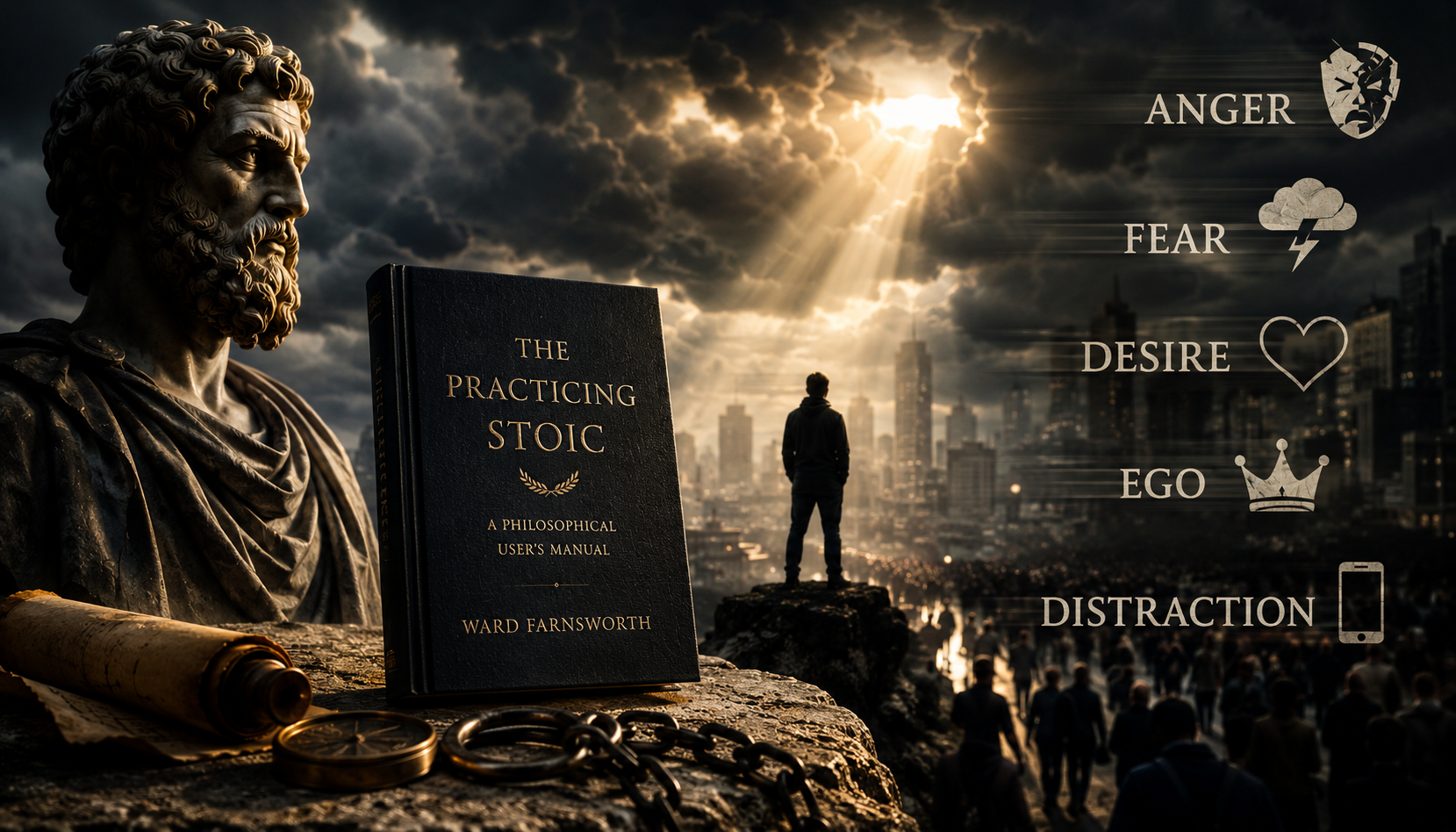
The Ancient Philosophy Behind Modern Self-Control
Judgment, Emotion, Adversity, Virtue, And Control
The Practicing Stoic looks like a calm guide to ancient philosophy, but its real force is sharper than comfort: it asks whether most of the pain, status anxiety, anger, fear, and disappointment people carry is not caused by life itself, but by the silent judgments they keep making about life before they realise they are doing it.
Farnsworth is not writing as a motivational celebrity or productivity influencer. He is a legal scholar and professor at the University of Texas School of Law, and Godine describes him as the author of The Socratic Method and the Farnsworth Classical English series as well as The Practicing Stoic.
The Big Idea Of The Book
The central argument of The Practicing Stoic is brutally simple: most people do not suffer directly from events, losses, insults, pleasures, threats, or disappointments. They suffer from the judgments they attach to those things.
That does not mean pain is imaginary. It does not mean grief is weakness. It does not mean injustice is irrelevant. Farnsworth’s Stoicism is not a command to pretend nothing matters. It is a discipline for separating what happens from what the mind adds to what happens.
The book’s core claim is that the human mind constantly mistakes interpretation for reality. Someone does not reply, and the mind calls it rejection. A plan fails, and the mind calls it disaster. A rival succeeds, and the mind calls it humiliation. Money arrives, and the mind calls it safety. Praise appears, and the mind calls it worth.
Stoicism, in Farnsworth’s version, begins by interrupting that sequence. First, identify the event. Second, identify the judgment. Third, ask whether the judgment is true, useful, within your control, and consistent with virtue.
That is why the book is more demanding than ordinary self-help. It does not ask the reader to feel better by repeating affirmations. It asks the reader to become a better judge.
The Argument In One Flow
Farnsworth begins where practical Stoicism has to begin: judgment. The book’s first movement is not about courage, habits, success, calmness, or resilience. It is about perception. Before anyone can govern anger, fear, desire, grief, envy, or pride, they must see how those states are formed.
The ordinary person thinks events strike the mind directly. A person insults you, so you become angry. You lose money, so you become miserable. Someone else receives attention, so you feel small. Farnsworth presents the Stoic objection: between the event and the emotion stands a judgment. The emotion may happen quickly, but speed does not make it innocent.
This is the book’s foundation. If emotion comes from judgment, then emotional life is not entirely outside the reach of reason. You cannot always choose the first sensation. You may feel the body react before thought has caught up. But you can examine the story that follows. You can ask whether the insult is really damage, whether the loss is really ruin, whether the praise is really proof, whether the fear is really knowledge.
The next step is externals. For the Stoics, the most common human mistake is to treat external things as if they are the substance of happiness. Wealth, reputation, health, comfort, beauty, status, influence, and approval are not dismissed as worthless. The argument is more precise. They are not good in the deepest moral sense, because they can be used badly, lost suddenly, or possessed by miserable people.
This is where many readers misread Stoicism. The point is not that money, health, and relationships do not matter. The point is that they are unstable materials. They can support a good life only when governed by good judgment. A wealthy coward is not living well. A famous fool is not admirable. A healthy person who is corrupt, resentful, or cruel has not solved the problem of being human.
The Stoic claim that virtue is central to happiness has deep roots. The Internet Encyclopedia of Philosophy describes Stoicism as a eudaimonic virtue ethics in which virtue is necessary and sufficient for happiness, while Stanford’s entry on Marcus Aurelius summarises the Stoic view that virtue is the only true good for oneself and vice the only true evil.
Farnsworth’s book then moves into perspective. Once the reader sees that external things are unstable, the next discipline is scale. Most distress feeds on exaggeration. A problem feels absolute because the mind holds it too close. Stoicism teaches the reader to pull back: from the moment, from the ego, from the crowd, from the hunger for immediate vindication.
Perspective does not erase difficulty. It resizes it. A humiliation may still be unpleasant, but it is not the collapse of a life. An argument may still need handling, but it is not a cosmic verdict. A career setback may require practical repair, but it is not proof that a person has no future.
Farnsworth’s use of perspective is one of the book’s strongest practical moves because it attacks the inflation mechanism inside human distress. The mind has a habit of turning inconvenience into injustice, uncertainty into doom, and delay into rejection. Stoicism does not ask the reader to deny the facts. It asks the reader to stop enlarging them without evidence.
Death follows naturally from perspective. Farnsworth does not treat death as a gothic theme or a morbid obsession. He treats it as the ultimate test of judgment. If people live as though death is unspeakable, they become easily manipulated by fear, vanity, urgency, and false importance.
Stoic reflection on death is not meant to produce despair. It is meant to produce proportion. A person who remembers mortality is less likely to waste life on petty rivalry, reputation theatre, luxury addiction, pointless resentment, or fantasy control. Death makes trivial pursuits look trivial. It also makes real duties more urgent.
The book’s argument then turns to desire. This is where Stoicism becomes psychologically severe. Human beings often believe the problem is that they do not have enough of what they want. The Stoic suspicion is different: the problem is that desire itself has become badly trained.
Desire creates dependency. Wanting food, shelter, friendship, health, and work is natural. But craving admiration, domination, indulgence, revenge, luxury, constant attention, or guaranteed comfort makes the mind hostage to things it cannot command. The more a person requires from the world before they can be at peace, the more fragile they become.
Farnsworth’s treatment of desire is not anti-ambition. It is anti-enslavement. The Stoic question is not “Should I achieve things?” It is “What happens to me internally if I do not get them?” If the answer is rage, collapse, envy, humiliation, or desperation, then ambition has become a master rather than a tool.
Wealth and pleasure extend that argument. Money can protect, enable, and liberate. Pleasure can refresh life. Farnsworth does not need to pretend otherwise. The Stoic concern is attachment. The person who cannot be content without luxury is poorer than they appear. The person who cannot endure discomfort is weaker than they admit.
Pleasure becomes dangerous when it trains the mind to expect frictionless living. Every convenience can quietly lower tolerance. Every indulgence can become a new baseline. The person who once enjoyed a pleasure freely may later need it merely to feel normal.
This is one of Farnsworth’s most modern sections even though the material is ancient. Consumer culture depends on turning preferences into necessities. Social media does the same with attention. Status culture does it with recognition. The Stoic diagnosis is that many people are not enjoying abundance; they are being trained by it.
The argument then moves into reputation and what others think. This may be the most painfully relevant part of the book. Human beings are social animals, and social judgment matters. But Farnsworth’s Stoics see how quickly concern for reputation becomes a form of servitude.
Approval is addictive because it feels like evidence of worth. Criticism is painful because it feels like damage. But the Stoic response is to ask whether either reaction makes sense. If praise comes from shallow people, why should it matter so much? If criticism comes from people whose judgment you do not respect, why should it control your peace? If the crowd is unstable, why build your identity inside its weather?
The book is not telling readers to become antisocial. It is telling them to stop outsourcing their moral centre. A person should care whether they are just, honest, useful, disciplined, courageous, and wise. They should not make their internal life dependent on applause, gossip, misunderstanding, or fashion.
Valuation comes next, and it is the hinge of the whole book. Stoicism is not merely emotional control; it is value correction. People suffer because they price things incorrectly. They overvalue comfort, reputation, victory, sensual pleasure, money, beauty, and convenience. They undervalue character, steadiness, self-command, fairness, duty, and reason.
Farnsworth’s genius is to show that many Stoic exercises are not isolated tricks. They are methods for repricing life. Once a person sees that an insult is not real injury, anger loses fuel. Once they see that luxury is not necessary, craving loses authority. Once they see that death is inevitable, pettiness loses glamour. Once they see that reputation is unstable, approval loses its throne.
Emotion, therefore, becomes the result of valuation. If you believe something terrible has happened, grief, fear, or anger follows. If you believe something essential has been gained, elation follows. Change the valuation, and the emotion changes.
This does not make Stoicism emotionally dead. It makes it emotionally disciplined. The Stoic is not someone without feeling. The Stoic is someone who refuses to let irrational evaluation run the whole household.
Stanford’s older entry on Stoicism notes that the Stoics understood passions such as fear and envy as arising from false judgments, while the Internet Encyclopedia of Philosophy’s entry on Epictetus summarises the central ethical claim that only virtues and virtuous activities are good, while vice is the only evil.
Adversity then becomes the proving ground. It is easy to admire Stoicism when nothing is happening. The philosophy exists for moments when something unwanted arrives: illness, loss, insult, delay, betrayal, failure, uncertainty, fear, or grief. Farnsworth’s argument is that adversity is not just a burden; it is material.
This does not mean adversity is secretly pleasant. It means adversity gives the person a chance to practise the virtues that comfort does not test. Courage requires danger. Patience requires delay. Temperance requires temptation. Justice requires conflict. Self-command requires pressure.
Here, Stoicism becomes less like therapy and more like training. A bad day is not merely a bad day. It is a test of what rules the person: judgment or impulse, virtue or vanity, discipline or appetite, reality or fantasy.
Virtue is the book’s moral centre. Without virtue, Stoicism becomes a set of self-soothing techniques. Farnsworth does not let that happen. The point is not to feel calm while living selfishly. The point is to live rightly with a mind less easily thrown off course.
This is the most important distinction between Stoicism and mere emotional numbness. A numb person avoids disturbance. A Stoic seeks excellence of character. A numb person withdraws from life. A Stoic participates without becoming owned by outcomes. A numb person says, “I do not care.” A Stoic asks, “What is the right thing to do?”
The final movement is learning and criticism. Farnsworth does not present Stoicism as a perfect, closed system that answers every objection. The book recognises that Stoicism can look too severe, too demanding, too detached, or too indifferent to ordinary human attachment. That honesty matters.
The answer is not to water Stoicism down until it becomes ordinary comfort advice. The answer is to understand what kind of philosophy it is. Stoicism is not designed to flatter instinct. It is designed to train judgment under pressure. It is strict because the forces it opposes are powerful: fear, vanity, pleasure, anger, grief, pride, craving, and dependence on luck.
By the end, Farnsworth has not given the reader a list of motivational lessons. He has rebuilt the reader’s map of the self. Events are not the whole problem. Externals are not the whole good. Pleasure is not freedom. Approval is not identity. Adversity is not always defeat. Emotion is not always truth. Virtue is not decoration; it is the only stable centre.
The Most Important Ideas Inside The Argument
The first important idea is that judgment comes before emotional slavery. People often treat their reactions as facts. Farnsworth’s Stoics attack that assumption. They teach that a reaction may be understandable without being wise.
This matters because many lives are run by unexamined conclusions. “They ignored me” becomes “I am worthless.” “I failed” becomes “I am finished.” “They criticised me” becomes “I have been harmed.” “I want it” becomes “I need it.” Stoicism asks the reader to slow that machinery down.
The second important idea is that control is narrower than people want and more powerful than they realise. You do not control death, other people’s opinions, the past, chance, the market, your reputation, or the behaviour of fools. But you do control your judgments, intentions, choices, discipline, and conduct.
That sounds limiting until it becomes liberating. Much misery comes from trying to control what is not yours to command. Much strength comes from becoming excellent at what is.
The third important idea is that external success cannot secure inner freedom. Wealth, praise, comfort, pleasure, and status are unstable. They can improve circumstances but cannot govern the soul. If they become necessary for peace, they turn into chains.
The fourth important idea is that adversity reveals training. A person does not discover their philosophy in calm conditions. They discover it when tired, rejected, afraid, tempted, embarrassed, criticised, or deprived. Pressure exposes the real hierarchy of values.
The fifth important idea is that Stoicism is social, not selfish. It is not a philosophy of hiding from people. It is a philosophy of becoming less needy, reactive, vain, and resentful so that one can act more justly. The Stoic wants fewer false goods so they can serve real ones.
The Strongest Chapter Or Section
The strongest section of The Practicing Stoic is its treatment of judgment because everything else depends on it. Without judgment, the book would become a collection of ancient advice about death, adversity, pleasure, and reputation. With judgment, those subjects become one connected system.
Judgment explains why insult hurts more when believed. It explains why money seduces when treated as salvation. It explains why praise intoxicates when mistaken for worth. It explains why adversity terrifies when treated as moral ruin. It explains why death becomes unbearable when life is measured by possessions, vanity, and unfinished cravings.
The judgment section also makes the book practical. It gives the reader something to do immediately: inspect the interpretation. Before arguing, collapsing, chasing, buying, boasting, resenting, or panicking, ask what judgment has entered the mind and whether it deserves obedience.
This is stronger than generic advice to “stay calm.” Calmness without judgment is fragile. It lasts only while circumstances cooperate. Farnsworth’s Stoicism aims deeper. It tries to change the reasoning that creates the disturbance.
The Weakest Chapter Or Section
The weakest aspect of the book is not a single chapter but a recurring limitation: Stoicism can underplay how difficult some judgments are to change when trauma, poverty, addiction, illness, social pressure, or prolonged instability are involved.
The Stoic answer is still useful. Judgment matters even in hard conditions. But a reader should not confuse philosophical truth with psychological ease. Seeing that a fear is partly judgment does not automatically dissolve fear. Knowing that reputation is external does not instantly remove shame. Understanding that death is natural does not make grief tidy.
There is also a risk that readers use Stoicism to judge themselves harshly for ordinary pain. That would be a misuse of the book. The point is not to feel guilty for feeling. The point is to practise better interpretation over time.
Farnsworth’s book is strongest as a manual for intellectual and moral training. It is weaker if treated as a complete account of therapy, social injustice, attachment, trauma, or material hardship. Stoicism can help a person respond better to those realities, but it does not make those realities simple.
What The Book Proves
The Practicing Stoic proves that Stoicism is not a vague attitude of toughness. It is a disciplined system of judgment, valuation, and conduct.
It also proves that ancient philosophy can be practical without becoming shallow. Farnsworth does not modernise Stoicism by stripping away its difficulty. He makes the difficulty readable.
The book proves that emotional life is more cognitive than people like to admit. Anger, fear, envy, pride, and craving often feel like direct contact with reality. Farnsworth shows that they are often contact with interpretation.
It proves that many modern problems are old problems in new clothing. Status anxiety, pleasure addiction, fear of criticism, fear of death, resentment, luxury dependence, and comparison culture did not begin with smartphones. Technology accelerates them. It did not invent them.
Most importantly, the book proves that self-command is not a personality trait reserved for naturally calm people. It is a practice. It can be trained through attention, repetition, correction, and honest self-scrutiny.
What The Book Does Not Prove
The book does not prove that every form of suffering can be solved by private judgment. Some suffering comes from material deprivation, violence, illness, exploitation, grief, or social conditions that require action, help, reform, medicine, or community.
It does not prove that emotion is bad. That is one of the laziest misreadings of Stoicism. The better claim is that emotions should be examined according to the judgments that produce them.
It does not prove that ambition is wrong. Farnsworth’s Stoicism does not tell readers to become passive spectators. It tells them to pursue external aims without placing their worth inside the result.
It does not prove that relationships are unimportant. It does suggest that love becomes less distorted when stripped of possession, panic, vanity, and dependency. But the book should not be twisted into an excuse for emotional avoidance.
It does not prove that the Stoic sage is a realistic everyday standard. The sage operates more like a compass than a mirror. The point is direction, not instant perfection.
What Most Summaries Miss
Most summaries miss the way Farnsworth builds Stoicism as a sequence rather than a mood. The book is not “care less.” It is “judge better, value better, desire better, endure better, act better.”
They also miss the connection between externals and emotion. If someone believes external things are the highest goods, then fear, envy, and resentment become logical. Fear protects the goods. Envy measures who has more of them. Resentment rises when the world distributes them unfairly.
Change the definition of the good, and the emotional economy changes. That is why virtue is not a decorative chapter at the end. It is the only thing that makes the rest coherent.
Another missed point is that Farnsworth’s Stoicism is not merely defensive. It does not only protect the reader from pain. It frees energy for action. The less attention a person spends defending ego, chasing applause, fearing discomfort, and rehearsing grievance, the more attention remains for work, duty, learning, service, and clear decision-making.
Most summaries also flatten the book into “control what you can control.” That phrase is useful but insufficient. Farnsworth’s deeper lesson is about valuation. Control matters because it helps identify where moral effort belongs. But valuation decides what the person believes is worth wanting in the first place.
What Most People Misunderstand
The most common misunderstanding is that Stoicism means suppressing emotion. Farnsworth’s version is better understood as refusing to worship emotion as truth.
A Stoic can feel the first movement of fear, sadness, anger, or desire. What they resist is the unexamined conclusion that the emotion should rule. Emotion is treated as evidence to inspect, not a king to obey.
The second misunderstanding is that Stoicism means indifference to people. That is false. Properly understood, Stoicism reduces the ego-noise that often corrupts relationships. It helps a person become less possessive, less reactive, less dependent on praise, less hungry for control, and less fragile under criticism.
The third misunderstanding is that Stoicism makes life smaller. In practice, it can make life larger because it reduces the number of things that can hold the mind hostage. A person who needs constant approval has a narrow life. A person who can act well without applause has more room to move.
The fourth misunderstanding is that Stoicism is pessimistic. It is actually severe optimism about human agency. It says that even when luck, time, people, illness, and death remain outside your control, your judgment and conduct still matter.
The Dangerous Misreading
The dangerous misreading of The Practicing Stoic is to use it as an excuse to detach from responsibility.
A person could say, “Other people’s feelings are external, so I do not care.” That is not Stoicism. It is selfishness wearing philosophical clothing. Stoicism does not remove duties to others. It demands justice, restraint, honesty, and rational concern.
Another dangerous misuse is emotional self-punishment. A reader might think, “If I were stronger, I would not feel this.” That turns Stoicism into another weapon against the self. Farnsworth’s Stoicism is a practice of correction, not a theatre of shame.
A third misuse is passivity. “I cannot control the outcome, so I will not act.” That misses the point. Outcomes are external, but effort, courage, preparation, honesty, and duty are not. Stoicism does not tell the archer to stop aiming. It tells the archer not to place their soul inside the flight of the arrow after release.
The most toxic modern misuse is status-Stoicism: people using Stoic language to look dominant, cold, masculine, superior, or untouchable. That reverses the philosophy. The real Stoic is not performing invulnerability. They are reducing vanity.
The Taylor Tailored Interpretation
The best way to understand The Practicing Stoic is as a book about emotional sovereignty.
Most people think freedom means getting more options, more money, more attention, more control, more comfort, more proof, more certainty, and more admiration. Farnsworth’s Stoics argue that this is often slavery with better furniture.
If your peace depends on replies, praise, luxury, revenge, public opinion, perfect health, romantic certainty, career momentum, or being understood by everyone, then your inner life has many owners. Each owner can pull a lever. Each lever can ruin your day.
The Practicing Stoic offers a harder kind of freedom. It does not promise that you will get everything you want. It asks you to want fewer false things. It does not promise that people will treat you fairly. It asks you not to let fools define your soul. It does not promise that loss will stop. It asks you to build a character that can survive contact with loss.
That is why the book matters. It is not a comfort manual. It is a sovereignty manual.
Why This Book Still Matters
The Practicing Stoic matters now because modern life constantly monetises bad judgment.
Platforms profit from outrage. Advertising profits from dissatisfaction. Status culture profits from comparison. Political media profits from fear. Luxury markets profit from insecurity. Dating apps profit from attention hunger. Work culture often profits from ambition without proportion.
Stoicism is not a full solution to these systems, but it is a powerful defence against them. It teaches the reader to ask: What judgment is being triggered? What desire is being trained? What external is being sold as salvation? What fear is being inflated? What identity is being manipulated?
The book also matters because it offers a rare form of self-help that does not flatter the reader. Many modern books promise optimisation. Farnsworth offers examination. Many promise confidence. Farnsworth offers discipline. Many promise a better mood. Farnsworth offers a better hierarchy of values.
That makes the book less instantly comforting and more durable. It is not trying to pump the reader up. It is trying to make the reader harder to purchase, provoke, distract, shame, or seduce.
In an age of constant emotional stimulation, that is not antique wisdom. It is strategic armour.
If You Only Remember Three Ideas
First, you react to judgments, not just events. The space between what happens and what you decide it means is where Stoic practice begins. Most people lose themselves because they never examine that middle step.
Second, externals are materials, not masters. Money, status, health, reputation, comfort, and pleasure can be useful, but they should not become the foundation of identity. If they rule your peace, you are dependent on luck.
Third, virtue is the only stable centre. Stoicism is not about becoming cold. It is about becoming less corruptible. The aim is to act with courage, justice, temperance, and wisdom even when circumstances are unpleasant.
The Sentence That Explains The Book
The Practicing Stoic teaches that freedom begins when you stop treating every event, desire, insult, pleasure, fear, and opinion as a command.
The Real-Life Test
The real-life test of The Practicing Stoic is not whether you can quote Seneca or Marcus Aurelius. It is whether you can catch yourself in the moment when judgment becomes reaction.
When someone criticises you, do you inspect the criticism or defend your ego automatically? When someone ignores you, do you gather facts or invent rejection? When you want something badly, do you ask whether it is useful or merely intoxicating? When you lose comfort, do you adapt or collapse? When you receive praise, do you enjoy it lightly or become dependent on more?
At work, the Stoic test is whether status has become your master. Can you do excellent work without needing constant recognition? Can you accept correction without humiliation? Can you pursue promotion without turning your identity into a job title?
In relationships, the test is whether love has become possession. Can you care without controlling? Can you be disappointed without becoming cruel? Can you see another person’s behaviour clearly rather than forcing it to confirm your fear or fantasy?
With money, the test is whether wealth is a tool or a sedative. Are you building security, or are you buying relief from insecurity? Are you using money to support freedom, or are you using it to construct a more expensive cage?
With adversity, the test is whether pressure improves or degrades your character. Anyone can talk about values in peace. The question is what remains when pride is wounded, plans fail, comfort disappears, and the crowd stops clapping.
Five Questions To Test Whether You Understood The Book
When you feel a strong emotion, can you identify the judgment underneath it?
Which external thing has the most power over your peace: approval, money, comfort, romance, status, health, pleasure, or certainty?
What do you call a disaster that may only be disappointment, inconvenience, embarrassment, or delayed gratification?
Where are you using Stoic language to avoid action, honesty, vulnerability, or responsibility?
What would change in your life if virtue mattered more than being liked, praised, comfortable, rich, desired, or right?
The Final Lesson
The final lesson of The Practicing Stoic is that most people do not need a larger empire outside themselves. They need a smaller kingdom inside themselves that is actually governed.
A person ruled by praise, fear, pleasure, anger, status, and desire may look successful while living as a servant. A person governed by judgment, restraint, courage, justice, and proportion may lose things and still remain free.
Farnsworth’s book endures because it does not ask the reader to escape life. It asks the reader to stop surrendering the mind to every passing thing that life sends through the gate.
