Tris, Four and Caleb
A Virtue Can Become A Cage When It Ends Discussion
Beatrice Prior expects bravery to open a door and selflessness to keep a family intact. In Veronica Roth’s The Sixth Faction, published by HarperCollins on 6 October 2026, those hopes collide at the Choosing Ceremony and refuse to settle into a tidy moral. This alternate-universe return to the Divergent world follows what happens when tragedy interrupts Tris’s plan to leave Abnegation for Dauntless, and when the faction that raised her proves willing to manage her mind as carefully as her manners. The book is the opening half of a planned duology rather than a replacement for the original trilogy, and it rewards readers who want the conspiracy, the romance and the cost of each choice laid out in order.
The City’s Rules Before the Ceremony Breaks Them
Years after the Purity War, Chicago is organised around five factions, each elevating one virtue: Abnegation’s selflessness, Dauntless’s bravery, Erudite’s intelligence, Candor’s honesty and Amity’s kindness. At sixteen, every citizen sits an aptitude test and then chooses a faction. Choosing outside the faction of one’s birth means leaving family behind.
Beatrice’s test marks her as Divergent—too complex for a single faction’s account of a person. Complexity is politically dangerous, so concealment becomes the first practical skill the system teaches her. She still plans the bravest exit she can imagine: Dauntless. The plan is personal as well as political. Bravery promises an identity Abnegation’s grey discipline never quite allowed her to claim.
The technology beneath those rituals matters more here than nostalgia. Aptitude testing introduces transmitters that remain in the brain. Different factions then access different functions: Abnegation through memory systems, Candor by constraining lies, Dauntless by inducing fear. Roth’s Substack describes the research path that produced this design—brain–computer interfaces as a way to unify rules that once bent whenever the plot needed a new serum. Readers do not need a laboratory manual. They need to know that belonging now includes hardware, and that whoever administers the hardware can reshape what a person can remember, fear or admit.
That rule-set changes how every later betrayal should be read. When an Abnegation leader reaches for memory, the act is not metaphorical. When Candor’s honesty becomes a switch rather than a practice, truth-telling stops being a virtue and becomes an administered condition. When Dauntless courage can be simulated into soldiers, bravery becomes a resource that can be requisitioned. The faction mottos remain attractive. The receivers make them enforceable.
Tragedy at the Choosing Ceremony
Before Beatrice can select Dauntless, factionless rebels interrupt the ceremony. A young person connected to Abnegation is killed with ammunition the city’s official culture does not casually display. In the chaos, Beatrice sees Evelyn Eaton—wife of Abnegation leader Marcus Eaton, long believed dead—appearing as an Amity woman with a gun. The image refuses the official family story she has been raised on.
She tells no one, not even her father when he later questions her. Silence becomes a second kind of Divergence: knowledge the system has not authorised her to hold. Private ceremonies continue at faction headquarters after the public shock. Caleb chooses Erudite, the faction most openly critical of Abnegation. Pressure, grief and the sudden cost of abandoning family pull Beatrice into staying. The choice that once looked like cowardice in her own imagination becomes the route into the book’s real investigation.
The sequence matters because the alternate timeline is not a clean laboratory swap in which Tris simply picks a different bowl. Evelyn’s attack changes the emotional and political field first. Tris’s altered decision follows from a city that has already shown her that family can be hunted in public and that official stories about the dead can be false. The premise marketed as “what if she chose differently” is therefore also “what if the ceremony itself was broken before she spoke.”
Abnegation From the Inside
Staying does not restore safety. It places Tris inside Abnegation initiation and closer to the routines that make selflessness feel like a complete world: early discipline, muted dress, service language, and the expectation that desire itself is a kind of greed. For some readers, these pages are the book’s special contribution. Abnegation stops being a grey waiting room before Dauntless and becomes a community with texture, hierarchy and sacred spaces.
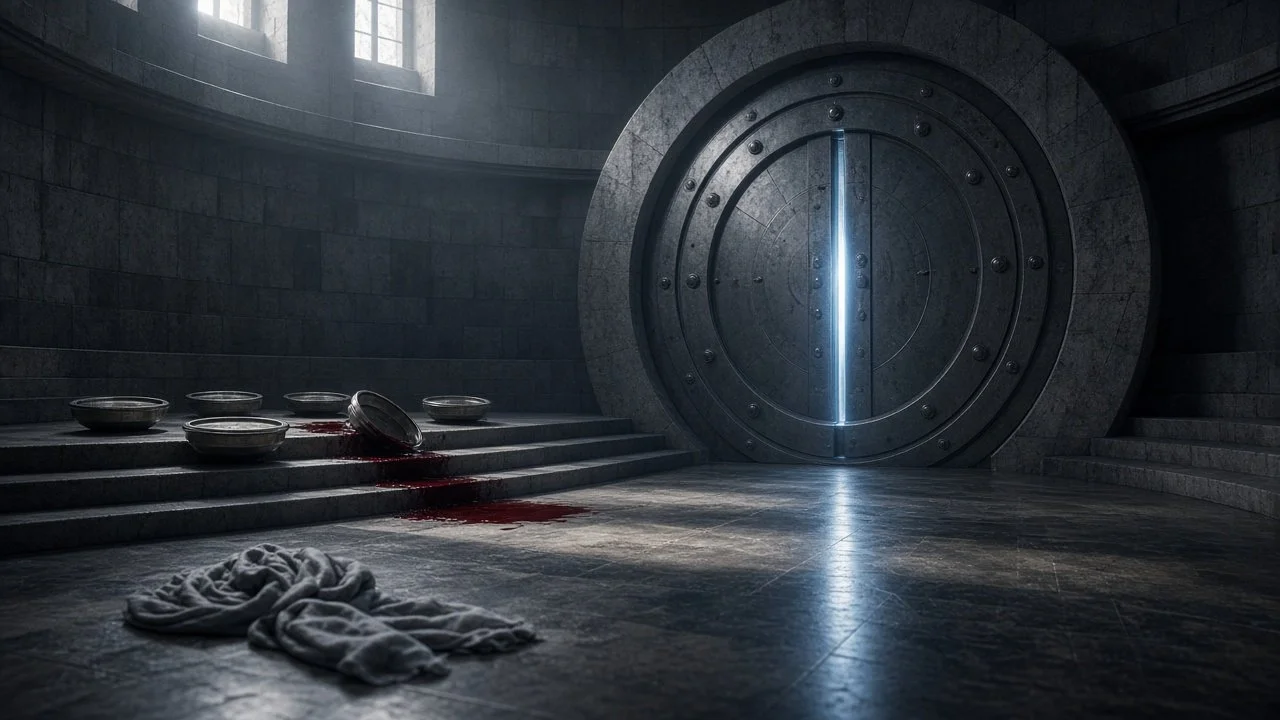
Central among those spaces is the Memory Vault. In its public logic, the Vault preserves important records so the city can keep a history. The comparison some readers make to The Giver is useful only up to a point: the Vault is not introduced as a society-wide happiness machine that empties every mind. It is an archive controlled by people who already govern. The danger is subtler and worse. If leaders can decide which memories are stored, retrieved or removed, then public agreement becomes unreliable. Peace can look like consent while functioning as managed compliance.
When Andrew, Tris’s father, tries to erase her memory of Evelyn, that danger turns intimate. He does not win an argument about what she saw. He tries to delete the seeing. Natalie helps Tris recognise that she is unsafe and guides her escape towards the factionless world. Beatrice takes the name Tris and leaves the house that taught her to disappear. The first major causal chain of the novel is complete: concealed Divergence → interrupted ceremony → retained dangerous knowledge → attempted memory erasure → flight.
Life Among the Factionless and the Foxes
Outside official belonging, Tris enters a different economy of survival. The Rookery and the Foxes—rebels who steal, spy and plot—offer training, purpose and new friendships without promising purity. To join fully, she has to prove usefulness in a culture that distrusts faction virtues even while depending on people who once held them. The factionless are not a blank utopia. They are a sixth pressure on the map: a reminder that the five official categories never accounted for everyone they discarded.
Christina arrives after injury and exclusion from Dauntless, including the loss of an eye after violence involving Peter. Their renewed connection matters because it shows how easily a faction’s promise of identity can fail a person who no longer meets its physical or social conditions. In the original continuity, shared initiation and shared resistance help build the friendship. Here, the bond has less of that earned apprenticeship and more of the fragile recognition between people who have both been expelled. The difference is not a minor casting change. It alters how much emotional shelter Tris has while the conspiracy accelerates.
Tris also becomes useful to Evelyn’s larger project. Evelyn wants Four. Tris’s path towards him is therefore never only romantic; it is entangled with recruitment, secrecy and the factionless claim that the entire system should die. The novel refuses to treat exclusion as automatic moral credit. Being harmed by a structure does not prevent a leader from reproducing its methods under a new banner. Evelyn can be right that the factions crush people and still be dangerous in the way she gathers power.
Caleb in Erudite and the Widening City
Caleb’s chapters, told with different access to his thinking than Tris receives, follow Erudite initiation and Jeanine Matthews’s growing hold over him. Multiple viewpoints are one of the book’s structural bets. Where a single Tris narration once limited the reader to one faction hallway at a time, the wider lens lets the city feel larger: how factions move, where they gather, and how their technologies sit inside ordinary ambition.
Intelligence becomes institutional loyalty in Caleb’s arc. The siblings share a childhood and almost none of the same information. When Tris later confronts him inside Erudite territory, blame and unfinished explanations sit between them. She resents a choice that, in her mind, helped trap her in Abnegation. He has entered another controlling system and is already learning to interpret evidence the way Erudite prefers. He even senses that something about their mother does not fit, which means a door was briefly ajar. Tris does not walk through it carefully enough. That missed conversation becomes part of the tragedy later, because the final confrontation arrives after the chance for shared doubt has narrowed.
Four, Fear and the Path Tris Did Not Take
Tobias Eaton—Four—appears first as the Dauntless boy Tris never became. Roth’s own notes on their dynamic are unusually clear: he intrigues her; she haunts him. He represents the path she refused after the ceremony. Fear simulations have taught him a hard self-knowledge she has not yet earned by the same route. She, arriving with too much information about who he used to be, sees more than he wants seen.
Their relationship develops under political pressure rather than the long shared initiation of the original book. Some readers, including detailed early reviews, have found the romantic acceleration abrupt; Kirkus still flags the slow burn and banter as strengths. Both observations can be true of the same pages: the book borrows emotional recognition from a famous pairing while giving this continuity fewer quiet hours to earn it. What the text does establish is mutual usefulness and mutual risk. Neither can keep the relationship separate from the uses Evelyn, Jeanine and Abnegation find for them.
Four’s history with Marcus keeps domestic abuse inside the novel’s politics. Escaping a violent parent does not automatically sanctify the parent who returns from the dead with a rebellion in hand. Evelyn’s continued existence is a destabilising truth long before it becomes a strategic alliance problem. In Four’s chapters, Dauntless without Tris also becomes newly visible: the same faction culture, different absences, and a clearer view of the pressures that made him a person who names himself by counting fears.
How the Conspiracy Closes In
Jeanine’s programme turns Dauntless soldiers into instruments of attack, converting courage without independent judgement into directed violence. The faction system’s neat separation of virtues now looks like a design flaw: bravery can be borrowed by whoever holds the simulation. Evelyn’s factionless leadership, meanwhile, proves capable of its own bargains, including strategic entanglement with Erudite and the willingness to treat family as leverage. Adults on every side hold secrets and accept collateral damage.
Tris’s work among the Foxes, her infiltration towards answers about the ceremony attack, and Four’s confrontation with Eric push both of them into the open. Natalie remains the clearest early ally inside the Prior family, and the novel gives her more direct instruction to Tris than the original continuity allowed at the same stage of the story—including guidance that points Tris towards her mother’s own record of the past. That change matters because it alters when Tris receives Natalie’s history and how she interprets sacrifice. Instead of discovering a mother mainly through aftermath, she receives an instruction to fight and survive while believing Natalie will follow.
When the attack on Abnegation arrives, losses become irreversible. Natalie dies protecting Tris, converting escape into a debt Tris cannot repay with later success. The Memory Vault, the transmitters and the simulations are no longer background texture. They are the machinery through which love, loyalty and obedience are enforced. A reader looking for a soft adventure about teenage sorting hats will not find one. The book’s second half insists that the city’s virtues were always operational systems.
How Does The Sixth Faction End?
In the control-room crisis that follows, Caleb holds Four at gunpoint and forces Tris into a simulation. She breaks free and shoots Caleb, killing her brother to save Four. The act prevents one death by creating another. It refuses a version of heroism in which every necessary choice leaves the protagonist morally untouched.
Andrew survives this continuity—an important difference from the original first novel’s emotional map. After a further confrontation with Evelyn, Tris, Four, Andrew and Marcus leave by train towards Amity once Evelyn is pressed into letting them go. The immediate battle ends. The consequences do not. Natalie and Caleb remain dead. Tris and Four have an immediate future together that begins inside guilt rather than innocence. Four’s sense that he must try to be worth what saving him cost Tris hangs over the departure without resolving it.
NPR is right that this ending prevents the book from functioning as a soft alternate on-ramp into the same later trilogy. Caleb’s death alone bifurcates the moral geometry. The publisher copy for The Last Testimony confirms the forward motion: Tris has been Abnegation initiate, faction defector and covert Fox; now she is on the run with Tobias beside her, chasing a secret that makes their known world look incomplete. This volume is a completed movement, not a closed series.
Why the Ending Hurts in This Continuity
Caleb’s death is the novel’s most argued beat, and it should be. Earlier scenes make him more visible as a manipulated teenager than a simple traitor: Erudite isolates him, Jeanine shapes his explanations, and he still attempts a distorted form of protection by pushing Tris into a simulation before he moves against Four. From inside his distorted logic, he can believe he is reclaiming a sister who has been captured by enemies. From outside it, readers can see both the care and the capture. Tris has chances to plant doubt and does not take them fully. When she finally decides that the Abnegation brother she knew never existed, the speed of that judgement is part of what later criticism is reacting to.
The book does not ask readers to celebrate the shot. It asks them to hold necessity and responsibility in the same hand. Choosing Four is no longer only a romantic outcome; it is bound to an irreversible family fracture. Andrew’s survival complicates the ledger further. Tris keeps one parent and loses trust in him because of the memory attack. She loses her mother in the act of being saved. She kills the sibling who shared her childhood. The train offers motion without cleansing.
If you only remember one causal point about the ending, remember this: the simulation gives Caleb a way to hide the killing from Tris, and her Divergence-linked resistance to control is what lets her break out in time to stop him. The technology that organised the city’s virtues becomes the arena of the final family choice. That is cleaner storytelling than a sudden gun appearing from nowhere, and it is also why the new receiver rules were worth Roth’s research detour.
Tris’s Arc Without Dauntless Initiation
In the original story, Tris learns courage partly by surviving Dauntless training and then has to reconcile that courage with Abnegation’s language of care. Here, remaining in Abnegation forces an earlier confrontation with how poorly the home faction fits her, and how willingly it will violate her mind to preserve itself. Independence arrives as refusal of managed memory before it arrives as battlefield bravado.
Her movement therefore requires more than nerve. She must separate a value from the people claiming exclusive authority over it. Selflessness can still mean protecting Natalie, Christina or Four. It cannot mean consenting to have Evelyn wiped from her mind because Abnegation finds the truth inconvenient. By the ending, her independence includes guilt. Freedom is not the fantasy of a clean exit. It is the capacity to own a consequence she cannot reverse.
That is why searches about whether Tris dies miss the point of this particular book. The fear is not that the system kills her on the page. The fear is that it teaches her to become the kind of person who can kill and keep moving. Compared with the sacrificial endpoint of the original trilogy, this opening volume bets on survival under contamination rather than purity through death. Whether that bet pays off belongs to the sequel.
Four, Caleb and the Family Problem
Four’s fear work and Marcus’s abuse show political control and domestic control as related patterns. Evelyn’s rebellion adds a third pressure: love and recruitment wearing the same face. Caleb’s Erudite allegiance completes the set. Shared upbringing does not produce shared judgement, and intelligence can become loyalty to whichever institution first makes a clever teenager feel seen.
Andrew’s attempt to erase Tris’s memory is the family’s most intimate betrayal because it borrows the vocabulary of care. He does not argue her out of dangerous knowledge. He tries to remove the knowledge. Once that line is crossed, every later parental gesture has to climb back over it. Marcus remaining in the departure party keeps another unresolved authority nearby. The train is not only an escape vehicle. It is a crowded carriage of competing claims about who gets to define the Priors and the Eatons next.
What the Alternative Timeline Is For
An alternate timeline earns its keep when changed circumstances create different information, which then creates different decisions. Evelyn’s attack precedes Tris’s altered choice; the ceremony is not a free laboratory experiment. The useful question is not which continuity is “correct,” but which pressures this continuity makes newly legible: Abnegation’s inner machinery, factionless compromise, a technology stack with clearer rules, and a Tris who meets corruption earlier and pays a different price for resisting it.
Readers who want the original trilogy deleted will be disappointed on purpose. Roth has said she does not want to betray the younger writer who finished Allegiant under crushing pressure. The new duology sits beside that work. Comparison should sharpen understanding, not erase either version. If you want a different model of returning to a beloved series—deepening familiar events through new perspective rather than changing the fork in the road—Taylor Tailored’s coverage of Threshing Day by Rebecca Yarros offers a useful contrast. One approach revisits continuity; the other builds a neighbour to it.
Why the Book Still Matters Beyond Fandom
The durable argument is institutional, not nostalgic. A society can praise honesty while controlling which truths may be spoken. It can celebrate selflessness while punishing the person who questions what must be surrendered. It can recruit the excluded into a rebellion that still bargains with the old power. Transmitters and simulations exaggerate the mechanism, but the mechanism is recognisable: attractive words used to close a question rather than answer it.
That is also why the title’s “sixth” pressure matters. Any category that cannot contain a whole person will eventually invent a dump for leftovers—factionless zones, failure labels, managed memories. Divergence is dangerous because it proves the sorting system is a convenience, not a discovery. The practical reading habit the book trains is simple and difficult: when a group praises your best quality, ask what that praise now permits them to demand.
Final Insight
The Sixth Faction is not a nostalgia product that politely restages Dauntless initiation with new wallpaper. It is a conspiracy about who owns memory, who defines virtue and what a sixteen-year-old becomes when every institution that claims to love her tries to edit her. The train at the end moves. The dead stay dead. The living have to decide whether courage still means anything once it has been used to save one person by destroying another.
Sources
The Sixth Faction — Veronica Roth (author page) — official premise and publication framing (checked 5 November 2026).
THE SIXTH FACTION is out today! — Veronica Roth Substack — release-day confirmation, technology design notes and Tris/Four relationship principles (6 October 2026).
Exclusive: Veronica Roth Announces New Divergent Book, The Sixth Faction — ELLE — BookCon announcement, AU duology framing, 6 October 2026 date and sequel timing (18 April 2026).
THE SIXTH FACTION | Kirkus Reviews — plot outline corroboration and critical assessment (review posted online 1 October 2026; pub date 6 October 2026).
With The Sixth Faction Veronica Roth rewrites Tris — NPR — independent critical response to character change and ending implications (9 October 2026).
The Last Testimony — Bookshop.org / HarperCollins listings — sequel title, 2 February 2027 date and publisher synopsis continuity (checked 5 November 2026).
Next Reads
The Hunger Games: Sunrise on the Reaping — another major YA dystopia return that revisits a famous world under new pressure.
Could The Hunger Games Ever Happen? — historical comparisons for readers who want the genre’s real-world stakes made concrete.
Threshing Day by Rebecca Yarros — a contrasting model of revisiting a beloved series through deepened perspective rather than an alternate timeline.
