What The Fourth Turning, The Storm Before The Storm And The Decline And Fall Of The Roman Empire Reveal About Why Civilisations Collapse
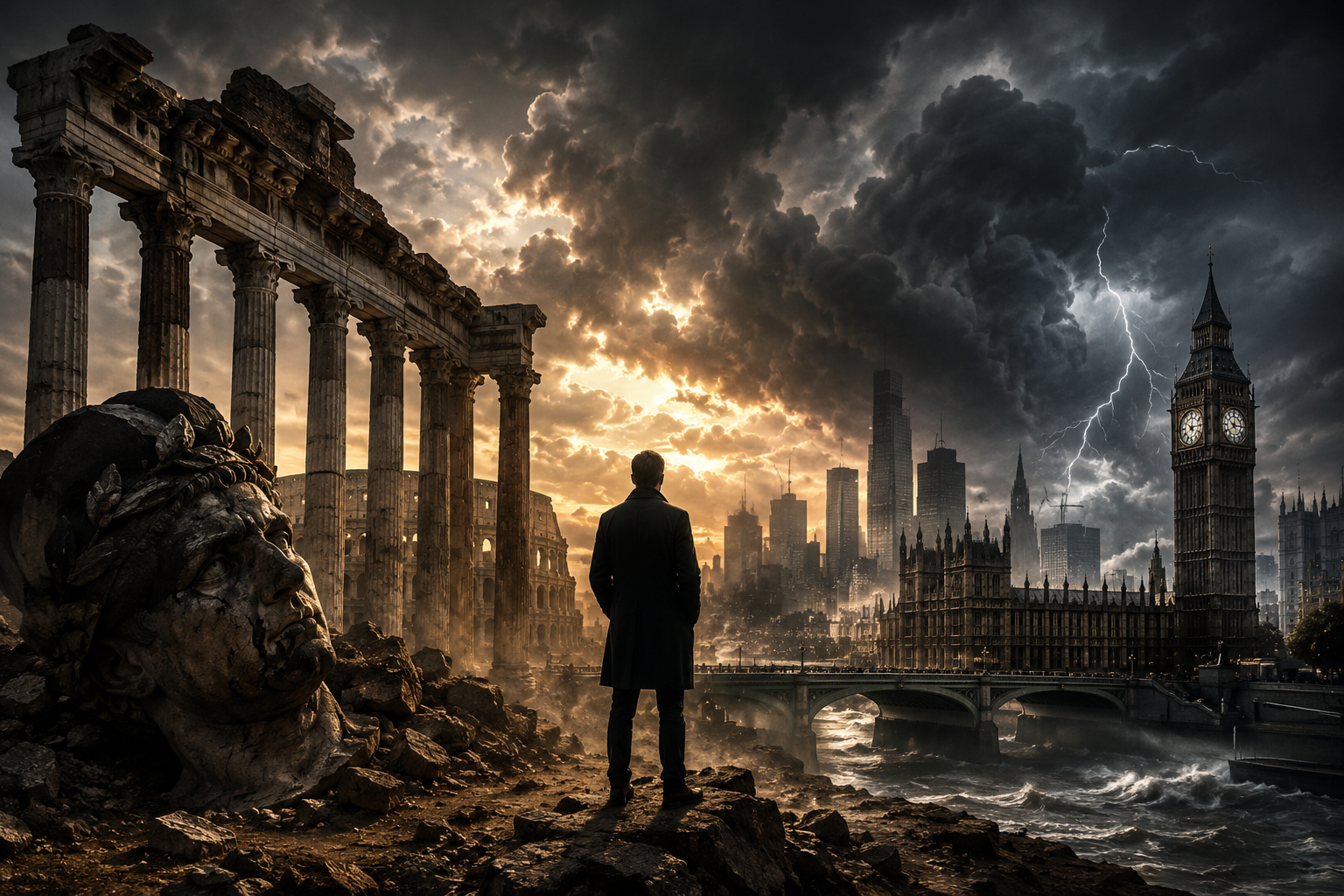
Why Great Nations Decay From The Inside Before They Fall Apart
The Fourth Turning, The Storm Before The Storm And The Decline And Fall Of The Roman Empire Reveal One Terrifying Pattern
Civilisations usually look strongest near the point where their weakness becomes irreversible.
The buildings still stand. The rituals still continue. The leaders still speak in the language of confidence. The institutions still hold meetings, pass laws, issue statements and insist that the centre is secure.
Then the shock arrives.
A debt crisis. A war. A legitimacy collapse. A constitutional breakdown. A demographic shift. A plague. A migration wave. A populist uprising. A succession crisis. A technological rupture. A religious fracture. A leadership vacuum.
The lazy explanation is that the shock destroyed the civilisation.
The darker explanation is that the shock merely revealed what had already happened.
That is why The Fourth Turning, The Storm Before The Storm and The Decline and Fall of the Roman Empire belong together. One is a controversial theory of generational crisis. One is a narrative history of the Roman Republic before Caesar. One is the monumental Enlightenment account of Rome’s long imperial decline.
They are different books, written in different styles, with different assumptions. But read together, they reveal a single pattern.
Civilisations collapse when pressure rises faster than renewal.
The uploaded Taylor Tailored prompt asks for individual summaries, cross-book synthesis, practical lessons, weaknesses, hidden patterns, and a retention-first framework for understanding these books together.
Books Covered
The Fourth Turning by William Strauss and Neil Howe — a 1997 book built around Strauss–Howe generational theory, arguing that Anglo-American history moves through recurring social cycles ending in crisis.
The Storm Before The Storm by Mike Duncan — a history of the Roman Republic’s destabilisation between Rome’s post-Carthaginian supremacy and the violent political breakdown that preceded Caesar. Publisher descriptions frame the book around Rome’s success after 146 BC becoming part of the Republic’s undoing.
The History of the Decline and Fall of the Roman Empire by Edward Gibbon — a six-volume work published between 1776 and 1789, covering the Roman Empire, early Christianity, the fall of the Western Empire and the later fall of Byzantium.
The Big Idea Connecting These Books
These books are all about the same terrifying contradiction.
Civilisations are built to preserve order, but the systems that preserve order can become the systems that prevent adaptation.
That is the central pattern.
A society creates institutions to solve previous crises. Those institutions become respected because they once worked. Over time, elites learn how to use them, citizens learn how to depend on them, and everyone begins to confuse the machinery of stability with stability itself.
But reality keeps moving.
Wealth concentrates. Old bargains break. Military burdens grow. Public trust declines. Political language becomes more extreme. Reform becomes harder. Grievance becomes identity. Each faction starts treating compromise as surrender.
The Fourth Turning describes crisis as cyclical renewal. The Storm Before The Storm shows how elite competition, inequality and political violence hollowed out the Roman Republic. Gibbon’s Decline and Fall shows how imperial power decays across centuries through overextension, weakened civic virtue, religious and political transformation, military pressure and administrative strain.
Together, they reveal the deeper truth.
Collapse is not an event.
Collapse is a loss of corrective capacity.
The Fourth Turning Summary
The Fourth Turning is not a conventional history book. It is a theory of historical rhythm.
Strauss and Howe argue that societies move through recurring generational cycles. Each cycle, or saeculum, lasts roughly the length of a long human life. Within it are four “turnings”: a High, an Awakening, an Unravelling and a Crisis.
The High is the period after a great national emergency has been resolved. Institutions are trusted. Public confidence is high. Individual expression may be lower, but collective purpose is strong.
The Awakening is the revolt against that order. People begin to feel spiritually, culturally or morally constrained. They challenge inherited institutions and seek personal authenticity.
The Unravelling is the period when institutions weaken, individualism rises and public life becomes fragmented. Trust falls. Culture wars intensify. The old order still exists, but fewer people believe in it.
The Fourth Turning is the crisis.
This is the book’s central claim: history repeatedly builds toward periods when society must pass through danger before it can be renewed.
The most important part of the argument is not the exact timetable. The most important part is the psychological pattern.
Each generation is shaped by the social mood into which it is born. A generation raised during crisis tends to value security and collective order. A generation raised after crisis tends to inherit stability without remembering the terror that created it. A later generation rebels against that stability. Another grows up amid institutional decay.
Eventually, the society reaches a point where accumulated contradictions can no longer be postponed.
Then the crisis begins.
The Plot In One Flow
The Fourth Turning tells history almost like a repeating drama.
A society survives a major crisis, builds a new institutional order, trusts that order, rebels against it, fragments around it, and eventually discovers that its inherited systems no longer match reality.
The book moves through examples from Anglo-American history, connecting periods of upheaval with generational succession. Its deepest narrative is not about one empire or one election. It is about memory decay.
The people who experienced the last catastrophe eventually die. Their children inherit the structures built after the catastrophe. Their grandchildren question them. Their great-grandchildren may only know them as lifeless machinery.
By the time the next great crisis arrives, the society is full of people who use words like freedom, order, justice, nation, rights and duty, but no longer agree on what those words require.
That is when crisis becomes clarifying.
The Fourth Turning argues that a society cannot avoid the season of crisis forever. It can only decide whether the crisis produces renewal or destruction.
If You Only Remember Three Ideas
The first idea is that civilisations are shaped by memory.
A society that remembers catastrophe behaves differently from one that treats peace and prosperity as normal. When hardship becomes distant, people become less willing to maintain the habits that made stability possible.
The second idea is that institutional decay often feels like personal liberation at first.
As public trust falls, individuals gain more freedom from inherited norms. But when every person, faction and institution begins operating from its own reality, collective action becomes harder exactly when it becomes most necessary.
The third idea is that crisis can be destructive or regenerative.
The Fourth Turning is not simply a doom book. Its deeper claim is that crises burn away exhausted arrangements. The danger is that societies may not survive the fire.
The Sentence That Explains The Entire Book
A civilisation enters its most dangerous period when the generation that remembers the last catastrophe has disappeared and the generation that must face the next one has not yet learned what reality costs.
Why This Book Still Matters
The Fourth Turning remains powerful because it gives readers a language for social mood.
Even if one rejects the book’s stronger claims about historical cycles, its diagnosis of institutional unravelling feels disturbingly useful. It explains why societies can become rich, technologically advanced and publicly dysfunctional at the same time.
The book also matters because it influenced modern political thinking far beyond literary circles. It has been widely discussed because of its role in the worldview of figures such as Steve Bannon, showing that historical-cycle theories can become political tools as well as analytical frameworks.
Its modern relevance is obvious: trust in institutions, generational conflict, political polarisation, economic insecurity and crisis psychology are no longer abstract themes. They are the atmosphere people live inside.
Where The Book Is Weakest
The danger of The Fourth Turning is that it can make history feel too neat.
Cycles are seductive because they turn chaos into pattern. But real history is messier than any model. Economic systems, technology, geography, leadership, war, biology and chance all matter.
The book can also encourage fatalism. If readers believe crisis is inevitable, they may start interpreting every event as proof of prophecy. That can become politically dangerous, because people may begin to welcome upheaval as necessary cleansing.
Its best use is not as a crystal ball.
Its best use is as a warning about what happens when societies lose institutional trust and generational memory at the same time.
Who Should Ignore This Book
Readers who dislike sweeping historical theory may struggle with it.
So will readers who want narrow academic caution, because the book is ambitious, pattern-heavy and at times speculative. Anyone looking for a conventional history of one civilisation should start elsewhere.
But readers interested in social mood, political crisis, generational psychology and civilisational stress will find it memorable.
How This Compares To The Storm Before The Storm
The Fourth Turning gives the theory.
The Storm Before The Storm gives the blood.
Strauss and Howe describe how societies move toward crisis. Mike Duncan shows what that process looks like when institutions are still standing but political life has begun to rot from within.
Where The Fourth Turning is cyclical and abstract, The Storm Before The Storm is historical and visceral. It does not need prophecy. It has assassinations, land conflict, elite panic, military loyalty, public grievance and constitutional norms being broken by people who claim necessity.
The Fourth Turning asks: what season is the civilisation in?
The Storm Before The Storm asks: what happens when ambitious men discover the old rules can be violated and still rewarded?
The Storm Before The Storm Summary
The Storm Before The Storm is about the Roman Republic before the famous final collapse.
That is what makes it so valuable.
Most people know the later drama: Julius Caesar, Pompey, civil war, dictatorship, assassination, Augustus and the birth of empire. Duncan’s book focuses on the earlier period, when Rome had defeated its greatest external rivals but had not yet understood what victory had done to it.
Rome becomes the dominant power in the Mediterranean. Wealth floods in. Conquered territories bring slaves, tribute, land and new opportunities for elite enrichment. The Republic grows richer and more powerful, but the old social compact begins to fracture.
Small farmers are squeezed. Land accumulates among the wealthy. Military service becomes harder to sustain under the old citizen-soldier model. Political competition intensifies. Reformers try to address social and economic pressures, but reform itself becomes a battlefield.
The Gracchi brothers become central figures.
Tiberius Gracchus pushes land reform. His opponents see him not merely as a politician but as a threat to the senatorial order. Violence enters Roman politics in a new way. His death marks a boundary crossing.
Gaius Gracchus follows with broader reforms and a more developed popular programme. He too is destroyed.
The Republic survives these crises, but survival is deceptive. Each violation creates a precedent. Each precedent makes the next violation easier.
Then comes the rise of men like Marius and Sulla.
Military command becomes politically transformative. Soldiers become tied less to the Republic as an abstract civic body and more to generals who can promise land, reward and status. Politics becomes militarised. Personal ambition and public crisis fuse.
Sulla’s march on Rome is one of the decisive moments. Once a Roman army can be turned against Rome itself, the Republic has entered a different reality.
The laws still exist.
But the taboo has broken.
The Plot In One Flow
The Storm Before The Storm begins with Rome victorious.
This is the crucial irony. Rome’s problem is not failure. It is success on a scale its institutions cannot absorb.
The Republic expands. Wealth concentrates. Inequality rises. Political offices become prizes in an increasingly ruthless elite game. Reformers emerge because the system has real problems, but reform threatens people who benefit from those problems.
The Gracchi attempt to use popular politics against senatorial obstruction. Their enemies respond with escalating hostility. Political murder, once unthinkable, becomes possible.
Rome then moves deeper into crisis through military and social change. The old citizen body is no longer enough to sustain the Republic’s imperial burdens. Ambitious commanders gain power through armies. Soldiers increasingly rely on generals for material reward.
Marius changes the political-military landscape. Sulla takes the logic further. By marching on Rome, he demonstrates that armed force can settle domestic politics.
The story ends before Caesar, but that is the point.
The storm before the storm is the moment when the Republic has not yet fallen, but the conditions of its fall are already visible.
The centre is still there.
But it no longer commands sacred obedience.
If You Only Remember Three Ideas
The first idea is that victory can destabilise a civilisation more than defeat.
Rome’s expansion made it rich, powerful and prestigious. But the wealth of empire changed the Republic’s internal balance. Success created new interests, new inequalities and new temptations.
The second idea is that political violence begins as an exception and becomes a method.
Once one side breaks a norm and benefits, the other side learns the lesson. The question changes from “is this legitimate?” to “can we afford not to do it too?”
The third idea is that institutions depend on restraint.
Rules matter, but unwritten limits matter more. When elite actors stop caring about the spirit of the system, the system can be legally alive and politically dead at the same time.
The Sentence That Explains The Entire Book
The Roman Republic began dying when its leaders learned they could break the rules to save the Republic and then discovered they preferred the power that breaking the rules gave them.
Why This Book Still Matters
The Storm Before The Storm matters because it explains the pre-collapse phase.
This is the stage people usually misunderstand. Societies rarely move straight from order to ruin. They pass through a period where everything looks familiar, but the meaning of familiar things has changed.
Elections still happen. Speeches are still made. Offices are still held. Laws are still cited. But beneath the surface, the incentives have shifted.
Duncan’s account is especially useful for modern readers because it focuses on political escalation. It shows how elite competition, public grievance, economic inequality and military transformation can reinforce one another until reform becomes indistinguishable from factional war.
The publisher’s own framing captures the core irony: after 146 BC Rome emerged as the strongest Mediterranean power, but that success helped undo the Republic.
Where The Book Is Weakest
The book’s strength is narrative clarity, but that also creates a limitation.
By telling the story with momentum, it can make the path toward collapse feel smoother than it was. Historical actors did not know they were living in the “beginning of the end.” They were responding to immediate pressures, rivalries, fears and opportunities.
The book also focuses on a specific phase of Roman decline: the late Republic. It is not a full account of why the Roman Empire later weakened. For that, Gibbon enters the conversation.
Who Should Ignore This Book
Readers who want a complete history of Rome should not treat this as the only book they need.
It is best for readers interested in political breakdown, republican institutions, elite competition and the early warning signs before dictatorship.
Anyone looking for a slow academic monograph may find it too narrative-driven. Anyone looking for modern political parallels spelled out directly may also be frustrated, because Duncan often lets the reader make the comparison.
That restraint is part of the book’s power.
How This Compares To The Decline And Fall Of The Roman Empire
The Storm Before The Storm is about the Republic losing its internal restraints.
The Decline and Fall is about empire across vast time.
Duncan’s book feels like watching cracks race through the foundations. Gibbon’s work feels like standing on a mountain and watching centuries grind down a civilisation.
The emotional difference is major.
The Storm Before The Storm is tense because the Republic still has choices. Decline and Fall is tragic because the reader sees how many layers of pressure accumulate until no single reform can save the whole structure.
Duncan is immediate.
Gibbon is vast.
Duncan shows the moment the taboo breaks.
Gibbon shows what happens when a civilisation becomes too large, too complex, too burdened and too transformed to recover its earlier strength.
The Decline And Fall Of The Roman Empire Summary
Gibbon’s The History of the Decline and Fall of the Roman Empire is one of the most ambitious historical works ever written in English.
It is not merely about the fall of Rome in the narrow sense. It follows the Roman world across centuries, from imperial height through fragmentation, religious transformation, military pressure, administrative strain and the eventual fall of the Western Empire. It then continues into the Byzantine world and the fall of Constantinople.
The scope is enormous.
Gibbon begins with Rome at or near its imperial grandeur. The empire appears vast, ordered and magnificent. Its armies defend the frontiers. Its laws structure civic life. Its emperors command prestige. Its cities radiate power.
But the grandeur contains weaknesses.
Succession is unstable. Military power becomes increasingly decisive. Emperors rise and fall through the army. Frontier pressures grow. Civic virtue declines in Gibbon’s interpretation. The empire becomes harder to govern, tax, defend and morally unify.
Gibbon gives major weight to the transformation of religion, especially the rise of Christianity. His treatment of Christianity was controversial, and modern readers should approach it critically. But within his argument, religious transformation is part of a wider shift in Roman identity and public spirit.
The empire does not collapse because of one invasion.
It weakens through accumulation.
Administrative burdens grow. Military reliance changes. Barbarian groups become enemies, allies, federates and settlers. Internal political instability makes external pressure more dangerous. The West loses resilience.
Rome is sacked. Imperial authority fragments. The Western Empire falls.
But Gibbon’s story does not stop there. He continues through the Eastern Empire, showing how Rome survives in altered form at Constantinople before that world too eventually falls.
The result is not a simple story of one fall.
It is a study of transformation, exhaustion and historical mortality.
The Plot In One Flow
The narrative begins with imperial Rome as a civilisation of astonishing scale.
For a time, it seems almost permanent. The empire’s borders stretch across continents. Its cities, roads, armies and laws give it an aura of inevitability.
Then the machinery begins to strain.
Power struggles weaken imperial continuity. The army becomes kingmaker. Civil conflict drains strength. The empire faces pressure from Persians, Goths, Vandals, Huns and other forces. Leaders attempt reforms, divisions and reconstructions, but the underlying challenge keeps returning: how does such a huge civilisation preserve unity, legitimacy and defence across time?
The empire adapts, but adaptation is uneven.
The West becomes more vulnerable. Rome’s symbolic power remains immense, but symbolic power cannot defend frontiers or fund armies by itself. Eventually, the Western imperial structure collapses.
The East survives longer, but survival is not the same as restoration. Constantinople preserves Roman continuity in a transformed world, but it too faces centuries of military, political and religious pressures before its final fall.
Gibbon’s story is therefore not the fall of a city.
It is the fading of a world system.
If You Only Remember Three Ideas
The first idea is that scale creates fragility.
Rome’s greatness made it difficult to manage. The wider the empire became, the more it depended on administration, taxation, military discipline and leadership continuity. When those weakened, size became a liability.
The second idea is that internal decay makes external pressure decisive.
Barbarian invasions alone do not explain Rome’s fall. External shocks matter most when the internal system has already lost resilience.
The third idea is that civilisations can survive in form after losing their original spirit.
Rome did not simply vanish. Its institutions, religion, law, language and imperial memory persisted in altered forms. Collapse often means transformation before disappearance.
The Sentence That Explains The Entire Book
Rome fell not because history turned against it in a single moment, but because the civilisation that had conquered the world slowly lost the discipline, unity and resilience required to govern what it had won.
Why This Book Still Matters
Gibbon still matters because he made decline feel like a civilisational drama rather than a list of events.
His work is not modern history in the full contemporary academic sense. Many of his assumptions, especially around religion and “barbarism,” require caution. But the scale of his analysis remains extraordinary.
Penguin describes the work as one of the most ambitious narratives in European literature, covering rulers, wars, society and the events that led to Rome’s collapse across a vast historical span.
Its relevance today lies in the questions it forces.
Can wealth soften a civilisation? Can military overreach hollow out political life? Can administrative complexity outgrow competence? Can public spirit decay while institutions still appear impressive? Can an empire become too accustomed to its own permanence?
Those questions have not aged.
They have sharpened.
Where The Book Is Weakest
Gibbon’s weaknesses are inseparable from his historical moment.
He was an Enlightenment writer, not a modern social scientist. His treatment of religion, culture and non-Roman peoples reflects assumptions that require scrutiny. His prose is magnificent but demanding. His judgements can be brilliant, cutting and unfair in the same movement.
The other limitation is scale.
Because the work is so vast, readers can mistake grandeur for completeness. Rome’s decline involved economics, climate, disease, demography, military adaptation, institutional change, regional divergence and contingency. No single framework explains everything.
Gibbon remains essential, but not sufficient.
Who Should Ignore This Book
Readers looking for a quick introduction to Rome should not begin with full Gibbon.
The work is long, dense and stylistically old. It rewards patience, but it does not behave like modern popular history.
Readers interested in contemporary scholarship should pair it with newer historians. But readers who want to understand the literary, intellectual and civilisational imagination of decline will find it irreplaceable.
The Common Themes Running Through All These Books
The first common theme is institutional exhaustion.
All three books show systems that once worked becoming less capable under new pressure. The problem is not that institutions are useless. It is that institutions built for one era can become dangerously slow in another.
The second theme is elite failure.
In all three books, collapse is accelerated by leaders who put faction, status, ideology or personal ambition above long-term survival. Elites do not merely mismanage decline. They often profit from the conditions that produce it.
The third theme is memory decay.
Civilisations forget why their rules exist. They inherit rituals without remembering the terror that created them. They keep the language of duty after losing the habits that made duty real.
The fourth theme is the danger of success.
Rome’s expansion helped destroy the Republic. Imperial scale burdened the Empire. In The Fourth Turning, post-crisis stability eventually breeds generations that do not understand the cost of stability.
The fifth theme is legitimacy.
A civilisation can survive hardship if people believe its institutions are basically legitimate. But when legitimacy breaks, every problem becomes existential.
Taxes become theft.
Compromise becomes betrayal.
Opposition becomes treason.
Reform becomes revolution.
The Hidden Pattern Across All These Books
The hidden pattern is this:
Civilisations collapse when their survival systems become status systems.
Institutions begin as tools for solving collective problems. Over time, they become ladders for ambition, symbols of identity and shields for vested interests.
A senate that once mediated power becomes a battlefield for aristocratic prestige.
An empire that once secured order becomes a machine for extracting resources to maintain itself.
A generational order that once preserved social trust becomes a hollow inheritance defended by people who no longer understand its purpose.
This is the moment decline becomes hard to reverse.
Because the people inside the system are no longer rewarded for repairing it.
They are rewarded for performing inside it.
That is the true pre-collapse signal.
Not poverty.
Not war.
Not corruption alone.
The real warning sign is when a civilisation’s most talented people become better at exploiting the system than renewing it.
Where The Books Quietly Disagree
These books agree that societies face recurring danger, but they disagree on what matters most.
The Fourth Turning emphasises rhythm, mood and generational succession. It suggests that crisis is part of a recurring historical pattern.
The Storm Before The Storm emphasises political incentives. It shows how elite rivalry, inequality and violence can make a republic ungovernable.
Decline and Fall emphasises duration, scale, morality, military pressure, religion, administration and historical transformation.
One sees cycles.
One sees escalation.
One sees exhaustion.
That disagreement is useful.
Because collapse is never caused by one thing. It is caused by interacting pressures. A civilisation dies when its economic model, political legitimacy, elite behaviour, social trust and defensive capacity all begin to weaken at the same time.
What Most People Misunderstand About These Books
The shallow reading of The Fourth Turning is: “A crisis is coming.”
The deeper reading is: “A society that loses memory and trust becomes vulnerable to crisis.”
The shallow reading of The Storm Before The Storm is: “Rome became violent.”
The deeper reading is: “Political violence became possible because elites decided winning mattered more than preserving the rules that made politics possible.”
The shallow reading of Decline and Fall is: “Rome fell because it became decadent.”
The deeper reading is: “Rome’s decline was a multi-century interaction of scale, pressure, leadership, legitimacy, defence, identity and adaptation.”
The internet loves simple collapse stories because simple stories are emotionally satisfying.
But these books are more disturbing than that.
They show that civilisational decline is not always obvious to the people living through it. Decline can look like normal politics. It can look like legal manoeuvring. It can look like necessary reform. It can look like defensive reaction. It can look like prosperity.
Until the system needs to absorb a shock.
Then everyone discovers how brittle it has become.
What The Internet Gets Wrong About These Books
Social media turns The Fourth Turning into prophecy.
It turns Rome into a meme.
It turns Gibbon into a quote machine about decadence.
That misses the point.
The value of these books is not that they let people declare, “We are Rome now.” That is usually lazy. Every age thinks it is uniquely doomed. Every faction thinks history confirms its own prejudices.
The better use is diagnostic.
Ask what conditions these books teach you to watch.
Is trust rising or falling?
Are elites repairing institutions or gaming them?
Are citizens still willing to sacrifice for the common order?
Are political losers still willing to accept defeat?
Are military, economic and administrative burdens growing beyond competence?
Are people using crisis language because reality demands it, or because crisis benefits them?
That is the real lesson.
Not “Rome fell, so we will fall.”
The lesson is: Rome fell after enough people stopped doing the boring, restrained, unglamorous things that keep a civilisation alive.
The Collapse Before Collapse Model
The Collapse Before Collapse Model has five stages.
Stage One: Success Outgrows The System
A civilisation wins under one set of conditions, then keeps using the same institutional habits after reality changes.
Rome conquers beyond the Republic’s old civic structure. The Empire expands beyond easy coherence. A modern society enjoys post-crisis stability long enough to forget the fear that created it.
The danger begins when yesterday’s success becomes today’s burden.
Stage Two: Elites Convert Stewardship Into Extraction
Leadership becomes less about preserving the system and more about maximising advantage inside it.
Offices become prizes. Public duty becomes branding. Reform becomes factional ammunition. Crisis becomes opportunity.
When elites benefit from dysfunction, dysfunction becomes durable.
Stage Three: The Public Loses Shared Reality
Citizens stop seeing opponents as rivals inside the same system and start seeing them as existential enemies.
Trust collapses. Rumour replaces authority. Every institution is interpreted through faction. The centre no longer speaks for the whole.
This is when compromise starts looking immoral.
Stage Four: Norms Break Before Laws Do
The written rules may remain, but restraint disappears.
This is the Roman lesson at its clearest. A republic can still have offices, assemblies and laws while the unwritten taboos that protect it are already dead.
Once one faction benefits from breaking norms, the other factions adapt.
The system becomes an arms race.
Stage Five: Shock Reveals The Truth
The final stage is not the cause of collapse.
It is the exposure.
War, debt, migration, plague, succession, economic crisis or technological rupture strikes the system. A healthy civilisation absorbs the blow. A brittle one fractures.
The shock gets blamed.
But the real collapse happened earlier.
The Real-Life Test
This pattern appears everywhere.
In careers, people collapse when their reputation becomes bigger than their competence. They keep the title, the language and the confidence, but stop updating the skill underneath.
In relationships, couples collapse when rituals remain but repair disappears. They still text, eat together and make plans, but conflict no longer produces understanding.
In money, households collapse when lifestyle becomes a status system rather than a stability system. The income may still look respectable, but the margin has gone.
In leadership, companies collapse when meetings replace decisions. Everyone can describe the process. Nobody can confront the truth.
In politics, nations collapse when every side can explain why the other side is dangerous, but nobody can explain what shared order they are still willing to protect.
The civilisational lesson is also personal.
Collapse begins when feedback stops changing behaviour.
How To Apply These Lessons Without Turning Them Into Another Self-Help Fantasy
Do not turn these books into vague motivation.
The practical lesson is not “be resilient” or “prepare for chaos.”
The practical lesson is sharper.
Measure whether your systems still correct errors.
In work, that means asking whether reports, meetings and dashboards actually change decisions.
In relationships, it means asking whether conflict produces repair or just resentment.
In personal finance, it means asking whether income growth is increasing freedom or simply funding fragility.
In leadership, it means asking whether people can tell the truth before the crisis.
In society, it means asking whether institutions still solve problems or merely perform authority.
Civilisations collapse when they cannot metabolise reality.
People do too.
Which Book Should You Read First?
Best entry point: The Storm Before The Storm.
It is the most narrative, immediate and accessible. It gives readers the clearest sense of how a political system can decay while still appearing alive.
Best for modern pattern recognition: The Fourth Turning.
Read it for social mood, generational memory and crisis psychology. Do not treat it as mechanical prophecy. Treat it as a model to pressure-test.
Best for scale and seriousness: The Decline and Fall of the Roman Empire.
Read Gibbon when you want the full grandeur of civilisational mortality. It is harder, slower and less immediately practical, but it gives decline its epic dimension.
Best combined reading order:
The Storm Before The Storm first.
The Fourth Turning second.
Gibbon third.
That sequence moves from concrete political breakdown, to general crisis theory, to vast imperial decline.
Five Questions To Test Whether You Actually Understood These Books
What system in your life still looks functional but has stopped correcting errors?
Where are you mistaking inherited stability for permanent stability?
Which leaders, organisations or institutions around you are rewarded more for performance than repair?
What norm, once broken, would make future breakdown much easier?
If a major shock arrived tomorrow, which parts of your life, work or society would prove resilient — and which would be exposed as theatre?
The Final Lesson
The deepest lesson across these three books is not that collapse is inevitable.
It is that collapse is prepared in advance.
Prepared by arrogance. Prepared by memory loss. Prepared by elites who exploit what they were meant to preserve. Prepared by citizens who inherit order but forget obligation. Prepared by institutions that keep their names after losing their function.
Civilisations do not fall simply because enemies arrive at the gates.
They fall because, long before the gates are breached, too many people inside have stopped believing the walls are their responsibility.
