Yesteryear Explained: The Tradwife Nightmare That Turns A Perfect Online Life Into A Prison
The Dark Truth Behind The Tradwife Fantasy
Caro Claire Burke’s Yesteryear begins with one of the sharpest fictional hooks of 2026: a famous tradwife influencer, celebrated and hated for selling an idealised vision of traditional domestic life, suddenly wakes up in what appears to be the real 19th century. No electricity. No indoor plumbing. No modern medicine. No content team. No staff quietly keeping the fantasy alive.That premise is why the book exploded. It is clean, marketable and immediately provocative. Natalie Heller Mills has spent her public life telling modern women that the old ways were better. Then the story appears to give her exactly what she claimed to want.
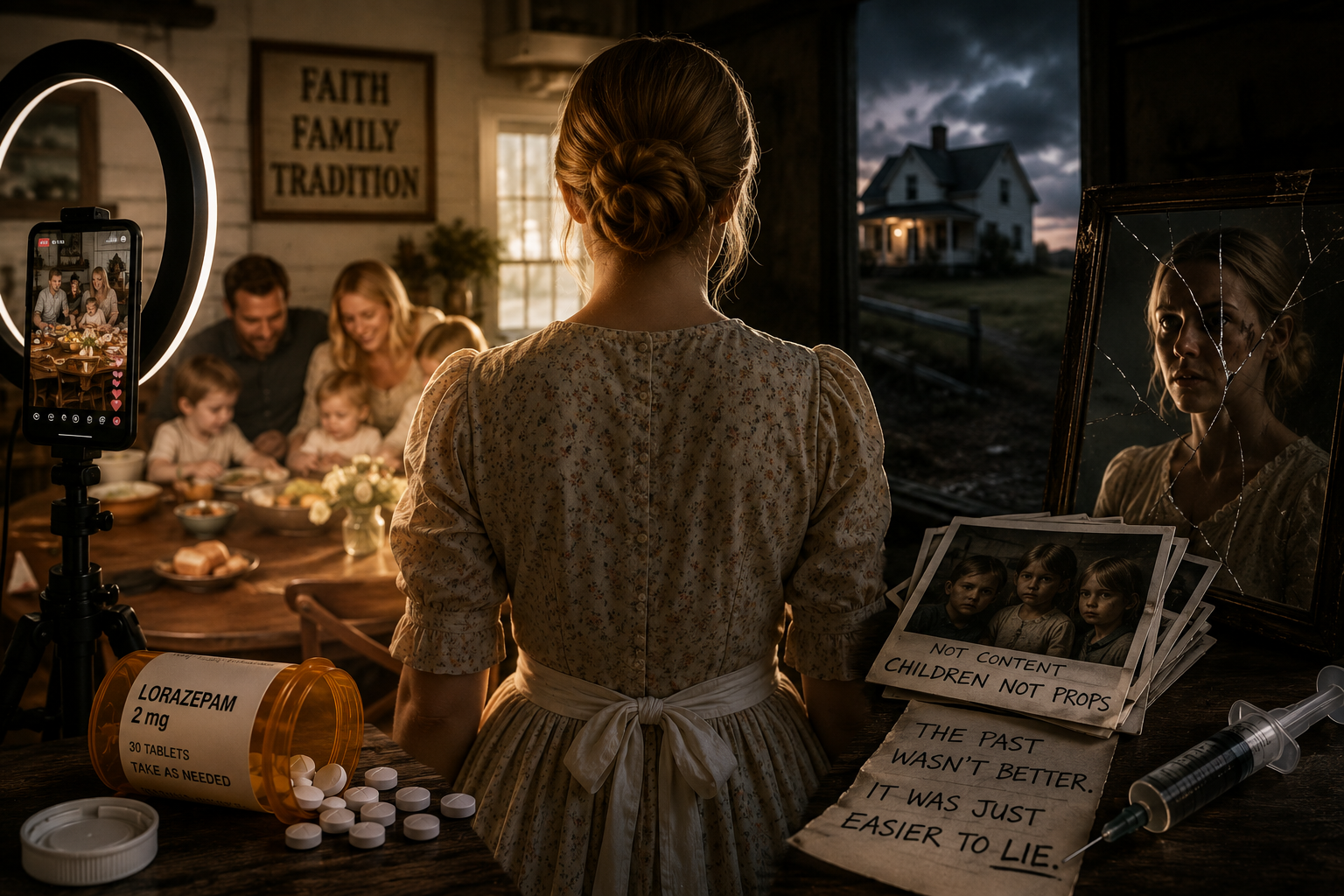
But Yesteryear is not simply a “tradwife gets what she deserves” morality tale. It is more uncomfortable than that. The novel’s real subject is not the past. It is the online present: the way people turn identity into content, family into product, marriage into theatre, faith into branding and suffering into proof of authenticity.
The question underneath the book is brutal: what happens when the image you perform becomes stronger than reality itself?
The Big Idea Of The Book
The big idea of Yesteryear is that nostalgia becomes dangerous when it stops being aesthetic and starts becoming ideology.
Natalie does not merely like old clothes, home cooking, children, marriage, Christianity and rural life. She sells them as proof that modern women have gone wrong. Her brand depends on the claim that the past was purer, simpler and morally superior.
The nightmare of the book is that she is forced to confront the difference between the edited image of traditional life and the physical reality of it. The old world is not soft lighting, sourdough, gingham and obedience filmed from the correct angle. It is labour, fear, danger, pregnancy, disease, male power, isolation and dependence.
That is the hook. The deeper point is colder: Natalie’s life was already a prison before she ever woke up in the past.
The Plot In One Flow
Natalie Heller Mills begins the novel as a woman who appears to have won the internet.
She lives on Yesteryear Ranch with her husband Caleb and their children. She presents herself as a perfect wife, perfect mother, perfect Christian woman and perfect symbol of a return to older values. Her online life is built around the idea that modern feminism has failed women and that the good life is found in submission, domestic labour, motherhood, modesty, faith and rural self-sufficiency.
But this perfection is already unstable. Natalie is not just a homemaker. She is a business. Her marriage, children, ranch, kitchen, clothes, routines and moral language all feed a brand. She has followers in the millions, critics in the millions, and a persona that depends on being envied and despised at the same time.
The contradiction is immediate. Natalie performs humility while craving dominance. She promotes female submission while behaving with ruthless ambition. She praises domestic purity while relying on modern wealth, technology, staff, production, distribution and social attention. She sells simplicity through one of the most complex attention machines ever built.
Her life only works because the unpleasant labour is hidden. The audience sees the loaf, the dress, the child’s smile, the farm image and the moral certainty. It does not see the machinery behind the performance.
The early Natalie is therefore not a woman outside modernity. She is one of modernity’s purest products.
Her husband Caleb appears, at first, as part of the brand. He is the masculine counterpart to Natalie’s traditional femininity: ranch, family, authority, Christian marriage, fatherhood, rural competence. But the marriage is not a simple patriarchal fantasy. Their relationship is full of tension, humiliation and resentment. Natalie may preach submission, but she does not naturally submit. Caleb may represent male authority, but he is not the commanding hero her content needs him to be.
That mismatch matters. The family’s public identity depends on a hierarchy that does not quite exist in private. Natalie’s brand needs Caleb to be strong. Her personality often suggests she thinks he is weak. She needs him as a symbol, but she does not necessarily respect him as a man.
This is one of the book’s smartest tensions. Natalie has built her fame on a gender arrangement that cannot contain her own temperament.
The ranch is also not simply a home. It is a stage. The children are part of that stage, and the novel gradually makes the reader aware that the family’s private life has been consumed by the logic of public visibility. Childhood becomes content. Domesticity becomes performance. Morality becomes monetisation.
Natalie’s children are not just children in the eyes of the brand. They are proof. Their existence validates her message. Their clothes, faces, obedience, illnesses, education and daily routines all become part of the story she sells about what a family should be.
This is where the novel becomes darker than a surface satire. The danger is not merely that Natalie is hypocritical. The danger is that her ideology has practical victims.
Then the speculative premise detonates.
Natalie wakes up in what appears to be 1855. Different sources and early summaries emphasise the 19th-century setting as the brutal historical reality behind her fantasy of old-fashioned domestic life. She finds herself stripped of the world that made her performance possible: no modern home comforts, no technology, no online audience, no assistants, no convenience, no infrastructure, no camera-ready control.
At first, the shock is conceptual. Natalie has wanted the old world as a symbol. Now she has the old world as a condition.
This is where Yesteryear becomes a trap narrative. Natalie must live inside the life she has advertised as better. The farm is no longer a curated brand location. It becomes a physical environment that can hurt her. The labour is not content. It is survival. The absence of modernity is not an aesthetic. It is exposure.
She has to deal with basic realities that the tradwife fantasy usually edits out: bodily discomfort, exhaustion, food, heat, cold, danger, illness and dependence on other people. A woman who has built a career out of romanticising older womanhood now faces a world where women’s freedom is materially limited by law, custom, poverty, childbirth risk, male violence and isolation.
The first emotional movement is panic mixed with denial. Natalie does not immediately become humble. She tries to interpret the situation through frameworks that preserve her ego. Is this a hoax? Is it a reality show? Has she been kidnapped? Has she travelled through time? Is she being punished? Is she losing her mind?
That uncertainty is central to the novel’s suspense. The reader is asked to inhabit the same unstable reality as Natalie. The book’s engine is not just “a woman in the past.” It is “a woman who cannot tell whether reality itself has turned against her.”
The 1855 sections work because they attack Natalie’s ideology at the level of the body. Online, she could speak about submission and simplicity from a position of hidden advantage. In the apparent past, she has no frictionless escape hatch. She cannot log off. She cannot reframe hardship as content. She cannot send staff to fix what does not fit the image.
The more she is forced into this world, the more the fantasy collapses. The past does not validate her. It exposes her.
Yet the novel does not make Natalie instantly sympathetic. She remains difficult, controlling, self-protective and often morally ugly. She is not a pure victim of a system she never chose. She has actively profited from it. She has helped sell it. She has turned other women’s insecurity into an audience.
The story then begins to move between Natalie’s life before the apparent time shift and her life inside the supposed historical nightmare. This structure matters because the 1855 plot is not isolated from the modern plot. The past increasingly becomes a distorted mirror of the life she had already created.
Before the collapse, Natalie’s fame is rising but unstable. She is a celebrity within a culture war. Her followers love her because she appears to offer certainty. Her critics hate her because she appears to package female regression as empowerment. Media attention grows. The ranch becomes more visible. The family becomes more valuable as spectacle.
But the system requires constant escalation. A normal domestic life is not enough. Content must sharpen. Moral branding must intensify. Enemies must be named. Purity must be displayed. Contradictions must be hidden.
Natalie’s public image depends on control, but her private world is becoming uncontrollable.
Caleb is not the simple husband-protector figure the brand requires. Their marriage is rotting underneath the public story. He is resentful, passive in some ways, complicit in others, and increasingly exposed as someone who benefits from the performance while also hiding behind it. Reviews and reader discussions note that Caleb’s role darkens sharply as the novel progresses, especially around his complicity in the deception, harm and family breakdown.
There is also Shannon, whose presence helps rupture the carefully managed family image. Shannon is involved with Caleb, and when the affair becomes part of the public collapse, Natalie’s rage turns violent and desperate. A spoiler-focused reader guide describes Caleb telling Natalie he is in love with Shannon, Shannon attacking the reality of Natalie’s “home” as more business than family, and Natalie responding by trying to strangle her.
That moment matters because it punctures Natalie’s central fiction. Her home is not a sanctuary. It is a production company with children inside it. Her marriage is not a sacred hierarchy. It is a failed relationship being forced to perform coherence for profit and politics.
The Shannon crisis also pushes the novel toward psychological breakdown. Natalie’s public enemies now have evidence. The brand is no longer merely controversial; it is vulnerable. Accusations and revelations begin to accumulate around pesticides, animal harm, child harm, family exploitation and sexual misconduct.
The ranch, once sold as proof of moral superiority, becomes a crime scene in slow motion.
The children become the emotional centre of the book’s consequences. This is where Yesteryear refuses to let ideology remain abstract. It is not enough to say Natalie has bad ideas. The novel shows bad ideas becoming household conditions. Children are controlled, displayed, neglected and drawn into a fantasy they did not choose.
Natalie’s relationship with motherhood is one of the book’s most uncomfortable elements. She presents motherhood as sacred. Yet her children often function inside her life as evidence, accessories and extensions of her worldview. Some critics argue that the novel’s portrayal of motherhood and the children can feel underdeveloped or instrumental, but within the plot, that instrumental quality is also part of the horror: children in influencer families can become symbols before they are allowed to be people.
The more Natalie’s public world cracks, the more the apparent 1855 world becomes narratively suspicious.
At first, the reader may treat the historical setting as literal speculative punishment. Natalie wanted the past, so she got the past. That is the clean hook. But the book gradually plants evidence that something else is happening. The past is not a coherent historical reality. It begins to look constructed, unstable and connected to Natalie’s modern collapse.
The logic of the nightmare starts to bend.
Natalie encounters figures and moments that do not fit a simple time-travel story. Illness, fear and confusion intensify. Maeve becomes sick, forcing Natalie to seek help. She asks Mary where to find a doctor and sets out in desperation, an inversion of the confident online mother who once claimed to know what women and families needed.
The journey is important because it strips Natalie down. She is no longer filming the past. She is begging reality to make sense. She is no longer the woman with answers. She is the woman who cannot protect her own child inside a world she once claimed was better.
Then comes one of the major rupture points: Natalie reaches a neighbour’s house, and a boy calls her “Mama.” She becomes confused. Then, as she heads back, a car appears and Clementine gets out. The intrusion of the modern world into the supposed past breaks the illusion.
That image is the story’s trapdoor.
The reader now has to reinterpret everything. If this is 1855, why is a car here? If Natalie travelled through time, why does the modern family world remain connected? If she is trapped in a historical reality, why does the structure feel increasingly like a manufactured escape from scandal?
The answer is that Natalie has not been living in a genuine time-travel miracle. She has been inside a breakdown and a deception.
The ending reveals that the historical nightmare is not literal time travel and not simply a reality show. Natalie suffered a psychological collapse after Shannon’s interview and the public unraveling of her life, and she turned Yesteryear into a fake past as a way of hiding from the truth. Spoiler discussions describe the final revelation as Natalie not having time-travelled, but instead retreating into a constructed historical fantasy after her life imploded.
This twist changes the entire meaning of the book.
The 1855 world is no longer just punishment from outside. It is an extension of Natalie’s own ideology, mental collapse and refusal to face consequences. She does not merely believe in the past. She uses the past as a bunker.
That is the cruel genius of the title. “Yesteryear” is not just a time period. It is a brand, a fantasy, a property, a psychological defence and eventually a prison.
Caleb’s role becomes more disturbing in the reveal. Reader discussions point to his participation in drugging Natalie, lying to the children and playing along with the false world, while also being implicated in the wider abuse and harm around the ranch.
This makes Caleb more than a passive husband. He is not merely trapped by Natalie’s madness. He is a collaborator in the collapse. He helps sustain the illusion when it serves him, and his own manosphere/prepper logic gives him a reason to remain inside the fake world.
The book’s gender politics become more complicated here. Natalie sold female submission while privately acting as the dominant force in the brand. Caleb looked like patriarchal authority while often appearing weak, resentful or morally cowardly. But in the final movement, both are exposed as dangerous. The fantasy required both the ambitious performer and the complicit man beside her.
The children are the ones with the least power and the greatest cost.
Natalie and Caleb eventually leave the fake historical world, not because they have morally awakened, but because the alternative has become untenable. Their hatred, exhaustion and mutual contempt make the constructed past impossible to sustain. The fantasy collapses under the weight of reality.
Then accountability arrives.
Natalie is arrested and receives a 30-year prison sentence for child abuse and other crimes, according to spoiler discussion material. Caleb also faces consequences connected to child and animal abuse, though Natalie appears to receive additional punishment because of the wider charges around her conduct.
The ending also features an interview between Natalie and Reena, her old college roommate and long-time rival. This is significant because Natalie’s life has always been shaped by comparison. Reena represents the alternative woman, the old measuring stick, the person Natalie wanted to defeat, disprove or outshine.
By the time Natalie sits for that interview, the reader might expect transformation. Prison, collapse, public exposure and the destruction of the family brand might have forced her into insight.
But the novel withholds easy redemption.
Natalie has been punished, but punishment is not the same as wisdom. She can explain, perform, justify and narrate. Yet the evidence suggests she has not truly escaped the old need to control the story.
This is why the ending lands with a sour aftertaste. The legal system can sentence Natalie. Public opinion can condemn her. The brand can die. But the deeper machinery that created her remains alive: attention, grievance, gender performance, moral certainty, curated family life, online hatred and the hunger to turn identity into proof of superiority.
Natalie loses. But the world that made Natalie possible does not disappear.
The Main Characters Inside The Plot
Natalie Heller Mills is the novel’s centre: intelligent, ambitious, cruel, funny, unstable, self-aware in flashes and blind in the ways that matter most. She wants reverence. She wants control. She wants the world to confirm that her chosen performance of womanhood is not only valid but superior.
Her tragedy is that she does not actually fit inside the image she sells. She performs obedience but wants domination. She praises simplicity but thrives on attention. She claims family is sacred while treating family as brand infrastructure. She condemns modern women while being deeply modern herself.
Caleb is the husband-symbol who becomes something darker. At first, he appears as part of Natalie’s aesthetic of traditional marriage. But the story gradually exposes him as resentful, compromised and morally weak. By the end, he is not just a failed husband; he is an accomplice inside the family’s collapse.
Shannon is one of the forces that breaks the brand. Her relationship with Caleb and her later public role expose the lie inside Natalie’s home. When Shannon says Natalie does not really have a family but a business, the accusation lands because the entire novel has been proving it.
Reena functions as Natalie’s long-term mirror. She is not only a person from the past but a psychological rival. Natalie’s need to be seen, judged and validated by Reena helps explain why even after catastrophe she still wants one more controlled public performance.
The children are the moral evidence. They show that ideology is not harmless when it becomes household law. Adults can choose fantasy. Children have to live inside it.
The Central Conflict Inside The Plot
The central conflict is not Natalie versus the past.
It is Natalie versus truth.
She has built a life around a claim: that women would be happier, purer and more fulfilled if they returned to older roles. But the evidence of her own life contradicts her. Her marriage is miserable. Her children are exploited. Her home is a business. Her faith is entangled with performance. Her domesticity is supported by modern systems she publicly despises.
The apparent 1855 nightmare forces the contradiction into physical form. If the past is so good, why is it unbearable? If submission is so natural, why does Natalie fight so hard for control? If family is more important than fame, why does fame repeatedly win?
The deeper conflict is between image and consequence. Natalie can control image for a long time. She cannot control consequence forever.
The Turning Points Inside The Plot
The first major turning point is Natalie waking inside the apparent 19th century. This converts her ideology from content into lived reality. The fantasy stops being decorative and becomes dangerous.
The second major turning point is the collapse of the modern family brand through Caleb, Shannon and the public allegations around the ranch. This reveals that Natalie’s old life was already breaking before the historical nightmare began.
The third major turning point is the intrusion of the modern world into the supposed past, especially Clementine appearing after Natalie’s confused journey. This breaks the time-travel frame and signals that the reader has been inside something more psychologically and materially constructed.
The final turning point is the reveal that Natalie did not literally travel through time. She retreated into a fake past after a breakdown, with Caleb’s participation and the children trapped inside the consequences.
Each turn makes the book less simple. It begins as satire, becomes survival horror, becomes psychological thriller, and ends as social indictment.
The Emotional Journey Inside The Plot
The emotional journey begins with contempt. Natalie looks easy to hate. She is smug, hypocritical and publicly invested in judging other women.
Then the book shifts into satisfaction. The premise gives readers the pleasure of seeing someone forced to live by the rules she marketed to others. The punishment feels narratively clean.
But that satisfaction curdles. As the plot reveals children, breakdown, abuse, complicity and mental collapse, the reader is forced to confront the ugliness of enjoying Natalie’s suffering too much. This is one reason the book became so heavily discussed: it gives the audience a villain, then asks whether the audience’s hunger to see her punished is itself part of the same attention economy.
By the end, the dominant feeling is not triumph. It is contamination. Nobody comes out clean: not Natalie, not Caleb, not the public, not the media, not the followers, not the critics, and not the fantasy of the past.
The Ending Explained
The ending reveals that Natalie’s apparent journey into 1855 was not literal time travel. It was the product of psychological collapse, deception and a constructed retreat from the consequences of her modern life. After Shannon’s interview and the exposure of the ranch’s realities, Natalie hides inside the most extreme version of her own brand: a fake old world where she can pretend the modern one no longer exists.
This is why the ending matters. The novel is not saying “the past was bad and the present is good.” It is saying that false worlds become dangerous when powerful adults force children and dependents to live inside them.
Natalie’s prison sentence is the legal ending. Her failure to truly understand herself is the moral ending. She is punished, but the performance instinct survives.
The final interview with Reena suggests that Natalie still wants control over the story. She still wants an audience. She still wants to narrate herself into significance. That is the last horror of Yesteryear: even after everything collapses, the urge to perform does not die easily.
The Story Anchor
The strongest image in the novel is not Natalie waking up in the past.
It is the moment when the fake past starts breaking and the modern world returns.
Natalie has been moving through the nightmare as though history itself has swallowed her. Then reality punctures the illusion. A child calls her “Mama.” A car appears. Clementine steps into the scene. The frame collapses.
That moment is the book in miniature. The past was never pure. It was never sealed. It was always connected to the present, to the children, to the lies and to the consequences Natalie was trying to outrun.
If You Only Remember Three Ideas
First, nostalgia is safest when it remains honest about cost.
There is nothing inherently wrong with liking tradition, domestic life, motherhood, faith or rural beauty. The danger begins when an aesthetic becomes a moral weapon and the actual costs are hidden from view.
Second, a family becomes unsafe when it is forced to serve a public identity.
Natalie’s worst failure is not hypocrisy. It is making the people closest to her live inside her performance. The children are harmed because the brand needs them to prove something.
Third, punishment does not automatically create wisdom.
Natalie is exposed, disgraced and imprisoned. But the ending refuses to pretend that consequence equals transformation. Some people do not learn from collapse. They simply find a new way to narrate it.
The Sentence That Explains The Entire Book
Yesteryear is about a woman who sells the past as paradise, then destroys her family trying to hide inside the fantasy she created.
Why This Book Matters
Yesteryear matters because it captures a real cultural tension: many people are exhausted by modern life, but the fantasies offered as escape are often heavily edited, monetised and politically weaponised.
The tradwife trend is not just about baking bread or raising children. It is about status, gender, resentment, attention, identity and the desire to believe that modern confusion can be solved by returning to older rules.
The novel also matters because it understands the internet as a pressure system. Natalie is not famous despite being controversial. She is famous because she is controversial. Her enemies help build her. Her critics sustain the spectacle. Her followers and haters are part of the same machine.
If the book were written again in five years, the social media platforms might change. The underlying dynamic would not. People will still build brands out of pain. Audiences will still confuse performance with truth. Families will still pay the price when private life becomes public property.
Misconceptions
The shallow reading is that Yesteryear is simply anti-tradwife.
The deeper reading is that it is anti-performance.
The book is not only attacking women who romanticise the past. It is attacking the entire system that rewards people for turning identity into theatre. Natalie’s ideology is the most visible target, but the attention economy around her is also on trial.
Her critics are not automatically pure. Her followers are not automatically stupid. The novel’s darker implication is that everyone involved in the spectacle gets something from it.
The internet version of Yesteryear is simple: tradwife influencer gets sent to the past and learns it was terrible.
That is clickable, but incomplete.
The actual plot is more psychologically compromised. Natalie does not merely learn the past is hard. She collapses under the contradictions of her own life, then helps create a false world where those contradictions can be denied. Caleb’s involvement, the children’s suffering and the legal ending make the book less like a neat fantasy punishment and more like a domestic horror story about adults choosing ideology over reality.
Book-summary culture often turns novels into lessons. Yesteryear resists that because its lesson is ugly: people can be exposed and still not understand themselves.
The Taylor Tailored Interpretation
The Taylor Tailored reading is this: Yesteryear is a novel about what happens when status anxiety disguises itself as moral conviction.
Natalie does not only want a traditional life. She wants to win. She wants to be admired for choosing the “right” life, envied for embodying it, hated by enemies who prove her importance, and defended by followers who need her certainty.
That is why the past is so useful to her. The past cannot answer back when it is being used as content. It can be edited into whatever the brand requires.
But once the fantasy becomes physical, it stops flattering her. It reveals that she never wanted the past as it was. She wanted the authority of the past without the suffering, the aesthetics without the danger, the hierarchy without the helplessness, the obedience without the humiliation, the family image without the family responsibility.
Her real addiction is not tradition. It is control.
The Real-Life Test
The real-life test of Yesteryear is simple: where are you using an identity to avoid evidence?
People do this in careers, relationships, politics, health, money and status. They decide what kind of person they are, then defend the image even when reality contradicts it.
A leader says they are decisive but avoids hard conversations. A partner says they value honesty but hides inconvenient truths. A creator says they are authentic but edits every part of life into performance. A family says it is loyal but punishes anyone who breaks the image.
Natalie is an extreme version of a normal human pattern. She confuses consistency with truth. She would rather intensify the role than admit the role is failing.
How To Apply The Lessons Without Turning Them Into A Fantasy
Do not ask what identity sounds best. Ask what behaviour is producing.
If a belief makes you calmer, kinder, more responsible and more honest, it may be useful. If it makes you cruel, brittle, performative, dependent on enemies and unable to hear correction, it is probably protecting ego rather than truth.
Do not romanticise systems you have not stress-tested. Domestic life, career ambition, traditional marriage, modern freedom, religion, politics, entrepreneurship and creativity all have costs. Adults should choose with eyes open.
The practical lesson is not “avoid tradition” or “avoid modernity.” It is simpler: never build a life that requires you to lie about the damage it is causing.
Five Questions To Test Whether You Actually Understood This Book
What did Natalie actually want: tradition, safety, admiration, control or punishment?
At what point did her family stop being a family and become part of the business?
Why does the fake past reveal more truth than Natalie’s public present?
Was Caleb weak, evil, complicit or all three?
Does Natalie’s punishment prove justice, or does it simply create one final public performance?
The Final Lesson
The final lesson of Yesteryear is that the past becomes dangerous when people use it to escape accountability in the present.
Natalie Heller Mills wanted a world where the rules were fixed, the roles were clear, the family looked perfect and nobody could force her to admit the lie. What she built instead was a prison with a farmhouse door, a camera-ready kitchen and children trapped inside the content.
The horror is not that Natalie woke up in the wrong century.
The horror is that she built the century herself.
