

Homelander Analysis: The Wound, the Mask and the Terrifying Lie That Built a God
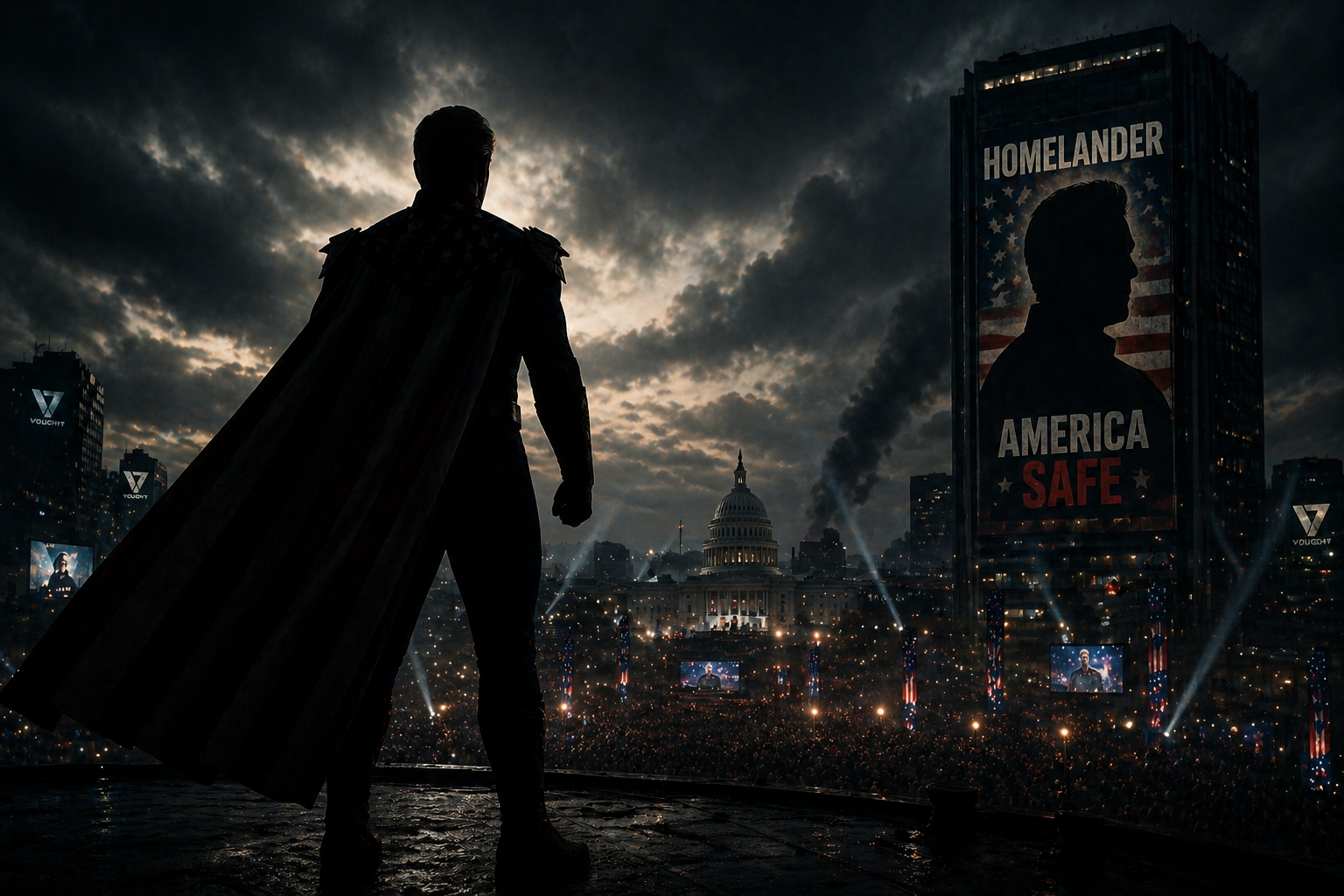
The Hidden Psychology of Homelander: Power, Shame and the Need to Be Loved
The Broken Child Inside the American God
The monster in Homelander is not born from strength, but from a child who was taught that love must be earned through fear
Homelander is terrifying because he is not a god who becomes human.
He is a child who becomes a weapon, then discovers the world will applaud the weapon if it smiles properly.
That is the engine of the character. Not laser eyes. Not flight. Not invulnerability. Not the flag, the cape, the perfect jawline, or the corporate speeches about safety and freedom. Those are decorations. Homelander’s real story is about a person with absolute physical power and almost no inner structure. He can hear a heartbeat across a room but cannot tolerate the sound of his insecurity. He can tear bodies apart but cannot survive being emotionally ignored. He can rule crowds, boardrooms, cities, and eventually a country, but he remains trapped inside the original room that made him.
That is why he works so well as a villain. Homelander is not frightening because he is emotionless. He is frightening because he is ruled by emotion and powerful enough to make everyone else pay for it.
His central contradiction is brutal: he wants to be loved freely, but he has no idea how to receive love without controlling, buying, threatening, performing, or punishing his way into it. The more worship he gets, the less safe he feels. The more powerful he becomes, the more visibly childish he looks. The more he insists he is above humanity, the more obvious it becomes that he is starving for the most human thing imaginable.
To understand Homelander is to understand the difference between power and security.
He has the first in limitless supply.
He has almost none of the latter.
Who Is Homelander?
Homelander is the leader of The Seven in The Boys, the public face of Vought’s superhero empire, and the most dangerous figure in the show’s world. Official material frames The Seven are led by Homelander, played by Antony Starr, and the series builds its central conflict around what happens when a corporate superhero product becomes politically, emotionally, and physically uncontrollable.
On the surface, he is the ultimate patriotic saviour. He descends from the sky like divine authority with a press-ready smile, a heroic costume, and a voice trained for cameras. He is sold as a protector, soldier, celebrity, father figure, national symbol, and moral certainty.
Underneath, he is Vought’s most successful failure.
The company made him powerful, marketable, and nearly untouchable. It did not make him whole. Homelander was not raised by a family. He was engineered, studied, isolated, and conditioned. He was treated less like a boy than a military asset with branding potential. That origin matters because it explains the emotional deformity at the center of him. He has been worshipped by millions, but he was not loved by one stable parent in the ordinary human sense.
That gap creates the character.
Homelander is not merely a corrupt superhero. He is a manufactured messiah whose private emotional life never caught up with his public mythology. He performs adulthood, dominance, and divine certainty, but his emotional reflexes often belong to someone much younger: needy, jealous, impulsive, humiliated by criticism, desperate for approval, and violently unable to regulate disappointment.
The show’s brilliance is that it never lets his pain excuse him. His childhood explains the wound. It does not absolve the murders, coercion, cruelty, sadism, manipulation, or authoritarian hunger. Homelander is both damaged and responsible. That tension keeps him from becoming a flat monster or a misunderstood victim.
He is the child in the lab.
He is the god in the sky.
He is the tyrant in the room.
All three are true.
Homelander Character Analysis: Surface Identity vs Real Identity
Homelander’s surface identity is built from certainty.
He speaks as though the moral order of the universe has already placed him at the top. His costume is clean, symbolic, and loud. His posture tells people where to look. His smile functions like a threat hidden inside customer service. Even when he is pretending to reassure someone, there is often a second message underneath: you are safe only because I have decided not to destroy you.
That surface identity is the mask Vought built for him and the mask he eventually believes he deserves.
But his real identity is much less stable.
The real Homelander is not confident. He is addicted to confirmation. He needs crowds, ratings, applause, fear, sexual validation, family possession, political submission, and symbolic victory because none of them last long enough to calm him. He is not secure in his superiority. He has to keep proving it.
That is why he reacts so badly to disrespect. A secure god would ignore mockery. Homelander cannot. A secure leader would not need everyone in the room to emotionally submit. Homelander does. A secure father would let his child become separate. Homelander cannot bear separation because he experiences it as rejection.
The public mask says: “I am above you.”
The private wound says, "Please do not leave me.”
This is why his cruelty often has the rhythm of humiliating revenge. He does not only kill to remove obstacles. He punishes people for making him feel small. That is a different kind of violence. It is intimate, emotional, and shame-driven. He wants the victim to know they caused the correction. He wants them to understand that the person they underestimated was never weak.
The terrifying part is that he confuses that revenge with truth.
The Core Wound: A Boy Raised Without Love
Homelander’s core wound is not that he was denied power.
He was denied attachment.
He was raised inside an institution that measured him, tested him, praised him when useful, and controlled him when necessary. The result is a person who never formed a stable sense of worth separate from performance. He does not believe he is valuable because he exists. He believes he is valuable because he is exceptional, feared, adored, and useful.
That is the emotional poverty beneath the cape.
A normal child learns that love can survive mess, weakness, mistakes, tears, and need. Homelander learns something colder: if you perform correctly, the room responds. If you fail, the room becomes dangerous. If you are powerful enough, the room cannot hurt you. If you are loved, it is because you are impressive.
This turns love into a transaction.
It also turns vulnerability into a threat. Homelander cannot admit need without feeling degraded. So he converts need into dominance. He does not ask to be held; he demands devotion. He does not ask to be accepted; he forces loyalty. He does not ask for forgiveness; he rewrites reality until everyone else has to behave as if he were right.
His early emotional world gives him no healthy model for dependence. That is why his later relationships become distorted. Madelyn Stillwell becomes part handler, part mother, part lover, and part mirror. Stormfront becomes an ideological seducer and fellow supremacist. Ryan becomes child, heir, possession, and self-repair fantasy. The Seven become family only in the way a throne room becomes family: everyone is close enough to serve and near enough to fear.
The wound never disappears. It mutates.
Early on, it appears as loneliness.
Then as jealousy.
Then as rage.
Then as open domination.
By the time Homelander reaches his later arc, he is no longer hiding the wound. He is building a world where the wound becomes law.
The Mask He Wears: The Smiling God
Homelander’s mask is the smiling god.
It is not only a superhero costume. It is a complete survival system.
The smile tells the public he is safe. The voice tells executives he can be managed. The patriotic imagery tells the nation he belongs to something larger than himself. The cape tells children he is a dream. The controlled media appearances tell viewers that he is polished, noble, and righteous.
But the mask also protects Homelander from the unbearable truth that he is dependent on the very people he despises.
He hates human weakness, yet he depends on human admiration. He mocks ordinary people as lesser beings, yet their applause regulates his mood. He claims he does not need anyone, yet abandonment destabilizes him. He presents himself as truth but survives through branding.
This is why his public image is not a shallow detail. It is the prison and the weapon.
The mask allows him to be worshipped without being known. That is exactly what he wants and exactly what keeps him empty. Real intimacy would require someone to see the frightened, needy, damaged self beneath the myth. Homelander cannot tolerate that for long. If someone sees too much, they either become a source of obsession or a threat.
That is why he wants love but keeps creating fear.
Fear is easier.
Fear does not require vulnerability. Fear gives immediate obedience. Fear lets him control the terms. Fear makes people stay in the room even when affection would not.
The mask becomes darker as the story progresses. Early in the show, Homelander still needs the public performance to look heroic. He may be rotten underneath, but the costume must remain clean. By the middle, he begins discovering a more dangerous truth: some people will love him more when he stops pretending. By the later stages, the smiling god no longer has to hide the tyrant. The audience inside the show has changed. The mask does not come off because he becomes honest. It comes off because the world becomes sick enough to cheer the face underneath.
That is the turning point that makes him culturally frightening.
The Lie He Believes
Homelander’s lie is simple:
If everyone worships me, I will finally feel whole.
Every major choice he makes flows from that false belief. He thinks more love will fix the absence of love. He thinks more control will cure the fear of abandonment. He thinks more power will silence shame. He thinks more domination will prove he was never helpless.
But the lie keeps failing.
The public loves him, and he still feels threatened.
Vought protects him, and he still feels used.
Madelyn manages him, and he still feels emotionally hungry.
Stormfront validates his superiority, and he still feels unstable.
Ryan gives him a real blood connection and he still cannot love without possession.
The political world begins bending around him, and he still needs enemies to destroy.
The reason the lie fails is that worship is not love. Worship puts Homelander above people. Love would require him to stand beside someone. Worship allows distance. Love demands mutuality. Worship can be forced. Love cannot.
Homelander keeps choosing the substitute because the real thing would expose him.
His deepest need is not applause. It is a secure attachment. It is the experience of being seen without being managed, needed without being used, corrected without being humiliated, loved without being worshipped. But he cannot reach that need because his entire identity is built on never admitting it exists.
So he settles for the closest counterfeit.
Crowds.
Control.
Fear.
What Homelander Wants vs What He Actually Needs
Homelander wants adoration without accountability.
He wants family without compromise.
He wants obedience without loneliness.
He wants truth without self-knowledge.
He wants to be seen as superior while still being emotionally fed by inferior people.
Those wants create his external arc. He moves from Vought asset to public rebel, from corporate mascot to movement leader, and from unstable celebrity to authoritarian force. Season Four explicitly frames the world as being on the brink while Victoria Neuman moves closer to the Oval Office under Homelander’s influence and while he consolidates power.
But what he actually needs is the one thing he will not choose: to accept that being damaged does not make him owed the world.
That is the moral line.
Many characters in The Boys are wounded. Butcher is wounded. Hughie is wounded. Annie is wounded. Maeve is wounded. A-Train is wounded. The show is full of people whose pain could justify bitterness, withdrawal, or revenge. Homelander’s distinction is that he turns pain into entitlement. He does not merely suffer. He decides his suffering makes other people disposable.
That is why his wound becomes evil.
The cost is paid by everyone around him. The Seven live in fear. Vought employees become emotional hostages. Romantic partners become mirrors or tools. Ryan becomes a battleground for Homelander’s fantasy of self-redemption. The public becomes an audience he can manipulate, punish, and eventually command.
Homelander does not need more power.
He needs to stop treating his emptiness as proof of destiny.
He never does.
The Psychology Behind Homelander’s Choices
Homelander’s psychology is built around shame avoidance.
He cannot sit with humiliation. He cannot metabolize criticism. He cannot accept emotional uncertainty. When something makes him feel exposed, he tries to regain control through performance, intimidation, seduction, cruelty, or violence.
This creates a recognizable pattern.
First, he senses rejection.
Then he interprets rejection as disrespect.
Then disrespect becomes a threat to identity.
Then he must reassert dominance.
The reaction may look sudden, but the emotional logic is consistent. He is protecting the god-image from the child-feeling. The more childish the feeling, the more extreme the response must become.
His defense mechanisms are obvious but powerful. He projects weakness onto others. He denies dependency while clinging to attention. He idealizes people who validate him, then devalues them when they disappoint him. He splits the world into worshippers and enemies. He reframes cruelty as honesty. He treats empathy as weakness because empathy would force him to recognize the reality of other people.
His relationship to violence is especially revealing. For some villains, violence is strategy. For Homelander, it often becomes emotional regulation. He kills, threatens, or humiliates to restore the inner hierarchy. The world has made him feel small, so someone else must become smaller.
Yet he is not stupid. That matters. Homelander can read rooms. He understands branding, power, fear, and timing. He knows when to perform softness. He understands the value of symbols. His danger comes from the combination of emotional immaturity and tactical awareness. He can throw a tantrum like a child and then weaponize the aftermath like a politician.
That mix makes him unpredictable.
Not random.
Unstable with purpose.
Homelander’s Character Arc Explained
The Beginning: The Lie Still Works
Early in the story, Homelander’s lie still functions.
He can be cruel in private and adored in public. He can threaten people behind closed doors while appearing noble on camera. Vought’s machinery absorbs the damage. The brand protects him. The public image gives him a container.
At this stage, he is already monstrous, but not yet fully liberated from the need to pretend. His power is immense, but his freedom is limited by corporate management, ratings, marketability, and the people who know how to flatter or redirect him.
Madelyn Stillwell is crucial here because she understands his emotional machinery. She does not defeat him physically. She manages his need. She gives him attention, praise, maternal softness, and sexualized control. She knows Homelander is strongest when worshipped and weakest when emotionally deprived.
The first major fracture comes when Homelander realizes that the people who appear to love him may only be managing him.
That revelation cuts deeper than professional betrayal. It touches the original wound. He was made, raised, trained, and sold by people who never loved him as a person. When he suspects the same pattern is continuing, the mask begins to crack.
The Disruption: Real Family Appears
The discovery of Ryan changes Homelander’s arc because it gives him something he has never had: blood connection.
Ryan is not a fan. Not a handler. Not an employee. Not a lover. Not a corporate creation in the same public-facing sense. Ryan is his son. For Homelander, that means Ryan becomes more than a child. He becomes proof that Homelander is not alone in the universe.
But Homelander does not know how to love a child as a separate being.
He sees Ryan as heir, mirror, and emotional repair project. He wants Ryan to validate him by becoming like him. He wants to give Ryan the belonging he never had, but he also wants Ryan to confirm that Homelander’s worldview is right. This makes his fatherhood unstable from the start.
The difference between wanting a child and loving a child becomes central.
Homelander wants Ryan.
But he struggles to respect Ryan’s autonomy.
That is not love in its mature form. It is possession wearing the language of family.
The Middle: The Mask Starts to Reward Cruelty
By the middle of the arc, Homelander discovers that public cruelty does not necessarily destroy him.
This is one of the sharpest moves in the show. For a long time, Vought’s logic has been simple: keep the monster hidden so the product survives. But Homelander begins to learn that certain audiences do not want the monster hidden. They want him unleashed. They experience his lack of restraint as authenticity. They mistake his emotional incontinence for courage.
The birthday speech is a vital stage in this transformation. Homelander stands before an audience designed to celebrate him and breaks from the approved script. On the surface, it is a celebrity meltdown. Psychologically, it is a man discovering that the public mask can be altered. He does not have to be the smiling savior. He can become the aggrieved truth-teller, the persecuted strongman, the wounded god who claims he has been silenced.
This is where his narcissistic injury becomes political theatre.
He stops merely wanting applause.
He begins wanting followers who will bless his worst impulses.
The Breaking Point: Soldier Boy and the Failure of Origin
Soldier Boy matters because he offers Homelander the fantasy of origin.
Homelander has spent his life without an ordinary tether. an ordinary family. Soldier Boy appears as the missing father, ththatource, the bloodline, the older masculine authority who might finally explain him. For a moment, Homelander can imagine himself not as an experiment but as a son.
But Soldier Boy does not give him the acceptance he wants.
That rejection is devastating because it destroys one of Homelander’s last fantasies: that if he found the right family connection, the wound would close. Instead, he receives judgment from the very figure he wanted validation from.
The scene cuts because it attacks the child beneath the god. Homelander can survive weapons, but paternal contempt reaches a place no weapon can touch. Soldier Boy’s rejection tells him he is not merely unloved by humans or managed by Vought. He may be unworthy even to the father he mythologized before truly knowing him.
That is why Ryan becomes even more important afterward.
If Soldier Boy refuses the role of father, Ryan can still be shaped into the role of son.
The Later Arc: The Wound Becomes a Regime
Near the later stage of the story, Homelander stops trying to fit inside Vought’s structure and begins remaking the structure around himself.
This is the natural end point of his psychology. If the room once controlled him, he must control every room. If experts once tested him, he must submit to it. Submit to it. If executives once managed him, corporations must kneel. If the public once judged him, the public must be trained to cheer judgment itself.
Season Five’s official premise pushes that trajectory to its most extreme form, presenting a world under Homelander’s control, with dissenters imprisoned and the remaining resistance fighting against his rule.
That is not a random escalation. It is the political expression of the childhood wound.
The lab becomes the country.
The scared child becomes the ruler.
The demand is the same: no one gets to make him feel powerless again.
Key Relationships and What They Reveal
Madelyn Stillwell: The Handler as False Mother
Madelyn reveals Homelander’s dependency.
With her, he is not only a threatening superhero. He is needy, jealous, possessive, and strangely infantile. Their relationship exposes the sexual and maternal confusion at the core of him. He wants comfort, approval, attention, and specialness. Madelyn gives him enough to keep him attached, but never enough to make him secure.
She sees the child.
She exploits the child.
That is why their relationship cannot survive truth. Once Homelander understands that her care is strategic, his emotional need turns lethal. He cannot bear being managed because being managed reminds him of being made.
Billy Butcher: The Enemy Who Understands Hate
Butcher is Homelander’s opposite and shadow.
Both are driven by wounds. Both become dangerous through obsession. Both use violence to give shape to grief. Both can reduce other people to instruments in a personal war. The difference is that Butcher knows he is damaged. Homelander keeps calling it damage superiority.
Their rivalry works because neither man sees the other as just an opponent. Butcher sees the embodiment of everything corrupt, inhuman, and unforgivable. Homelander sees Butcher as one of the few humans with the nerve to hate him without flinching.
Butcher does not worship.
That makes him intolerable.
Queen Maeve: The Witness Who Survived Him
Maeve reveals Homelander’s relationship to control.
She knows the brand. She knows the private cruelty. She knows what it costs to stand near him. Their dynamic carries the weight of a person who has seen behind the public image and lived long enough to despise it.
Maeve matters because she refuses the emotional reality Homelander wants everyone to accept. She does not see a god. She sees a bully with powers. That kind of witness is dangerous to him because it breaks the spell.
Homelander can fight enemies.
He fears witnesses.
Stormfront: The Seduction of Being Understood
Stormfront gives Homelander ideological permission.
She does not merely desire him. She flatters the worldview he is already tempted by: that superiority should rule openly, that ordinary morality is weakness, and that power should stop apologizing. apologizing. With her, Homelander is not pulled toward humanity. He is pulled away from it.
Their relationship reveals how vulnerable he is to anyone who can turn his shame into doctrine.
Stormfront does not heal him. She translates his emptiness into supremacy.
That is why she is so dangerous to his arc. She offers him a story where his lack of empathy is not a defect. It is destiny.
Ryan: The Son as Salvation Fantasy
Ryan is the most emotionally important relationship in Homelander’s later arc.
With Ryan, Homelander gets the chance to become something other than what made him. He could protect Ryan’s innocence. He could give him freedom. He could let him be afraid without shame. He could become the father he never had.
But Homelander’s love is contaminated by possession.
He wants Ryan to choose him, admire him, and resemble him. Ryan’s independent moral responses threaten Homelander because they imply that blood does not guarantee loyalty. If Ryan can love him and still reject his worldview, then Homelander must face the possibility that his worldview is not inevitable.
That is unbearable.
Ryan is not only Homelander’s child.
Ryan is the test Homelander keeps failing.
The Scene That Explains Homelander Best
The lab return in Season Four may be the purest psychological key to Homelander.
On the surface, he goes back to punish the people who raised and abused him. It is revenge, staged as a homecoming. He brings the past into the present and forces the people who once held power over him to feel what he felt: fear, helplessness, exposure.
But the scene is not powerful only because he is cruel.
It is powerful because he thinks the cruelty will free him.
That is the mistake that explains the whole character. Homelander believes that if he can reverse the power dynamic, the wound will close. If the scientists shake, if the old rooms belong to him, if the people who studied him become specimens of his rage, then the child in the lab will finally be avenged.
But revenge is not integration.
He does not heal the child. He performs for him.
The most revealing detail is the emotional confusion of the scene. Homelander is not coldly efficient. He is theatrical, wounded, playful, sadistic, childlike, and furious. He wants the people in that lab to understand that they hurt him. He wants them to admit it. He wants power over their bodies, but also power over the story.
That is why the scene contains the character’s deeper truth.
Homelander does not only want to win.
He wants the past to confess.
When it cannot give him the repair he wants, he turns the room into punishment. The child who was trapped in the white lab becomes the man who traps others inside his pain. The scene shows that he remembers everything, but memory alone does not make him wise. It makes him precise.
He knows exactly where he was hurt.
He has no idea what to do with that knowledge except hurt people and hurt people back.
What Most People Misunderstand
The common misread is that Homelander is terrifying because he does not care what people think.
He cares obsessively.
That is the point.
He is not detached from public opinion. He is enslaved by it. He may despise ordinary people, but he needs their faces lifted toward him. He may claim superiority, but he watches reactions with the hunger of someone who cannot self-soothe. He may act invincible, but emotional rejection controls him more effectively than any weapon.
Another misread is that Homelander becomes more authentic when he stops pretending to be good.
He does not become authentic. He changes masks.
The heroic corporate savior mask gives way to the persecuted strongman mask. Both are performances. Both protect him from the same truth. He is not free when he rages in public. He is still performing for an audience, still shaping himself around response, still asking the crowd to tell him who he is.
That is what makes his later popularity inside the story so dark. His supporters are not seeing the real Homelander. They are rewarding a different performance, one closer to his impulses but still dependent on spectacle.
Homelander never escapes branding.
He becomes the brand’s final form.
What Most Analyses Miss
What most analyses miss is that Homelander is not only a warning about power without morality.
He is a warning about a damaged person discovering that the world will reward the performance of being wounded.
His breakthrough is not simply realizing he can be cruel. He already knew that. His breakthrough is realizing that grievance can be monetized, hispoliticized, and turned into identity. He learns that the public does not always punish emotional immaturity when it appears inside a dominant body. Sometimes it calls that immaturity strength.
That is the intellectual knife twist of the character.
Homelander’s private wound becomes public language. His humiliation becomes ideology. His need for love becomes a demand for loyalty. His fear of abandonment becomes a politics of enemies. His inability to tolerate shame becomes a movement built around punishing anyone who makes him feel small.
This is why he evolves beyond the evil Superman idea.
An evil Superman would be frightening because he has godlike powers and no restraint.
Homelander is sharper than that because he is emotionally recognizable. recognizable. His psychology is built from ordinary human materials: insecurity, loneliness, status anxiety, parental hunger, shame, envy, fear of being laughed at, fear of being ordinary, fear of being unloved. The horror comes from scale. In most people, those feelings create sulking, bitterness, bad relationships, ugly ambition, ambition, or emotional avoidance. In Homelander, they become a national emergency.
He is not alien because he has feelings we cannot understand.
He is monstrous because we understand too many of them.
Why People Relate to Homelander
People relate to Homelander for uncomfortable reasons.
Not because they want to murder people with laser eyes. Not because they genuinely want to become fascist superheroes. The connection is more subtle and more dangerous.
They recognize the fantasy of never being ignored again.
Homelander represents the dream of total visibility. No one can overlook him. No one can dismiss him. No one can laugh without consequence. He never has to be ordinary. He never has to sit silently while others decide his worth. His body itself refuses humiliation.
That fantasy is powerful because shame is common.
Many people know what it feels like to be unseen, underestimated, rejected, mocked, controlled, or emotionally starved. Homelander converts those feelings into a brutal wish: what if you could make the world clap? What if the people who hurt you had to look up? What if you could become so powerful that no one could ever put you back in the room where you were small?
That is the dark appeal.
He also embodies emotional permission. He says what he wants. He takes what he wants. He stops apologizing. apologizing. For audiences exhausted by politeness, compromise, compromise, or invisibility, that can look seductive on the surface.
But the appeal is a trap.
Homelander is not free from shame. He is governed by it. He does not transcend need. He is consumed by it. He does not become strong by rejecting vulnerability. He becomes brittle, lonely, and increasingly dependent on domination to hold himself together.
The part people relate to is the wound.
The part they must not admire is the answer he chooses.
The Warning Hidden Inside Homelander
The warning inside Homelander is not simply “power corrupts.”
Power reveals what a person worships.
Homelander worships the end of helplessness. Every cruel choice is an attempt to prove that he will never be the powerless child again. But because he refuses to grieve that child honestly, he keeps recreating the conditions of his own damage. He builds rooms where other people are afraid. He creates children who must manage adult emotions. He turns love into loyalty tests. He uses fear to prevent abandonment and then wonders why he is still alone.
That is the cycle.
The story refuses to let us romanticize it.
His pain is real.
His loneliness is real.
His abuse is real.
His need is real.
But none of that makes his domination noble.
This is an important distinction because damaged villains often attract admiration from audiences who confuse explanation with excuse. Homelander has reasons. He does not have justification. The difference matters. To understand him is not to soften him. It is to see exactly how the wounded child becomes the adult tyrant when pain is protected instead of confronted.
The show’s harshest message is that trauma does not automatically make someone compassionate.
Sometimes it makes them fluent in the language of harm.
Symbolism: The Cape, the Flag and the Empty Room
Homelander’s symbolism is almost too bright, which is why it works.
His costume is not subtle. The cape, the eagle-like shoulder design, the flag colors,colors, the sculpted armor, and the clean heroic silhouette all announce myth. He is built to be instantly readable. Before he speaks, the image has already told the public how to feel.
But the costume also hides absence.
There is no ordinary self underneath that can survive without the suit. Homelander out of costume rarely feels relaxed. He feels exposed, restless, and unfinished. The suit is not clothing. It is structure. It gives shape to a self that was never allowed to form naturally.
Vought Tower works the same way. It is height without warmth. Homelander belongs above people but rarely with people. Glass, boardrooms, studios, and staged public spaces surround him. His world is full of surfaces designed for watching and being watched.
Then there is the lab.
The lab is the anti-home. White, controlled, sterile, observational. It is the place where a child should have been held but was instead measured. When Homelander returns there, the symbolism completes itself. The god descends back into the room that made him a product. But instead of finding the lost child, he turns the room into a shrine of revenge.
The costume says he is a national dream.
The lab says he was never allowed to be a boy.
The gap between those images is Homelander.
Homelander’s Ending Explained: Why His Arc Points Toward Collapse
Homelander’s arc points toward collapse because it is built on an impossible demand.
He wants the world to provide an emotional repair that the world cannot provide. No crowd can replace a childhood. No office can replace love. No son can undo the lab. No enemy’s death can create inner peace. No political victory can make shame disappear.
That does not mean he cannot win externally.
That is part of the horror. Homelander can gain more territory, more followers, more institutional control, more fear, and more open power. The official final-season framing places him at the center of a world increasingly subjected to his whims, with key members of the resistance imprisoned or scattered.
But psychologically, every victory tightens the trap.
The higher he rises, the fewer people can tell him the truth. The fewer people tell him the truth, the more delusional he becomes. The more delusional he becomes, the more fragile his ego gets. The more fragile his ego gets, the more violence he needs to protect it.
That is not strength.
That is escalation.
Homelander’s likely end, whether literal death, symbolic defeat, isolation, or exposure, has to answer one question: can the god-image survive contact with the unloved child beneath it?
His entire life has been an attempt to avoid that meeting.
The ending matters because Homelander cannot be defeated only by force. Force can stop his body. But the story’s deeper victory would be the collapse of the lie. The world has to stop mistaking his performance for greatness. Ryan has to stop confusing blood with destiny. The public has to stop rewarding rage as truth. Homelander has to be seen, finally, not as a god, savior, or king, but as a man who became monstrous because he could not bear being human.
That is the final humiliation he fears most.
Not death.
Being ordinary.
Legacy: Why Homelander Still Matters
Homelander lasts because he refreshes an old archetype with modern precision.
He is the false god. The fallen king. The monster with a human wound. The child wearing adult armor. The performer trapped inside his own performance. He belongs to the tradition of characters who reveal what happens when charisma, trauma, spectacle, and institutional power fuse into one body.
But he is not only a superhero inversion.
His lasting force comes from how perfectly he fits an age obsessed with image, grievance, fandom, branding, masculinity, celebrity politics, and emotional performance. Homelander is not just powerful. He is produced. He is packaged. He has been edited. He is sold. He is focus-grouped until he begins focus-grouping himself.
Then he turns against the machine that made him while keeping its methods.
That is what makes him feel current. He is not anti-brand. He is brimming with resentment. He is not anti-celebrity. He is a celebrity weaponized. He is not anti-performance. He is performing freed from shame.
Audiences keep returning to him because he sits at the crossing point of several fears. Fear of unchecked power. Fear of corporate control. Fear of unstable masculinity. Fear of mass worship. Fear of the wounded person who refuses healing because domination feels better. Fear of a public that does not merely tolerate cruelty but starts to find it entertaining.
His legacy is not that he is the strongest person in the room.
His legacy is that he exposes how many rooms secretly want someone strong enough to remove their moral responsibility.
Homelander remains unforgettable because he turns the fantasy of invincibility into something sick. He shows that a man can fly above everyone and still be ruled by the smallest, most frightened version of himself.
Final Meaning / Closing Interpretation
Homelander is not a story about what happens when a superhero becomes evil.
He is a story about what happens when a human being is denied love, given worship instead, and then becomes powerful enough to punish the world for the difference.
That is why he is so disturbing. The lasers and flight are spectacular. The real horror is emotional. He is a person who wants to be loved but chooses the methods that make love impossible. He wants family but turns family into ownership. He wants truth but cannot face himself. He wants freedom but keeps obeying the wound. He wants to be a god because being a man would require grief.
The final meaning of Homelander is not that power makes someone less human.
It is that power can protect a person from ever having to become fully human in the first place.
And that is the nightmare. Not a monster who feels nothing. A monster who feels the original pain so intensely that he builds an empire to avoid admitting it still hurts.
Summary
Homelander is the central villainous force of The Boys: the leader of The Seven, Vought’s greatest product, and the terrifying result of giving divine power to someone raised without ordinary love. His public identity is the smiling patriotic god, but his private self is driven by shame, need, abandonment fear, and emotional hunger. He wants worship because he mistakes it for love. He wants control because vulnerability feels like humiliation. He wants family, especially through Ryan, but struggles to love without possession.
Across the story, Homelander moves from a corporate-managed superhero to an open authoritarian figure. His mask changes from polished savior to aggrieved strongman, but the wound underneath remains the same. Key relationships with Madelyn, Butcher, Maeve, Stormfront, and Ryan reveal different parts of him: dependency, rivalry, exposure, ideological seduction, and failed fatherhood.
People relate to Homelander because he embodies the dark fantasy of never being ignored, mocked, or powerless again. But his legacy is a warning. Pain may explain the monster, but it does not excuse him. Homelander matters because he shows how terrifying a wounded person can become when the world rewards domination instead of demanding truth.
