

Saul Goodman Analysis: The Wound, the Mask and the Tragedy of Jimmy McGill
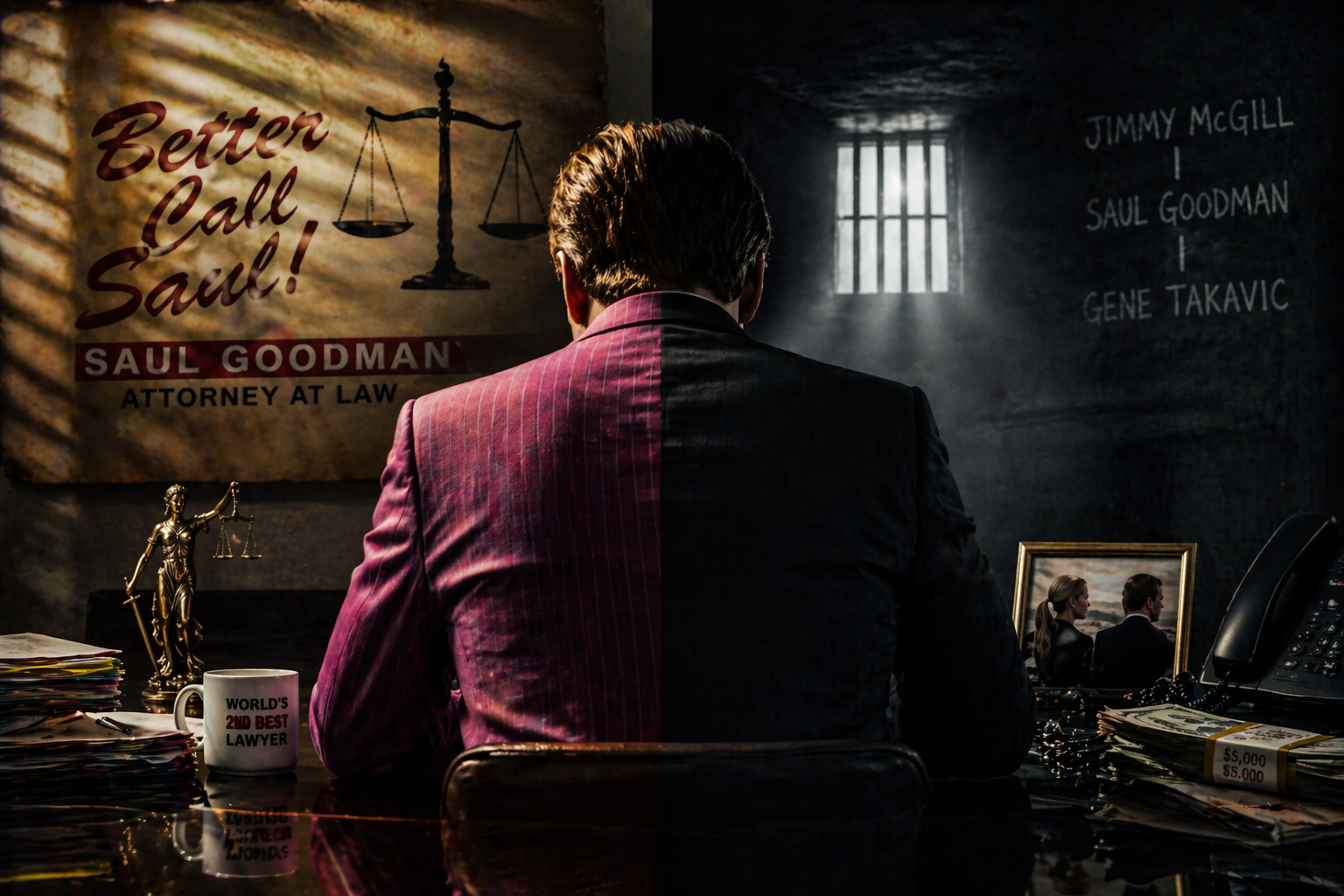
The Real Meaning of Saul Goodman: How Jimmy McGill Turned Shame Into a Weapon
Why Saul Goodman Was Always a Survival Strategy
Saul Goodman is not the story of a bad lawyer becoming worse. He is the story of a wounded man who discovers that a fake name hurts less than the truth.
Saul Goodman: This is what happens when shame gets a marketing budget.
He is loud because silence would force him to think. He is funny because pain becomes safer when it has a punchline. He is clever, because cleverness lets him survive situations that honesty would expose. He is slippery because standing still would mean admitting who he really is: Jimmy McGill, a man desperate to be loved, respected, and believed—especially by people who have already decided he is beneath them.
That is the wound underneath Saul Goodman. Not greed. Not criminality. Not even ambition. The wound is rejection.
Jimmy McGill wants to be considered good. Saul Goodman is born when Jimmy decides that being virtuous will never be enough.
The brilliance of Better Call Saul is that it takes a character introduced in Breaking Bad as comic relief—a fast-talking criminal lawyer with cheap ads, louder suits, and no visible shame—and turns him into one of television’s sharpest studies of identity collapse. Bob Odenkirk plays Jimmy McGill, Saul Goodman, and Gene Takavic across a story that begins as a legal drama, becomes a moral tragedy, and ends as a confession. The series ran for six seasons, with Odenkirk credited by the Television Academy across the role’s shifting names: Jimmy McGill, Saul Goodman, and Gene Takavic.
The central tragedy is simple: Saul Goodman is not Jimmy McGill’s opposite. Saul is Jimmy’s pain, with better branding.
Who Is Saul Goodman?
Saul Goodman is the professional alias of James “Jimmy” McGill, a former con artist turned lawyer who eventually becomes the flamboyant criminal attorney known from Breaking Bad. In Better Call Saul, he begins as a struggling public defender in Albuquerque, operating out of the back room of a nail salon, fighting for scraps of legitimacy while trying to prove he belongs in the same legal world as his older brother Chuck McGill.
The surface version is easy to describe. Saul is a crooked lawyer. He launders money, enables criminals, manipulates clients, bends the law until it snaps, and sells moral compromise as customer service. His name itself is a joke: “S’all a good man.” Even the brand is a con.
But Jimmy McGill is not born empty. That matters.
Jimmy is funny, fast, emotionally intelligent, and terrifyingly good at reading people. He understands desperation because he lives inside it. He sees the insecurity under arrogance, the greed under respectability, and the fear under authority. He possesses the ability to influence others effectively because he understands their desires before they articulate them.
That gift could have made him a brilliant lawyer. In another life, it might have made him an advocate for people ignored by cleaner, colder institutions. For a while, that possibility feels real. His elder-law work is sincere. His rapport with ordinary clients is not fake. His instinct for the underdog is genuine.
But Jimmy’s gift is also his danger. He can always find the angle. He can always justify the shortcut. He can always convince himself that the system is rigged, that everyone else is corrupt anyway, that his scam merely exposes hypocrisy.
Saul Goodman is the answer Jimmy provides when the world keeps asking him one question: why can’t you be respectable?
Saul Goodman Character Analysis: Surface Identity vs Real Identity
Saul’s surface identity is performance. Every detail is designed to overwhelm doubt.
The suits are too bright. The office is too loud. The commercials are too shameless. The voice is too quick. The jokes arrive before sincerity can survive. Saul turns the legal profession into a carnival because carnival rules suit him better than courtroom dignity.
But the real identity underneath is not confidence. It is humiliation.
Jimmy has spent his life being treated as a problem to manage. “Slippin’ Jimmy” is not merely a nickname; it is a cage. It means every future version of him is judged by the worst version people remember. Even when he passes the bar, even when he works hard, even when he tries to build something legitimate, the old identity follows him into every room.
Chuck embodies that judgment. Howard channels it. The legal establishment formalizes it. Jimmy’s entire emotional life becomes a trial where the verdict has already been written.
That is why Saul’s vulgarity is vital. Saul does not ask permission to belong. He kicks the door open and charges by the hour.
Jimmy wants approval from the respectable world. Saul mocks the respectable world for ever thinking its approval mattered.
The contradiction is brutal: Jimmy becomes Saul to escape shame, but Saul guarantees that Jimmy will be seen as shameful.
The Core Wound: Chuck McGill and the Pain of Never Being Enough
Chuck McGill is the emotional court of appeal; Jimmy can never win.
Their relationship is the center of the character. Chuck doesn't create every bad choice Jimmy makes, but he gives Jimmy’s worst belief a voice: you are not really good, and everyone is safer when they remember that.
Chuck is brilliant, disciplined, and legitimate. Jimmy is improvisational, charming, and tainted by his past. Jimmy admires him, cares for him, and longs for his approval. That longing makes Chuck’s rejection devastating.
The tragedy is that Chuck is not entirely wrong about Jimmy’s capacity for manipulation. Jimmy does cut corners. Jimmy does enjoy the con. Jimmy does have a dangerous relationship with rules. But Chuck’s mistake is treating Jimmy’s worst tendencies as his permanent essence. He does not merely fear what Jimmy might do. He refuses to believe Jimmy can become anything else.
That refusal becomes a prophecy.
The Sandpiper case is one of the great early tests. Jimmy discovers wrongdoing against elderly residents and builds a serious case through persistence, instinct, and genuine concern. On the surface, this case is proof that he can be a real lawyer. Psychologically, it is the moment he nearly earns the life he wants.
Then the door closes.
Chuck’s hidden role in blocking Jimmy from HHM wounds him more deeply than a normal professional setback. It confirms the private fear Jimmy carries: even when he does something right, the people whose approval matters most will still see a con man wearing a suit.
That is the emotional engine of Saul Goodman. The mask forms where hope gets humiliated.
The Mask Saul Goodman Wears
Saul Goodman is not just a name. He is a defense mechanism.
He protects Jimmy from rejection by pretending he is irrelevant. He protects Jimmy from guilt by converting consequences into jokes. He protects Jimmy from tenderness by making everything transactional. He protects Jimmy from grief by keeping the room moving too fast for grief to speak.
His main coping mechanism is performance. When he is scared, he talks. When he is guilty, he jokes. When he is exposed, he sells. When he is abandoned, he becomes busier, louder, and shinier.
That is why the Gene Takavic timeline is so haunting. Strip away the suits, the office, the ads, and the spectacle, and what remains is not peace. It is a ghost.
Gene is Saul without an audience. He works in a mall, hides in black-and-white anonymity, and watches old commercials like a man replaying proof that he once existed. If Jimmy is the wounded self and Saul is the mask, Gene is the aftermath: survival without identity.
Saul’s mask works because it is built from real strengths. His charisma is real. His legal mind is real. His improvisational genius is real. His ability to read human weakness is real.
But a mask made from truth can still become a prison.
The Lie Jimmy McGill Believes
Jimmy’s lie is not “I am a criminal.”
The deeper lie is if people already think I am bad, I might as well become useful as the bad thing they expect.
That lie gives him freedom at first. It releases him from the exhausting project of proving himself. It lets him stop begging for moral recognition. It lets him monetize the very traits he was shamed for.
But the lie is poisonous because it confuses prediction with destiny.
Chuck thinks Jimmy will always be Slippin’ Jimmy. The legal world sees him as a hustler. Criminals see him as a service provider. Clients see him as a miracle worker with dirty hands. Eventually, Jimmy accepts the role because it is easier to perform a condemned identity than to keep fighting for a redeemed one.
This is what makes Saul Goodman so psychologically sharp. He is not a man with no conscience. He is a man who decides conscience is bad business.
And yet conscience never disappears. It leaks out through Kim. Through guilt. Through panic. Through rage. Through the courtroom confession. Through every moment where the joke lands half a second too late and the face underneath becomes visible.
What Saul Wants vs What Jimmy Actually Needs
Saul wants control.
He wants money, status, clients, attention, leverage, and escape routes. He wants the room tilted in his favor. He wants to win even when winning costs him the part of himself that once knew why victory mattered.
Jimmy needs recognition.
Not applause. Recognition. He needs someone to see the whole of him: the hustler and the helper, the liar and the lover, the performer and the wounded younger brother still waiting to be told he is not a mistake.
That is why Kim Wexler matters so much.
Kim sees Jimmy more fully than almost anyone. She knows the charm and the rot. She knows the sweetness and the danger. She is not naïve about him, which is why her love carries such weight. When Kim believes in him, Jimmy feels real. When Kim joins him in the scam, Saul feels validated. When Kim leaves, Saul becomes easier to inhabit because Jimmy has lost the person who made him want to be better.
What Jimmy needs is accountability without annihilation. He needs to face what he has done without concluding that he is only what he has done.
He does not fully reach that until the finale.
Saul Goodman Psychology Explained
Jimmy’s psychology is built around shame avoidance.
Shame is different from guilt. Guilt says, “I did something wrong.” Shame says, “I am wrong.” Jimmy can handle guilt if he can talk his way around it. Shame is harder. Shame attacks the self. It confirms Chuck’s verdict. It turns every failure into proof.
So Jimmy develops strategies.
He externalizes blame. The system is rigged. Howard is smug. Chuck is cruel. The clients are hypocrites. The law is theater. Everyone has an angle.
Often, he is partly right. That is what makes the rationalization seductive. Institutions are hypocritical. Respectability does hide corruption. Powerful people do use procedure as a weapon. Jimmy sees real ugliness in the world.
His mistake is using that ugliness as permission to become uglier.
He also uses humor as emotional misdirection. Saul’s comedy is not lightness; it is smoke. He makes people laugh before they can look too closely. He turns danger into banter, legal advice into salesmanship, and moral collapse into entertainment.
Then there is compulsion. Jimmy does not merely scam for money. He scams for aliveness. The con gives him a rush because it reverses humiliation. In the con, he is no longer the rejected outsider. He is the author of reality. He knows the script, and everyone else is improvising inside it.
That is why straight success rarely satisfies him for long. Normal legitimacy is too slow, too vulnerable, and too dependent on other people’s approval. The scam offers immediate proof of superiority.
The problem is that the high never heals the wound. It only postpones the crash.
Saul Goodman’s Character Arc Explained
Jimmy’s arc is not a simple fall from good to evil. It is a series of retreats from vulnerability.
He begins as a man trying to become legitimate without fully surrendering the thrill of illegitimacy. His early life as Slippin’ Jimmy gives him both skills and stigma. He can charm, improvise, and survive. He can also deceive, exploit, and justify.
His first major transformation comes through Chuck’s rejection. The wound becomes structural. Jimmy realizes that respectability may never accept him, no matter how hard he works. Instead of simply rebelling, he becomes split, still craving legitimacy and increasingly contemptuous of it.
The next stage is moral improvisation. He begins crossing lines for reasons that appear defensible: helping clients, helping Kim, punishing hypocrisy, beating people who look down on him. The reasons matter less than the pattern. Every successful shortcut teaches him that rules are obstacles for people with less imagination.
Chuck’s death intensifies the split. Jimmy’s grief is displaced into denial. When Howard expresses guilt over Chuck’s suicide, Jimmy lets him carry a burden Jimmy cannot face. That moment is crucial because it shows Jimmy choosing emotional survival over truth. He does not simply lie to Howard. He lets Howard suffer so he does not have to.
Then comes Saul Goodman as a professional identity. When Jimmy regains his law license and announces he will practice under the Saul name, it is not a costume change. It is a surrender disguised as reinvention. He has stopped trying to persuade the world that Jimmy McGill deserves respect. He will now build a world where Jimmy McGill is unnecessary.
The Howard scheme with Kim is the point where play becomes poison. Jimmy and Kim tell themselves they are targeting a privileged, polished man who can absorb the damage. But the scheme becomes intimate cruelty. They do not merely beat Howard. They rewrite him in other people’s eyes.
Then Howard dies.
That death is the moral rupture. Howard’s murder by Lalo Salamanca is not Jimmy’s intended outcome, but the road to that apartment is paved by Jimmy and Kim’s choices. Their scam does not pull the trigger, but it places Howard in the room.
After Kim leaves, Saul becomes total. Not because Jimmy has no feelings, but because feelings have become unbearable.
By Breaking Bad, Saul Goodman is fully operational: a criminal lawyer, fixer, and facilitator for Walter White’s empire. The series Better Call Saul is a prequel to Breaking Bad with scenes set before, during and after that story, and it reframes Saul not as comic relief but as the end product of Jimmy’s unresolved damage.
The final transformation comes in “Saul Gone.” Peter Gould, who wrote and directed the finale, described Jimmy’s courtroom confession as “the last moment of Saul Goodman.” That is exactly why the ending works. Jimmy does not become innocent. He becomes honest.
That is his redemption: not escape from punishment, but escape from the lie.
Key Relationships and What They Reveal
Chuck McGill: The Judge Inside Jimmy’s Head
Chuck reveals Jimmy’s shame. He is the brother, father figure, rival, and internal prosecutor. Jimmy wants Chuck’s love so badly that Chuck’s contempt becomes spiritually disfiguring.
Their relationship exposes the wound: Jimmy believes he must perform goodness to earn love, while Chuck believes Jimmy’s performance of goodness is itself a scam.
Kim Wexler: The Person Who Sees Both Men
Kim reveals Jimmy’s longing. With her, he can be funny, brilliant, vulnerable, and dangerous. She is his partner, his witness, and his moral pressure point.
Their tragedy is not that Kim fails to see Saul coming. She sees too much. She recognizes the thrill because part of her feels it too. Their chemistry is built on intimacy and conspiracy. They are most alive together when they are also most dangerous together.
When Kim leaves, Jimmy does not merely lose love. He loses the last person whose gaze made Jimmy McGill feel worth keeping.
Howard Hamlin: The Respectable Man Jimmy Needs to Humiliate
Howard reveals Jimmy’s envy and projection. For a long time, Jimmy sees Howard as the polished gatekeeper blocking his future. Later, when the truth about Chuck’s influence is clearer, Jimmy still needs Howard to represent everything he resents: ease, status, polish, institutional belonging.
Howard’s decency makes the cruelty worse. The more human Howard becomes, the less defensible Jimmy’s hatred looks.
Mike Ehrmantraut: The Professional Criminal Jimmy Pretends He Can Become
Mike reveals Jimmy’s lack of discipline. Mike has a code, however compromised. Jimmy has instincts, appetites, and rationalizations. Mike can live with silence. Jimmy cannot. Mike accepts the cost of his choices with grim clarity. Jimmy keeps trying to turn cost into theater.
Walter White: Saul’s Worst Client and Dark Mirror
Walter reveals what Saul becomes when cleverness serves ego without restraint. Saul thinks he is managing Walt. In reality, he is helping build a monster because the money, danger, and momentum feed Saul’s need to be indispensable.
Walter and Saul are both men who construct alternate identities to escape humiliation. Walter becomes Heisenberg. Jimmy becomes Saul. The difference is that Walter’s mask is domination, while Jimmy’s is performance.
Both masks destroy lives.
The Scene Where the Mask Finally Cracks
The most revealing Saul Goodman scene is the courtroom confession in “Saul Gone.”
On the surface, Jimmy sabotages an astonishingly favorable legal deal. He has negotiated his way down from catastrophic punishment to a far lighter sentence. It is the ultimate Saul Goodman victory: a guilty man using charm, leverage, and procedural intelligence to beat consequence.
Then Kim appears.
That presence changes the room. Suddenly the performance has an audience that matters. Not prosecutors. Not judges. Not inmates. Kim.
Jimmy begins as Saul, still controlling the script. But the confession becomes something else. He admits his role in Walter White’s empire. He stops minimizing. He stops selling. He stops hiding behind technicalities. He speaks Chuck’s name. He takes responsibility not only for legal crimes but also for moral evasions.
The key is not that he becomes pure. He does not. The damage remains. The sentence remains. The dead remain dead.
The key is that he chooses truth when lying would benefit him.
For most of his life, Jimmy uses language to escape reality. In the finale, he uses language to enter it.
That is why the scene explains him best. It contains every version of the character: the brilliant lawyer, the showman, the brother, the lover, the coward, the penitent, the man who can still read a room, and the man who finally stops using that talent to flee himself.
Saul Goodman dies not because the law catches him. Saul dies because Jimmy McGill finally tells the truth in public and survives the shame of being seen.
What Most People Misunderstand
The biggest misunderstanding is that Saul Goodman is Jimmy’s “true self.”
He is not.
Saul is real, but he is not whole. He is a weaponized fragment. He is Jimmy’s intelligence without humility, humor without tenderness, ambition without conscience, and resilience without peace.
People sometimes read Saul as liberation: Jimmy finally stops caring what others think and becomes powerful. But that reading misses the pain. Saul is not free from judgment. Saul is obedient to judgment. He becomes exactly what Chuck feared, exactly what the legal world expected and exactly what criminals needed.
That is not rebellion. That is surrender wearing a loud suit.
The other misunderstanding is that Jimmy’s tragedy is caused by Chuck alone. Chuck wounds him deeply, but Jimmy still chooses. The show never lets him off the hook. It gives him context, not absolution.
That distinction is vital. Jimmy is shaped by rejection, but he is not programmed by it. He repeatedly meets moments where he could stop, confess, repair, or walk away. Sometimes he almost does. Often he does not.
The tragedy is not that Jimmy had no chance.
The tragedy is that he had chances, knew they were chances, and kept choosing the identity that hurt less in the moment.
What Most Analyses Miss
What Most Analyses Miss
What most analyses miss is that Saul Goodman is not built from the absence of love. He is built from failed love.
Jimmy is not a cold man. He is needy, sentimental, loyal in flashes, and capable of deep care. He loves Chuck even after Chuck humiliates him. He loves Kim with a sincerity that makes his worst behavior more painful, not less. He can be generous to clients. He can fight for people who would otherwise be ignored.
That is what makes Saul so devastating. The mask is not hiding emptiness. It is hiding a person who feels too much and has decided feeling is a liability.
If Saul were merely a sociopath in a colorful suit, the story would be thinner. The sharper reading is more uncomfortable: Saul Goodman is what a feeling person can become when shame teaches him to distrust sincerity.
His corruption is not the death of emotion. It is emotion rerouted into performance, hustle, and control.
He turns pain into products.
That is why he lasts. Audiences recognize the temptation. Not the cartel connections. Not the money laundering. The temptation to turn rejection into a persona. To become funny instead of honest. To become impressive instead of vulnerable. To become untouchable instead of healed.
Saul Goodman is the nightmare version of a common human strategy: if the real me is not enough, maybe the invented me can win.
Why People Relate to Saul Goodman
People relate to Saul because he understands humiliation.
He is for anyone who has felt underestimated, boxed in by old mistakes, or judged by people who never planned to update their opinion. He speaks to the fantasy of outsmarting the polished people, beating the gatekeepers, and turning weakness into advantage.
There is also a power fantasy in him. Saul is never the strongest man in the room, rarely the most dangerous, and not always the richest. But he can talk. He can pivot. He can survive. He can make powerful people need him.
That is intoxicating.
For viewers who feel trapped by institutions, Saul offers a fantasy of verbal escape. He finds the loophole. He bends the rule. He turns bureaucracy into a stage and makes authority look slow.
But the relatability has a darker edge. Saul also appeals to the part of us that wants consequence without accountability. He gives a language to rationalization. He makes corruption funny enough to enjoy. He makes cowardice look like cleverness.
That is why admiration for Saul can become dangerous. If you admire only his wit, resilience, and style, you miss the cost. The show does not ask us to hate him. It asks us to see him clearly.
Liking Saul is easy.
Understanding Jimmy is harder.
The Warning Hidden Inside Saul Goodman
The warning is not “do not break the law.” That is too small.
The deeper warning is do not build your identity around the wound you refuse to heal.
Jimmy’s wound is rejection. His mask is Saul. His lie is that becoming the expected villain is better than begging to be recognized as good. His need is honest accountability and love that does not depend on performance. The cost is enormous: Chuck, Howard, Kim, his clients, his victims, his freedom, and his own name.
Saul shows how seductive self-caricature can be. If people call you a joke, become the funniest person alive. If people call you crooked, become useful to criminals. If people say you will never belong in respectable rooms, build a room where respectability looks ridiculous.
That strategy can win. For a while.
But it cannot give peace because it still lets the original wound define the architecture of the life.
Saul Goodman is not destroyed by his enemies. He is destroyed by the fact that the mask keeps succeeding.
The Symbolism of the Suit, the Office and the Name
Saul’s visual world matters because it tells the story before he speaks.
The bright suits are armor against invisibility. Jimmy’s early professional world is cramped, beige, and humiliating. Saul’s world is loud, artificial, and impossible to ignore. The color is not confidence. It is compensation.
The office is a theme park of legal desperation. It rejects the solemn dignity of elite law and replaces it with spectacle. Saul does not want clients to feel the law is noble. He wants them to feel the law can be hacked.
The name is the cleanest symbol. Saul Goodman is a joke that becomes a legal identity. It sounds harmless, almost friendly, but beneath it sits a total erasure of Jimmy McGill.
Names matter across the arc. Jimmy is the man who still wants to be loved. Saul is the man who wants to win. Gene is the man who wants not to be found.
The finale matters because he reclaims Jimmy. Not as innocence. As responsibility.
What the Screen Version Adds
Saul Goodman could not work this powerfully without performance.
Bob Odenkirk’s achievement is that he makes the character’s speed feel like both intelligence and panic. Saul’s speech often sounds like a getaway car. The words accelerate because stillness is dangerous. Odenkirk lets the audience see the micro-cracks: a pause after a joke, a look after Kim leaves, a flash of pain when Chuck’s judgment lands.
Rhea Seehorn’s Kim Wexler is equally essential because she gives Jimmy’s soul a witness. Without Kim, Saul risks becoming a study of corruption only. With Kim, the story becomes a tragedy of intimacy: two people who understand each other so well that they become capable of enabling each other’s worst instincts.
Michael McKean’s Chuck gives the wound its shape. Patrick Fabian’s Howard gives Jimmy’s resentment a target and then complicates that target until the resentment curdles into cruelty. Jonathan Banks’s Mike gives Jimmy a contrast: another morally compromised man who understands cost more honestly.
The screen version also uses time as structure. Better Call Saul does not simply tell us Saul has a past. It makes the audience live inside the slow construction of a mask. The black-and-white Gene scenes make that mask feel like something already dead, replayed by a man trapped in the consequences.
That is why the adaptation deepens the original Breaking Bad character. It does not contradict him. It reveals the wound that the earlier show did not need to stop and examine.
Saul Goodman Ending Explained
The ending is not about whether Jimmy deserves forgiveness.
It is about whether he can finally stop performing.
In legal terms, Jimmy makes his life worse. In spiritual terms, he saves what is left of it. He trades the Saul Goodman miracle deal for the truth. He gives up the final scam. He accepts a harsher sentence because the lighter one would require him to remain Saul.
That choice is easy to misread as romantic sacrifice for Kim. Kim matters deeply, but the act is larger than winning her approval. He is not simply trying to impress her. He is choosing to exist before her without the mask.
For Jimmy, that is almost unimaginable.
His final prison life is bleak, but not empty. Other inmates recognize Saul, chant his name, and treat him as a folk hero. That detail is bitterly funny because the mask still has cultural power. But Jimmy’s private exchange with Kim suggests a quieter victory. He may never be free in the legal sense. Yet he is freer than Gene, who lived outside prison while trapped inside fear.
The ending refuses cheap redemption. Jimmy does not undo the harm. He does not get a clean slate. He does not ride away reborn.
He tells the truth. For him, that is monumental.
Legacy: Why Saul Goodman Still Matters
Saul Goodman lasts because he transformed from comic device to psychological architecture.
He began as the kind of character who could have remained a memorable supporting player: funny, sleazy, useful, quotable. Instead, Better Call Saul rebuilt him into a study of performance, shame, and moral erosion. The result is a character who can be watched two ways. In Breaking Bad, Saul is the shameless lawyer who helps criminals navigate consequence. In Better Call Saul, Saul is the ruin Jimmy McGill spends years assembling.
The legacy is also formal. The character proves that a prequel can deepen rather than shrink mystery. It can take a known endpoint and make the path toward it more painful, not less. The suspense is not whether Jimmy becomes Saul. The suspense is how much of Jimmy will still be alive when Saul arrives.
That is why the finale lands. The show’s co-creator framed the courtroom confession as the last moment of Saul Goodman, and the power of that idea is that Saul’s death is not physical. It is moral and linguistic. The mask dies when the man tells the truth.
The character’s award recognition also reflects the scale of the performance. Bob Odenkirk received repeated lead actor nominations for playing Jimmy McGill and Saul Goodman, while the series itself was repeatedly recognized in major drama categories. But Saul’s cultural endurance is not only about acclaim. It is about recognition.
People still talk about Saul because he captures a modern fear: that identity can become branding, that pain can become content, that shame can be monetized, and that the invented self can become more successful than the real one.
Saul Goodman is funny until you realize how much of him is grief.
Final Meaning: The Man Beneath the Commercial
The final meaning of Saul Goodman is not that people cannot change. It is that change requires surrendering the lie that protected you.
Jimmy McGill spends most of his life trying to win love without standing still long enough to be judged. Saul Goodman lets him win rooms, clients, money, and status. Gene Takavic lets him survive. But only Jimmy can confess.
That is the real arc.
A not good man becomes a bad man.
The wounded man becomes a mask. The mask becomes a prison. Prison finally forces the man to speak.
Saul Goodman is unforgettable because he makes corruption look entertaining before revealing it as loneliness with better lighting. He jokes, sells, performs, and survives. But the story’s final blow is that survival is not the same as salvation.
Jimmy McGill does not defeat Saul Goodman by becoming innocent.
He defeats Saul Goodman by becoming answerable.
Summary
Saul Goodman is the mask Jimmy McGill builds to survive rejection, shame, and the lifelong fear that he will never be seen as legitimate. Beneath the loud suits, cheap ads, and criminal charm is a man wounded by his brother Chuck’s contempt, addicted to the thrill of outsmarting authority, and desperate for recognition he cannot ask for honestly.
His transformation across Better Call Saul and Breaking Bad is not a simple moral collapse. It is the gradual replacement of vulnerability with performance. Jimmy becomes Saul because Saul hurts less, wins faster, and never has to beg for approval. But the cost is devastating: Kim, Howard, Chuck, his clients, his freedom, and his own name.
People relate to Saul because he turns humiliation into power. They admire his wit, resilience, and refusal to be ignored. But the warning is sharp: a mask built to protect you can become the thing that destroys you.
Saul Goodman’s legacy is that he turns a comic criminal lawyer into a profound study of identity, shame, and confession. His ending matters because Jimmy finally stops selling the lie and accepts the truth.
