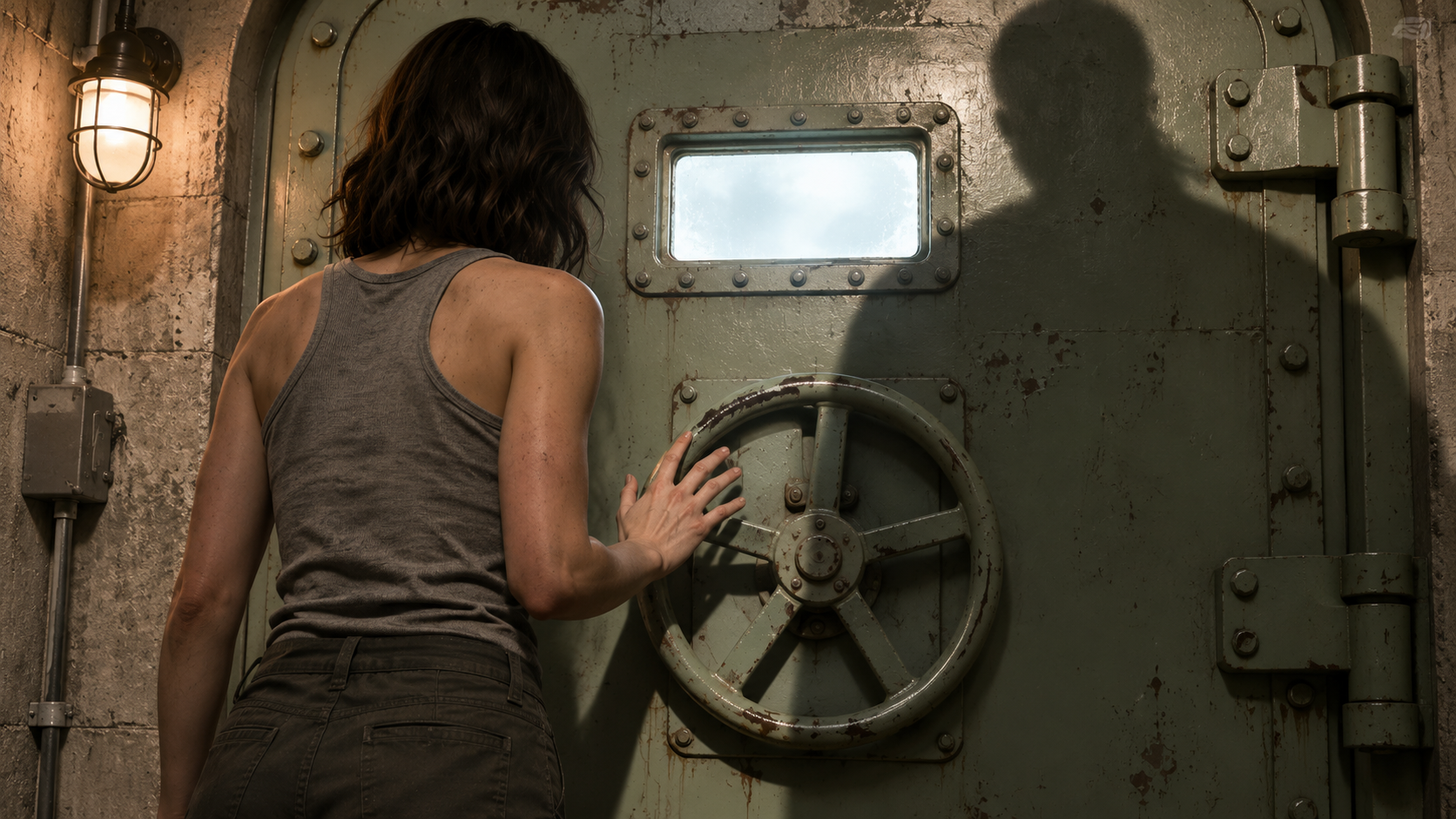
The Photograph, the Warning and the Ending
What If Your Rescuer Refuses to Let You Leave?
A locked door can keep danger out. It can also stop someone escaping. In 10 Cloverfield Lane, a young woman wakes after a car accident and discovers that the distinction depends on a man she has never met. He says he has saved her life. He also says the world beyond his underground shelter is no longer safe to enter.
Directed by Dan Trachtenberg, the 2016 American thriller places Michelle, played by Mary Elizabeth Winstead, inside a survival arrangement she cannot independently verify. Her host controls the supplies, the exits and most of the information. Another resident appears to support his account. To decide what to do, Michelle must distinguish useful evidence from reassurance, intimidation and her own understandable fear.
Michelle Wakes Inside Someone Else’s Explanation
Michelle leaves her fiancé, Ben, following an argument and drives away. The film initially gives us the departure rather than a complete explanation of their relationship. On the road, reports of widespread power problems suggest that something larger is happening, but her immediate concerns remain personal. Then another vehicle strikes her car, sending her off the road.
She regains consciousness with an injured leg, chained inside a bare underground room. Howard, played by John Goodman, presents himself as the person who rescued her. He claims an attack has contaminated the outside world and that his bunker offers protection. Michelle has no reliable contact with anyone who could confirm either his story or her whereabouts.
Her first task is therefore more basic than solving a mystery. She must work out what she can reach, what she can use and how her captor responds to resistance. Injury restricts her movement, but she immediately looks for ways to change her circumstances. The film establishes her resourcefulness before providing any reason to believe that escape will succeed.
Howard’s explanation contains an enormous demand. Accepting that he helped her after a crash would be one thing; accepting that she must remain underground indefinitely requires much more evidence. He treats these propositions as inseparable. Because he says he saved her, he expects her to accept his authority over what happens next.
That reasoning gives the opening its particular discomfort. Food and treatment are useful to Michelle, yet receiving them does not tell her whether the person supplying them is trustworthy. Her dependence exists before consent is possible. The bunker’s apparent generosity comes with conditions she has had no opportunity to negotiate.
There is a close connection to the captivity explored in Taylor Tailored’s analysis of Stephen King’s Misery: an injured person must assess someone whose help gives them extraordinary power. Here, the additional possibility of a catastrophe makes refusing that help especially difficult.
Emmett Gives Michelle a Second Account
The shelter’s other resident is Emmett, played by John Gallagher Jr. He helped build the bunker and says he fought to get inside after witnessing an alarming event outside. Unlike Michelle, he wanted entry. His presence complicates the straightforward explanation that Howard has invented everything solely to imprison her.
Nevertheless, Emmett cannot confirm every part of Howard’s account. Witnessing something frightening does not establish its cause, geographical extent or likely duration. The distinction between those questions remains important throughout the film. Howard moves easily from observations to sweeping conclusions, while Michelle has to decide which parts of his certainty are justified.
The bunker itself supplies another kind of evidence. Its provisions and working facilities show preparation, knowledge and practical competence. Howard has built something capable of sustaining people underground. Michelle cannot dismiss him as someone whose claims have no material basis, even when his behaviour makes her deeply uncomfortable.
Domestic rules intensify that discomfort. Howard regulates conduct and reacts badly when he feels challenged or excluded. Sharing a meal becomes an exercise in judging his mood. Michelle and Emmett may occupy the same rooms, but they do not have an equal say in how those rooms are used.
Goodman’s role depends on that unstable mixture of capability and grievance. Howard can explain a practical problem, offer something helpful and make an interaction threatening without changing the basic subject. He seems to regard other people’s independence as an insult to the effort he has invested in keeping them alive.
For Michelle, Emmett offers the possibility of comparing impressions with someone who is not setting the rules. That relationship is valuable before it becomes an alliance. In a place where one man supplies the dominant explanation for everything, another person’s account can reveal which assumptions are shared and which belong to Howard alone.
The Woman at the Door Changes the Calculation
Michelle recognises Howard’s vehicle as the one involved in her crash. Her suspicion acquires a concrete basis: the person claiming to have found her also has a connection to the event that left her helpless. She takes an opportunity to seize his keys and makes for the exit.
At the outer door, however, a distressed woman appears outside, pleading to be admitted. Her face is visibly damaged. Howard insists that opening the door will expose everyone inside to contamination. Michelle stops, confronted by evidence that leaving may involve a danger she cannot simply dismiss as his invention.
The scene gives her two incompatible responsibilities. Opening the door might help someone desperate for shelter, but it might also endanger everyone already inside. Keeping it shut protects the small group while abandoning a person whose suffering is visible. Michelle cannot resolve that conflict by obtaining better information first.
This is the film’s most effective early reversal because it changes an action already under way. She reaches the place that should mean freedom and discovers a reason to retreat. The exit remains physically available for a moment, yet the meaning of crossing it has changed.
Howard later identifies the woman as his neighbour, Leslie, and admits that he caused Michelle’s crash. He describes the collision as accidental, the result of panicking while rushing towards his shelter. His admission settles his involvement; it does not independently establish the innocence of his motives.
Michelle’s decision to stay temporarily is therefore understandable without requiring complete trust. She has evidence of danger outside and unanswered questions about danger inside. Survival means adjusting to the evidence available, even when none of the options feels safe.
The film also resists a convenient reading of the woman as merely another suspicious story Howard tells. Michelle sees her condition herself. Any later judgement about Howard has to account for that encounter rather than pretending it never happened.
A Household Routine Conceals Unequal Stakes
Time underground develops a rhythm. Meals, films, puzzles and conversation make the shelter resemble an improvised household. These ordinary activities offer relief, but they also create the possibility that an intolerable arrangement could become familiar enough to endure.
Howard talks about his daughter, Megan, and presents a photograph as hers. His account of family separation places responsibility on others. Michelle receives an image of a father who believes he has been denied the companionship he deserves, although she has little means of checking the history behind that belief.
The emotional stakes differ sharply between the residents. Michelle wants a route back to a life she chooses. Emmett has escaped an immediate external threat. Howard appears invested in the household itself, including the roles everyone occupies within it. Stability for him may mean something very different from safety for them.
Michelle and Emmett also discuss their regrets. He recalls abandoning the chance to attend college on an athletics scholarship because he was afraid of failing. She describes seeing a father mistreat a young girl and being unable to intervene, an encounter connected to memories of her own abusive childhood.
These disclosures make their bond more specific than shared dislike of Howard. Each recognises a moment when fear narrowed the future. Emmett remained within familiar limits; Michelle remembers leaving someone else without the protection she wished she could provide. Their conversation gives the story a question beyond whether she can get out: what might she do when action becomes possible?
That question should not become an accusation against Michelle for protecting herself. Her account expresses guilt, but guilt is not proof that a frightened person could safely have controlled the situation. The film is more persuasive when it treats courage as something she gradually exercises than when her past is reduced to a simple habit of running away.
Her interest in designing clothes also becomes relevant. Sketching and making things belong to her life before the bunker. They preserve an identity beyond Howard’s household and establish a practical skill that can matter when ordinary routes of escape are unavailable.
What the Photograph and Earring Reveal
A problem with the air filtration system sends Michelle into the ventilation passages because she is small enough to reach the necessary area. The task forces her beyond the rooms Howard normally supervises. While there, she discovers a plea for help scratched into the inside of a window and a bloodstained earring.
The earring connects the space to the young woman in Howard’s photograph. Michelle initially interprets the evidence through the identity he has supplied. Emmett then recognises the pictured girl as Brittany, a local young woman who disappeared two years earlier. The photograph is not what Howard claimed it was.
The strength of the discovery comes from the combination. An abandoned earring alone could have an innocent history. A photograph alone might be misidentified. A message scratched from inside a restricted space, the jewellery and the recognition of a missing person together suggest captivity concealed beneath Howard’s story about his daughter.
Michelle and Emmett conclude that Howard abducted and killed Brittany. The released film strongly supports the suspicion that he held her there, but it does not show her death or establish exactly how she died. Nor does it provide a complete account of what happened to the real Megan. Those gaps should remain gaps, rather than being filled with an invented sequence of crimes.
The discovery also changes the timeline of the threat. Brittany’s disappearance predates the current emergency. Whatever has happened outside cannot explain away evidence of someone previously trying to escape from within the bunker.
Howard’s photograph has another unsettling function. By assigning Brittany his daughter’s identity, he presents a relationship as a fact that others are expected to accept. Michelle now has reason to fear that entering his home may mean being fitted into a role he has already chosen.
A comparable use of familiar images to test a reassuring account appears in Get Out. In both films, the protagonist gains leverage by comparing what an image contains with what another person says it means.
An Escape Plan Gives Ordinary Objects New Uses
Michelle and Emmett begin planning a way out that takes the external danger seriously. She works on a makeshift protective suit and breathing apparatus, using materials available inside the shelter. Emmett helps obtain supplies and conceal their activity from Howard.
This is a meaningful development in her reasoning. She does not have to prove that the outside is harmless before deciding that staying is unacceptable. Instead, she tries to reduce one risk while preparing to leave the other. Her plan is imperfect, but it responds to both bodies of evidence.
The construction also gives her design skills a clear narrative purpose. Turning available material into something wearable demands observation, planning and practical experimentation. Her usefulness does not suddenly appear because the story needs a capable heroine; an established interest acquires urgent consequences.
The bunker’s limited resources make secrecy difficult. Materials have owners, tools have places and missing items can be noticed. Howard does not need sophisticated surveillance to realise that something is happening. In such a small environment, using a pair of scissors can leave evidence of an intention.
His discovery leads to a confrontation involving a barrel of corrosive acid. Emmett accepts responsibility, claiming he intended to obtain Howard’s gun and excluding Michelle from his supposed plan. He gives Howard an explanation designed to protect her and absorb the consequences himself.
Howard shoots him.
The killing ends the possibility that respectful behaviour or a carefully framed apology will reliably contain Howard’s violence. Emmett has tried to satisfy the demand for an explanation, but Howard treats confession as an opportunity to eliminate him. The punishment is not governed by a rule the others could have followed successfully.
Michelle is left with the escape plan, the loss of her ally and direct knowledge of what Howard will do. There is no longer a useful debate about whether his threatening manner has been misunderstood. She has witnessed murder, and the man responsible still expects ordinary life together to continue.
Howard’s Offer of Normality Becomes Unbearable
After killing Emmett, Howard attempts to establish a more intimate domestic arrangement with Michelle. His efforts to appear pleasant cannot undo what has happened. Instead, they reveal how easily he can place his own preferred version of events over someone else’s grief and terror.
The remaining pair do not experience the silence in the same way. For Howard, Emmett’s absence removes a rival presence and an obstacle to control. For Michelle, it removes the person with whom she could speak freely. The same physical space now contains fewer opportunities for help, distraction or shared resistance.
His apparent kindness therefore becomes threatening in a new way. Before the shooting, Michelle was assessing whether hospitality concealed violence. Afterwards, hospitality asks her to behave as though violence has settled the household’s problems. Accepting a treat or sitting down to dinner risks becoming part of a performance he interprets as agreement.
Bear McCreary’s account of composing the film helps explain its attention to psychological pressure. He describes Howard’s musical theme as relatively small despite the character’s imposing presence, with increasing dissonance making it progressively more uncomfortable. The approach suits a threat that often develops through conversation before it erupts physically.
Michelle continues preparing her suit. When Howard discovers it, concealment gives way to confrontation. She overturns the acid barrel during their struggle, burning him and triggering a fire. Retrieving her protective equipment and using the ventilation route, she reaches the locked escape hatch and breaks the padlock with the aid of a freezing spray.
The escape brings earlier knowledge together: the passages she has navigated, the material she has worked with and a method Howard himself has demonstrated. His command of the shelter has never meant that she is incapable of learning it. The place becomes usable against him once she can act on that knowledge.
What Happens at the End of 10 Cloverfield Lane?
Michelle escapes the burning bunker and discovers that an alien attack is real. Howard remains inside as the shelter is destroyed. Outside, she survives an encounter with an alien creature and a large biomechanical craft, then drives away and chooses to head towards Houston after hearing that people there need help.
The revelation arrives in stages. Birds and breathable air initially suggest that Howard’s account of an entirely uninhabitable surface was wrong. Then the aircraft appears, and the explosion draws attention to her location. She has escaped one danger without reaching a safe world.
These observations are compatible. Being able to breathe at a particular place and moment does not prove there has been no attack or that contamination cannot occur. The craft’s toxic spray demonstrates a continuing threat. Leslie’s condition at the door now fits the larger emergency, even though the film never gives a comprehensive scientific explanation of the attackers’ weapons.
Michelle is pursued and eventually lifted inside Howard’s truck towards the craft. She improvises an incendiary weapon from a bottle of alcohol and throws it into an opening. The resulting explosion frees her from the immediate threat. She leaves in Leslie’s car, carrying the story beyond the property whose address supplies the film’s title.
A radio broadcast distinguishes between a route towards refuge and a call for people with relevant skills to help in Houston. Michelle takes the road towards the latter. Lightning reveals further alien craft, making clear that the wider conflict continues.
Her decision answers the personal question established in her conversation with Emmett. Having described a moment when she could not help someone, she now turns towards people asking for assistance. The film does not establish that she has become a trained soldier or that she will win the war. It ends with her choosing participation despite uncertainty.
The sudden expansion into science fiction can reasonably feel abrupt. The bunker scenes depend on gestures, limited information and small changes in trust; the finale moves quickly into creatures, machinery and explosive action. Its emotional connection is stronger than its continuity of scale. Michelle’s practical ingenuity carries across both, but viewers who preferred the contained thriller may still find the transformation too compressed.
Why Howard Being Partly Right Does Not Vindicate Him
Howard’s warning about an attack is substantially correct. His conclusion that Michelle must submit to him does not follow. The film’s central trap is the temptation to treat the discovery of aliens as a verdict on everything else he has said and done.
The evidence needs to remain separate. Howard has useful survival knowledge and a functioning shelter. He also lies about the photograph, controls Michelle’s movement and kills Emmett. The catastrophe establishes the value of preparation; it supplies no moral defence for murder or captivity.
That is why the ending does more than resolve whether the bunker’s owner is telling the truth. Michelle has to abandon the expectation that one revelation will classify him neatly as either rescuer or fraud. A dangerous person can understand a real danger and use that understanding to make obedience seem unavoidable.
The film’s relationship to Cloverfield works similarly at the level of audience expectation. It is the second released film in the franchise, but it tells a self-contained story with different central characters. Trachtenberg explained at release that it was not designed as a direct continuation beginning after the original film’s events. No knowledge of the first film is required to understand Michelle’s choices.
The title can encourage viewers to anticipate an extraordinary external threat. That expectation does not remove the uncertainty over Howard’s intentions, Brittany’s disappearance or what Michelle should do with incomplete information. The story remains effective when the mystery is understood as a problem of judgement rather than a single concealed answer.
By the final crossroads, Michelle has lost the certainty Howard offered and gained something more useful: experience of acting without it. She cannot make the world safe before entering it, and the film does not promise that Houston will reward her courage. What changes is her relationship to the next decision. She has survived someone who demanded the right to choose for her, and she now chooses where to go herself.
Sources
Paramount — 10 Cloverfield Lane: Official director, cast and year information. paramount.de
Culture Crypt — 10 Cloverfield Lane (2016): Contemporary review and spoiler synopsis, including the crash, Leslie and the bunker discoveries. CULTURE CRYPT
Looper — 10 Cloverfield Lane’s Ending Finally Explained: Escape mechanisms and Michelle’s final decision. looper.com
RetroZap — 10 Cloverfield Lane (2016): Corroboration of character histories, clues and exterior events. RetroZap
High on Films — 10 Cloverfield Lane: Ending Explained and Themes Analysed: Additional comparison of pivotal developments; conclusions about unseen crimes are qualified in this article. High On Films
Springfield! Springfield! — 10 Cloverfield Lane Movie Script: Unofficial dialogue transcript used cautiously to cross-check conversations, not visual details. SS
The Playlist — Interview With Director Dan Trachtenberg: The film’s standalone relationship to Cloverfield. theplaylist.net
Bear McCreary — 10 Cloverfield Lane: The composer’s first-person explanation of Howard’s musical theme. Bear McCreary
Next Reads
Misery Explained: Annie Wilkes, Paul Sheldon and the Meaning of the Ending — Stephen King’s novel and the danger of a rescuer who demands ownership.
Get Out Explained: Chris, the Sunken Place and the Meaning of the Ending — Reassuring explanations, troubling evidence and the struggle to leave.
The Fly Explained: Seth Brundle, His Transformation and the Meaning of the Ending — Science-fiction horror built around an increasingly dangerous personal relationship.
