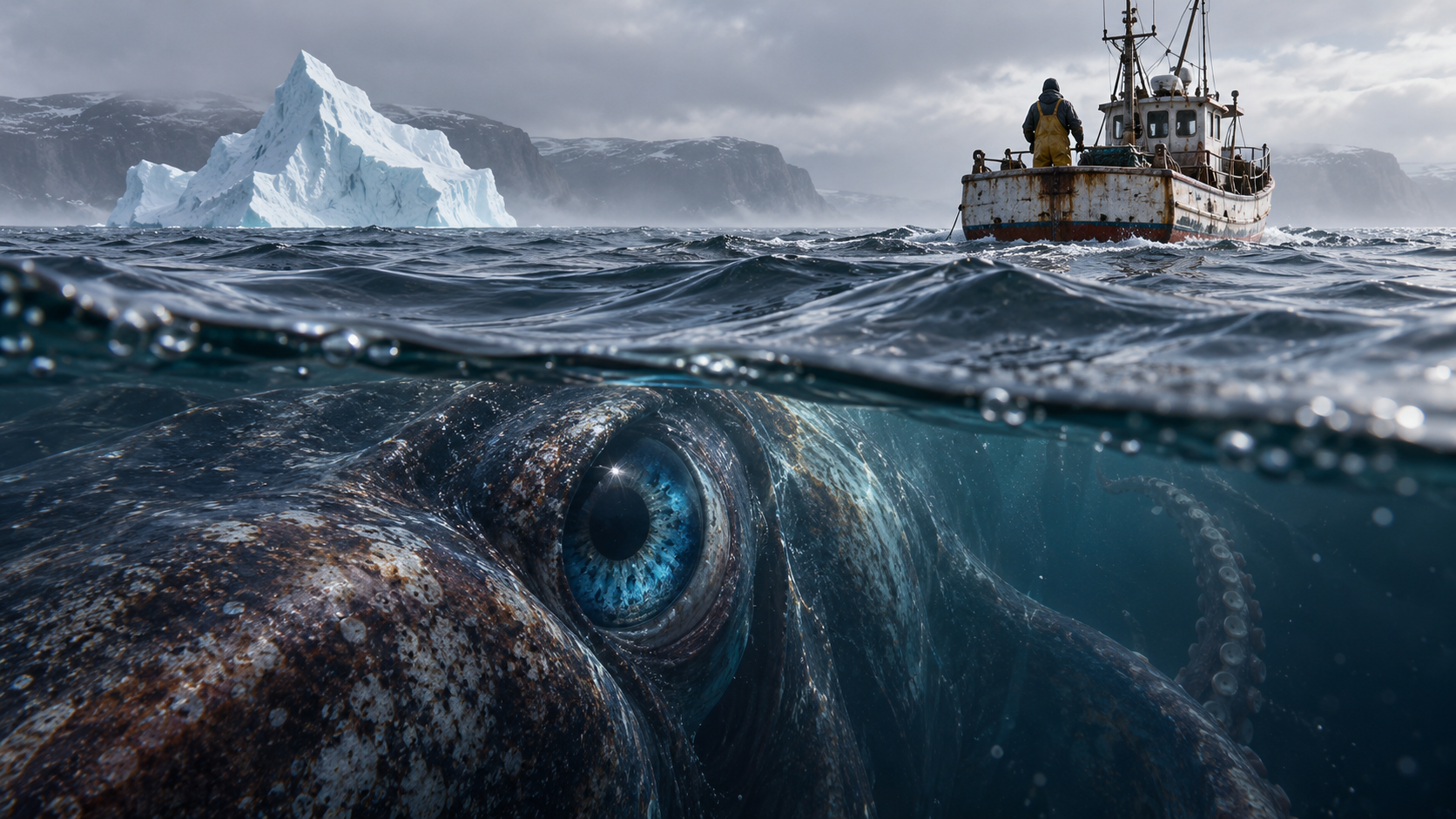
The Creature and the Penney Family
A Fishing Town Cannot Escape Its Own Waters
For Calvin Penney, leaving home would mean surrendering the place that has already taken so much from him. Staying becomes just as frightening when something enormous begins moving beneath the water. Below, Netflix’s 2026 Canadian limited series created by Jesse McKeown, follows a Newfoundland fishing community caught between economic decline, pressure to relocate and an increasingly dangerous sea. Across six episodes, directed by Jamie Childs, Helen Shaver and Stephen Dunn, the mystery draws Calvin’s family into a struggle that reaches beyond identifying a creature. Their disagreements about work, responsibility and belonging become urgent when familiar waters turn hostile. The ocean supports this community, divides its families and holds evidence that its residents have never properly understood.
The Loss That Shapes Calvin’s Life
The story begins in 1986, when Calvin’s family leaves Little Pot Rock during a resettlement programme. Their house is being towed across the water when something catches it. Calvin’s father, Leo, is inside as the building begins to sink, threatening to drag the boat and the rest of the family down with it.
Young Calvin cuts the connecting rope. He saves the people aboard the boat, but his father disappears with the house. Beneath the surface, Calvin sees an enormous eye.
The circumstances establish a painful gap between what Calvin does and what he believes that action means. Cutting the rope is an emergency response to a disaster already unfolding. Yet he carries the memory as though he personally chose his father’s death. The child survives with responsibility far beyond anything a child could reasonably bear.
Forty years later, Calvin is a widower trying to sustain a livelihood in Snook’s Arm. His children gather for the community’s Come Home Year celebration: Wade remains nearby, while Mary returns with her boyfriend, Noah, and Jay arrives with troubles he initially conceals. Calvin’s sister, Ruth, is also central to the family and the town’s resistance to another proposed relocation.
The new resettlement offer turns the opening tragedy into an active problem. Once again, officials are asking people to exchange their homes for the promise of a more practical future. For residents struggling with scarce work, compensation has an understandable appeal. Calvin and Ruth see the loss of a community that money cannot simply recreate.
Calvin’s opposition therefore contains both conviction and fear. He knows what leaving once cost his family. That knowledge makes him alert to the damage of displacement, but it also makes compromise feel dangerously close to repeating the worst event of his life.
An Iceberg Offers Opportunity and Brings Disaster
Calvin hopes harvesting ice can help his finances. The arrival of a huge iceberg seems to offer something valuable in waters that no longer reliably provide enough fish. However, an unusual sample draws the attention of marine biologist Dr Fonda Howander, played by Mackenzie Davis.
This is an effective starting point for the investigation because the suspicious material enters through ordinary work. Calvin approaches the sea as someone looking for something he can sell. Fonda examines what that material contains. Their different questions gradually become part of the same enquiry.
Wade goes out with Jerry to collect ice at night. The expedition ends catastrophically: Jerry dies after becoming caught in a tightening cable, and Wade survives a terrifying encounter with the force beneath the water. His rescue brings the danger directly into Calvin’s household.
For Wade, survival does not provide a clear account of what happened. He has gaps in his memory, intense thirst and circular marks on his back. His father recognises a disturbing connection between this incident and the childhood experience he has never escaped.
The marks also give Fonda something more useful than a frightening story. They suggest contact with a large tentacled animal. As further evidence accumulates, including recorded footage of an attack, the possibility of a giant squid becomes increasingly difficult to dismiss.
Calvin and Fonda make a productive but uneasy partnership. He understands the local waters and the people who depend on them; she can connect apparently separate observations. Neither kind of knowledge is sufficient alone. Familiarity with a place does not guarantee an explanation for every new event there.
Meanwhile, Wade’s condition makes the family’s existing assumptions more consequential. He is already treated as someone who needs managing. Once he becomes frightened and confused, it becomes even harder for him to establish that his experiences deserve attention.
Why the Danger Spreads Through the Town
The threat does not remain offshore. Contaminated ice spreads exposure to material associated with the creature, and residents develop disturbing symptoms, particularly overwhelming thirst and a compulsion towards water. The community begins to lose its ability to respond coherently just as it most needs to organise.
The story initially allows these symptoms to resemble a curse. People behave as though something is calling them into the sea, while Wade experiences disturbing visions of a woman. Fonda’s investigation supplies a physical explanation for the outbreak, although the precise science belongs to the series’ fictional creature.
That distinction prevents two mysteries from being flattened into one. The town’s illness has an environmental route of exposure. Wade’s encounters with the woman develop into a separate revelation about actual people and their intentions. An apparent supernatural pattern does not mean every strange event has the same cause.
Fonda helps care for affected residents while the crisis overwhelms ordinary arrangements. Ruth is among those endangered by the impulse to enter the water. Noah also falls ill, making Mary’s visit home much more than an awkward introduction between her partner and her family.
His proposal during the emergency is a small but useful counterpoint to the larger action. The missing engagement ring cannot prevent him from expressing what he wants, and Mary accepts without it. Their commitment becomes clear when the usual performance of a proposal falls apart.
Jay’s difficulties pull another outside danger into the town. His apparent success conceals serious financial trouble, and the men pursuing him make the family reunion increasingly precarious. These problems matter because Calvin cannot protect his children simply by concentrating on the sea.
The siblings are living different versions of uncertainty. Wade has stayed without finding a secure adult role. Jay has left without achieving the stability his homecoming suggests. Mary must consider what belonging to this family requires while building a life of her own.
The Hunt Makes Calvin More Vulnerable
New arrivals offer the prospect of confronting the creature. Steve and Dr Sayed approach it with ambitions that do not align neatly with Calvin’s desire to stop the attacks. Their expedition draws him into a dangerous pursuit aboard the Sir John Franklin.
Calvin wants a decisive end to the threat. The others want access to an extraordinary animal and the rewards associated with that discovery. Their shared destination disguises a disagreement about what success would mean.
The attempt to track and approach the squid demonstrates how badly the expedition has underestimated it. The animal sheds the tentacle carrying the tracking device, defeating the mechanism meant to make its movements predictable. The hunters have acquired information without gaining control.
Calvin then becomes trapped in a submersible encounter that returns him to the terror of being helpless above an enormous underwater presence. The expedition collapses into violence between its own participants, and he is thrown back into the sea before eventually reaching land.
This sequence gives his initial solution a practical failure. Simply reaching the creature does not resolve his grief or secure his family’s future. It puts him in the hands of people whose judgement is compromised by their own interests.
Back in Snook’s Arm, the absence of reliable information creates a different kind of suffering. His relatives cannot know whether they should keep searching or begin grieving. Their fear is intensified by interference with communication: Jan sabotages a radio rather than allowing a distress message to produce an ordinary rescue response.
The danger now plainly includes human decisions. Whatever the squid is doing, it cannot explain why someone would obstruct assistance. The investigation has to widen beyond the animal without pretending that the animal’s attacks have become harmless.
Little Pot Rock and the Truth About Maggie
Calvin reaches Little Pot Rock, the place his family left decades earlier. There he finds Wade and learns that the frightening woman associated with his son’s visions is Maggie, daughter of Calvin’s childhood friend Walton Budgell.
Walton’s family remained hidden when others resettled. They have maintained an arrangement with the squid, which they call Mudder, and receive abundant fish through that relationship. What initially resembles an extraordinary method of survival gradually reveals a system of abuse.
The family feeds human victims to the creature. Phil, a captive fisherman, is being mutilated and used as an ongoing source of offerings. Their continued existence on the island depends on treating someone else’s body as a resource they can consume in stages.
Walton also interprets Wade’s marks as evidence that Mudder has selected him for Maggie. Calvin fears that his son will be useful only until he has fathered a child, after which he could become another sacrifice. This prospective fate is Calvin’s inference from what he discovers, rather than an event the series shows occurring.
Wade’s attachment to Maggie makes the situation harder to resolve. She offers him desire, recognition and a place where he appears to matter. From his perspective, his father arrives to remove something meaningful from his life again.
The disturbing feature of the arrangement is how affection and coercion overlap. Wade can experience his feelings as real while remaining vulnerable to people who have assigned him a purpose without his informed agreement. Feeling wanted does not establish that the relationship is safe.
Calvin also encounters his father’s grave. Walton explains that remains were recovered and buried, confronting Calvin with a material trace of the loss he has carried for decades. Walton challenges his self-blame: without cutting the rope, Calvin could have lost the rest of his family too.
This moment does not make Walton trustworthy. It makes him more complicated than a figure who speaks only lies. He can correctly identify Calvin’s childhood predicament while committing terrible acts in the present. Calvin must accept a useful truth without accepting the man’s authority over his son.
The Secret Beneath the Resettlement Scheme
On the island, Calvin discovers evidence of the Crocker Group’s mining interests. Valuable cobalt and copper deposits connect the area’s land to a much more profitable future than residents have been told about. Resettlement would clear the people living above those resources.
The discovery changes the meaning of the compensation offer. A payout presented as a solution to an unviable community also serves those who want access to its land. The residents are being asked to make a decision without the information necessary to judge what they are giving up.
This explains why the past and present relocations belong in the same story. Calvin’s family history is entangled with an economic project that outlasts individual disasters. The squid did not invent the pressure to leave; its attacks make an existing plan easier to advance.
Walton’s island offers no acceptable refuge from that system. Calvin tries to escape the household’s violence, and Wade ultimately intervenes to save him. Father and son leave together as fire consumes the house behind them.
Wade’s decision begins to change their relationship. Calvin needs the son he has underestimated. Wade acts rather than merely being retrieved, allowing their return to become something more substantial than a restoration of parental control.
Meanwhile, Fonda makes the discovery that explains the iceberg’s importance. A small squid emerges from material in her sample: the ice contains the creature’s developing young. The enormous animal has been guarding a nest.
The two discoveries fit together without becoming identical. Calvin has uncovered why powerful people want the land. Fonda has uncovered why the creature remains near the ice. Their combined knowledge offers a way to address the immediate danger while challenging the people exploiting it.
What Happens at the End of Below?
Calvin and his family prevent the planned destruction of Mudder by moving the ice containing her young away from the harbour. The military stands down, and Snook’s Arm survives the immediate crisis. Mudder subsequently dies after releasing her offspring, however, and Fonda reports that the young do not survive the warm water.
Reaching that outcome requires the Penneys to resist an evacuation already under way. Jim Crocker’s influence is now explicit, and Jan is revealed as his daughter. The proposed airstrike would remove the creature while helping make the community’s displacement permanent.
Fonda explains that Mudder’s aggression is bound up with protecting offspring in unsuitable conditions. Calvin can now recognise a purpose in behaviour he has understood primarily through his own bereavement. Another parent is struggling to keep its young alive.
The family initially prepares to leave, but Calvin stays to attempt an alternative. Wade joins him, and the others ultimately help. Their plan uses local skills and knowledge: break the iceberg into manageable pieces, gather the section containing the nest in a net and tow it into deeper water.
Mary fires the successful shot that fractures the ice. Calvin then moves the netted section with his boat, drawing Mudder away from the harbour. Fonda refuses the Crockers’ demands that she stop him, even when Jim threatens her professional position.
The military commander declines to proceed once the creature no longer presents the harbour threat used to justify the operation. Jim’s continuing insistence exposes how far his desired outcome exceeds the public safety argument.
Calvin releases the net by cutting its ropes and shares another encounter with Mudder’s eye. The action recalls the opening loss, but his understanding has changed. As a child, he cut a connection because everyone could otherwise drown. Here, he lets go after helping another family escape immediate destruction.
The resemblance does not erase his father’s death or prove that the creature was secretly benevolent throughout. It gives Calvin a different relationship with the memory. He can act decisively without turning the action into another sentence of lifelong guilt.
The aftermath remains painful. Moving the nest prevents a bombing; it cannot guarantee a viable habitat. Mudder’s death and the failure of her offspring keep the rescue from becoming an uncomplicated promise that goodwill can solve every environmental problem.
A year later, Calvin has opened the Big Squid Distillery and Brewing company. Wade captains the boat, demonstrating a practical change in the trust between them. Mary and Noah remain together, the family survives, and Calvin and Fonda show the beginnings of a possible romantic connection.
The Crockers’ interests have not disappeared. The town has won time and retained its home, but it has not secured immunity from future pressure.
What the Final Iceberg Means
The closing return to the water brings another ominous sight: more ice offshore. Calvin and Wade now understand how much an iceberg can conceal, so the image carries a threat that would not have meant the same thing at the beginning.
It does not establish that Mudder has returned from death. Nor does it identify a specific new creature inside the approaching ice. Its force comes from renewed uncertainty after the characters have learned that apparently familiar natural events can carry consequences they cannot anticipate.
McKeown has described the ending as part of a complete story that remains open to the larger disruption associated with climate change. That intention fits the separation between the family’s progress and the environment’s continuing instability. Calvin can repair a relationship with Wade without repairing the ocean.
The final image also complicates the town’s commercial recovery. A creature that nearly destroyed local life has become part of a business identity. The community is resourceful enough to make something of its experience, yet that adaptability should not be mistaken for control over what comes next.
There is a useful distinction between Mudder’s reality within the fiction and the series’ borrowing from marine biology. She is a fictional, extraordinary cephalopod, not evidence that ordinary giant squid behave this way. The production consulted marine biologist Annie Mercier, but its attacks, scale of threat and unusual effects belong to a dramatic invention.
That invention allows the story to connect two kinds of displacement. People face losing their homes through decisions made by those who want the land. Mudder’s young face an environment that cannot sustain them. Each struggle becomes more dangerous when those with power respond only to the most visible symptom.
Below finishes with a family better able to face uncertainty together. Calvin has stopped treating protection as something he must impose alone, and Wade has gained a role that requires trust. Their achievement is tangible, even with another iceberg ahead. The ending leaves them neither completely safe nor helpless: they have learned to investigate what threatens them, recognise who benefits from their fear and choose a response beyond repeating the violence of the past.
Sources
Below: Watch as Josh Hartnett Unravels an Underwater Mystery Now — Netflix Tudum. Official series identification, premise and directing credits.
Meet the Small-Town Community Taking on a Mysterious Sea Creature in Below — Netflix Tudum. Character relationships and the Penney family’s circumstances.
Show Snob’s episode recaps: Episode 1, Episode 2, Episode 3, Episode 4, Episode 5 and Episode 6. Episode order, the outbreak, expedition, island discoveries and rescue mechanics.
What Happens at the End of Below? — Netflix Tudum. Official explanation of Maggie, Walton, the Crockers and Calvin’s final encounter with Mudder.
Below: A Sea Monster and a Town Under Threat — The Viewer’s Perspective, and Below Recap & Ending Explained — High On Films. Additional plot corroboration and the community’s aftermath.
Below Episode 6 Recap and Review: “The Unfathering Deep” — A Town Saved, a Mother Lost — Litehouse. Finale corroboration, including Mudder’s death and the unsuccessful survival of her offspring.
Could the Sea Creature in Below Really Exist? — Netflix Tudum. Consultant Annie Mercier’s distinction between marine biology and the fictional creature; confirmation of the offspring’s fate.
‘Below’ Bosses Explain Finale Ending — Will There Be a Season 2? — TV Insider. Creator and executive-producer commentary on the final image and the limited series’ intended completeness.
