Donnie Darko Explained: Frank, the Tangent Universe and the Ending
Why Does Donnie Laugh?
A Stranger in a Rabbit Suit Starts the Countdown
Donnie Darko survives an accident because a disturbing visitor draws him out of his bedroom. The visitor wears a grotesque rabbit costume and brings a precise warning: the world has less than a month left. For Donnie, already struggling with sleepwalking, family arguments and troubling experiences, survival creates questions that nobody around him can answer.
Written and directed by Richard Kelly, Donnie Darko is a 2001 American film that brings teenage romance, suburban satire and science fiction into the same uneasy world. Its mystery depends on the relationship between ordinary choices and extraordinary consequences. Understanding it means following both: the boy trying to make sense of his life, and the increasingly strange pattern taking shape around him.
Donnie Comes Home to an Impossible Accident
The story takes place in October 1988, in suburban Virginia. Donnie, played by Jake Gyllenhaal, lives with his parents, Rose and Eddie, his older sister Elizabeth and his younger sister Samantha.
The family’s arguments are rude, funny and recognisable. Politics and irritation share the dinner table. These exchanges establish a household with affection as well as friction. Donnie can be cruel to his mother, but his parents’ concern for him is real. Their difficulty is understanding what kind of help he needs.
Donnie is receiving psychiatric treatment. His sleepwalking also places him outside the security suggested by the family home. The opening finds him waking away from his bedroom, before returning through a neighbourhood whose orderly appearance offers little explanation for his behaviour.
Then a voice calls him outside during the night.
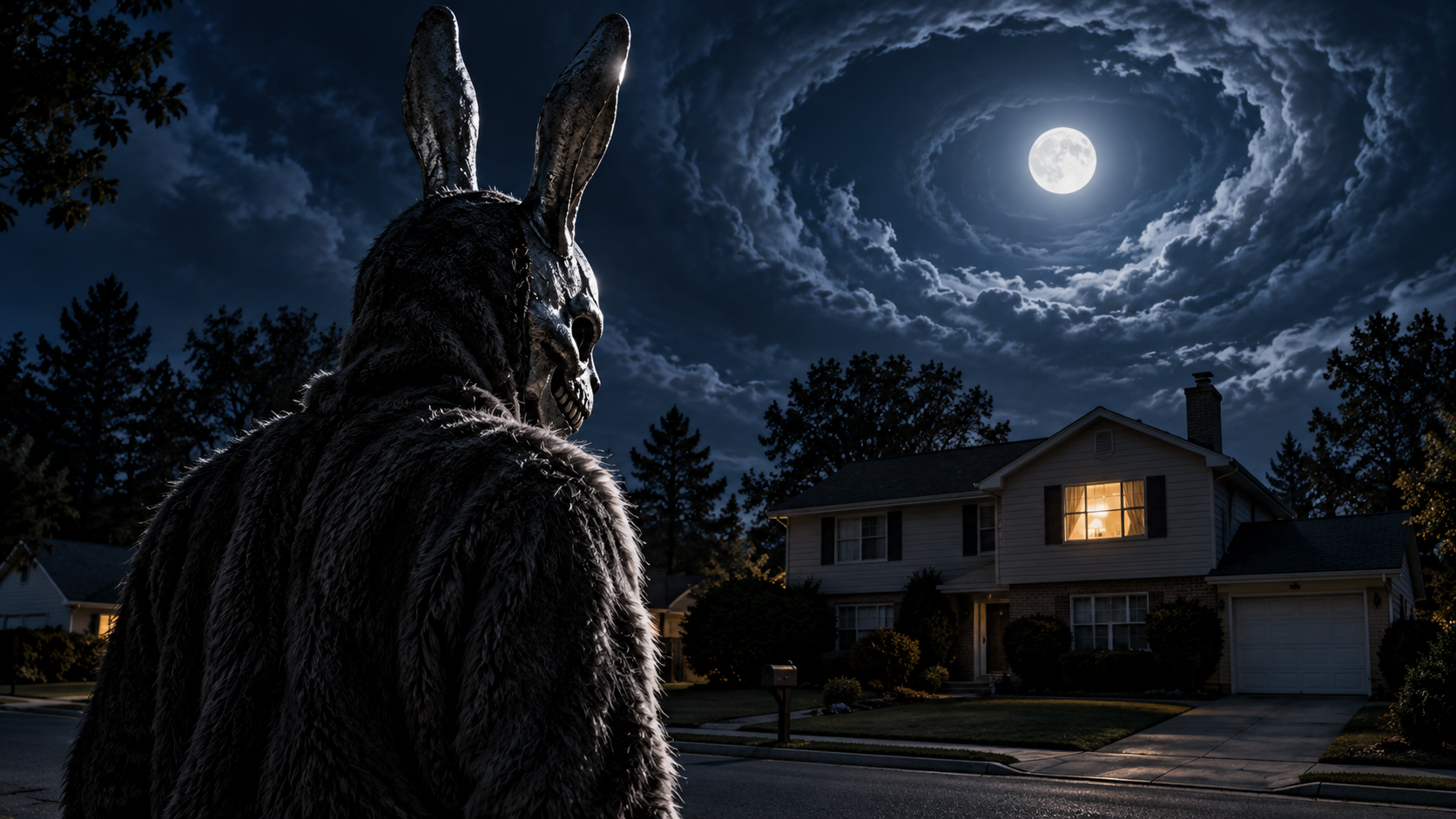
It belongs to Frank, a figure with long rabbit ears, a metallic-looking face and an expression that seems permanently threatening. Frank tells Donnie that the world will end in 28 days, six hours, 42 minutes and 12 seconds.
The precision makes the prediction more unsettling. It sounds less like a vague threat than an appointment.
Donnie wakes on a golf course. When he gets home, a jet engine has fallen through the roof into his bedroom. Had he stayed in bed, he would have been beneath it.
Investigators cannot establish where the engine came from.
This leaves Donnie with two incompatible ways of understanding Frank. He might be an expression of Donnie’s difficulties, yet following him has also prevented an actual death. The film makes that contradiction its starting point.
For his family, the central fact is that Donnie survived. For Donnie, the unanswered question is why.
An accident normally separates a life into before and after. Here, the accident also makes the future feel suspicious. If Frank knew enough to lead him away, perhaps the countdown deserves attention too.
School Offers Certainty That Donnie Cannot Accept
Returning to school does not restore a convincing sense of normality.
The school contains competing ideas about how young people should think. English teacher Karen Pomeroy encourages engagement with difficult material. Science teacher Kenneth Monnitoff is willing to take Donnie’s questions seriously. Other adults prefer a much narrower account of right and wrong.
Kitty Farmer, his physical education teacher, promotes the teachings of motivational speaker Jim Cunningham. His system reduces human behaviour to a line between fear and love.
Donnie objects because the exercise leaves out the complexity of actual experience.
His response is abrasive, but the objection matters. A person can feel affection, shame, anger and fear at once. A diagram that demands one answer can become a way of avoiding the situation it claims to explain.
Kelly places this argument inside a school rather than a philosophical debate. Donnie is expected to complete an exercise and accept the teacher’s authority. His refusal therefore becomes a disciplinary problem before anyone considers whether his criticism is reasonable.
Meanwhile, Frank continues to influence him.
Under that influence, Donnie damages a water main and floods the school. A disturbing act of vandalism interrupts the institution’s routine and creates time away from lessons.
The film does not offer Donnie’s intelligence as an excuse for this destruction. Being able to identify hypocrisy does not make every action he takes defensible. That tension keeps him from becoming a straightforward teenage spokesman.
The school sequences also establish how cinema can organise a community without explaining everyone through dialogue. The flowing movement through its corridors, accompanied by Tears for Fears’ “Head Over Heels”, connects students, teachers and social groups within one shared space.
The music gives the passage the feeling of remembered adolescence. The camera supplies something less comforting: a sense that these apparently separate lives already belong to a larger arrangement.
Donnie experiences school as a place that misunderstands him. The viewer begins to see it as a network whose connections may matter.
Gretchen Makes the Future Feel Worth Having
Gretchen Ross, played by Jena Malone, enters Donnie’s life as a new student.
She and her mother have moved under changed identities to escape her violent stepfather. Gretchen’s guardedness has a concrete history. She knows that a home can conceal danger and that moving somewhere new does not immediately remove its effects.
Donnie’s strangeness does not automatically repel her. Their conversations allow humour and vulnerability to exist together, without requiring either teenager to explain themselves perfectly.
Their relationship gives the film a future more immediate than Frank’s prediction.
Until now, Donnie’s survival has mainly produced confusion. With Gretchen, the extra time also contains possibility: someone to walk with, someone whose attention feels chosen, and the beginnings of intimacy.
This makes the countdown emotionally complicated. A warning about the end of the world is abstract. A warning that time with someone might run out is easier to feel.
Gretchen should also be understood as more than a calming influence. She has her own fears and boundaries. Their connection works because she responds to Donnie rather than simply reassuring him.
He, in turn, becomes capable of a gentleness that his arguments at home and school do not always reveal.
Gyllenhaal’s performance is important here. Donnie’s unsettling smiles and confrontational manner can make other people uncertain about him. In quieter exchanges, the same character becomes awkward and exposed. His confidence is uneven, and sometimes protective.
That variation prevents his sarcasm from becoming his entire personality.
The romance also complicates the film’s question about loneliness. Donnie can be loved by his family and still feel that nobody can reach the place where his fear originates. Gretchen offers connection without solving that fear.
For a while, being understood by another person seems possible even if the universe remains incomprehensible.
Roberta Sparrow Gives Donnie Another Way to Think
Frank introduces the possibility of time travel, and Donnie takes the question to Monnitoff.
The teacher gives him The Philosophy of Time Travel, written by Roberta Sparrow. She once taught science at the school. Now elderly and isolated, she is known locally as Grandma Death.
Donnie has already encountered her near the road. She repeatedly checks her letterbox, appearing to wait for something that never comes.
Her presence changes once Donnie learns about the book. Someone the neighbourhood treats as a curiosity may possess knowledge that its more respectable authorities lack.
This does not establish that everything she wrote is true. It gives Donnie a framework to investigate.
Their earlier encounter also introduces a fear that follows him: the possibility of dying alone. The thought disturbs him because it concerns more than physical company. It suggests that the final experience of being a person may be impossible to share.
His conversations with his therapist, Dr Thurman, reveal how deeply that possibility troubles him.
At the same time, his experiences become more visibly strange. Liquid-looking extensions emerge from people’s chests, indicating routes they are about to take. Donnie appears able to perceive movement before the person makes it.
These images turn a question about free will into something he can watch.
If a path already exists, is the person choosing to follow it? Could seeing the path create an opportunity to refuse? Or would that refusal already belong to the same design?
The film allows these possibilities to remain uncomfortable.
Monnitoff can discuss scientific ideas, but his willingness to continue reaches a limit when their conversation moves towards God and predestination. His hesitation exposes another boundary around Donnie: even a sympathetic adult has professional and intellectual constraints.
Donnie now has fragments of explanation, a book and experiences that seem to support extraordinary possibilities.
He still lacks a reliable guide to what he should do with them.
Frank’s Instructions Reach Beyond Donnie
Donnie’s growing interest in time does not stop Frank from directing his actions.
During a cinema visit with Gretchen, Frank appears again. With Gretchen asleep nearby, the encounter briefly separates Donnie from the ordinary experience of a date.
Frank removes his rabbit head.
Underneath is a young man with a terrible wound to one eye.
The disclosure changes the nature of the mystery. The costume contains a recognisable person, but recognising a human face does not explain how he can appear to Donnie or know what is coming.
Frank directs Donnie to burn Jim Cunningham’s house.
The fire leads to the discovery of a hidden collection of child sexual abuse material. Cunningham, whose public image depends on moral guidance and personal improvement, is arrested.
The revelation gives Donnie’s contempt for Cunningham a horrifying context. However, it does not make arson a generally reliable route to truth. Within this story, a destructive act exposes another person’s concealed wrongdoing. The ethical discomfort remains part of the sequence.
Cunningham’s reassuring public language now appears especially sinister. He has taught people to recognise virtue through confidence and a simple message. Those habits make scrutiny easier to resist.
Kitty Farmer continues to support him.
Her response shows how loyalty can protect an admired figure from the evidence against him. Accepting the discovery would require her to reconsider her own judgement and the authority she has promoted.
Her decision also changes the Darko family’s practical arrangements.
Kitty was due to accompany Samantha’s dance group, Sparkle Motion, on a trip to Los Angeles. Because she wants to help Cunningham’s defence, Rose goes instead.
The connection is essential. Frank’s instruction produces a fire. The fire exposes Cunningham. His arrest changes who travels with the children.
What seemed like separate stories about a teenager, a motivational speaker and a dance competition now share a chain of consequences.
Donnie does not yet possess a complete view of that chain. Neither does the audience.
The Town Protects Its Order While Donnie Loses His
The school’s response to disruption also affects Karen Pomeroy.
Her teaching becomes a target in an atmosphere where difficult books and questioning students are treated as threats to order. She loses her job.
The contrast with Cunningham’s supporters is revealing. Some adults are more comfortable defending an admired man than allowing students to encounter challenging ideas.
Karen’s departure narrows Donnie’s access to sympathetic authority. She has not solved his problems, but she has treated interpretation as something worth attempting.
Before she leaves, she draws attention to the phrase “cellar door”, admiring its sound.
At this stage, the phrase belongs to language: an ordinary combination of words that can be heard differently when someone asks you to notice it. It fits a film in which familiar objects keep acquiring unfamiliar significance.
Donnie also writes to Roberta Sparrow.
The letter extends his search beyond conversations with teachers and his therapist. He wants a response from the person whose book seems closest to his experiences.
Meanwhile, the prediction’s deadline approaches.
Donnie’s conversations in therapy become more troubling. He speaks about Frank and the destruction of the school and Cunningham’s house. What might initially have sounded like fantasy now has connections to events outside the consulting room.
Dr Thurman’s concern gives the viewer a grounded perspective. Donnie’s experiences are frightening, and people who care about him have reasons to worry about his safety and actions.
The science-fiction mystery does not remove that human reality.
Nor does the possibility of psychiatric illness automatically settle the mystery. The film has already introduced information and events that resist a simple explanation from within Donnie’s mind.
Its tension comes from maintaining both pressures. Donnie needs care, and something extraordinary may also be happening.
The approaching deadline intensifies his isolation because neither available explanation tells him clearly how to act.
Halloween Brings the Separate Stories Together
With Rose away and Eddie absent on business, Donnie and Elizabeth hold a Halloween party. Elizabeth’s acceptance to Harvard gives them a reason to celebrate.
Gretchen arrives distressed because her mother is missing.
The fear associated with her stepfather returns, disturbing the sense of safety she has begun to find. Donnie comforts her, and their relationship becomes sexually intimate.
The party places that private closeness inside a busy house full of costumes, music and other people. For a brief period, teenage life seems to continue around the countdown.
Then Donnie recognises how little time remains.
He leaves with Gretchen and two friends to visit Roberta Sparrow. They approach her house through the cellar entrance, giving Karen’s earlier phrase a physical counterpart.
Inside, they encounter Seth and Ricky, school bullies who are breaking into the property.
A confrontation spills outside. Gretchen ends up lying in the road. A car approaches, swerves around Sparrow and runs over her.
Gretchen is killed.
The driver gets out wearing the rabbit costume.
He is Frank, Elizabeth’s boyfriend: a living young man whose Halloween clothing matches the figure Donnie has been seeing.
Donnie shoots him in the eye.
The injury corresponds to the wound revealed during the cinema encounter. The film has finally supplied a connection between the visitor and an event that, for Donnie, had not yet happened when he first saw it.
This is the point at which the story’s arrangement becomes unmistakably circular.
Frank’s death appears to explain the wounded figure who has already guided Donnie. That guidance has helped create the circumstances in which Frank dies.
The revelation does not make the scene emotionally tidy. Gretchen is dead, Frank has been shot, and Donnie has participated in the catastrophe he was trying to understand.
The threatening rabbit has become both a supernatural messenger and a frightened person caught inside events.
The Final Morning Returns to the First Night
Donnie carries Gretchen away.
As a huge disturbance develops above the town, he takes her body to the ridge overlooking the area.
Rose and Samantha are returning by plane from the dance trip. The aircraft becomes caught in the extraordinary event, and an engine is torn away.
The mystery introduced at the beginning now has its missing connection. The engine is associated with this later flight and the rupture in time.
The film reverses the previous weeks and returns to October 2.
Donnie is back in bed. He laughs, remains there, and the engine crashes into his bedroom.
This time, he dies.
The changed outcome prevents the following weeks from unfolding as the audience experienced them. Gretchen is alive. Frank is alive. The relationship, the Halloween tragedy and the journey to the ridge no longer occupy the same place in ordinary history.
Yet the film does not portray the reset as entirely clean.
Across the community, people wake disturbed. Frank touches his eye. Cunningham is visibly distressed. The sequence suggests emotional traces of experiences they cannot straightforwardly remember.
The piano-led recording of “Mad World”, performed by Gary Jules with Michael Andrews, accompanies these separate awakenings.
Earlier, music helped connect the school into a lively social world. Here, it connects people through private disturbance. They are apart, yet the editing gives their unease a shared rhythm.
The next morning, Gretchen cycles past the Darko house and learns that a boy has died.
She does not know him.
She and Rose exchange a small wave.
For Gretchen, the gesture can be sympathy towards a grieving stranger. For the viewer, it contains the relationship and loss that have just been removed from her life.
The film closes on a connection whose full meaning belongs to neither woman.
What the Tangent Universe Explains
The director’s cut makes the science-fiction framework more explicit by incorporating passages from Sparrow’s book.
Its central distinction is between the Primary Universe and a temporary, unstable Tangent Universe. The latter can collapse catastrophically. A metal object called an Artefact must be guided back to the Primary Universe.
In Donnie’s story, the Artefact is the jet engine.
Donnie occupies the role called the Living Receiver. Within the book’s mythology, that person gains unusual abilities and must enable the Artefact’s return.
People around the Receiver help shape events. The terminology distinguishes the Manipulated Living from the Manipulated Dead. Frank belongs to the second category because he dies within the Tangent Universe and can influence Donnie across its sequence of time.
This explains why the visitor already bears the injury Donnie will inflict.
Frank is not simply predicting a stranger’s future. His appearance participates in a causal loop involving his own death.
The mythology also describes an “Ensurance Trap”: circumstances that push the Receiver towards completing the task. Gretchen’s death gives Donnie an overwhelming personal reason to undo the sequence.
That framework explains why seemingly incidental developments matter. The school closure creates opportunities for the romance. Cunningham’s exposure changes Rose’s travel arrangements. The gun, the party and the visit to Sparrow’s house acquire places within the same structure.
However, the fictional book should not be treated as real physics. It is the story’s explanatory mythology.
Nor does every uncertainty vanish once its terms are defined. The theatrical cut leaves the mechanics comparatively implicit, and even the expanded framework does not provide a detailed explanation for every choice.
Most importantly, the necessity of returning the engine and the meaning of Donnie’s death are related questions, but they are not identical. The film shows the return and his death together. It does not demonstrate a universal rule that every Living Receiver must die.
Why Donnie Laughs, and What the Ending Leaves Open
Donnie’s laughter is one reason the ending can feel peaceful as well as devastating.
Earlier, survival left him frightened and searching. In the final bedroom scene, he no longer appears caught in the same agitation.
The strongest reading is that he retains some understanding of what has happened and accepts the outcome. His stillness gives the return to bed the quality of a choice.
The film does not tell us exactly how much he remembers. It offers no final speech explaining his knowledge or motives.
That restraint matters. A complete explanation from Donnie would turn the scene into a report. Instead, his expression carries a change that the audience must interpret.
The ending also returns to the argument about fear and love.
Cunningham’s system insists that they can be separated into opposing categories. Donnie’s final situation makes that distinction inadequate. Fear of death can coexist with love for Gretchen, concern for his family and relief at the possibility of preventing disaster.
His decision becomes meaningful because those feelings are entangled.
A psychological interpretation remains available, especially in the theatrical cut. The story can be approached through Donnie’s distress, dreams and fear of death. But calling everything a hallucination leaves important features unexplained, including the final sequence involving other characters and the engine’s connection across time.
The Tangent Universe interpretation supplies the clearest account of the film’s external events. A psychological reading helps describe its emotional experience.
Neither requires treating Donnie’s suffering as evidence that his life has no value. The tragedy depends on the opposite: the audience has seen how much value his life could contain.
The final wave preserves that loss.
Rose has lost her son. Gretchen has lost no relationship she can consciously name. The viewer knows what existed between them, and cannot restore it by explaining the mechanics.
Time has changed. The emotional consequences remain with the audience.
Sources
BFI: Donnie Darko Programme Notes and Richard Kelly Interview — Film details and the director’s discussion of its background.
Richard Kelly Interview: The Two Cuts and the Film’s Ambiguity — Kelly on interpretation and the relationship between versions.
Donnie Darko: Plot and Key Scenes — Supporting reference for major events and the ending.
