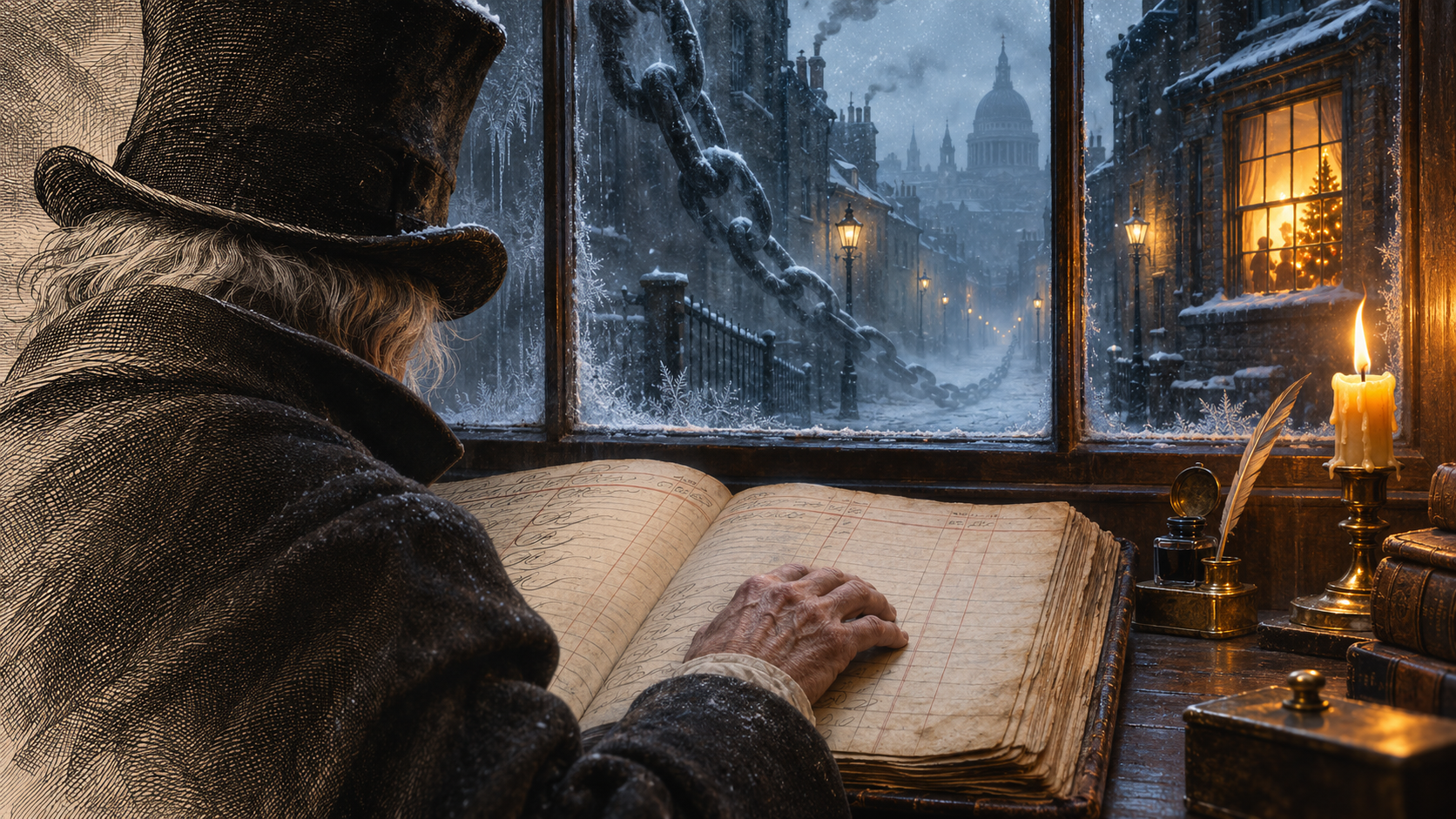
Scrooge Has More Reason to Distrust People Than Dickens’ Miser
Before Marley Haunts The Counting House, We Hear Him Laugh In It.
A kettle is coming to the boil when Jacob Marley dies. It is an ordinary sound to have to listen to after a man has drawn his last breath, especially when the man who would normally attend to it is the one lying dead. In Charles Dickens’ A Christmas Carol, Marley has been buried for seven years before we meet Ebenezer Scrooge. Ti West’s Ebenezer lets us hear what their office sounded like when there were two of them. Johnny Depp’s Scrooge once had somebody to share a joke with. The unfortunate thing for Bob Cratchit is what the two men found funny.
Released in British cinemas on 13 November 2026, Ebenezer follows the miser through the same extraordinary Christmas Eve that Dickens imagined in 1843. Its biggest changes concern the people around him. Marley gets a working day, Belle gets a profession and Bob eventually gets something that no employer in Dickens’ book thinks to offer him. West also gives Scrooge grounds for several of his worst suspicions. That decision does more to alter the meaning of A Christmas Carol than anything that climbs out of a grave.
Why the Film Lets Us Meet Jacob Marley Alive
Dickens spends the opening of his ghost story making sure we believe a death certificate. Marley’s burial paperwork was signed by all the proper people. Scrooge signed it himself. Having established the point, the narrator allows himself a leisurely digression about whether a doornail really is the deadest piece of ironmongery available. There is something disarming about an author who stops to consider the claims of a coffin nail when he is supposed to be frightening you. By the time a face appears on Scrooge’s door knocker, you have been enjoying the company of a very reasonable man.
West gives that opening companionship to Scrooge himself. Ian McKellen’s living Marley shares his partner’s pleasure in putting their clerk in his place. With the two of them there, Bob has to judge the cost of speaking up twice over. Anything he says can furnish one man with material to amuse the other. Rupert Grint’s Bob consequently begins the film with a piece of knowledge an employee might carry for years. He knows exactly how little encouragement his employer needs to be unkind.
Seven years later, the dead partner’s name still belongs to the firm. Dickens makes a joke of this. Newcomers sometimes address the surviving proprietor as Marley, and Scrooge answers readily enough to either name. West has given that joke a human shape. We have heard the two men in agreement when both could speak. Now one comes back desperate to say that the other must stop. Imagine what it would take for the one colleague who approved of every decision you ever made to withdraw his approval. That is the authority McKellen brings through the door.
Johnny Depp Finds the Pleasure Scrooge Takes in Being Difficult
Dickens gives his miser some excellent material. Scrooge objects to giving Bob Christmas Day off on full pay because nobody would thank him for withholding half a crown from Bob’s wages on an ordinary day. He can make the two propositions sound sufficiently alike to carry an argument, particularly when the only person available to point out the difference depends on those wages. It is easy to imagine him going home pleased with the conversation.
Depp catches that pleasure. His Scrooge can be prickly, petulant and quite entertaining while making somebody else’s afternoon thoroughly miserable. The amusement matters because of how little Scrooge enjoys the things his money could buy. Dickens sends him to a melancholy tavern and then home to eat gruel in a barely heated room. A man primarily interested in luxury would long ago have found a better use for his fortune. What appeals to Scrooge about having money is the frequency with which it allows him the last word.
A ghost makes a splendid adversary for such a man. Nobody needs his permission to come in. Threatening to dismiss a spirit would be particularly futile. When West has the bed itself swallow Scrooge, the indignity comes remarkably close to the spirit of Dickens’ jokes about his dressing gown and slippers. Here is one Londoner accustomed to deciding when an interview is over. Even his own bed has ceased to respect the arrangement.
Fezziwig’s Fate Changes the Meaning of His Christmas Party
Old Fezziwig gives the best office party in English literature partly because he understands how much of his staff’s evening a bad host could waste. The desks are cleared away, the shutters go up and an apprentice’s workplace becomes a dance floor. Dickens even gives the fiddler a book of music and sets him up on the lofty desk. A few hours previously that surface belonged to the business. For tonight the musician gets to decide what everybody does next.
Watching his younger self there, Scrooge objects when the Ghost of Christmas Past measures Fezziwig’s achievement by the few pounds the party cost. A master, he explains, has it in his power to make working life easy or burdensome. Much of it turns on words, looks and little gestures almost too slight to add up. He is still flushed with the defence of his old employer when he remembers the clerk he left in a freezing office. For a glorious moment Scrooge has won an argument and would give anything to take the victory back.
West changes what became of Fezziwig. The generous employer was murdered by a beggar he helped. For the older Scrooge, the party now comes attached to a terrible piece of hindsight. Young Ebenezer had once seen what goodness allowed a man to do. He subsequently learnt what it could cost him. An adult who retells that story every time somebody asks him for money has found a way to go on mourning Fezziwig while behaving in a manner Fezziwig would scarcely recognise.
There is a cost to the invention. Dickens lets the party stand as a perfectly practicable example of how to run a business. Fezziwig can afford the candles and he can afford the fiddler. Whatever excuses Scrooge might have for treating Bob differently, expense is a particularly poor one. West gives him a harder memory to face. It also leaves the audience with a dead benefactor as the film’s most memorable early example of what happens to a generous man.
What Happens When Scrooge Is Right About the Charity Collectors?
Dickens sends two gentlemen into the counting house to collect money for people who need food, drink and warmth. Scrooge asks whether the prisons and workhouses are still functioning. The gentlemen understand the question perfectly well. Those places exist, they explain, and some people would sooner die than go to them. Scrooge has just been offered the chance to make a modest decision about somebody’s supper. Within a few exchanges he is pronouncing on whether that person ought to live.
Depp’s Scrooge notices the collectors’ clothes and suspects that some of the money finds its way into their own pockets. The future shown to him gives the accusation uncomfortable weight. When a false will promises a large sum to their charity, the men are willing to accept the arrangement, including a handsome share for the man who produces the document. Their conduct in this possible future lends credibility to a suspicion Scrooge voiced before he knew anything about them. It also leaves open the rather important question of whether they had actually stolen a penny on the day he turned them away.
There are excellent reasons to refuse a crooked collector. None explains why a clerk sitting a few feet away should have to plead for time off. At its most interesting, the film lets Scrooge be right about someone and still badly wrong about what he owes everyone else. Dickens gives the reader a cleaner confrontation. His gentlemen ask a reasonable question, get a monstrous answer and leave. Anyone keen to find another explanation for their host’s refusal must supply it themselves.
Belle Becomes the Author of a Book Scrooge Can Buy
Belle gets one of the most adult conversations in Dickens. She asks Ebenezer to consider whether he would seek her out and try to marry her if they were meeting for the first time that day. They became engaged when both were poor. He has since acquired prospects, a terror of losing them and a habit of measuring every choice by what it might cost. She gives him an opening to say that he would choose her again. His inability to give a convincing answer does much of the work of the separation.
The old Scrooge subsequently sees Belle in a noisy home with a husband and children. Dickens is wonderfully attentive to the commotion, although there is a limit to what Scrooge can discover there. He can look at her family and imagine the daughter who might have called him father. The scene tells him little about what Belle might once have wanted to accomplish on an afternoon she had to herself.
In Ebenezer, Belle becomes a novelist. Scrooge can walk into a bookshop and encounter something she made after their lives parted. A book also allows him a form of contact that leaves her marriage in peace. He writes a note, and her husband reads it to her. There is no private audience for Scrooge to request, no need for Belle to weigh his regrets against her present happiness. For once the man who always had an answer can leave a woman to decide for herself what to make of it.
The Horror Dickens Had Already Written
It is worth opening Dickens at the appearance of Jacob Marley before giving any filmmaker credit for making A Christmas Carol disturbing. Marley wears a bandage around his head. When he removes it, his lower jaw drops towards his breast. Outside the window are spirits desperate to intervene in suffering they can still see perfectly well. One wails at the sight of a woman with an infant below him. He has lost the power to give the sort of help that would have cost him so little when he was alive.
West finds a new place to put an old fright. In Dickens, the Ghost of Christmas Present opens his robe to reveal two desperately neglected children, Ignorance and Want. In the film, the children inhabit the spirit’s ribcage. They can break free and pursue Scrooge. The image changes how we understand the great feast associated with the ghost. Tramell Tillman’s spirit can eat in front of us while carrying starvation inside his own body.
Something falls away in the move from revelation to pursuit. On the page the children crouch at the spirit’s feet and Scrooge asks whether there is anywhere for them to go. The ghost replies with the questions about prisons and workhouses that Scrooge himself asked earlier. Reading the exchange, one can almost feel the old man searching for an objection to his own words. A child who gives chase produces a more immediate sensation. The impulse to get away is exactly the one Dickens makes his reader sit through.
Whose Face Is Beneath the Last Spirit’s Hood?
The Ghost of Christmas Yet to Come does surprisingly little in the novella. It points. London supplies the rest, including men prepared to attend a funeral if lunch is provided and a woman who has stripped the bed curtains from around a corpse. The dead man had paid for those curtains and could once have excluded anybody he liked from the room. Now his possessions are doing the first useful thing they have done for somebody else in years. They are fetching a price.
There is an equally chilly calculation at the funeral in The Death of Ivan Ilyich, where a judge’s colleagues immediately begin working out whose promotion his death might enable. Dickens adds a peculiar cruelty by allowing the deceased to hear the conversation. Scrooge spends a considerable part of the vision waiting for somebody to mention what has become of him. People have been talking about him all along. He simply expected to be of greater interest.
West allows Scrooge to demand a look beneath the final spirit’s hood. The dead face he discovers is his own. At the grave, hands reach up for him. Dickens’ Scrooge has to put a series of clues together until he can no longer avoid reading the name on a stone. Depp’s gets the awful experience of meeting the person whose arrangements he has been inspecting. It is an effective answer to a problem any new adaptation faces. Almost everybody buying a ticket already knows whose funeral it is.
The more unsettling future belongs to the Cratchits. In the book, Bob comes home after visiting the place where Tiny Tim will be buried. He tries to describe how green it is. His family know what it costs him to keep talking, and the reader remembers just how much care this man put into carrying his living son. West takes the family to a debtors’ prison. The sight of Tim’s crutch there brings the boy’s absence into an institution of exactly the kind Scrooge considered an adequate answer to poverty. He finally has to picture someone he knows on the other side of its walls.
Why Bob Cratchit’s Name Belongs Over the Door
Dickens saves a last uncomfortable joke for Bob. When he arrives late on the morning after Christmas, Scrooge adopts his familiar ferocity. Bob has every reason to think he is in serious trouble. His employer eventually announces a pay rise and promises to help his family. The joke reveals a small inequality that survives Scrooge’s night of revelations. Only one of the men in that office can afford to find the first half of the conversation funny.
Ebenezer goes further with the terms of the offer. Scrooge has arranged medical attention for Tim. He raises Bob’s wages and offers him a place in the business under a new name, Scrooge and Cratchit. After all those years answering to a dead partner’s name, Scrooge will put a living colleague’s over the door. Tomorrow somebody coming into the office might ask for Mr Cratchit and have a perfectly good business reason for doing so.
Dickens gives Bob’s family something a film cannot establish quite so easily in a Christmas morning scene. His narrator can look years ahead. He tells us that Tiny Tim lives and that Scrooge becomes a second father to him. That promise takes in all the ordinary weekdays on which a child might need somebody dependable. West gives the audience a different assurance in the shape of the new partnership. Bob will come back to work after the decorations come down, and his improved circumstances will still be written on the sign.
There remains the question of what Scrooge will do when he meets somebody whose history he cannot check. The film leaves him with a beggar and the pocket watch that once belonged to Marley. Scrooge gives the man the watch and invites him in for tea. After the fraud, the false will and Fezziwig’s death, he has ample material with which to talk himself out of opening that door. Instead, he offers the stranger a seat. Think back to the kettle boiling at the beginning of the film. For seven years Scrooge has had every reason to associate that sound with the loss of his only companion. Now he has found somebody to share the pot.
Sources
Charles Dickens — A Christmas Carol — The original five staves, including Fezziwig’s party, Belle’s decision, the three spirits and Dickens’ account of Tiny Tim’s future.
The Guardian — Ebenezer review: Johnny Depp’s Scrooge tries to exorcise ghosts of business past — The release date, performances, living-Marley prologue and changes to Fezziwig and Belle.
The Movie Spoiler — Ebenezer — A scene-by-scene account of the released film, including the false will, the final spirit, Bob’s promotion and Marley’s watch.
Next Reads
The Death of Ivan Ilyich Explained: Gerasim, the Black Sack and the Final Light — Tolstoy opens with a funeral, then asks what a successful man might change if he could see his life as others experienced it.
Rebecca Explained: Manderley, the Second Mrs de Winter and the Ending — How a dead woman keeps her influence over a house and everyone who enters it.
The Moonstone Explained: The Paint Stain, Rachel’s Silence and the Missing Diamond — Another Victorian story in which the people who own a house understand far less about it than the people who work there.
