The Meaning of Inheritance
Rome Turns a Grieving Enemy into Public Entertainment
A man who has built a life beyond Rome finds himself dragged into its arena. The empire that destroys his home then sells his struggle to survive as entertainment. In Gladiator II, that journey brings private grief into contact with a political system that knows how to profit from it.
Ridley Scott’s 2024 sequel follows Lucius, played by Paul Mescal, through enslavement, spectacle and a struggle over Rome’s future. Denzel Washington’s Macrinus recognises the usefulness of his anger, while Lucilla and the general Acacius connect him to a past he has tried to leave behind. The film’s historical names provide a setting for a largely invented story about inheritance, revenge and the difference between gaining power and changing what power does.
Spoiler warning: the following summary discusses the plot, major twists and ending, including connections with Gladiator.
A Roman Victory Becomes a Personal Catastrophe
Living under the name Hanno in Numidia, Lucius loses his wife, Arishat, when Roman forces led by Acacius conquer his community. He is taken captive. Rome celebrates a military success that, from his position, means bereavement and the destruction of an ordinary future.
That difference in perspective drives the opening. An empire can describe a campaign through territory, prestige and the commander’s achievement. The people subjected to it experience specific losses. Lucius’s hatred begins in that immediate experience, long before he is asked to consider Rome as an ideal worth saving.
The film therefore sets itself a difficult task. Its hero has a persuasive reason to reject the city altogether, yet the story will draw him towards a responsibility for its future. That movement needs more than the discovery of an important surname. He must find reasons to distinguish Rome’s inhabitants and possibilities from the rulers directing its violence.
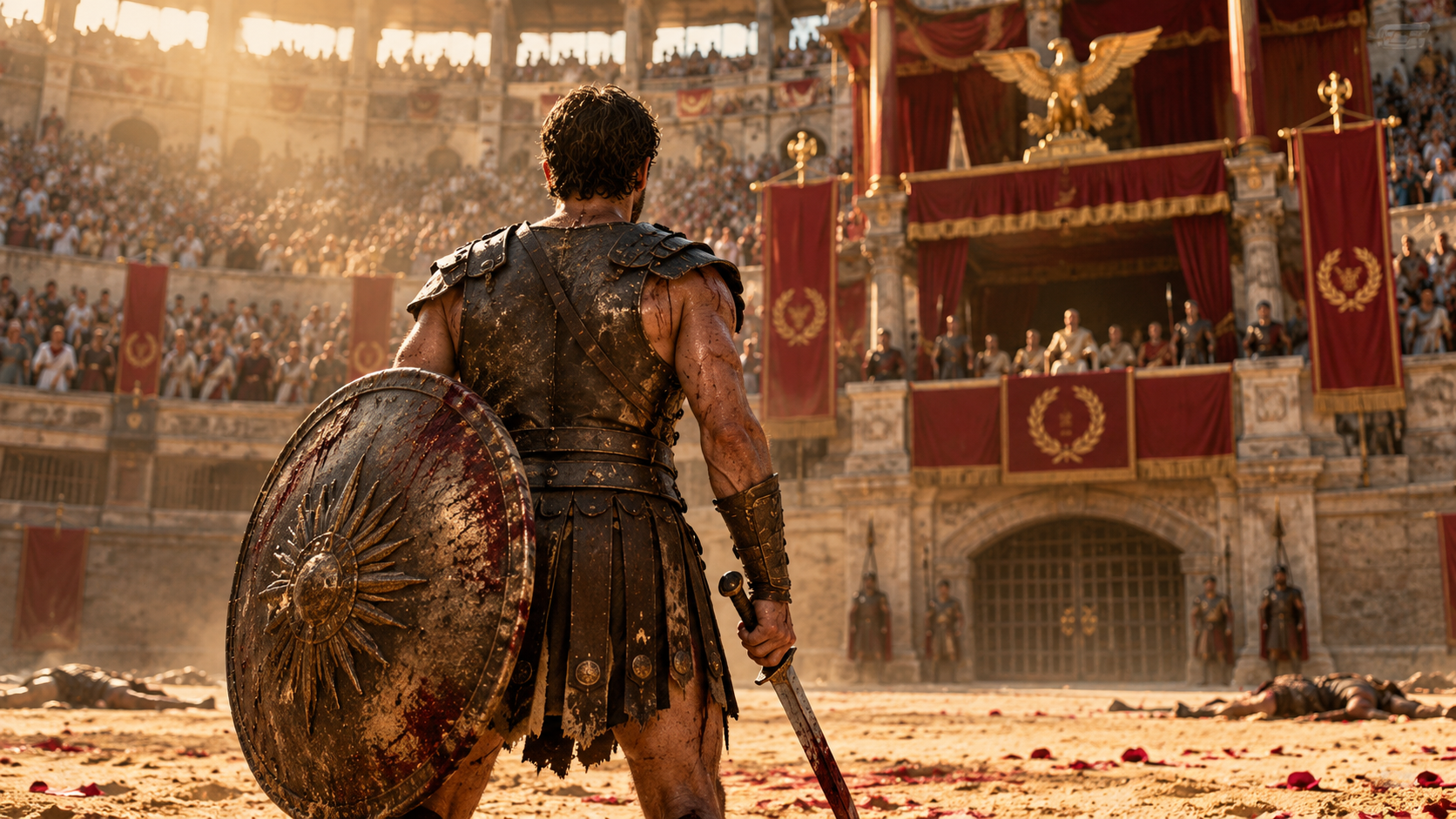
His enslavement makes the distinction harder. He does not initially encounter the empire through debate or citizenship. He encounters ownership, coercion and public risk. The arena transforms the damage inflicted on him into a product consumed by the society that inflicted it.
As an interpretation of the film, this is the connection between conquest and spectacle: Rome acquires people through force and then displays its continuing control over their bodies. Lucius’s survival may make him famous, but fame within that arrangement is not the same as freedom.
What Macrinus Sees in Lucius
Macrinus purchases Lucius after recognising his fighting ability and intensity. He offers a route towards the revenge Lucius wants against Acacius. The promise gives their relationship a clear exchange: Lucius supplies victories, and Macrinus presents himself as the person who can turn those victories into access.
Macrinus understands that a fighter’s motivation can be an asset. He does not need to share Lucius’s grief to use it. By appearing to offer the desired destination, he makes the path towards it serve his own interests.
This is more subtle than simply ordering an enslaved person to fight. Compulsion remains, but it is accompanied by an apparent alignment of purposes. Lucius can begin to understand each victory as progress towards his own objective even while it increases his owner’s influence.
The arrangement raises a question about agency. A choice can feel personal while its available options have been selected by someone else. Lucius’s determination is real, yet Macrinus controls many of the circumstances in which he can express it.
Washington’s character is effective because he moves between the arena and elite politics. He can assess physical courage, social weakness and ambition without treating them as separate worlds. What happens on the sand becomes leverage among the people watching from above.
His relationship with Lucius should therefore be read through incentives rather than assumed affection. Useful attention can resemble mentorship. The distinction emerges when the interests of the person being guided and the person doing the guiding cease to coincide.
Acacius Is Both Conqueror and Potential Ally
Acacius returns to Rome as a successful general, but he is dissatisfied with the emperors’ appetite for further war. With Lucilla, he becomes involved in opposition to their rule. His position complicates the simple target Lucius has chosen for his anger.
From Lucius’s perspective, the general remains connected to Arishat’s death. Later evidence of political opposition does not make that earlier experience disappear. The film asks whether a person can recognise a potential ally without pretending that the ally has never helped cause harm.
Acacius also embodies the limits of disapproval from within a violent institution. He has served Rome effectively. His discomfort becomes politically meaningful only when it produces an action that threatens the people directing him.
That makes his relationship with the emperors different from Macrinus’s. Acacius wants to resist a course he considers destructive; Macrinus looks for opportunities within the rulers’ weaknesses. Both can speak critically of those at the top while pursuing very different outcomes.
Lucius does not immediately have access to this distinction. His knowledge is partial and shaped by trauma. The viewer can understand why his first judgement is narrow without assuming that the narrow judgement must remain correct as new information arrives.
The confrontation between Lucius and Acacius is therefore built around a revision of knowledge. Revenge promises a clear ending: kill the person associated with the loss. Politics introduces the possibility that doing so may assist someone whose intentions are worse.
Why Lucilla Sent Her Son Away
Lucilla recognises the fighter as her son, whom she sent away after the events surrounding Commodus’s death. She intended to protect him from the dangers attached to his position. Lucius experienced that separation as abandonment.
The two accounts are emotionally compatible even though they lead to opposing judgements. A parent can make a protective decision and still cause a child lasting pain. The existence of a reason does not automatically repair the experience of being left.
Their reunion is consequently not solved by exchanging information. Lucilla can explain what she feared, but Lucius must decide what that explanation changes. His adult life outside Rome has been real; it cannot be treated merely as an interval before he returns to his rightful place.
The revelation that Maximus was his father connects the sequel to the original film. It gives Lucius a legacy that others recognise and a model of courage to which he can be compared. It also creates the risk that his individuality will be swallowed by the role of successor.
The most useful reading of that legacy is as a question rather than an instruction. Maximus’s example does not tell Lucius exactly how to govern, whom to trust or how to rebuild a political order. It gives him an obligation to consider what his strength is for.
Lucilla’s position adds another layer. She is attempting to protect her son while taking part in a struggle that makes protection more difficult. Her family relationships and political choices cannot be neatly separated because the regime treats both as matters of power.
The Arena Makes Every Choice Public
The film’s extravagant contests are more than obstacles placed before the hero. They gather the rulers, elites, fighters and crowd around the same event, allowing a personal action to become a political signal.
A fighter can be ordered to kill, but the meaning of compliance or refusal is not fully controlled by the person giving the order. The audience may admire courage, recognise injustice or turn against the people presiding over the spectacle. That possibility makes the arena useful and dangerous to rulers.
The spectacle nevertheless remains coercive. Popular approval does not guarantee that the people fighting can leave. The crowd may celebrate a man whose life is still being used to entertain it. Admiration and exploitation can occupy the same space.
Lucius’s growing prominence creates an opportunity to break that arrangement, but only if he can connect it to action outside the individual contest. Winning another fight does not by itself change who owns the fighters, commands the guards or issues the next order.
This is where Macrinus’s political intelligence becomes important. He knows that a striking event must be converted into influence. Lucius initially understands victory through survival and revenge; Macrinus understands how an audience’s reaction can create an opening elsewhere.
The film’s larger conflict is therefore partly a competition over interpretation. Who gets to explain what the crowd has just seen, and who can persuade others to act on that explanation?
Why Lucius Refuses the Revenge He Wanted
When Acacius is forced to face him, Lucius finally receives the opportunity towards which Macrinus has directed him. Instead of completing the expected killing, he recognises Acacius’s connection to Lucilla and his intention to help. He spares him, but the regime has Acacius killed regardless.
The refusal is a decisive change in Lucius’s understanding of strength. He can act against the purpose assigned to him even when that purpose once matched his own desire. His anger no longer determines the outcome automatically.
That does not mean he has forgiven the destruction of his home in any complete or uncomplicated sense. The film gives him a practical moral choice in the present. Killing Acacius now would serve the rulers’ spectacle and Macrinus’s manoeuvring more clearly than it would repair his own loss.
The execution also exposes the limits of mercy inside an institution that reserves final authority for someone else. Lucius can refuse to deliver the fatal blow, but he cannot yet make his decision binding. His personal development outruns his political power.
Acacius’s death turns the general’s popularity into a danger for the regime. The public killing of a celebrated commander invites people to reassess the rulers rather than simply applaud another display. Macrinus is ready to exploit that instability.
How Macrinus Moves Towards the Throne
Macrinus manipulates the rivalry between Geta and Caracalla. Caracalla kills Geta, and Macrinus advances within the resulting disorder. His method depends on making another person’s immediate fear or resentment serve a longer plan.
The brothers’ shared power is vulnerable because neither can fully trust the other. An adviser who controls information can make that insecurity worse, presenting aggression as self-protection. Macrinus does not have to be the strongest figure in the room if he can influence what the strongest figures believe is necessary.
His rise also distinguishes resentment from reform. The film gives him a history of subordination, but suffering under a system does not automatically make a person committed to abolishing it. He seeks to command the machinery that once held him down.
That is an important contrast with Lucius. Both have reasons to hate Rome’s hierarchy. The question is what each intends to do with the power available after the current rulers fall. Replacing the occupant of a throne can preserve the essential relationship between ruler and ruled.
Macrinus’s apparent flexibility becomes a source of danger. People who believe they are dealing with a supporter discover that their usefulness has an expiry date. His alliances are governed by advancement, and his promises do not survive a conflict with that aim.
Why Ravi Matters to Lucius’s Choice
Ravi offers a quieter perspective on the arena than the people who own it, govern it or perform in it. As a physician and former gladiator, he connects the spectacle to its physical aftermath. The crowd sees an event; the person treating the wounded sees what remains when the applause has ended.
His presence gives Lucius access to a relationship that is not organised entirely around domination. Macrinus evaluates what Lucius can accomplish for him. The emperors evaluate what he can provide as entertainment. Ravi encounters someone whose body needs care, even while that body is being used as an instrument by more powerful men.
That contrast matters in a story so interested in inherited greatness. Lucius’s connection to Maximus may explain why his identity carries political significance, but ancestry cannot perform an ethical choice for him. He still has to decide how to treat the people around him and what purpose his strength will serve.
The memory of Maximus, including the armour associated with him, gives Lucius a language through which to understand his position. It also creates a temptation for the viewer: to imagine that wearing the right inheritance completes the transformation. The film’s emotional logic asks for something more demanding. Lucius must make decisions that give the inheritance meaning.
Ravi helps make that distinction visible. His importance does not depend on a claim to the throne or a spectacular victory over a rival. He demonstrates that a life connected to the arena can contain knowledge, service and agency beyond the moment of combat. His role widens the possible meaning of survival.
This does not remove the sequel’s reliance on heroic violence. The decisive confrontation still belongs to its central fighter. But it gives that confrontation a context beyond personal revenge: Lucius has encountered people whose lives cannot be improved simply by giving the crowd a different man to cheer.
When assessing the ending, it is therefore useful to remember the characters who will have to live under whatever follows. Winning a duel can remove an immediate threat. It cannot, by itself, supply the care, trust or practical work that a better political order would require. Ravi makes that gap easier to see because his contribution is already concerned with repairing damage rather than turning it into spectacle.
What Happens at the End of Gladiator II?
Lucius organises resistance among the gladiators and sends Ravi to bring Acacius’s forces towards Rome. During the final upheaval, Macrinus kills Caracalla and shoots Lucilla. Lucius then confronts Macrinus outside the city, defeats him and appeals to the opposing soldiers to avoid further bloodshed.
The ending leaves Lucius in a position of leadership without showing a completed political settlement. He can unite people around a vision of a different Rome, but the film does not demonstrate the creation of a durable republic or establish the details of his future government.
That limit is important. The defeat of Macrinus resolves the immediate struggle over power. It does not automatically solve the problems that allowed the emperors and Macrinus to use people as instruments.
Lucius’s return to the arena and invocation of his father bring the ending back to inheritance. He has survived the structure that consumed Maximus and has another chance to act on the ideal associated with him. The gesture expresses continuity and uncertainty together: the past can inspire him, but it cannot answer on his behalf.
The loss of Lucilla prevents victory from becoming a restoration of the family as it was. Lucius gains public responsibility while losing the possibility of a longer reconciliation with his mother. The political opportunity arrives with a personal absence that success cannot remove.
Which Parts of Gladiator II Are Historically True?
Caracalla, Geta, Macrinus and Lucilla were real people, but the film changes their lives and chronology substantially. Geta and Caracalla were brothers, not twins. Lucilla died in 182, long before their joint rule. The historical Macrinus was a senior official who became emperor, not a documented gladiator owner following the film’s invented path.
Lucius’s identity as Maximus’s son belongs to the fictional continuity of the films. Maximus himself is an invented character. The family revelation should therefore be understood as a sequel’s narrative choice, not as a recovered historical fact.
The arena spectacles mix historical practices with invention. Romans staged naval displays and exhibited dangerous animals. That does not establish the film’s particular combination of sharks, combat and engineering, or provide evidence that gladiators rode rhinoceroses in the way shown.
The distinction is between a general practice and a specific reconstruction. Evidence that an animal appeared in an amphitheatre cannot support every imagined use of that animal. Likewise, evidence for ancient naval spectacles does not mean every later version of the Colosseum could accommodate the same arrangement.
These departures matter most when the film’s political ending is treated as history. The empire did not become a restored republic through the victory shown here. The sequel borrows historical names to tell a moral adventure about leadership, rather than reproducing a documented constitutional turning point.
What the Ending Leaves Unanswered
The film’s idea of Rome is more coherent as an aspiration than as a political programme. Lucius can reject cruelty and appeal to common purpose, but the audience is not shown how military command would be restrained, how power would be transferred or whose voices would count in the proposed future.
That is a legitimate limit of an action epic, but it also sharpens the interpretation. The ending is a beginning made possible by the removal of immediate enemies. Treating it as proof of lasting reform grants the hero an achievement the narrative has not yet established.
The strongest difference between Lucius and Macrinus lies in their final use of advantage. Macrinus treats people as steps towards personal supremacy. Lucius attempts to stop a larger confrontation when he has the chance to lead it. His claim to a better future rests on that choice, not solely on his parentage.
Gladiator II ultimately asks whether inherited violence must produce another violent ruler. Lucius cannot undo the conquest that killed Arishat or the losses suffered in Rome. He can decide whether those losses become permission to dominate others. The film ends when he earns the opportunity to answer that question through leadership, leaving the harder work beyond the last fight.
Sources
Gladiator II — Film and Plot Reference — Credits and narrative sequence, cross-checked against ending coverage.
TheWrap — Gladiator II Ending Explained — The final confrontation and the unresolved form of Lucius’s leadership.
Smithsonian Magazine — The Real History Behind Gladiator II — Historical people, altered chronology and arena practices.
Australian National University — Gladiator II Is Full of Historical Inaccuracies — Classicist Caillan Davenport’s discussion of animals, spectacle and historical representation.
Next Reads
Film Summaries, Endings Explained & Analysis — More analysis of cinematic endings and their implications.
