Heretic (2004) Film Summary: When Belief Becomes a Test—and the Test Becomes a Trap.
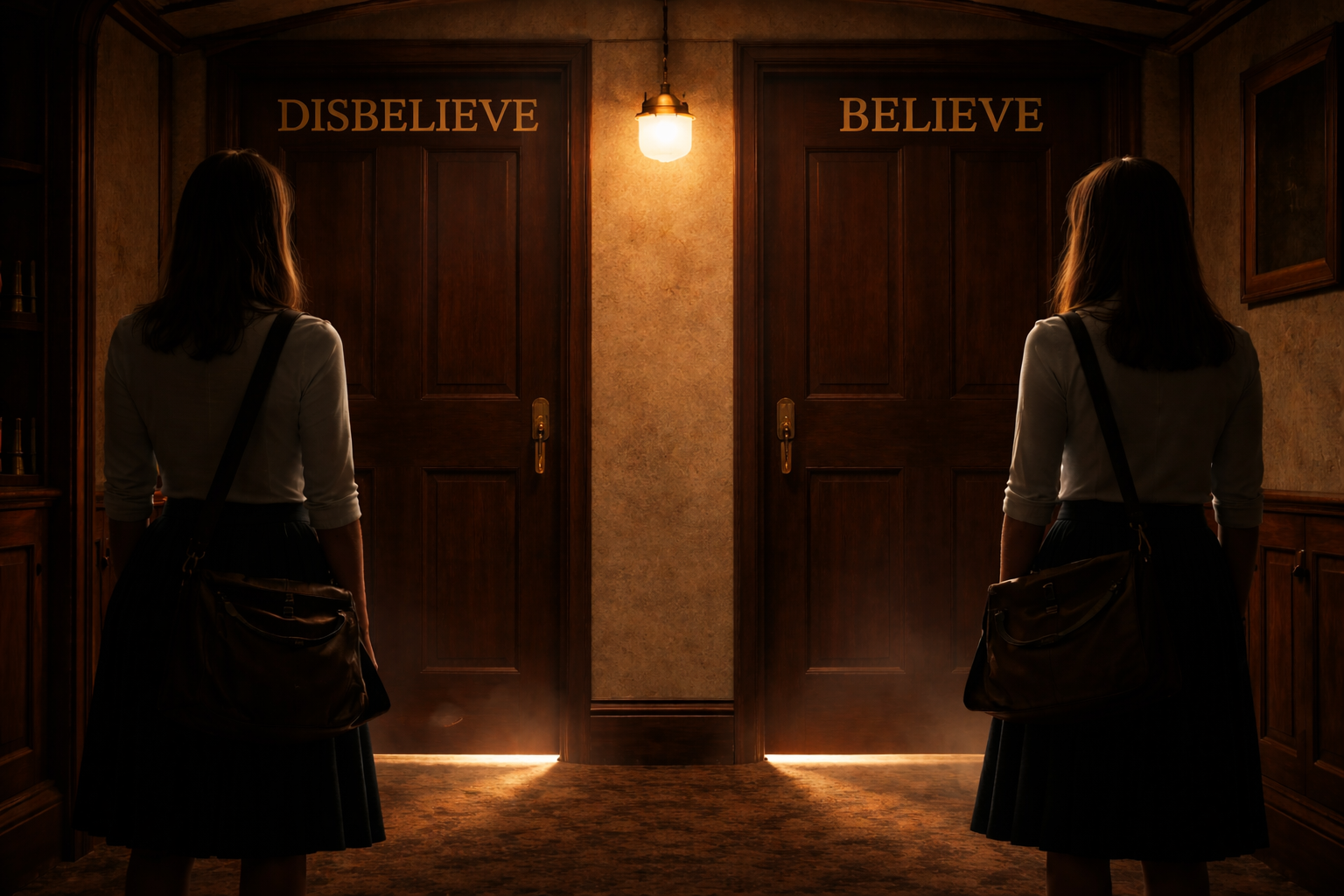
A conversation about faith turns into an experiment in control.
He offered them a choice. The choice was never real.
Heretic is a psychological horror film written and directed by Scott Beck and Bryan Woods. It traps two young Latter-day Saint missionaries inside the home of a stranger who claims he wants to learn about their faith, then turns the visit into a ruthless experiment.
Mr. Reed’s charm is the bait. Mr. Reed’s intelligence is the net. The story keeps asking how people get cornered without noticing the walls being built—by politeness, by rules, and by choices that are not really choices.
The story turns on whether faith is freedom or just another system of control.
Full Plot
Spoilers start here.
Act One: The Door Closes Softly
Sister Barnes and Sister Paxton are Latter-day Saint missionaries working in Boulder, Colorado. Barnes is more combative and analytical; Paxton is gentler and more relational. Early scenes establish how exposed they are in public and how often boundaries get tested. Paxton mentions a hopeful image of the afterlife—a butterfly returning to touch a loved one—planting a motif the ending will revisit.
They arrive at the home of Mr. Reed, who appears unusually interested in their faith. The missionaries state their rule: they can only enter if a woman is present. Reed says his wife is inside and mentions a blueberry pie baking as a signal of domestic safety. Once inside, Reed turns the visit into a long conversation about belief and authority, pressing the missionaries with pointed questions and unsettling comments.
Barnes and Paxton grow uneasy when Reed keeps deflecting requests to meet his wife. Reed steps away. Barnes realizes the pie smell comes from a scented candle, not a kitchen. The missionaries attempt to leave, but the front door is locked. Reed returns and explains it is latched on a timer and will not open until the timer runs out.
The visit is now confinement disguised as courtesy.
What changes here is that the women are trapped,, while Mr. Reed keeps pretending they still have control.
Act Two: The Illusion of Choice
At the church, Elder Kennedy realizes the missionaries have missed their check-in and goes looking for them. In the house, Reed reframes captivity as a test and offers two doors: “belief” and “disbelief.” Reed argues religions are iterations of earlier faiths and uses entertaining analogies to keep the lecture moving while it corners the women. Barnes disputes his claims and refuses to grant him intellectual dominance.
The missionaries choose “belief,” only to learn both doors lead to the same basement. The descent marks the midpoint shift. Debate becomes performance. A decrepit woman appears. Reed calls her a living prophet. Reed feeds her blueberry pie, claims it is poisoned, and promises resurrection.
Elder Kennedy arrives at the front door during this sequence. Reed distracts him with plausible conversation and sends him away. The “prophet” later appears to return and describes the afterlife. Barnes rejects the speech, comparing it to near-death hallucinations and suggestion. As Barnes signals Paxton to attack, Reed slashes Barnes’s throat.
Reed claims Barnes will rise and produces a metal object from her arm, calling it a microchip to “prove” reality is a simulation and to push Paxton toward self-destruction. Paxton recognizes the object as a contraceptive implant. She realizes Reed staged the miracle by swapping the dead woman for a substitute while they were distracted. The substitute added an unplanned line—“it’s not real”—forcing Reed to improvise the simulation claim to regain control.
What changes here is that Paxton sees the mechanism. The spell breaks.
Act Three: The One True Religion
Paxton searches for an exit and finds an underground chute that Reed presents as the path to the “one true religion.” She crawls through connected chambers and discovers a final room secured with the same bicycle lock she used earlier. Inside are multiple emaciated women in cages.
Reed’s thesis becomes physical. The one true religion is control.
Reed follows and asks if Paxton understands. Paxton answers: control. She stabs Reed with a letter opener and runs, but Reed stabs her in the stomach with the same weapon. Bleeding out, Paxton begins to pray. Reed mocks her, but Paxton reframes prayer as concern for others rather than a demand for proof.
As Reed crawls toward her, Barnes is revealed to have survived long enough to strike Reed in the head with a nail-studded plank. Reed dies. Barnes collapses and dies. Paxton escapes through a vent and emerges into clear skies and fresh snow. A butterfly lands on her hand, then disappears when she looks away.
The trap ends. The question remains.
What changes here is that control fails—but belief refuses to die.
Analysis and Themes
Theme One: Control Disguised as Choice
Claim: Heretic argues that the most dangerous power hides inside structured “options.”
Evidence: Reed offers labeled doors, timed locks, and staged demonstrations that force the missionaries to participate in their confinement. The basement miracle is scripted theater delivered under fear. The caged women reveal that the system was never theoretical.
So what: Modern power often narrows options while marketing autonomy. The film turns that mechanism into horror.
Theme Two: Faith vs Proof
Claim: The film separates faith as meaning from faith as evidence.
Evidence: Paxton’s butterfly image is personal and relational, not argumentative. Reed demands proof and creates fake evidence to demonstrate how belief can be manipulated. Paxton’s final prayer rejects transactional logic.
So what: When meaning is reduced to measurable output, manipulators gain leverage. The film challenges the demand that everything sacred must be proven.
Theme Three: Intellectual Intimidation
Claim: Reed destabilizes rather than persuades.
Evidence: He uses contradiction, reframing, and humiliation to keep Barnes and Paxton off balance. When exposed, he pivots to new claims instead of conceding error.
So what? Many modern debates are less about truth than dominance. Heretic dramatizes that dynamic with lethal consequences.
Theme Four: Gendered Power
Claim: The horror is rooted in structural vulnerability.
Evidence: The missionaries’ safety rule exists because danger exists. Reed exploits it with calculated deceit. The imprisoned women are reduced to props in his thesis.
So what? Control often intersects with gender. The film makes that structure visible by embodying it.
Theme Five: Who Controls Reality?
Claim: Authority edits perception.
Evidence: Reed stages resurrection through timing and substitution. The microchip claim reframes chaos as cosmic proof. The butterfly's ending refuses certainty.
In a world of manipulated media and curated feeds, reality becomes increasingly contextual. The film asks who sets the frame—and at what cost.
Theme Six: Prayer as Defiance
Claim: Prayer becomes resistance rather than superstition.
Evidence: Reed frames prayer as a failed transaction. Paxton redefines it as compassion under threat. Barnes’s final act is also relational—protecting someone else.
So what? Not all belief systems are about winning arguments. Some focus on sustaining moral orientation when power presses hardest.
Character Arcs: From Defense to Agency
Sister Paxton begins with faith as softness and ends with faith as agency. She stops trying to “win” the debate and instead sees the structure behind it. Her survival depends on naming the mechanism.
Sister Barnes begins as the sharper defender and ends as the physical protector. Her skepticism exposes the flaw but cannot dismantle the system alone.
Craft: Architecture as Argument
Heretic tightens in phases. It begins as a talk-driven thriller and morphs into architectural horror. The house becomes a diagram of Reed’s ideology.
Hugh Grant’s performance is essential. Reed remains charming even as violence escalates. The menace feels social before it feels physical.
The pacing mirrors coercion itself: incremental, polite, logical—until escape becomes nearly impossible.
What Most Viewers Overlook
Reed does not just want obedience. He wants participation. Each step, be it the doors, the lecture, or the staged miracle, requires the missionaries to consent to the structure.
The deeper irony is that faith equips Paxton to see through manipulation. Reed assumes belief equals naïveté. Instead, it becomes her lens for spotting deceit.
Why Heretic Feels Urgently Modern
Algorithms that present curated “choices”
Online rhetoric that shifts goalposts mid-argument
Workplace loyalty framed as voluntary
Safety systems studied and exploited
Manufactured proof in digital spaces
A culture unsure of shared reality
The film reflects a world where control is subtle and intellectual.
Ending Explained: Miracle or Meaning?
Heretic ends with Paxton escaping into snow and light. A butterfly lands on her hand, echoing her earlier hope about the afterlife. It vanishes when she looks away.
The ending means the film refuses to settle the argument it staged. The butterfly can be a miracle, hallucination, trauma response, or poetic closure.
The film denies certainty on purpose. It hands the interpretive power back to the viewer.
The Last Word
Heretic is horror built from conversation. It asks how easily structure becomes a prison and how readily argument becomes a weapon.
It is ideal for viewers who enjoy idea-driven thrillers and psychological tension. It may frustrate those who prefer clarity over ambiguity.
The final question lingers: when someone offers you a choice, are you choosing—or is the system choosing you?
