The Lighthouse Summary
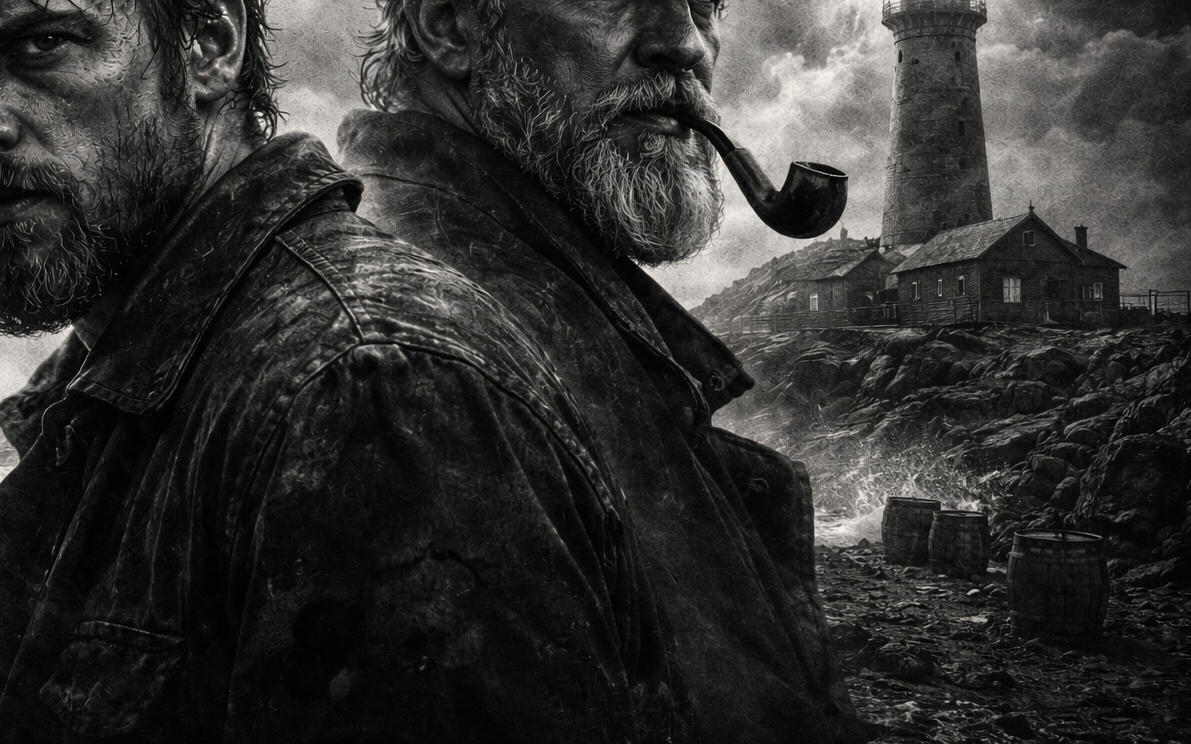
Two Men, One Light, and a Power Game That Turns Into a Reckoning
Two lighthouse keepers arrive on a speck of rock at the edge of the world, hired to keep the light burning and wait for relief.
One of them holds the keys, the routine, the authority, and the lamp room upstairs like it is a private religion. The other gets the dirty work, the silence, and a growing suspicion that the job is not just hard. It is designed to break him.
When the weather turns and the boat does not come, the island stops being a posting and becomes a closed system. Pride replaces time. Drink replaces sleep. And the light becomes less like a tool and more like a verdict.
This film turns on whether a man can stay whole when the only power left is locked behind a door.
By the end, you will know exactly how a two-man job becomes a war, why the light matters so much, and how guilt and control turn isolation into something close to madness.
It is a story about who gets to define reality when no one else is watching, and what it costs to chase a thing that refuses to love you back.
Key Takeaways
Power does not always need violence. Sometimes it just needs a key, a rulebook, and the patience to make someone beg.
When your world narrows down to just one individual, even the smallest slight can become a fundamental principle.
A hierarchy can look “practical” until it becomes personal. Then it turns into a trap with paperwork.
If you borrow a name to escape your past, you remain trapped. You still bear the burden, but with a more acceptable label.
Confession is not always honest. Sometimes it is leverage, sometimes it is a performance, and sometimes it is a weapon you turn on yourself.
The moment you start treating a goal like salvation, you stop asking whether it is good for you.
Drink can feel like a ceasefire. It is usually just a faster route to the same fight.
Reality breaks quickest when you have no outside witness, no clock you trust, and no way to leave.
The Plot
Set-up
In the late 19th century, two men are assigned to tend a lighthouse on a remote island. The older keeper, Thomas Wake, runs the station with rigid rituals and a sharp sense of rank. The younger man arrives under the name Thomas Howard, quiet and watchful, apparently keen to do the work and get through the posting.
From the start, labour is divided unfairly. Wake keeps the prestige tasks and reserves the lantern room for himself. Howard gets the heavy maintenance and the mess, with little rest and even less respect. Wake’s authority is not subtle. He sets rules, demands obedience, and expects gratitude for scraps.
Howard’s fixation grows around one point: the light itself, the room upstairs, the thing he is not allowed to touch.
Inciting Incident
Howard begins to notice that Wake’s control is not only about competence. It has a possessive edge. Wake guards the lantern room and treats the light like a private pleasure and a private duty. The more Howard questions it, the more Wake tightens the boundaries.
At the same time, the island starts to feel wrong. Strange sounds carry through the wind. Seabirds crowd the place like they own it. Howard’s sleep becomes unreliable, and his nights fill with unsettling impressions that he cannot easily explain.
The job stops being “keep the station running” and becomes “endure Wake”.
Rising Pressure
Howard’s frustration spills into small rebellions. He pushes back, he tests limits, and he tries to force his way into the one space that Wake refuses him. Wake responds with humiliation, suspicion, and more work.
The men begin drinking heavily. At first it looks like companionship, a rough sort of bonding that might soften the edges. But the drink does not erase the hierarchy. It just gives it teeth. Their warmth flips to cruelty without warning, and their apologies feel thin because the structure underneath never changes.
Meanwhile, Howard’s grip on what is happening starts to slip. He is drawn towards disturbing images and impulses, and the island’s details begin to feel charged with meaning. Even something as simple as a seabird becomes loaded, as Wake insists on rules and superstitions that make the island feel governed by punishment.
The Midpoint Turn
Howard commits an act of violence against a seabird. It is not a strategic choice. It is an emotional detonation, the kind of thing you do when you can no longer hold yourself in.
Wake treats it as a catastrophic breach, a provocation against the island itself. After this, the weather turns against them, and relief does not arrive. Time stretches. Their supplies and patience thin out. The sense of being stuck becomes absolute.
The posting shifts into a prolonged confinement. Without an external schedule to provide structure, their arguments become their sole means of marking time.
Crisis and Climax
With the storm keeping them trapped, the men spiral into paranoia and brutality. Wake asserts dominance through accusations and threats, and Howard oscillates between submission, rage, and a desperate need to be seen as more than labour.
A logbook becomes a turning point. Howard discovers that Wake has been recording an official account of the posting that paints Howard as incompetent and unfit, a story that could ruin him once they return to the mainland. Howard tries to resist the narrative being written about him, but Wake’s control now has a paper trail.
The conflict erupts. Their power struggle turns physical and terrifying. Roles blur. Commands become taunts. Apologies become traps.
In the chaos, Howard’s hidden truth surfaces: “Thomas Howard” is not his real name. He is actually Ephraim Winslow, and he has been running from a past job where a man died in circumstances tied to him. He took the dead man’s name, stepping into an identity that was never his.
That revelation does not free him. It makes the island feel like a place of judgement.
At the peak of the violence, Howard overcomes Wake. He forces Wake into the position of the humiliated animal, dragging him, degrading him, and then killing him. It is not justice. It is a reversal that shows how completely the island has stripped them down to domination and survival.
Resolution
With Wake dead, nothing opens up. The island does not reward Howard. The posting does not “end”. What remains is the thing that started the hunger: the lantern room.
Howard finally reaches the light. He experiences it directly, not as a duty but as a private encounter. Whatever he sees or feels is overwhelming enough to shatter him. He falls, broken, back down into the world of rock and salt.
Relevance of the ending
The final image is stark and ancient in its logic: Howard lies exposed on the rocks as seabirds feed on him. The image evokes a punishment from myth, not because the film requires a myth to function, but because the story has shifted into a realm where guilt and desire feel like natural forces.
He got the light. It cost him everything.
The Insights
The Light Is Not a Job; It’s a Gate
The lantern room is the simplest thing in the film: a place upstairs with a mechanism inside it. However, Wake transforms the lantern room into a gate, which then symbolises the entirety of their relationship.
Howard is not only exhausted. He is excluded. The rule is not “earn it by skill”. The rule is “you don’t get it because you are you.” That's why it's so challenging.
The clearest example is Wake’s repeated refusal to let Howard tend the light, even when the workload and logic would suggest sharing it. The point is not efficiency. The point is ownership.
Once your goal becomes access, you stop negotiating. You start pleading, then grabbing. The cost is that you hand your dignity to the gatekeeper.
The Logbook Writes a Reality You Can’t Argue With
When Howard finds the logbook, the conflict stops being only personal. It becomes institutional.
Wake can be cruel in private, but the book is what turns cruelty into consequence. If the written account follows Howard back to civilisation, it becomes the official version of his character. Lazy. Unstable. Unfit.
Howard’s reaction is not just anger. It is panic, because he recognises the trap: you can survive a bad week with a boss, but you cannot easily survive a record.
The cost is that Howard’s fight shifts from “I want respect” to “I must destroy the story being told about me,” and that kind of fight rarely stays clean.
A Superstition Is Still Useful If It Gets obeyed.
Wake’s talk of rules, omens, and consequences functions like folklore, but it also functions like management.
By insisting that certain actions bring punishment, Wake turns the island into a moral system with him as the interpreter. That makes him more than a colleague. It makes him a judge.
After Howard kills the seabird, Wake frames it as a disaster that will bring ruin. Whether you read the storm as fate or coincidence, the effect is real: Howard feels marked, and Wake feels justified.
The cost is that fear becomes a tool, and once fear is in charge, every mistake becomes a prophecy.
Borrowing a name doesn’t mean borrowing a clean slate.
Ephraim Winslow did not arrive as a blank page. He arrived as an escape artist.
Taking another man’s name is not a small lie. It is an entire life built on a death. The film does not treat it as clever. It treats it as rot that spreads.
When the truth comes out, it explains why Howard is so quick to feel trapped, judged, and desperate to control how he is seen. He is not only fighting Wake. He is fighting the fear that any authority figure will eventually see through him.
The cost is that identity becomes a debt. And debts come due in the worst places.
Drink Turns Conflict Into theatre.
The drinking scenes are not just “two men coping”. They are performances where affection and hatred swap masks.
When the men drink, they confess, praise, insult, embrace, and threaten each other in rapid cycles. The drink provides permission for intensity. It also erases the boundaries that might have prevented escalation.
The most telling pattern is how their temporary closeness never resolves the hierarchy. The next morning, Wake still commands, and Howard still scrubs. The “bonding” is a loop, not a cure.
The cost is that the drink becomes a false peace treaty, and each new binge makes the next betrayal feel inevitable.
The Island Is a Pressure Cooker With No Witnesses
Take away escape, privacy, and external time, and you do not gain clarity. You get distortion.
On the island, there is no normal social way to correct behaviour. There is no third person to say, “That’s not how it happened.” There is only Wake’s account, Howard’s account, and the fog in their heads.
As the storm delays relief, the men lose the stabilising idea that the post has a clear ending. Their reality collapses into immediate power. Who is stronger. Who is believed. Who has the keys.
The cost is that isolation does not merely reveal who you are. It can rearrange you into something you barely recognise.
The Engine
The story operates using a single mechanism: confinement combined with hierarchy and a locked prize.
Wake controls the light and the narrative. Howard wants access and recognition, but he also carries guilt that makes him desperate to outrun judgement. When the weather removes the exit, the power game becomes total, and every day raises the stakes because there is nowhere for the tension to drain.
What This Looks Like in Real Life
A junior staff member joins a team where one senior person controls the key systems and keeps the “interesting” work for themselves. The old approach is to prove yourself quietly and hope access comes. The new approach is to name the bottleneck early and ask for clear rotation. The consequence is either a healthier boundary or a faster exit, but not a slow psychological grind.
A couple moves to a remote place for a fresh start and finds their world shrinking to each other. The old approach is to treat every irritation as a personal insult. The new approach is to rebuild outside witnesses: routines, friends, scheduled check-ins, any external anchor. The consequence is that conflict stops being the weather and becomes something you can actually measure.
A creator ties their self-worth to a locked metric: an audience spike, a recommendation slot, or a gate kept by an unseen system. The old approach is obsession and escalation, sacrificing sleep, health, and relationships for “access”. The new approach is to broaden the goal: craft, community, and sustainability. The consequence is slower growth, but fewer psychological cliffs.
A Simple Action Plan
What “locked door” am I treating as proof that I matter?
Where am I accepting a hierarchy that has no clear end date?
What story about me is being written in a way I can’t respond to?
If I removed alcohol, distraction, or doom-scrolling, what conflict would I be forced to face?
What part of my identity is a performance to escape shame?
When I feel trapped, do I reach for control, confession, or violence in small forms?
Who is my outside witness, the person or routine that keeps reality stable?
What would leaving look like if I stopped bargaining with the gate?
Conclusion
The Lighthouse ends as a story of appetite and punishment. A man wants access to a thing that promises meaning. Another man exploits that desire to exert control over him. When isolation seals them in, the fight turns primal, and the past climbs out of its hiding place. The final cost is not only death. It is the collapse of self into exposure, the body left to the same birds he tried to defy.
Some stories do not end when the boat comes. They end when the lie runs out of air.
Relevance Now
This film resonates with contemporary audiences as it recognises the rapid reduction of a system to a single gate and a single judge. In workplaces built on access, permissions, and invisible rules, the “light” is often a calendar invite, a dataset, a promotion path, or the right person’s approval. The hunger feels rational until it becomes personal.
It also mirrors online identity, where a name and a narrative can be swapped, curated, and defended, right up until the past resurfaces. The logbook is not a parchment anymore. It is a trail of messages, metrics, and opinions that can harden into a record.
And it captures loneliness inside constant connection: being surrounded by noise but still trapped in your own head, making one relationship, one feed, or one boss carry far too much weight.
Watch for the moment a goal stops being a goal and starts being your only way to feel real.
When the world narrows, power gets loud.
