What Happens When a Gang Picks the Wrong Door?
Netflix's Never Surrender looks, on paper, like a familiar story: a retired soldier, a remote house and a gang that picks the wrong door. What took the Indonesian thriller to the top of Netflix's non-English film chart is the family at its centre. A grandfather who has kept his grandchildren at arm's length for years suddenly has to protect them from a Jakarta crime syndicate, and the only way through is to teach them how to fight.
It is the same appetite for tense, twisty Netflix thrillers that put The Body in the English-language chart the same week. The ending settles the siege, but it deliberately leaves the bigger fight open. Below we explain what happens, who survives, why the flash drive matters so much, and what the scene during the credits means for a possible sequel. Full spoilers follow.
Never Surrender at a Glance
- Original title: Serangan Balik (Indonesian)
- Director: Sidharta Tata, who co-wrote the script with Khalid Kashogi
- Producers: Kimo Stamboel and Edwin Nazir
- Released on Netflix: 12 November 2026
- Runtime: about 137 minutes
- Main cast: Lukman Sardi (Eyang Hari), Callista Arum (Putri), Sulthan Hamonangan (Dimas), Donny Alamsyah (Ulo), Derby Romero (Bastian), Dennis Adishwara (Agus), Laras Sardi (Mayang)
- Chart performance: No. 1 on Netflix's global non-English film list for 9–15 November 2026, with 11 million views in its first week
The Short Answer
Does Hari survive? Yes. He is thrown out of a window by the grenade blast that kills Ulo and looks dead for a moment, but he is alive and recovering a few days later.
Do Putri and Dimas survive? Yes. Both children come through the siege and help rebuild the farmhouse at the end.
Who dies? The children's father, Agus, is murdered by Ulo on a video call. Ulo's brother Bastian, his lieutenant Aldo and Ulo himself are all killed, along with most of the gang. Bastian also kills Ben, two local men and the village girl Mayang.
What is the twist? Hari's old military colleague, Anton, is working for the people behind the gang. The scene during the credits shows him offering to replace Ulo and to deal with Hari if the flash drive ever becomes a problem.
How the Story Begins
The film opens with two lives that barely touch. In Jakarta, Agus is a widowed father sinking under gambling debts and dealing with dangerous people. In a village in Central Java, Hari, a former special forces soldier, lives alone with his guilt and his routines. He has not seen his grandchildren, Putri and Dimas, in years.
Agus knows his situation is getting out of hand, so he drives the children out to Hari's farmhouse and leaves them there. It is an uncomfortable reunion. The children find their grandfather cold and distant; Hari has no idea how to be the warm figure they might have wanted.
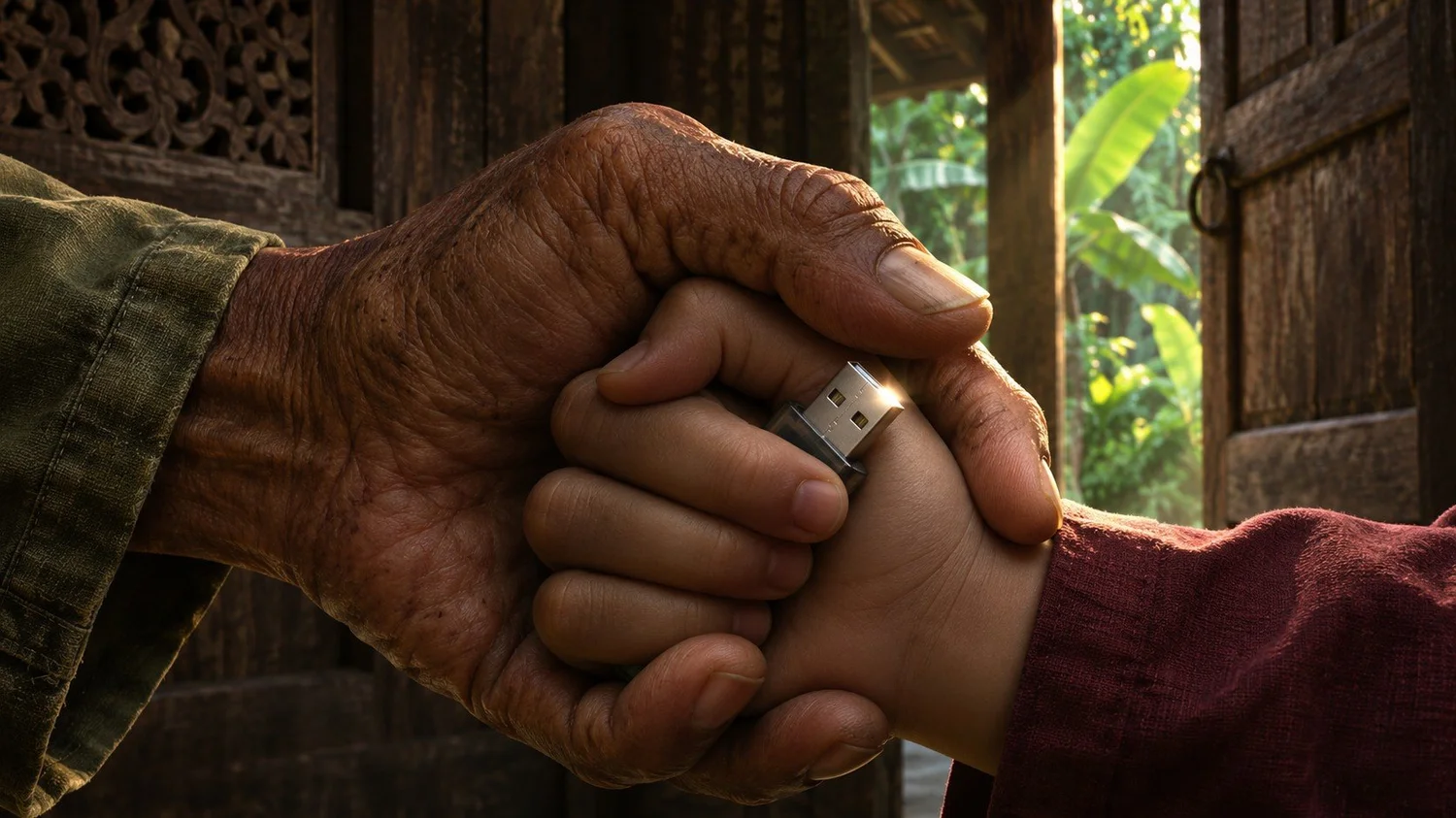
What none of them know is that Agus has stolen a flash drive from an associate, Ben. He hid it in Putri's bag, and Dimas unpacks that bag at the farmhouse. The most dangerous object in the film is now sitting in Hari's house.
What Is on the Flash Drive?
The film keeps the contents vague, and so do the recaps. The drive holds files that tie powerful figures to organised crime and corruption. Some accounts describe the figure at the top as a government minister, others as an influential businessman. Agus wants to sell the files to pay his debts. The people implicated want them back at any cost, and that is why Ulo's gang comes looking.
Bastian Comes to the Farmhouse
Ulo, the gang's leader, captures Agus and Ben and works out that the drive is not in Jakarta. He sends his younger brother Bastian, a volatile and openly sadistic killer, to the village to get it back. Bastian kills Ben on the way.
The first sign of danger in the village has nothing to do with the drive. Putri and Dimas, out on their own, are attacked by two local men. Mayang, a local girl who speaks in sign language and has befriended the children, runs to fetch Hari, who arrives and beats the men off. It is the first time the children see what their grandfather is capable of.
Bastian then uses those same two men to find the farmhouse, killing them once they have served their purpose. He also kills Mayang after she witnesses the murders, one of the film's most upsetting moments. He arrives at Hari's door pretending to be a lost traveller, but Hari sees through the act, overpowers him and ties him up.
When Bastian breaks free and goes after Dimas, Hari kills him. From that point on there is no way back.
Why Agus's Death Changes Everything
Ulo learns of his brother's death over a video call, and his response is the film's cruellest scene. With Hari and the children watching, he murders Agus on camera.
That moment does two things. Dramatically, it removes any chance of a negotiated way out: the gang is no longer just after a flash drive, it wants revenge. Emotionally, it leaves Putri and Dimas with only the grandfather they hardly know. Hari tells them to run. They refuse. The decision to stay and fight together is the real turning point of the film, because it is the moment the family becomes a family again.
The Siege: Turning a Farmhouse Into a Fortress
The second half of Never Surrender is a siege film. Hari uses everything he learned in the army to prepare the house: booby traps around the grounds, hidden routes through the building and makeshift defences. He teaches Putri to shoot with a bow and shows Dimas the secret passages. When the gang sends a drone to scout the property, Hari brings it down.
Ulo's men attack in waves, and the children are not passive bystanders. Putri picks off attackers with her bow and Dimas uses the traps and the house itself against them. Hari does most of the killing, but the film is careful to show that the three survive because they work together.
By the end of the assault only Ulo and his right-hand man, Aldo, are left. They use smoke to disorient Hari, who is exhausted and wounded by now, and finally overpower him and tie him up.
Never Surrender's Ending Explained
The Fake Flash Drive
With Hari captured, Dimas offers Ulo a deal: the flash drive in exchange for his grandfather. It is a bluff. Dimas has hidden the real drive and hands over a fake one. When Aldo realises he has been tricked, he chases the children through the grounds, straight into one of the traps they helped build, and he is impaled.
It is a satisfying reversal. The children were brought into the film as passengers in their father's mess; by the end, the youngest member of the family outthinks a hardened criminal.
Hari Versus Ulo
That leaves Ulo and Hari, fighting hand to hand in the burning house. Hari is older, injured and outmatched in strength, so he relies on what he always has: training and opportunism. During the struggle he pulls the pin on a grenade clipped to Ulo's own gear. The explosion kills Ulo and blows Hari out of a window.
For a moment the film lets you believe Hari has sacrificed himself. He has not. Putri and Dimas find him alive.
The Final Scene
A few days later, Hari is recovering, and he and the children are repairing the damaged farmhouse together. The house that was a fortress is becoming a home again, and the coldness of the opening scenes has gone.
The key detail is what Hari does with the real flash drive. He does not destroy it and he does not hand it over. He keeps it hidden. His reasoning is practical: Ulo is dead, but the people who sent Ulo are not, and the files are the only leverage the family has if those people come back.
The Credits Scene: Who Is Anton?
Never Surrender has one extra scene during the credits, and it reframes the ending. (Some recaps call it a mid-credits scene, others a post-credits scene; either way, it is worth waiting for.)
Anton is a former military colleague of Hari's, a figure from his past who earlier appears to be on his side. In the credits scene, Anton meets the powerful figure who had hired Ulo. With Ulo dead, he offers to take over the role, and he promises to deal with Hari if the information on the flash drive ever becomes a threat.
That is a very different kind of danger. Ulo was a stranger who came at the family with guns and a drone. Anton knows Hari personally: his training, his habits and probably his weaknesses. The film ends with the family safe for now, but with the next threat coming from someone Hari trusted.
Will There Be a Never Surrender 2?
As of 24 November 2026, Netflix has not announced a sequel. The credits scene clearly leaves room for one: an unresolved villain, a flash drive full of secrets and a hero who is still alive. Its first-week performance, with 11 million views and the top spot among non-English films worldwide, is the kind of result that tends to start sequel conversations. For now, though, a follow-up is a possibility the film sets up, not a confirmed project.
What the Ending Means
A Grandfather Who Finally Shows Up
Hari begins the film as a man who has withdrawn from his family, carrying guilt from his past and keeping everyone at a distance. The siege forces him into the role he has avoided. By the final scene he is not just the man who killed the gang; he is the grandfather who stayed.
Passing Down Violence
There is an uneasy question underneath the action. Hari survives by teaching two children to fight and kill. The film presents this as necessary, and in the moment it is, but it does not pretend it is harmless. The children win, but they have also inherited part of their grandfather's world, and that cost lingers in the quiet rebuilding scenes.
The Real Enemy Is Further Up
The ending is also a pointed comment on power. The men who die are the ones who did the dirty work. The people named in the files, whoever they are, are untouched, and the credits scene shows them simply hiring a replacement. Hari's decision to keep the drive is an admission that the system will not protect his family, so he has to.
How Does Never Surrender Compare?
The film sits in a clear tradition of "one man defends his home" thrillers, and reviewers have drawn comparisons with Taken and John Wick. Reception has been mixed. Critics have generally praised the choreographed fight sequences, the menace of the villains and the film's handling of its young characters, while criticising a predictable story and a running time of more than two hours. Its success is a reminder of the global reach Indonesian action cinema now has on Netflix.
Where the Recaps Disagree
A few small details vary between published accounts of the film, so it is worth being clear about them:
- The grandfather is credited as Eyang Hari, but some coverage calls him Haris.
- Some recaps describe Agus as Hari's son and others as his son-in-law. Either way, he is the father of Putri and Dimas.
- The person behind Ulo is described variously as a government minister and as a powerful businessman.
None of these change the shape of the ending.
Final Verdict
Never Surrender ends with a hard-won victory and an open question. Hari, Putri and Dimas survive; Ulo, Bastian and Aldo do not; and the flash drive stays hidden as the family's insurance policy. The credits scene makes clear that the war is not over. Anton has switched sides, the people at the top are untouched, and Hari's next enemy will be someone who knows exactly how he thinks.
Sources
- What's on Netflix: Netflix top 10s, week of 9–15 November 2026
- High On Films: Never Surrender (2026) plot summary and ending explained
- Moviedelic: Never Surrender ending explained
- Cinefilos.it: Never Surrender, il finale spiegato
- Martin Cid Magazine: Never Surrender cast and crew
- IBTimes UK: Never Surrender tops Netflix's global ranking
- But Why Tho?: Never Surrender review
