Parasite Film Summary: A Thriller About Class, Control, and Collapse
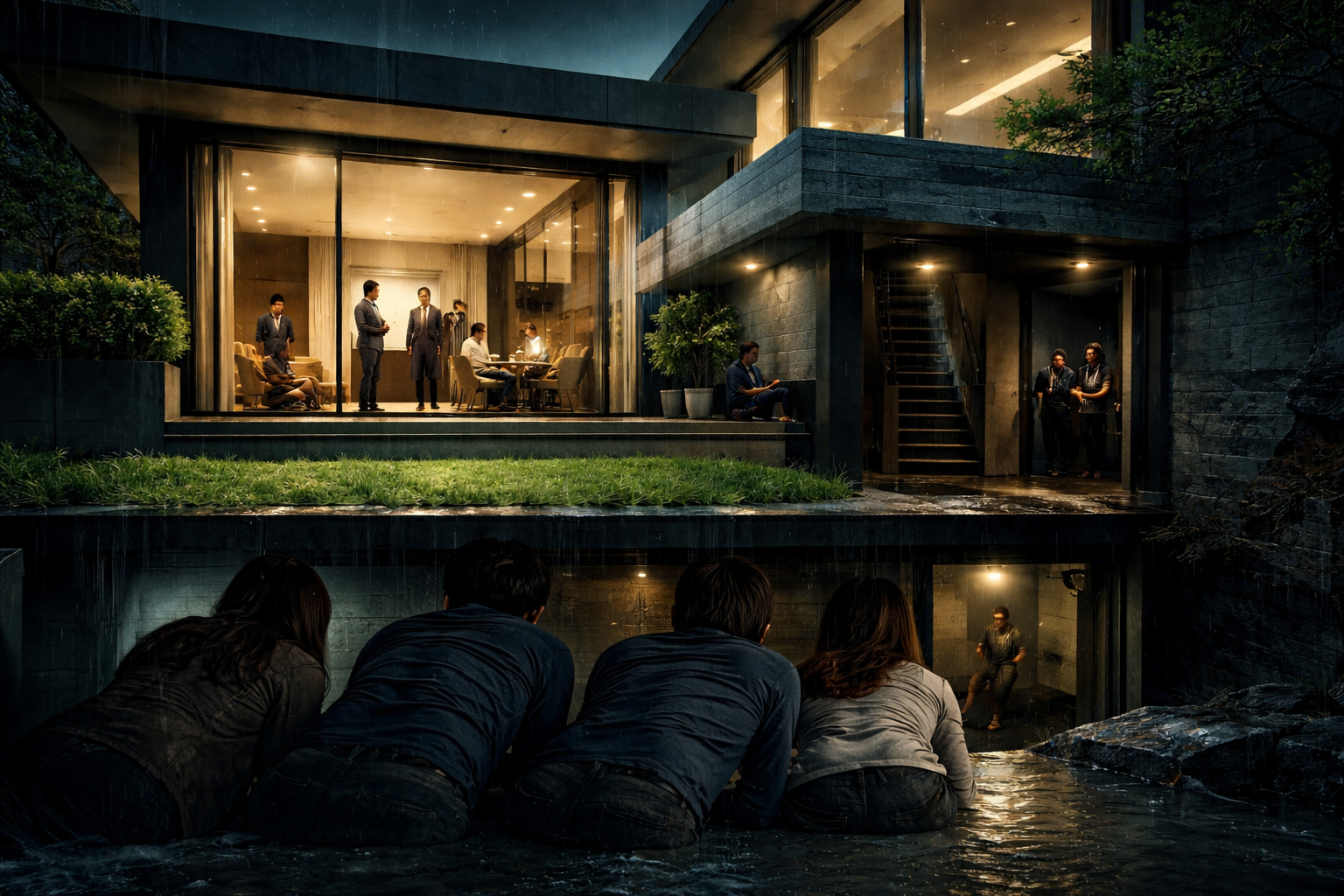
Parasite film summary with full spoilers, themes, relevance today, and an ending explained that shows how class, space, and hope collide in one house.
When Proximity to Wealth Becomes a Trap
Parasite (2019), directed by Bong Joon-ho, is a South Korean dark comedy thriller that starts as a clever hustle and steadily hardens into something sharper and more unsettling. This Parasite film summary explains what happens, why it hits so hard, and what it really argues about modern life.
The story follows the Kim family, who are on the brink of survival, as they attempt to gain entry into the wealthy Park family's home. Their plan is simple: turn opportunity into access and access into security.
But the film’s real engine is not the scam. It’s the question of whether two families can share the same space without the hidden rules of class turning every small moment into a test.
The story turns on whether the Kim family can keep their deception intact long enough to change their fate.
Full Plot
Spoilers start here.
Act I: Setup and Inciting Incident
The Kim family lives in a cramped semi-basement apartment in Seoul. Kim Ki-taek (father, wants stable work without humiliation), Chung-sook (mother, wants control and security), Ki-woo (son, wants a path up through “smart” choices), and Ki-jung (daughter, wants respect and money without being judged) patch together income through small jobs.
A family friend, Min-hyuk (a college student who wants to keep a romantic claim on a wealthy classmate), visits with a gift: a scholar’s rock meant to symbolize prosperity. Min-hyuk also offers Ki-woo a practical opening. Min-hyuk tutors the teenage daughter of the Park family, and he wants Ki-woo to replace him while he studies abroad.
Ki-woo does not have the credentials, but Ki-jung forges a university document. Ki-woo enters the Park home under the name “Kevin,” presenting himself as a student from a prestigious university. Mrs. Park, Choi Yeon-kyo (a wealthy mother who wants safety and reassurance), is impressed by confidence and manners more than proof, and she hires him to tutor Park Da-hye (a teen daughter who wants attention and approval).
Once Ki-woo is inside, he sees the larger possibility. The Parks live in a modernist house designed to feel open and calm, but it is also an ecosystem built to keep the messy world outside. Mr. Park, Park Dong-ik (wealthy father, wants order and efficiency), moves through his life assuming service will appear exactly when needed.
Ki-woo recommends Ki-jung to Mrs. Park as an art therapist for Park Da-song (young son, wants comfort after a frightening experience). Ki-jung arrives as “Jessica,” polished and intimidating, and she sells a story that Da-song’s behavior reflects trauma. Mrs. Park wants expertise that sounds decisive, and she hires Ki-jung.
With two positions secured, the Kim family shifts from opportunism to strategy. Every new job must pass through the Parks, and they resolve to remove any obstacles without disclosing their family connection. Their goal becomes total coverage of the house, the kind of control that feels like safety.
Ki-jung then targets the Park chauffeur, Yoon, who is an employee that wants to keep his job and maintain his dignity. She fabricates evidence to make it seem as though Yoon engaged in inappropriate behavior in the car. Mr. Park fires Yoon. Ki-taek, coached to be deferential and invisible, is hired as the replacement chauffeur.
The final barrier is the housekeeper, Moon-gwang (a longtime employee who wants to keep her position and protect her hidden secret). The Kims exploit Moon-gwang’s peach allergy, using it to create symptoms that suggest illness. Mrs. Park, terrified of contamination and eager to avoid discomfort, concludes Moon-gwang has tuberculosis. Moon-gwang is dismissed, and Chung-sook is hired in her place.
By the end of Act I, the Kim family has done something that initially feels impossible: all four are employed by the Parks, each under a separate identity, each positioned to protect the others. The Parks believe they have upgraded their household with competent strangers. The Kims believe they have built a ladder out of poverty inside someone else’s home.
What changes here is that the plan stops being a hustle and becomes a takeover with consequences the family cannot fully control.
Act II: Escalation and Midpoint Shift
The Kims settle into their roles. Ki-woo tutors Da-hye grows close to her, turning the job into a romance that feels like a claim on a different life. Ki-jung performs therapy as theater, using authority and ambiguity to keep Mrs. Park dependent. Ki-taek drives Mr. Park, absorbing small humiliations and learning the Park family’s habits. Chung-sook runs the house, enjoying power in a space that was never meant to be hers.
The Parks leave for a camping trip, and the Kims enjoy the house as if it has become their own. They eat, drink, and lounge in a living room that represents everything they have been denied. For a brief stretch, the film plays like a fantasy of class tourism, where proximity to wealth can masquerade as belonging.
That illusion breaks when Moon-gwang returns unexpectedly. She claims she left something in the house. Chung-sook allows her inside, expecting a quick errand. Instead, Moon-gwang moves with urgency toward a hidden entrance.
Moon-gwang reveals that the house contains a concealed underground bunker built by the architect and previous owner. Inside is her husband, Geun-sae (a desperate man who wants to survive and avoid creditors), who has been secretly living there to hide from loan sharks. Geun-sae is also the “ghost” Da-song once saw at night when Geun-sae surfaced to steal food.
Moon-gwang begs to keep Geun-sae hidden. She offers money and appeals to sympathy. But the Kims overhear everything, and their secret becomes fragile. When the Kims confront Moon-gwang, the situation flips. Moon-gwang uncovers the connection between Chung-sook, Ki-taek, Ki-woo, and Ki-jung, who have collectively infiltrated the household. Moon-gwang records evidence and threatens to expose them to the Parks.
This transition is the midpoint shift: the story stops being about fooling the rich and becomes about fighting the poor, who are even more trapped. The house is no longer just a prize. It becomes a pressure chamber where two hidden families compete for the right to remain invisible.
The Parks then call unexpectedly. A sudden heavy rainstorm has ruined their camping trip, and they are returning home immediately. The Kims must erase their party, restore the house, and hide Moon-gwang and Geun-sae, all before the Parks arrive.
A frantic struggle follows. Moon-gwang is injured during the fight, and Geun-sae is forced deeper into the bunker. The Kims manage to trap both Moon-gwang and Geun-sae in the hidden space, preventing exposure for the moment. Then the Parks arrive, turning the house into a live-wire situation where the Kims are present as staff but also present as intruders.
Ki-woo, Ki-jung, and Ki-taek end up hiding under the living room table while Mr. and Mrs. Park relax on the couch above them. In the dark, the Kims are forced to listen as the Parks talk casually about intimacy and then about “smell.” Mr. Park describes a specific odor he associates with Ki-taek, something he frames as a boundary that should not be crossed. The conversation does not resemble a villain's speech. It is worse: it is normal, unthinking, and confident.
When the Parks finally go to bed, the Kims escape into the night. The rain has turned the city into a river. They run downhill through streets filling with water, moving from the wealthy neighborhood to their own. Their semi-basement apartment floods with sewage-laced water, destroying belongings and erasing the small stability they had.
The Kims spend the night in a crowded gymnasium with other displaced residents. The next morning, after a shower and a change of clothes provided by disaster relief, they return to work. The experience has not bought them compassion from the world. It has only increased their exhaustion and shame.
Mrs. Park decides that the rainstorm has cleared the air and wants to celebrate her son’s birthday with an impromptu garden party. The Kims are expected to help. They are asked to perform cheerfulness while carrying the memory of their ruined home.
What changes here is that the Kims are no longer just risking embarrassment if they fail, because now the pressure includes exposure, punishment, and the possibility of irreparable loss.
Act III: Climax and Resolution
The endgame begins with the birthday party. The Parks treat the event as a fresh start, a chance to restore normalcy through consumption and ritual. The Kims move through tasks with forced calm, each carrying a private crisis.
Ki-woo, shaken and frustrated, decides to confront the problem he believes is poisoning everything. He takes the scholar’s rock and enters the bunker area, intending to resolve the threat posed by Geun-sae. His choice is driven by a mix of fear and a desire to regain control. The rock, introduced as a symbol of wealth, becomes a tool of force.
In the bunker, Ki-woo finds that Moon-gwang has died from her injuries. Geun-sae, now unbound by restraint or gratitude, attacks Ki-woo and bludgeons him with the rock. Ki-woo is left unconscious, a victim of the very symbol he treated like a promise.
Geun-sae then emerges from the hidden space, entering the bright garden party like a figure from a nightmare. He stabs Ki-jung in front of the guests. The violence is sudden, but it is also the logical end of a system where the hidden are pushed to extremes.
Da-song sees Geun-sae again and collapses in shock. The party turns into chaos. Chung-sook fights Geun-sae and impales him with a barbecue skewer. The Parks and their guests react with horror, but their reactions are not equal. People scramble to save the child of the wealthy household, while the wounded working-class young woman bleeds on the lawn.
Ki-taek rushes to Ki-jung, trying to stop the bleeding. Mr. Park demands that Ki-taek drive him immediately to take Da-song to the hospital. In the scramble, Mr. Park recoils from Geun-sae’s smell, reacting with disgust as he reaches for the car keys. Despite its small gesture, Ki-taek interprets it as a declaration: even in times of crisis, the wealthy man's body establishes a boundary between human and contaminant.
Ki-taek snaps. He takes the knife and kills Mr. Park. Then he flees the scene, disappearing as sirens approach. The murder is not framed as a triumph. It is framed as an eruption, a moment when a lifetime of swallowed humiliation turns into irreversible action.
In the aftermath, Ki-woo survives after brain surgery. Chung-sook and Ki-woo are convicted of fraud and placed on probation. Ki-jung dies from her injuries. The Park house changes owners, and the public story treats the bunker man as an unexplained intruder rather than as part of a hidden structure supported by the household’s blind spots.
Ki-woo watches the house from afar and notices a light blinking in a pattern. He realizes it is Morse code. The message is from Ki-taek, who has secretly returned to the bunker and is living there. Ki-taek buries Moon-gwang in the yard and survives by stealing food and avoiding detection, sending messages in the hope his son will see.
Ki-woo writes a letter to his father, promising that he will work, earn money, and eventually buy the house to free him. The film shows Ki-woo imagining the future: success, ownership, sunlight, and a reunion that feels like closure.
Then the film returns to reality. Ki-woo is still in the semi-basement with Chung-sook. The letter is a vow, but it is also an admission of how far away the goal is. The bunker remains underground. The house remains above. Ki-taek remains hidden.
Analysis and Themes
Theme 1: The Smell of Class
Claim: Class is treated as an invisible trait that becomes visible the moment the rich feel discomfort.
Evidence: Mr. Park frequently remarks on Ki-taek's odor, and his language transforms a person into a manageable environment. The table-hiding scene forces the Kims to hear how the Parks talk when they assume service workers are not present. The reaction to Geun-sae’s odor during the birthday party reinforces the same boundary that emerges in a crisis.
So what: Parasite argues that inequality is maintained not only by money but also by reflexes of disgust and distance. The most damaging moments are not the loud insults but the casual assumptions about who belongs. Social systems do not need explicit cruelty to be brutal; they only need normalized separation.
Theme 2: Architecture as Power
Claim: Space is not neutral in Parasite; it is a machine that sorts people into levels of visibility and safety.
Evidence: The Park house is bright, open, and elevated, while the Kim home is semi-buried and vulnerable to flooding. The bunker literalizes a deeper layer of deprivation beneath an already poor family. The film repeatedly uses stairs and slopes to show movement between worlds, and the rainstorm turns vertical geography into fate.
What this means is that the film portrays inequality not only as an economic issue but also as an environmental one. Where you live shapes what risks you absorb, what dignity you can keep, and how quickly your life can unravel. Modern cities often hide their underclass in plain sight through design: basements, back entrances, service corridors, and neighborhoods that flood first.
Theme 3: Credential Theater
Claim: Institutions reward the performance of legitimacy just as much as legitimacy itself.
Evidence: Ki-woo’s forged documents work because the Parks want reassurance, not verification. Ki-jung’s “therapy” works because she speaks in the language of authority and uses ambiguity to avoid being tested. Each Kim succeeds by reading what the Parks need to believe, then delivering that belief as a product.
So what? Parasite presents professional status as a social costume, especially in environments where the wealthy outsource judgment. When trust is built on signals, forgery becomes rational. The film poses a challenging question: if the system is already a form of theater, is it immoral to audition for one's survival?
Theme 4: Kindness as a Luxury Good
Claim: The Parks can be polite and even affectionate, but their kindness remains conditional on comfort.
Evidence: Mrs. Park greets staff with warmth, yet swiftly dismisses them when fear arises. The tuberculosis accusation spreads not through evidence but through panic. The Parks’ generosity operates within a frame where workers are replaceable and the household’s emotional needs matter most.
So what? Parasite distinguishes politeness from equality. You can be treated nicely and still be trapped in dependence. The film suggests that moral self-image is easier to maintain when you rarely face consequences for how your choices harm others.
Theme 5: Pressure Turns to Violence
Claim: Violence arrives when social pressure becomes unlivable and the system offers no safe release.
Evidence: The discovery of Geun-sae and the threat of exposure raise stakes beyond employment to survival. The flood strips the Kims of their last sense of control right before they are asked to perform happiness at the party. The climax triggers a series of events: the resurgence of trauma, the emergence of hidden individuals, and the transformation of minor humiliations into deadly ones.
So what? Parasite is not arguing that poverty automatically causes violence. It is arguing that a stratified system creates conditions where desperation, shame, and invisibility can explode. When people are forced to compete for the right to exist quietly, conflict becomes structural.
Theme 6: The Mirage of Mobility
Claim: The film treats upward mobility as a story people tell themselves to keep going, even when the math does not work.
Evidence: Ki-woo believes cleverness can solve the problem, first through a con and later through a vow to “earn” the house. The scholar’s rock shifts from symbol to burden to weapon, mirroring how hope can harden into obsession. The final return to the semi-basement after the dream of ownership undercuts the promise without mocking the desire.
So what? Parasite suggests that aspiration can be both necessary and cruel. Hope motivates effort, but it can also disguise structural limits as personal failure. The sting of the movie isn't Ki-woo's dreams, but rather how expensive they are—like a life sentence.
Character Arcs
Protagonist: Ki-woo begins believing that intelligence and opportunity can outmaneuver class barriers. He ends up believing he must play the system’s long game, converting hope into a plan measured in years, even as the film implies that the plan may be unattainable.
A key secondary arc is Ki-taek. Ki-taek begins as someone who tries to endure humiliation by staying flexible and avoiding conflict. Ki-taek concludes his journey as someone who has stepped over a boundary he can't undo, withdrawing underground due to the harshness and disdain of the world above.
Structure
Parasite’s power comes from how it reassigns genre without breaking the story. The first movement feels like a caper, then it becomes a suspense thriller, and finally it becomes a tragedy. Each shift is earned by escalation: every new danger grows directly out of the previous success.
The film’s set pieces are built around containment. The house keeps people close, forces hiding, and turns small timing changes into disaster. The rainstorm is not just weather; it is a structural device that collapses the fantasy of control in a single night.
The ending uses a brief vision of closure to expose the shape of denial. The film lets the audience feel relief, then takes it away to show what relief costs in a world built on separation.
What Most Summaries Miss
Most summaries treat Parasite as a story about a poor family tricking a rich family. That’s the surface, but the deeper trick is that the film keeps moving the moral target. At first, the Kims look like clever survivors. Then they look cruel. Then the film reveals a deeper layer of desperation that makes everyone’s choices feel like variations of the same trap.
Another overlooked element is that the Parks are not monsters, and that is the point. The film is not fueled by an evil rich family; it is fueled by a normal rich family whose comfort depends on invisible labor and invisible suffering. That normalcy is what makes the ending feel inevitable rather than exceptional.
Finally, the bunker is not just a twist. The bunker represents the film’s central argument: beneath the visible class divide lies a hidden divide, and the system persists by keeping the most disadvantaged individuals fighting in the dark while the affluent remain silent.
Relevance Today: Parasite Film
Work and culture: The Kim family’s hustle mirrors gig-economy logic, where stability is rare and people assemble survival from short-term roles and social performance.
Technology and media: The scam succeeds through signaling, not proof, which maps onto online identity and reputation systems that reward confidence and presentation over verification.
Politics and power: The bunker reflects how debt, fear, and informal enforcement can govern lives outside the protections that wealthy people assume exist for everyone.
Inequality: The flood sequence captures disaster inequality: the same storm that ruins a camping trip destroys a home for people living on the margins.
Relationships and identity: Ki-woo’s romance sits at the edge of a power imbalance, where affection blurs with aspiration and belonging becomes both emotional and economic.
Housing and status: The film makes housing the real battlefield, not luxury as taste, but luxury as insulation from risk, noise, and public consequence.
Social trust: Parasite shows how trust can become transactional, especially when people treat others as services rather than as fully legible lives.
Ending Explained
The ending resolves the immediate chaos but refuses to offer moral closure. Ki-taek escapes into the bunker, a literal descent into invisibility that matches his social position after the murder. Ki-woo survives, but survival comes with cognitive damage, legal punishment, and the loss of Ki-jung.
The ending means the promise of “working your way out” is both emotionally necessary and structurally fragile. Ki-woo’s letter is a coping mechanism as much as a plan: it turns helplessness into a narrative of effort and future payoff.
What is known is that Ki-taek is alive, hidden, and signaling through light, and that Ki-woo has understood the message. What is uncertain is whether Ki-woo can ever earn enough to buy the house and free his father, and the film’s final return to the semi-basement strongly suggests the vision of reunion is a dream rather than an approaching reality.
Why It Endures
Parasite endures because it turns class into something you can feel in your body: distance, smell, stairs, weather, and the constant stress of being watched. It is not satisfied with condemning greed or praising virtue. It shows how people bend under pressure, how small choices accumulate into catastrophe, and how comfort can coexist with a quiet brutality.
This film is for viewers who want suspense with real psychological weight and for anyone drawn to stories where every detail matters. It may not work for viewers who prefer clear heroes, clean justice, or endings that reassure rather than accuse.
The film prompts a persistent question: if survival hinges on concealing one's identity, what is the price of remaining hidden?
