Why Hurricane Otis Became So Dangerous, So Quickly
A Night’s Work Became a Fight to Stay Alive
A luxury yacht can look like an escape from ordinary life. For the people paid to maintain it, the same vessel is a workplace, with duties that continue after its passengers have gone. Surviving Hurricane Otis begins inside that difference. Its characters are working when the sea around Acapulco becomes something their employers’ property cannot withstand.
Jorge Michel Grau’s Mexican survival drama draws on the hurricane that struck Acapulco in October 2023 and on the experiences of sailors caught aboard boats. Its central relationship is fictionalised: Wirpul and Candi are half-brothers, while the real survivors who helped inspire the production, Marlon Valdez and Jonathan Chino, were friends. The storm is historical; the film gives it a constructed family story.
Understanding that boundary makes the film more interesting. It allows the real disaster, the survivors’ experiences and the drama’s argument about work to be examined without mistaking one for another.
What Happened When Otis Reached Acapulco?
Hurricane Otis made landfall near Acapulco on 25 October 2023 as a Category 5 hurricane. The US National Oceanic and Atmospheric Administration recorded sustained winds of 165 miles per hour and described it as the strongest hurricane to make landfall in the eastern Pacific during the satellite era.
The extraordinary feature was the speed of its transformation. Maximum sustained winds increased by approximately 115 miles per hour in twenty-four hours. A storm that had offered a very different impression of the coming danger became a catastrophic hurricane close to a densely populated coast.
That compressed the time available for almost every protective decision. A family could need to secure its home, contact relatives, obtain supplies and reach safer accommodation. A business could need to release staff, close buildings and protect equipment. Each action depended on recognising a changing threat before conditions made movement dangerous.
The relevant comparison is therefore between the time the storm took to intensify and the time people needed to respond. A warning can become more accurate while becoming less useful for a particular journey. If the journey requires hours and the safe window has nearly closed, certainty arrives too late to restore the earlier options.
Otis brought destructive wind into a city of hotels, homes, roads and working waterfronts. Damage to those systems also affected the response: communication, transport and access to supplies become harder precisely when more people need them. A hurricane’s consequences extend beyond the places directly struck by its strongest winds because those places are connected to everything around them.
Why Did the Hurricane Strengthen So Quickly?
A tropical cyclone draws energy from warm ocean water. Moist air rises, water vapour condenses in clouds, and the release of heat helps sustain the storm’s circulation. Air moves towards the low-pressure centre, feeding further rising motion and thunderstorm development.
Warm water alone does not guarantee a severe hurricane. The atmosphere must also permit the developing storm to organise. Large changes in wind speed or direction with height, called vertical wind shear, can disrupt that organisation. Moisture, the structure of the circulation and conditions beneath the sea surface also affect what happens.
Rapid intensification describes an unusually fast increase in a cyclone’s maximum sustained winds. It does not mean that the whole storm suddenly races across the ocean. Forward movement and wind intensity are different measurements: a hurricane can move relatively slowly while the air circulating around its centre becomes much more violent.
This distinction helps explain why familiar weather descriptions can mislead. Someone may hear that a storm is approaching gradually and assume there is plenty of time. Yet the hazard associated with its arrival can change substantially while its position changes much less dramatically.
Otis exposed the practical difficulty of anticipating the rate of strengthening. A forecast must estimate not merely whether the environment can support intensification, but whether the storm will exploit that environment, how quickly its internal structure will change, and how much strengthening will occur before landfall.
The ocean supplies energy; the storm’s organisation determines how effectively that energy becomes a stronger circulation. Forecasting must connect processes operating at different scales, from the wider atmosphere down to the arrangement of thunderstorms around a compact centre. A small error in the timing of those changes can produce a much larger error in the expected strength at the coast.
The useful lesson is not that forecasts are worthless. It is that decisions involving human safety cannot depend entirely on one reassuring estimate remaining correct. An uncertain forecast still contains information, including the possibility that conditions may deteriorate faster than expected.
Why Category 5 Does Not Describe Every Danger
Hurricane categories describe wind intensity. They are valuable because extreme sustained winds can damage buildings, throw debris and make exposed movement dangerous. But a single category is not a complete account of what a storm will do to a particular neighbourhood or vessel.
Rainfall, flooding and coastal water movement create separate hazards. The shape of the coastline, the terrain, drainage and the position of people within the storm all influence the outcome. Two locations affected by the same hurricane can experience very different combinations of danger.
For a person aboard a boat, the interaction of conditions matters more than the category alone. Wind acts on the vessel, waves move beneath it, and nearby objects may become hazards if boats or structures break free. The question is not simply whether the hull can remain afloat in isolation. It is whether the whole situation remains controllable.
A yacht designed to carry people comfortably is not automatically a safe shelter during an extreme hurricane. Its purchase price cannot answer questions about its location, moorings, maintenance, available crew or exposure. Luxury describes a market and an experience; it is not a universal measure of resilience.
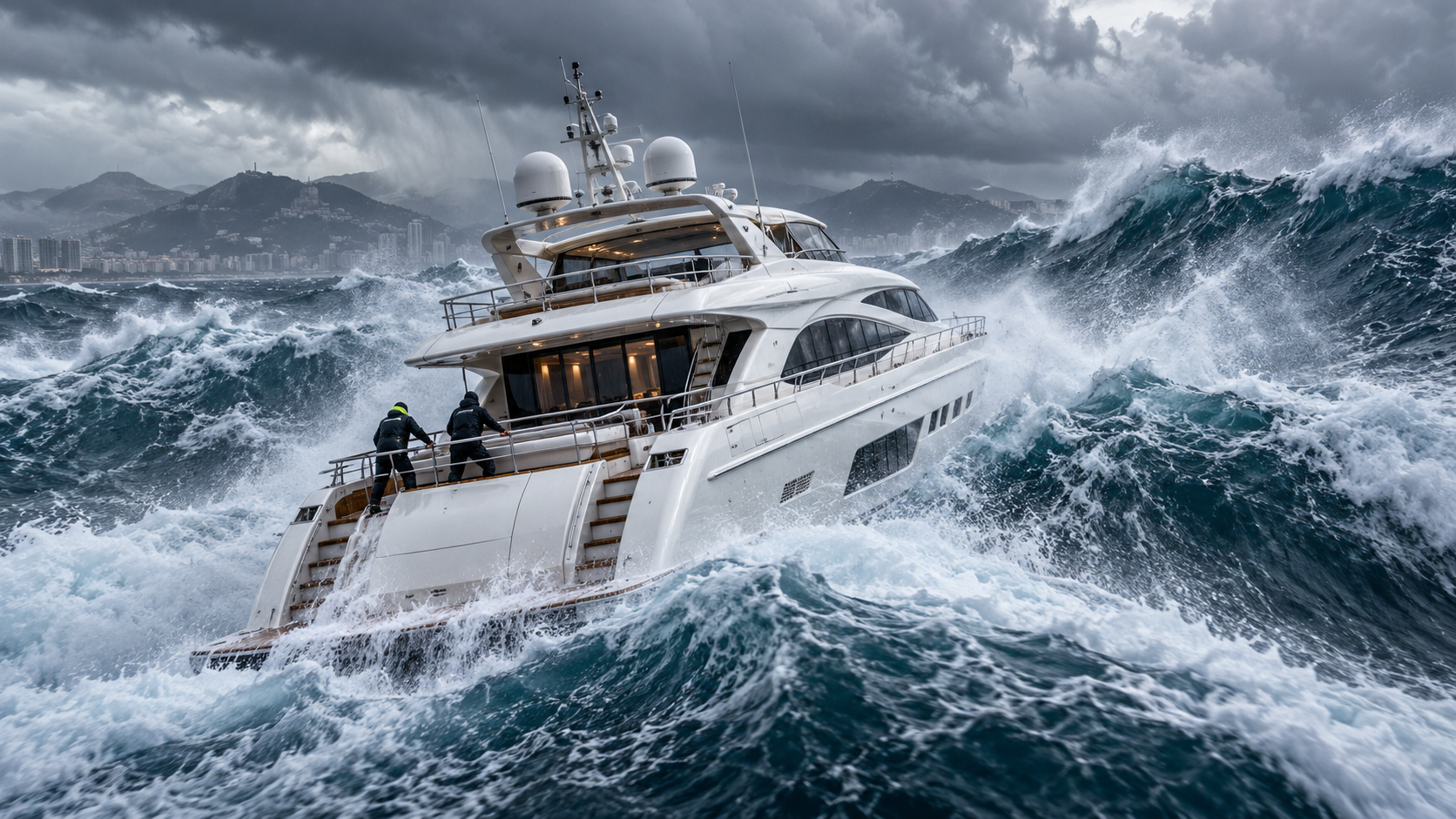
That is part of the film’s strongest visual idea. An object associated with wealth and leisure becomes a confined working environment. The comforts that make it desirable in calm weather cannot cancel the vulnerability of people who must remain inside it when the surrounding conditions change.
The scale also creates a storytelling trap. A spectacular wave is easier to represent than a sequence of ordinary decisions that placed someone in its path. Yet the decisions explain why that particular person, rather than the owner enjoying the yacht on another day, is present when the wave arrives.
Who Were the Real Sailors Behind the Story?
Marlon Valdez and Jonathan Chino were young sailors working in Acapulco when Otis struck. Their experiences became the starting point for the film, and both later contributed to its production. Their involvement gives the project a connection to lived experience, while the fictional characters allow the filmmakers to construct a different personal relationship.
The difference between friends and half-brothers is substantial. A friendship is built and maintained through chosen association; a sibling relationship carries an inherited family connection. Making the protagonists brothers allows a survival story to include unresolved family tensions without claiming that those tensions belong to the real sailors.
Viewers should therefore resist translating every dramatic detail into biography. A disagreement between Wirpul and Candi is not evidence of a corresponding argument between Valdez and Chino. A character’s motivation belongs first to the screenplay unless it has been independently established as part of the historical account.
This is particularly important when a film uses recognisable events. The more convincing the storm appears, the easier it becomes to assume that the conversations surrounding it are equally documentary. Visual realism and biographical accuracy are different achievements.
There is also a danger in treating survivors as people whose purpose was to produce an extraordinary story. Survival is an outcome, not a professional identity. The experience can interrupt work, relationships and a person’s willingness to return to the place where it happened. The public’s interest may be concentrated in one dramatic night while the person involved continues living with its consequences.
The film can bring attention to those experiences without becoming their final or definitive form. The most responsible way to approach it is as an invitation to understand the event, rather than a replacement for the people and records behind it.
What the Film Changes and Why It Matters
In the film, Wirpul has an opportunity to captain a yacht and brings Candi aboard. The prospect of work intersects with an uneasy family relationship. As the weather deteriorates, practical dependence becomes unavoidable: the men cannot resolve their situation simply by keeping their distance from one another.
This arrangement gives the drama two pressures. The external pressure is the storm. The internal pressure is whether the characters can cooperate when their existing relationship makes cooperation difficult. The hurricane forces decisions that an ordinary working day might allow them to postpone.
As an interpretation of the premise, the family conflict is effective because it prevents the men from becoming interchangeable survival figures. They arrive with different expectations and grievances. Their responses to danger can therefore reveal something about the relationship rather than merely demonstrate courage or technical competence.
However, this device also requires restraint from anyone explaining the true story. Emotional plausibility is not historical verification. A scene can express a recognisable truth about resentment, pride or loyalty without reproducing something the real survivors experienced.
The film’s work setting gives those emotions a material context. The men are not choosing an extreme-weather adventure. They are carrying out a job. Their relationship develops inside obligations involving another person’s valuable property, which creates questions that a purely recreational survival story would not need to answer.
It is possible to admire their resilience while also asking why resilience became necessary. These are compatible responses. An account that celebrates endurance without examining the circumstances risks making extraordinary danger seem like an expected part of ordinary employment.
Who Gets to Decide When Work Becomes Too Dangerous?
The film’s central social question concerns the distance between owning an asset and being responsible for it in person. The owner can suffer a financial loss. A worker remaining aboard can suffer that loss alongside immediate physical danger, without having the same control over the original decision.
That does not establish the legal responsibility of any particular real employer. Such a conclusion would require evidence about instructions, knowledge, available alternatives and the applicable law. The broader ethical problem can nevertheless be stated clearly: who is entitled to decide that protecting property justifies someone else’s continued exposure?
A worker’s agreement is not always easy to interpret. People can accept a duty because they believe it is manageable, because they trust someone else’s assessment, because they need the income, or because refusing seems likely to damage future employment. Those possibilities should not be assigned to an individual without evidence, but they show why the word “choice” can conceal important differences in freedom.
The practical test is whether there is a credible route to stopping work. Can the person leave without negotiating under worsening conditions? Has a stopping point been agreed in advance? Does anyone have responsibility for checking that the crew is safe rather than merely that the vessel is secure?
These questions locate responsibility before the most dramatic moment. Once a person is fighting to survive, the available choices have already narrowed. A meaningful examination of the event must look at the earlier period when more options existed and different people controlled them.
The same reasoning applies to the way audiences judge the characters. From a comfortable distance, leaving can appear obvious. Inside a changing situation, the decision may involve incomplete information and obligations that feel concrete until the danger overwhelms them. Understanding those constraints is more useful than assuming that hindsight was available at the time.
Knowing the Track Is Only Part of the Forecast
A hurricane forecast has to answer several different questions. Where will the centre go? When will it arrive? How strong will the storm become? How large will its damaging effects be? Those questions are connected, but getting one broadly right does not guarantee that all the others will be equally accurate.
This matters when people judge a disaster with hindsight. A coastal community may know that a storm is approaching without having a reliable picture, early enough, of the intensity it will reach. The difference is practical. Preparations that appear proportionate to one forecast can become inadequate if the threat changes sharply while people are carrying them out.
A vessel adds another layer of difficulty. Its position, condition, crew and available shelter affect what options remain. Moving it is an operation that takes time, and leaving later is not necessarily safer than remaining where it is. A film can show a decision in a single scene; the real decision may depend on a chain of earlier commitments and constraints.
That does not mean every dangerous choice becomes unavoidable. It means an explanation should identify what information and options existed at the time. Asking why someone did not simply leave is incomplete unless it also asks when they could have left, by what route, under whose authority and with what warning.
Otis makes the distinction between awareness and readiness especially stark. Knowing the name of an approaching storm does not mean a household, employer or harbour has finished preparing for its eventual strength. Readiness requires decisions to be made while conditions still permit action.
The wider lesson is about time as much as prediction. A useful warning must arrive with enough opportunity to act on it. When intensification compresses that interval, people can find themselves making consequential choices while both the weather and their understanding of it are changing. The emergency is already developing before the most spectacular destruction begins.
The Warning Is Only One Link in the Chain
A weather warning must travel through several stages before it changes anyone’s safety. It has to be issued, received, understood, believed and translated into an action that is still possible. Failure at any stage can reduce the benefit of accurate information.
Consider the difference between knowing that a storm is strengthening and knowing what to do about a particular workplace. A general message cannot by itself decide how a vessel should be secured, when staff should leave, where they should go or how they should travel. Those arrangements require preparation before the warning becomes urgent.
This is an analytical lesson from the disaster rather than a claim that every failure in Acapulco followed the same pattern. Different people faced different circumstances. Some were responsible for children or relatives; some depended on employers; others were isolated by damage. A single explanation cannot fairly stand in for all of them.
It does suggest that the quality of a response should be judged by the actions it makes possible. A message that reaches someone after their practical escape route has closed may still be accurate, but it cannot deliver the protection that earlier preparation might have provided.
Preparation also changes the burden placed on individuals. Without an agreed plan, a worker may have to challenge an employer, interpret technical information and organise transport at the same time. With clear procedures, the decision to leave can become an established duty rather than a personal act of defiance.
The difference is especially important when uncertainty remains. If a plan requires proof that catastrophe is imminent, it may activate only after useful time has been lost. A precautionary decision can be justified by the seriousness of the possible consequence even when the precise outcome is not yet known.
The Disaster Continues After the Wind Falls
Survival stories naturally concentrate on the period when death is closest. That gives them a clear dramatic structure: danger rises, people struggle, and the immediate crisis ends. A city’s recovery follows a less convenient pattern.
Shelter, employment, transport and public services are connected. Repairing one damaged building does not restore a household if its income has disappeared. Reopening a business does not mean that every worker can reach it or has somewhere secure to live. Recovery must be understood through those connections rather than a single visible milestone.
The distinction is particularly relevant to a tourist destination. Visitors encounter hotels, beaches, restaurants and boats as services. Residents encounter them as employers, workplaces and parts of a local economy. The same damaged yacht can represent a leisure asset to one person and the loss of regular work to another.
An economic estimate can measure part of the destruction, but it cannot express every consequence. Replacement costs, interrupted earnings and damage to public infrastructure answer different questions. None can fully account for the absence of a person who does not return.
For families of missing people, uncertainty creates a further problem. A recovery narrative may move towards reopening and rebuilding while they still lack a confirmed account of what happened. Public attention can shift before their most basic question has been answered.
A film does not have to explain every aspect of reconstruction to acknowledge this larger setting. But viewers should be cautious about allowing the end of a survival narrative to become the imagined end of the disaster itself. The successful completion of one story leaves many other lives unresolved.
How to Read the Film Without Confusing Drama and Evidence
The strongest approach is to ask three separate questions. What is established about the hurricane? What is established about the real people whose experiences informed the film? And what does the fictional story invite the audience to think about?
The first question belongs chiefly to meteorological records and documented accounts of damage. The second depends on survivor testimony and other reporting, with attention to what can be corroborated. The third permits interpretation, provided it remains connected to the characters, situations and choices actually presented.
Keeping these questions distinct does not drain emotion from the film. It protects the people behind it from being absorbed into invented biography, while giving the filmmakers proper credit for the dramatic decisions they made.
It also allows criticism. The presence of a real disaster does not make every fictional choice effective, and a moving performance does not settle the historical accuracy of a scene. Conversely, changing a relationship does not automatically invalidate a film whose intention is to explore a broader experience through invented characters.
Surviving Hurricane Otis is most compelling as an invitation to look at the people who make other people’s comfort possible. Its yacht belongs to a world of leisure, but its immediate story belongs to labour, dependence and survival. The real hurricane supplies the scale of the danger. The enduring question is how decisions made before that danger became overwhelming shaped who had to face it at close quarters.
Sources
NOAA — Hurricane Otis Causes Catastrophic Damage in Acapulco, Mexico — Landfall intensity and rapid strengthening.
NOAA — How Do Hurricanes Form? — Ocean heat, moisture and wind shear.
NOAA — Understanding Hurricane Hazards — The distinction between wind, flooding and other hurricane hazards.
Netflix — The True Story Behind Surviving Hurricane Otis — Film premise, cast and historical inspiration.
El País — Surviving Hurricane Otis: Jorge Michel Grau’s Film About Two Sailors — The distinction between the fictional brothers and real friends, and the survivors’ involvement.
Next Reads
Film Summaries, Endings Explained & Analysis — More film explanations and discussions of their underlying ideas.
