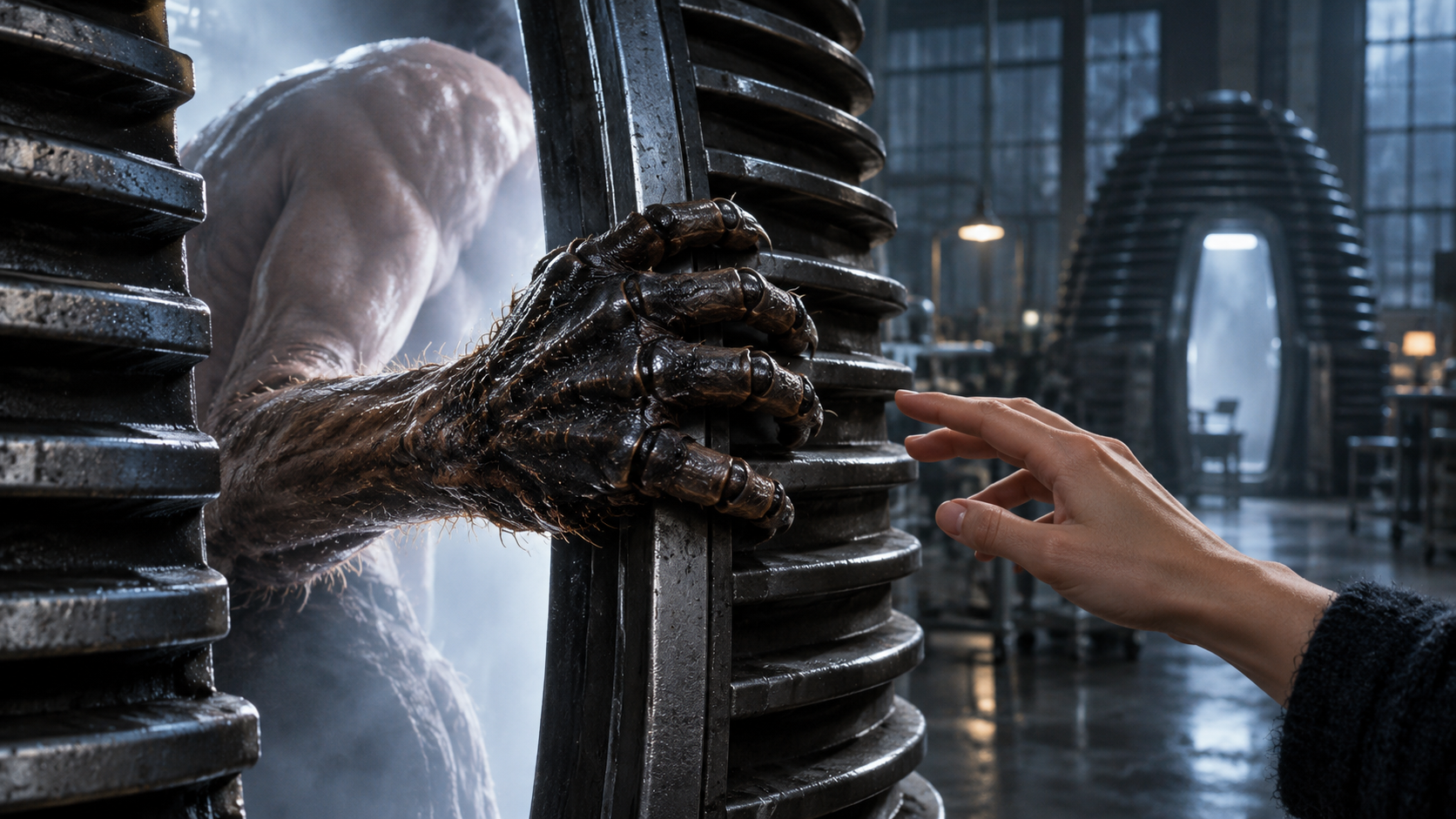
Scientific Breakthrough Becomes a Body-Horror Nightmare
What If Feeling Better Was the First Warning?
Seth Brundle believes he has found a way to change the world. His invention promises to move matter between two places without crossing the space between them. For a scientist who struggles with ordinary human contact, it also brings something less predictable into his life: a woman who wants to understand him.
David Cronenberg’s The Fly (1986), starring Jeff Goldblum and Geena Davis, builds its horror around that fragile connection. Scientific discovery becomes inseparable from attraction, jealousy and the difficulty of recognising danger when it initially feels wonderful. The laboratory offers proof that extraordinary things are possible. It provides much less certainty about whether those things should happen, or whether the person conducting the experiment can judge its consequences clearly.
The Experiment That Brings Two People Together
Seth meets science journalist Veronica Quaife at a press event and persuades her to inspect his work. Inside his laboratory, he demonstrates his telepods: chambers linked to a computer that disassembles matter and reconstructs it elsewhere.
Veronica recognises a potentially enormous story. Seth, however, needs time. His invention can transport inanimate objects, but living tissue presents a problem he has not solved. They agree that she can document his progress rather than immediately publish his discovery.
Their arrangement makes observation part of the relationship from the beginning. Veronica arrives with professional questions, and Seth gains an audience capable of appreciating his achievement. His work provides an unusually direct route into his private life because almost everything important to him happens around the machines.
Goldblum’s Seth is appealing partly because his confidence has such a narrow foundation. He can explain an extraordinary invention while appearing less comfortable with the ordinary negotiations of attraction. Technical authority does not give him equivalent emotional experience.
Veronica’s editor and former lover, Stathis Borans, complicates that developing intimacy. Played by John Getz, Stathis treats their previous relationship as a continuing entitlement to her attention. His intrusion into her home establishes a boundary problem before the scientific experiment becomes dangerous.
Seth seems to offer a different kind of relationship: excitement, vulnerability and the possibility of discovering something together. Yet Veronica’s position is already difficult. She must protect her professional independence while becoming emotionally involved with the subject of her reporting.
A failed attempt to teleport a baboon exposes the seriousness of Seth’s unfinished work. The animal emerges horribly damaged. Successful transportation of an object has not established that the system understands how a living body belongs together.
The experiment also changes Veronica’s role. She is no longer merely recording a remarkable demonstration. She has witnessed suffering produced by the gap between Seth’s ambition and his actual control.
Why the Computer Cannot Understand Flesh
As Seth and Veronica become lovers, their physical relationship helps him reconsider the problem with his machine. He has taught the computer to process matter without adequately accounting for the qualities of living flesh.
A comparison involving ordinary and teleported steak makes the failure easier to grasp. Something can emerge looking recognisable while having lost an essential quality. The computer’s reconstruction follows an interpretation of the material rather than guaranteeing perfect continuity.
This is the film’s most useful scientific explanation because it establishes a limitation that survives later improvements. The telepods depend on instructions. They cannot independently understand every distinction their creator considers obvious.
Within the film’s fictional science, Seth improves the process sufficiently to transport another baboon alive. It is a genuine breakthrough. It is also much narrower evidence than the sweeping conclusion he will draw from it.
An animal surviving a test does not establish long-term safety, explain every possible complication or make an unsupervised human trial sensible. Seth has answered one question and becomes impatient with the questions that remain.
Veronica then discovers that Stathis is threatening to publish the story. She leaves to confront him and protect the agreement she has made with Seth.
Seth misreads her departure as evidence that she remains romantically involved with her editor. Drinking alone, he decides to put himself through the telepods.
The decision joins scientific overconfidence to a personal humiliation that exists largely in his interpretation. His experiment becomes a way of proving something while the person whose approval matters to him is absent.
A fly enters the chamber with him.
The transfer appears successful. Seth emerges recognisably himself, without the immediate catastrophe that destroyed the first baboon. The apparent normality makes the event more dangerous: it gives him a reassuring result before he understands what the machine has actually done.
The crucial failure is therefore both technical and human. The system encounters an unanticipated combination of living material. Its inventor has placed himself inside it while emotionally distressed, intoxicated and unwilling to wait.
When the Warning Signs Feel Like Superpowers
At first, Seth experiences the aftermath as an improvement. His strength, energy and sexual appetite increase. His body seems newly capable, and he interprets those changes as evidence that teleportation has purified or revitalised him.
That interpretation makes the early transformation seductive. If the experiment had immediately left him helpless, he would have had little reason to defend it. Instead, it offers rewards that support the story he wants to believe.
Veronica notices changes that do not fit that story, including unusual coarse hairs growing from his back. She becomes concerned while Seth grows increasingly certain.
Their disagreement is about evidence, but it also concerns authority. Seth treats his own pleasure as a superior account of what is happening. Because he feels powerful, another person’s fear appears to him like an obstacle to enlightenment.
He wants Veronica to undergo teleportation too. Her refusal frustrates him because it prevents her from confirming his interpretation through participation.
This is where the film begins to separate intimacy from agreement. Veronica can love Seth and still refuse to enter his machine. He struggles to accept that distinction because he has begun making shared risk a test of shared feeling.
After an argument, Seth goes to a bar and breaks another man’s arm during an arm-wrestling contest. He brings a woman named Tawny back to the laboratory and tries to interest her in the telepods.
His new physical capacity has outpaced his restraint. Strength that initially appears exhilarating becomes an instrument through which other people can be injured or pressured.
Veronica intervenes with evidence that the hairs from his back are insect hairs. Seth resists her warning, but visible deterioration soon becomes impossible to dismiss.
The progression gives the early scenes a specific purpose. They show why a person might defend a harmful change before recognising it as harm. Seth is attached to an explanation that has improved his confidence, his sexuality and his sense of importance.
Acknowledging the danger would mean surrendering all three benefits at once.
The attraction of bodily improvement also connects the film to later body horror, but Seth’s particular error is unusually precise: he mistakes increased performance for proof that the process producing it is safe.
What Brundlefly Actually Is
When Seth examines the computer’s records, he discovers that it detected two living organisms during his teleportation and fused them at the molecular and genetic level.
The fly has not simply bitten him or infected him. Nor is an intact insect sitting inside his body, waiting to be removed. The machine has combined two forms of life into a new organism.
Seth calls that organism Brundlefly.
The name is useful because it preserves both parts of the result. Although people naturally describe him as turning into a fly, the film’s creature is a human–insect hybrid. His transformation reveals what the fusion has created.
This also explains why repeating the journey cannot automatically restore him. The computer no longer encounters the original Seth and a separate fly as neatly distinguishable passengers. It encounters their combined living result.
There is no demonstrated reversal procedure.
That absence gives the telepods a disturbing reliability. They can perform operations on matter without understanding which outcome their user would regard as a disaster. Technical completion and human success have become separate things.
The machinery invites a comparison with the box in Blake Crouch’s Dark Matter: access to an extraordinary process does not guarantee control over its consequences.
For Seth, naming the condition is also an attempt to remain its interpreter. He can still analyse, describe and classify what is happening. Those habits give him a role beyond being the body on which the experiment continues.
Yet his knowledge creates a cruel double position. The scientist understands enough to recognise the scale of the problem, while the patient cannot step away from it.
His earlier confidence depended on treating the body as a system he could improve. Now that system supplies evidence he cannot stop receiving.
The Laboratory Becomes a Place of Care
After a period apart, Veronica returns to find Seth severely deteriorated. The energetic man who celebrated his apparent improvement now needs support and struggles with a body that is visibly coming apart.
Human features loosen or disappear. He collects detached pieces of himself in a bathroom cabinet, calling the collection the “Brundle Museum of Natural History”.
The joke gives him a brief position of authority over an experience that otherwise humiliates him. A museum has an organiser, a catalogue and a subject. By naming his losses as exhibits, Seth tries to remain the curator of his own disappearance.
It is also a grotesquely intimate collection. These objects were not possessions he could choose to discard. They were parts of the physical continuity through which he recognised himself.
The horror effects work through that accumulation of losses. Instead of presenting one finished monster and asking the audience to accept it, the film repeatedly changes a body we already know. Each alteration has a remembered comparison.
The familiar bathroom setting strengthens the effect. Mirrors, teeth, nails and grooming belong to ordinary private routines. Their deterioration brings the impossible premise into activities through which people check that they remain recognisably themselves.
Seth’s digestion changes too. He demonstrates how he now breaks food down externally with corrosive secretions before consuming it.
His scientific manner makes the demonstration uncomfortable in a different way from an attack. He is explaining how to live in the body he now has. For him, the disgusting process is becoming practical knowledge.
Veronica must watch someone she loves establish a new normal that she cannot share. Her camera, once intended to record a discovery, now records decline.
That reversal prevents the film from treating documentation as emotionally neutral. A recording can preserve evidence, but it cannot protect the person being recorded. Veronica’s professional ability to observe offers no reliable solution to her private helplessness.
Seth resists outside medical intervention, fearing that he will become an experimental subject. The fear is understandable, although his isolation also removes possible sources of help.
His laboratory has become a place where the roles of inventor, patient and doctor collapse into one increasingly desperate person.
Veronica’s Pregnancy Changes What Is at Stake
Veronica discovers that she is pregnant. She cannot be certain whether conception occurred before or after Seth’s genetic alteration, and she fears what that uncertainty could mean.
The film gives her fear a horrific image: a nightmare in which she delivers a giant maggot.
This is a dream. It does not establish that the pregnancy contains a maggot, predict a confirmed birth or reveal a medical diagnosis. The distinction is essential because Veronica’s terror comes from not knowing.
Until this point, she has mainly confronted changes happening to Seth. Pregnancy makes the uncertainty enter her own body and future. She cannot simply observe it from the other side of a camera.
Her concern also exposes a limit in the idea that love should be able to endure anything. Endurance sounds straightforward when described from outside a crisis. Veronica faces decisions whose consequences she may have to carry physically.
She goes to Seth intending to tell him, but encounters another danger.
Seth warns that his remaining restraint is weakening. In his speech about insect politics, he imagines an existence without compassion or compromise and recognises that Veronica may no longer be safe around him.
The speech should not be treated as a scientific statement about insect behaviour. It is Seth’s frightened account of his changing impulses, expressed through the vocabulary of his transformation.
Its emotional force comes from the fact that he can still recognise a boundary. He understands that caring about Veronica may require sending her away.
For a moment, his capacity to protect her survives his capacity to resemble the man she met. Physical humanity and ethical behaviour are no longer aligned.
Veronica leaves without telling him about the pregnancy and seeks an abortion with Stathis’s assistance. Seth overhears enough to discover what she intends.
He abducts her before the procedure can take place, pleading that the child may preserve something human of him.
The interruption marks a decisive change in his conduct. His fear of extinction becomes a claim over Veronica’s choices. The future he wants to preserve now depends on overriding the person who must live through it.
The Rescue Plan That Destroys Consent
Stathis follows them to the laboratory with a shotgun. Seth attacks him with the same corrosive secretions previously shown as part of his feeding process, destroying a hand and a foot.
A bodily adaptation becomes a weapon. The earlier demonstration has prepared the audience to understand the attack without introducing an unrelated new power.
Veronica persuades Seth to stop before he kills Stathis. Her influence has not disappeared completely, but it is no longer enough to make the situation safe.
Stathis’s intervention complicates the film’s original triangle. The possessive former lover becomes the person willing to enter the laboratory and attempt a rescue. That action does not erase his earlier behaviour, but it prevents the characters from remaining fixed in their introductory roles.
Seth then reveals his proposed solution. He intends to fuse himself with Veronica and the unborn child, creating one combined organism with a greater proportion of human material.
The plan translates an emotional wish into a monstrous calculation. He wants to remain human and remain with Veronica. The computer offers a way to combine bodies, and he treats that operation as though it could fulfil both desires.
But a higher proportion of human genetic material would not establish the survival of the people being combined. Seth has no demonstrated basis for promising that Veronica’s identity, consciousness or independent existence would remain intact.
His solution would consume the relationship he claims to be saving. A relationship requires separate people who can respond to one another. His proposed family would remove that separation by force.
The reversal is especially painful because Veronica helped him think more carefully about flesh earlier in the film. Her presence expanded his understanding. Now he reduces her body to material that might repair his own.
His desperation remains emotionally intelligible without making the plan acceptable. The film allows sympathy for a dying man while showing the point at which his survival project becomes violence against somebody else.
As Veronica struggles against him, his jaw tears away and the remaining human exterior gives way to the final insect-like form.
The physical transformation reaches its climax after his proposed rescue has already become horrifying on ethical grounds.
What Happens at the End of The Fly?
At the end of The Fly, Stathis prevents Veronica from being fused with Seth, but Seth is accidentally fused with part of the telepod instead. The resulting creature guides Veronica’s shotgun towards its own head. She reluctantly shoots him, ending his suffering.
The sequence follows directly from the operation Seth has prepared. He confines Veronica inside one chamber and enters another, intending the system to combine them in the receiving pod.
Despite his injuries, Stathis shoots through the connections serving Veronica’s chamber. She is removed from the fusion process.
Seth tries to break out of his own pod while the sequence continues. The machine incorporates part of the chamber into the transfer, producing a damaged combination of Brundlefly and machinery.
The final accident repeats the original problem in a harsher form. The telepods combine material without preserving the distinctions that matter to the people using them. Seth’s attempt to reclaim his humanity through another fusion leaves him even further from his intended result.
Yet the creature’s last action is communicative. Unable to speak, it directs the weapon towards itself.
The gesture gives Veronica something recognisable within a body that no longer resembles her lover. It suggests awareness of suffering and a wish for release, though the film cannot precisely measure how much of Seth’s former mind remains.
Her hesitation keeps the killing from becoming an uncomplicated victory. She is confronting the remains of someone she loves, and his request makes her the person who must carry out the final act.
The film ends with her grief. It does not provide a reassuring recovery scene or establish what she subsequently decides about the pregnancy.
Within this film, the baby’s condition and eventual fate remain unresolved. The nightmare supplies no answer, and the interrupted procedure has not ended the pregnancy. Later franchise developments should be kept separate from what the 1986 ending itself shows.
The immediate story has reached a conclusion, but Veronica’s life has not been neatly repaired by it.
Why the Ending Still Feels Human
Cronenberg has explained that he understood the film through ageing and death, while acknowledging that audiences also read it through AIDS. His stated starting point was the broader experience of bodily decline and the pain of watching a loved person change.
That context helps explain the film’s unusual progression. Seth’s transformation contains exhilaration, denial, adaptation, humiliation and fear. It gives him enough time to develop competing explanations for what is happening.
Reading the film solely as punishment for scientific arrogance would flatten that progression. Seth makes reckless decisions, but the relationship’s suffering exceeds the satisfaction of seeing an overconfident inventor proved wrong.
Veronica does not receive a lesson she can use to restore him. Increased understanding brings harder decisions.
The ending also complicates Seth’s earlier claim that the insect has awakened and the man has disappeared. His final gesture remains intelligible as a request. The film places that moment of recognition after the most extreme physical deformation.
This does not mean that violence has been excused or that love has recovered a hidden, undamaged Seth. The person Veronica remembers cannot be separated from the creature and brought home. Recognition survives without producing rescue.
The distinction gives the practical effects their emotional purpose. The audience is encouraged to recoil from the body while still trying to understand its intention. Disgust and compassion must occupy the same moment.
There is a related struggle in Recursion, where technology becomes entangled with the desire to preserve people and experiences that cannot be held still. In The Fly, that struggle is compressed into a laboratory and a relationship whose future contracts with every visit.
The film’s final cruelty is that Seth can still be understood when he can no longer be saved. Veronica’s ability to recognise his request does not make fulfilling it bearable. The machine began as a promise to overcome physical distance; the story ends with two beings close enough to communicate across an almost unimaginable bodily difference, and with no route back to the life they briefly shared.
Sources
AFI Catalog — The Fly (1986) — Film identity, credits, production context and a detailed synopsis supporting the central chronology.
Filmsite — The Fly (1986) — Corroboration of the transformation, key dialogue, pregnancy nightmare and final telepod sequence.
IMDb — The Fly: Plot Summary — Supplementary detail on the experiments, relationship conflict and rescue mechanics, checked against the other plot accounts.
The Fly (1986 Film) — Supplementary cross-check of the fusion mechanism and the distinction between Veronica’s nightmare and events.
David Cronenberg Tries Opera — Interview in which Cronenberg discusses the film’s relationship to ageing, death and its AIDS interpretation.
