What Happens When A Stuntman Has To Take The Hit For Real?
Why Does A Star Who Does His Own Stunts Need Cliff Booth?
Charlie Peters has built a television career on doing the dangerous parts himself. Then he asks his agent to find Cliff Booth. It sounds like a job for Rick Dalton’s old stunt double, except Charlie has no trouble taking a fall on camera. He needs somebody willing to step in when the cameras are off. That distinction explains both the final fight and why, eight years after Once Upon a Time… in Hollywood, Cliff is still the man Hollywood calls.
Cliff Booth survives the final confrontation with the Verdusco brothers. The punishment he takes in the fight looks severe enough to kill him. The surprise is how lightly he appears to carry it afterwards. David Fincher and screenwriter Quentin Tarantino leave Brad Pitt’s character alive, still capable of working as a fixer, with his future beyond this job open. There is a sting in that outcome. A television star made a decision he came to regret, and a former stunt double once again took the hit.
What Did Charlie Peters Ask the Verdusco Brothers to Do?
The trouble begins overseas. After a fight with his wife, Toni, Charlie tells Eddie and Fernando Verdusco that he wishes she were dead. The brothers offer to kill her for $200,000. Charlie agrees. Once home in Los Angeles, he reconciles with Toni and wants the arrangement cancelled. The brothers have every reason to take his first answer seriously. Charlie gave them a price and a target. Only his feelings have changed.
That sequence matters because Charlie is easy to mistake for the unlucky celebrity at the centre of an extortion plot. By the time Karen Crosby, his agent, brings in Cliff, Charlie is frightened and wants his wife to live. Both things can be true of a man who previously agreed to have her killed. His remorse makes the job urgent. It does very little for Toni, whose life now depends on people honouring a change of heart she had no say in.
Cliff has a reason of his own to care. He and Toni have a romantic history that they keep from Charlie. It gives their scenes an ease that her husband cannot quite account for, and it changes what Cliff is taking on. The person in danger had a life before she became Charlie Peters’s wife. Cliff happens to remember some of it.
Why the Final Fight Lands Differently From Cielo Drive
In the ending of Once Upon a Time… in Hollywood, the intruders come through Rick Dalton’s door while Cliff is feeding his dog. He recognises them from Spahn Ranch. The encounter is accidental, and the audience understands something Cliff never needs to know. By fighting the people in front of him, he has helped give Sharon Tate a future.
The sequel offers a lovely, economical glimpse of what that means. By 1977, Sharon can turn up on television in a cigarette advert. She has lived long enough to take an ordinary, faintly ridiculous job. For anyone who remembers why the gate opening at the end of the first film felt so moving, there is something rather wonderful about that.
Fincher gives the Verdusco fight a different weight. This time Cliff knows why the men are there. Somewhere behind every blow is Charlie’s agreement to pay for Toni’s death. The final confrontation brings that decision back into the room, only the person physically answering for it is Cliff. Even his survival has a darkly funny professional logic. For years, his particular gift was taking a blow that an audience would remember somebody else surviving.
There is also a less flattering way to read his apparent invulnerability. Charlie’s co-star, the former football player Roderick “Hot Rod” Harrison, suffers a maiming. Cliff absorbs punishment that ought to finish him and comes through it. The difference makes it harder to treat the violence as harmless fun. This world has lasting injuries. Its leading man has been granted an extraordinary exemption.
What Does Karen Crosby See in Cliff?
Karen first reaches Cliff through work. Their attraction becomes more interesting when they get onto a subject about which neither needs a favour. Karen once wanted to be a film critic. Cliff runs a projector at the New Beverly Cinema. She is prepared to dismiss The Godfather as a gangster picture with artistic pretensions. Cliff thinks it is an obvious test case for whether a film can be art. For once, somebody has found a way to get a rise out of him without picking a fight.
It is a better clue to what Cliff might want from Karen than their connection to Charlie. Almost everyone wants to hear what happened with Bruce Lee or what Cliff did in the war. Karen can keep him at the table with an opinion about a film. He gets to be a man with taste, curiosity and the capacity to be mildly appalled by his date.
The attraction is real. Whether it becomes a settled life together remains open. Getting Charlie out of danger answers the question Karen called to ask. It cannot answer the more intimate question their conversation raises. When the job is over, do these two still have a reason to see each other? They have at least one good film argument left.
Why Toni’s Story Brings Billie Booth Back Into View
There is an uncomfortable piece of casting within the story itself. The man hired to prevent a husband from having his wife killed is Cliff Booth. Suspicion over the death of his own wife, Billie, once made it hard for him to find work. The sequel lets the audience make that connection without having Cliff deliver a speech about his past.
The distinction between versions matters here. In the 2019 film, Tarantino cuts away from the boat before the decisive moment. In his subsequent novel, the account of Billie Booth’s death makes Cliff responsible. Viewers who know only the films can see a bitter irony in his assignment. Readers of the novel have a harder fact to sit with.
It is tempting to read his concern for Toni as an attempt to make amends. His affection for her is evident, but the sequel gives him no corresponding reckoning with Billie. Calling it redemption would do a favour for Cliff that the film leaves the audience free to refuse. He can care what happens to Toni. Billie still deserves to be remembered on her own account.
Where Does the Sequel Leave Cliff?
Rick Dalton is working in Australia. Cliff lives with his father, Gus. They watch television and build models together. Between shifts behind a bar and in the projection booth, Cliff has a home, someone to look after and films worth arguing over. Those quiet details give him something more valuable than another opportunity to demonstrate how tough he is. They give him a life the audience can imagine him going home to.
The two films part company most clearly here. At the end of the first, a wounded Cliff leaves in an ambulance while Rick gets the invitation up to Sharon Tate’s house. It was always easier to remember the gate opening than to notice which man went through it. Eight years later, Cliff finally has the leading role. Charlie Peters gives him much the same job he had when his name was further down the credits.
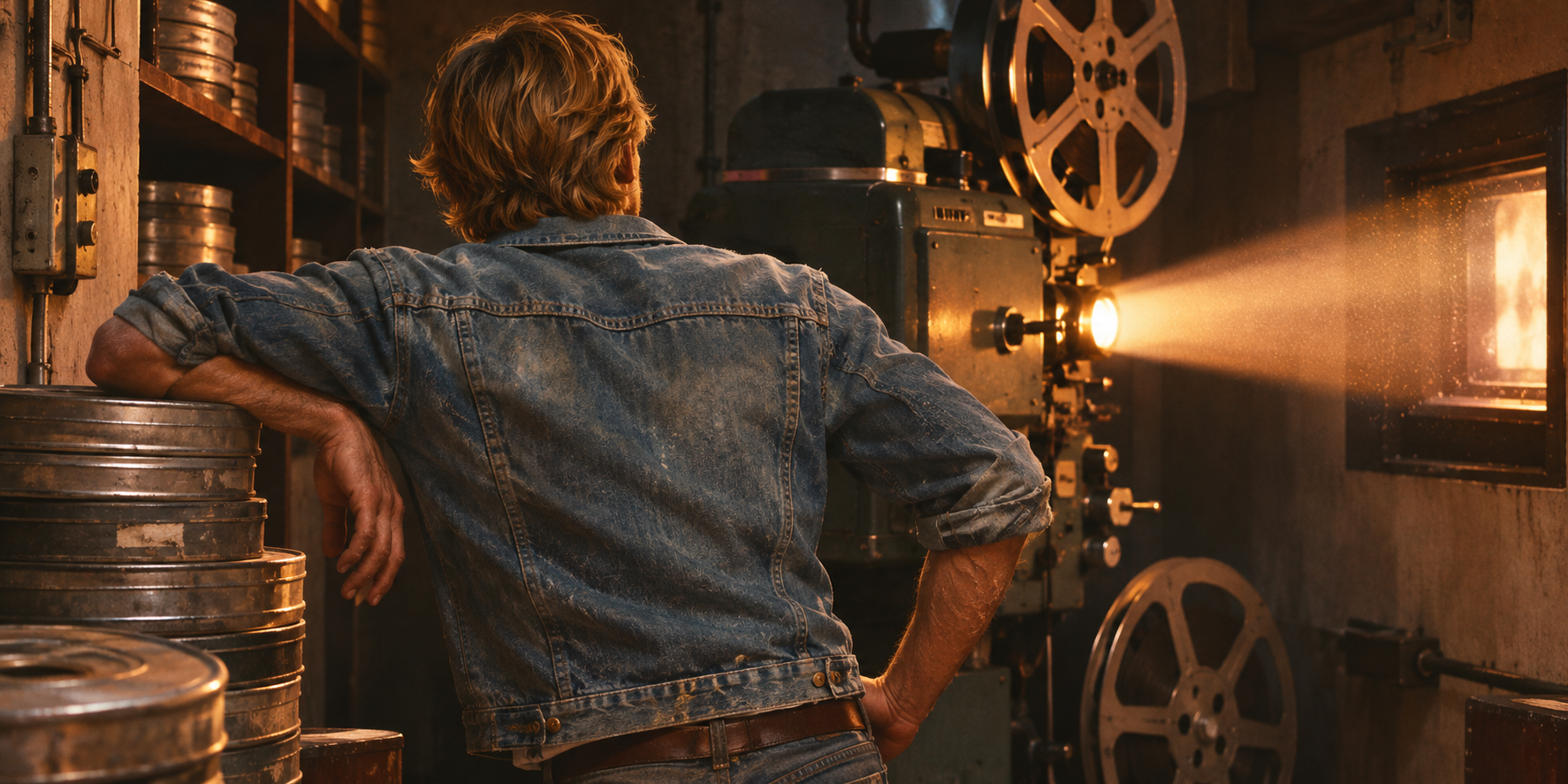
Perhaps the kindest thing the sequel does for him happens at the New Beverly. Downstairs, the audience gets the stars, the action and the happy ending if there is one. Upstairs is a man who loves films enough to turn up and run the projector. For once, we get to spend the evening with him.
Sources
Variety — The Further Mis-Adventures of Cliff Booth Review — Confirms Cliff’s survival in the final fight, the injury to Hot Rod and the substance of the film conversation with Karen.
Irish Film Critic — Brad Pitt’s Effortless Cool Meets David Fincher’s Precision in a Darker, Sharper Return — Details Charlie’s $200,000 agreement, his reconciliation with Toni and her history with Cliff.
Netflix Tudum — Let The Further Mis-Adventures of Cliff Booth Take You Back to 1977 — Establishes Cliff’s work, Karen’s role and Fincher’s approach to revisiting the character.
The Guardian — The Further Mis-Adventures of Cliff Booth Review — Documents Sharon Tate’s television appearance, Rick’s whereabouts and the sequel’s treatment of Billie Booth.
Next Reads
Once Upon a Time in Hollywood Ending Explained: What Happens on Cielo Drive and the Real 1969 Story — Follow Rick and Cliff through the night that gives the sequel its alternate Hollywood.
Did Cliff Booth Kill His Wife? What Tarantino’s Film Shows and the Novel Reveals — See precisely where the boat scene cuts away and what Tarantino later put on the page.
True Crime: Charles Manson Murders – Inside the Family, the Evidence and the Myth — The people and events behind the history Tarantino rewrote in the first film.
