Hunger, Power and the Final Descent
Your Next Meal Depends on Everyone Above You
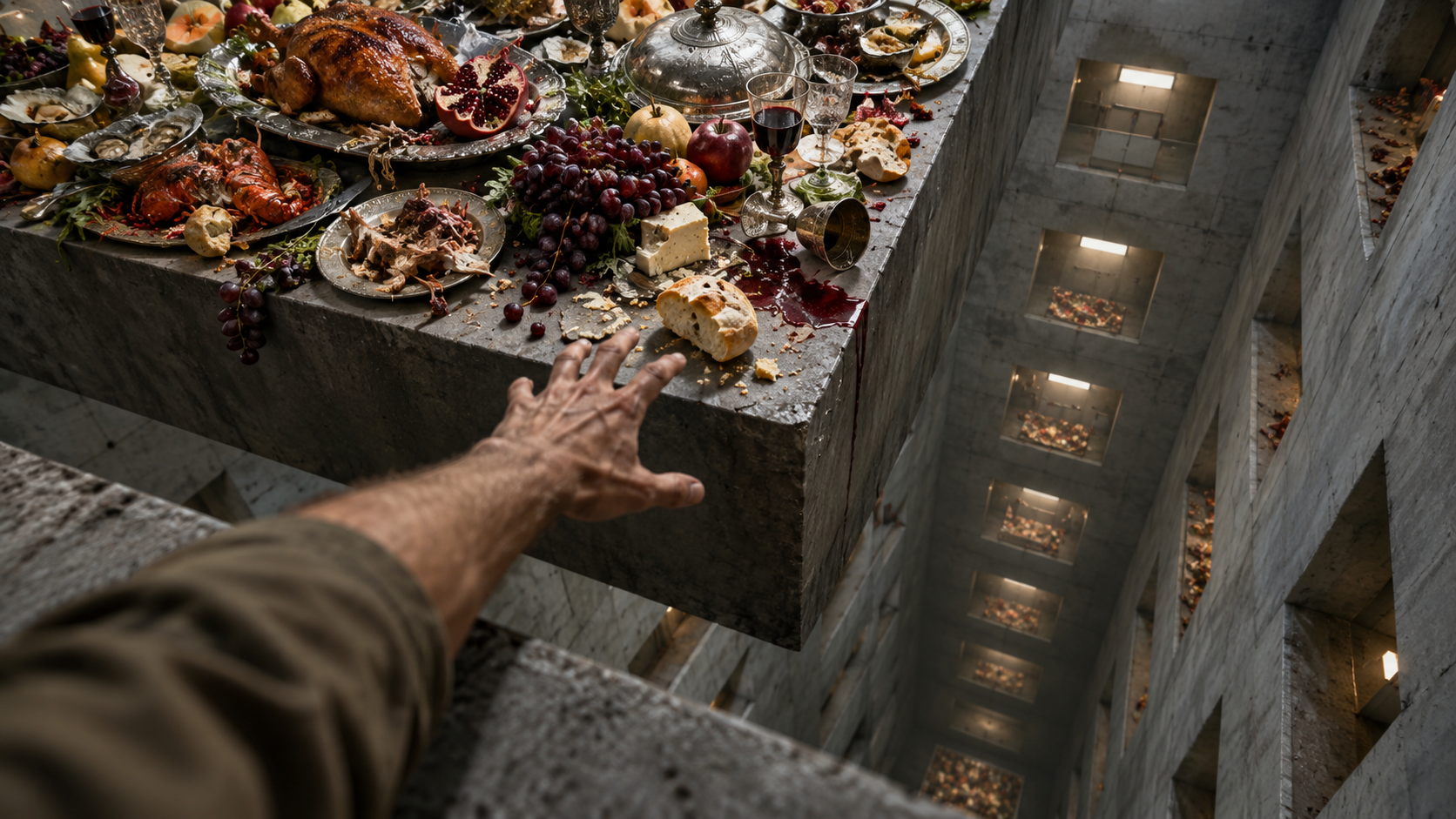
A banquet descends through a concrete prison. Those near the top can choose what they eat. Those further down receive whatever survives other people’s appetites. Tomorrow brings another meal, but no guarantee that anything edible will reach them.
The Platform, the 2019 Spanish film directed by Galder Gaztelu-Urrutia, turns this arrangement into a brutal survival story. Its original title, El hoyo, means “the hole”, and its inhabitants have little reliable knowledge of the institution surrounding them. They know their floor, their cellmate and the daily arrival of food. Understanding the rules offers no protection against what those rules permit.
For Goreng, a man who enters voluntarily, the immediate challenge is keeping himself alive. The harder challenge is deciding what survival allows him to become.
Goreng Discovers What Level 48 Means
Goreng wakes on Level 48 beside an older man named Trimagasi. Between their beds lies a rectangular opening through which they can see other cells above and below. The number on the wall determines their access to food.
Once a day, a platform carrying an elaborate meal descends from the kitchen at Level 0. It pauses at each occupied level, giving the residents a brief opportunity to eat before continuing downwards. Nothing is replenished between floors.
By the time it reaches Goreng, dozens of people have already handled the banquet. Trimagasi eats immediately. Goreng hesitates, repelled by the leftovers and his companion’s behaviour.
His first practical mistake is saving an apple.
After the platform leaves, the room becomes dangerously hot. Trimagasi explains that food cannot be kept for later. Goreng throws the apple into the shaft, and the punishment stops.
This establishes something more disturbing than a shortage. The institution possesses the means to detect and punish a small breach of its rules, yet it permits people further down to receive nothing. Its apparent absence from daily life is selective.
Goreng has volunteered for six months in exchange for an accredited diploma. He has brought a copy of Don Quixote, imagining that confinement might offer time to read. Trimagasi has brought a knife.
Their chosen possessions reveal the distance between preparation and experience. Goreng arrives expecting to occupy his mind. Trimagasi knows that his most urgent problem may involve another person’s body.
Trimagasi also explains the monthly reshuffle. Residents are rendered unconscious and reassigned to different levels. Someone who eats comfortably this month may starve during the next.
That uncertainty should give everyone a reason to preserve a system of sharing. Instead, it encourages immediate consumption. Nobody can store food, nobody can guarantee tomorrow’s circumstances, and nobody trusts the people above to exercise restraint.
Goreng gradually joins the scramble at the platform. Hunger makes his initial disgust expensive to maintain. His first adjustment is small enough to seem reasonable: eat what is available.
The film will keep moving the boundary of what “available” means.
Trimagasi Turns Survival Into an Excuse
Trimagasi presents himself as a realist. He understands the prison, accepts its arrangements and regards Goreng’s objections as evidence of inexperience.
His confidence is persuasive because some of his observations are correct. Appeals rarely travel upwards. People with first access to food have little immediate incentive to listen to those receiving their scraps.
But Trimagasi moves too easily from describing cruelty to excusing it.
He entered the institution after throwing a television from a window and killing someone below. His account shifts attention towards the circumstances of the incident and away from his responsibility. Inside the prison, he applies the same habit to whatever he considers necessary for survival.
Goreng also encounters Miharu, a woman who rides the descending platform. Trimagasi says she is searching for her child. She moves through the building rather than remaining safely within the limited territory of one cell.
Information about her arrives through other people. Goreng sees her vulnerability and capacity for violence, but he cannot verify the story explaining her journey. The prison makes rumour almost unavoidable: residents can observe fragments of one another’s lives without seeing the whole.
The following month, Goreng and Trimagasi wake on Level 171.
Goreng is tied to his bed. Trimagasi has restrained him before he can resist and intends to survive by cutting flesh from his body. Their previous companionship offers no protection once the older man anticipates starvation.
Trimagasi blames those above them. They have consumed the food, so he treats his own violence as the final link in a chain somebody else created.
The accusation contains a real grievance and a deliberate evasion. The distribution system has placed both men in danger. Trimagasi nevertheless chooses who will suffer first, and he secures that advantage through force.
When he begins cutting Goreng, Miharu arrives and intervenes. She attacks Trimagasi and releases Goreng, who kills him. Goreng subsequently eats his former cellmate’s flesh to survive.
His escape from becoming food requires him to cross the boundary he once regarded with horror.
Trimagasi then returns in hallucinations. These appearances do not restore him to life. They give Goreng’s experience an accusing voice, making it impossible to leave his dead companion neatly in the past.
The knife has defeated the book’s promise of peaceful self-improvement. Yet Goreng’s continuing distress also prevents Trimagasi from winning the argument completely. Survival has changed Goreng’s behaviour without making him comfortable with what he has done.
Imoguiri Believes the Prison Can Teach Cooperation
On Level 33, Goreng meets Imoguiri, the Administration employee who interviewed him before his admission. She has entered voluntarily after receiving a terminal cancer diagnosis and has brought her dog.
Her presence offers something Goreng has lacked: a person who appears to know the institution from the other side.
Imoguiri believes there is enough food for everyone if residents take only what they need. She describes the intended outcome as spontaneous solidarity. The people inside are supposed to recognise their shared predicament and organise themselves.
She attempts this directly, asking the residents below to ration their portions and pass the request onwards. Her approach depends on persuasion spreading through the building.
They ignore her.
Goreng achieves compliance by threatening to foul their food. His method works because he occupies a position from which he can carry out the threat. The same tactic cannot reach the people above him.
The building therefore distributes more than meals. It distributes the ability to make other people listen.
Imoguiri’s failure is often treated as proof that kindness is useless. That conclusion lets the institution escape too easily. She is trying to create cooperation among people who cannot organise freely, cannot verify most promises and cannot enforce reciprocal obligations.
A person who eats less today receives no assurance that someone else will do the same tomorrow. Even a successful agreement between neighbouring cells may disappear at the next reshuffle.
Her proposal lacks a dependable structure capable of protecting those who comply.
There is also a contradiction in the Administration’s supposed educational purpose. It expects humane behaviour while maintaining conditions that punish trust. Calling the outcome “self-management” places responsibility on residents without giving them control over the machinery governing their lives.
This resembles the institutional coercion examined in The Running Man: an organisation can describe a situation as a personal choice while controlling the alternatives that make the choice meaningful.
Miharu’s return further destabilises Imoguiri’s certainty. After receiving help, Miharu kills her dog. Imoguiri also rejects the account of a missing child, insisting that children are not admitted and that Miharu entered alone.
Her knowledge sounds authoritative because she worked for the Administration. Goreng has good reason to listen, but employment inside an institution does not necessarily provide access to everything it does.
The next reassignment exposes the limits of her understanding. Imoguiri has said that the prison contains 200 levels.
They wake on Level 202.
The Levels Change, but the Hierarchy Survives
Goreng discovers that Imoguiri has died by suicide. He survives the month by consuming her body, while hallucinations of his former companions continue.
The discovery of Level 202 destroys more than an estimate. It shows that a person involved in admitting residents could misunderstand the scale of the system she served.
The film does not provide a final explanation for every false assurance. Imoguiri may have received incomplete information, accepted institutional claims without sufficient scrutiny, or known only the part of the operation relevant to her role. Her sincerity cannot make those claims reliable.
For Goreng, the consequences are physical. Other people’s mistaken descriptions of the prison cannot supply the food missing from his level.
The monthly movements also clarify what the numbers mean. A low number brings access, while a high number brings deprivation. Those positions are temporary, but the order of distribution remains fixed.
Changing the occupants does not change the hierarchy.
This is why the reshuffle is such an effective part of the film’s construction. It removes the comforting possibility that the well-fed simply possess qualities absent from the starving. Goreng remains the same person as his circumstances shift from tolerable to catastrophic.
His moral decisions matter, but they do not determine where breakfast stops.
At the same time, the film refuses to divide its population into permanently virtuous victims and permanently vicious beneficiaries. Someone who has suffered below may overeat when moved upwards. Having experienced deprivation does not automatically produce restraint.
There are several possible reasons within the prison’s logic. A resident might fear returning to hunger, seek compensation for past suffering, or decide that generosity would merely benefit the next selfish person.
These explanations help us understand the behaviour without making it harmless.
The design also directs anger towards nearby people. Residents can shout at the floor above or threaten the floor below. The people who established the arrangement remain distant and largely inaccessible.
That makes conflict between prisoners easier than collective action against the prison. The hungry can identify the hands taking food before it reaches them. They cannot reach the hands controlling the platform.
Goreng’s next assignment finally gives him an opportunity to act from a position of advantage. He wakes on Level 6, close enough to the top to eat well.
He chooses to leave it.
Baharat and Goreng Try to Change the Distribution
Goreng’s new companion, Baharat, has brought a rope. His plan is to climb upwards with help from the people above.
They humiliate him instead.
The incident demonstrates how little physical distance guarantees. Baharat is close to the upper levels, but reaching them still depends on cooperation from people who can refuse without consequence.
Goreng proposes travelling in the opposite direction. They will ride the platform down and distribute the food themselves.
It is a major change in his behaviour. Previously, he has survived the level assigned to him. Now he gives up favourable conditions to intervene in what happens elsewhere.
Baharat supplies the partnership that earlier attempts lacked. Imoguiri had a proposal but little means of enforcing it. Goreng now has an ally willing to face the risks alongside him.
They arm themselves and begin the descent, initially withholding food from the upper fifty levels on the grounds that those residents already receive regular meals. Further down, they intend to provide controlled portions.
Their intervention attacks the immediate mechanism of deprivation. Instead of allowing each floor to seize whatever it can, they attempt to reserve food for people who would otherwise receive nothing.
But their authority has an uncomfortable foundation. They decide the allocation and use violence against resistance.
The film gives them a serious problem rather than an easy moral victory. Allowing unrestricted consumption would defeat their purpose almost immediately. Enforcing restraint makes them responsible for new injuries and deaths.
Their actions may protect some prisoners while harming others. A claim to be acting for everyone cannot remove the need to examine those consequences.
There is a further practical weakness: even a successful journey would last only one day. Goreng and Baharat have no durable organisation, no agreed succession and no control over the next reassignment.
They can demonstrate another way of distributing a meal. Maintaining that arrangement requires more than two exhausted men.
During the descent, an older prisoner advises them to preserve a panna cotta and return it untouched. The dessert would become a message to those preparing the food above.
Their mission acquires a second objective. They must feed people while protecting something that, under ordinary conditions, should have been consumed long before reaching the bottom.
The difficulty now concerns communication as well as distribution: what could travel upwards that the people at the top might understand?
Why the Food and the Panna Cotta Matter
The food begins as evidence of abundance. Its preparation receives care, skill and attention. By the time it reaches the lower levels, that labour has become a distant fact with little practical benefit.
The contrast makes the kitchen’s priorities unsettling. A beautifully finished dish can coexist with a distribution process that leaves people starving.
Quality at the point of production does not establish fairness at the point of consumption.
Imoguiri’s claim that there is enough for everyone should nevertheless remain a claim. The film does not supply a nutritional audit, and her mistaken understanding of the building’s size weakens her authority on the total requirement.
What the story clearly establishes is extreme inequality of access and extensive waste. It gives Goreng reason to attempt rationing without proving every part of the Administration’s explanation.
The panna cotta offers a way to reverse the normal direction of evidence. Usually, food moves down and the suffering below remains out of sight. An intact dessert returning upwards would be an anomaly.
Goreng and Baharat hope that anomaly will demand an explanation.
Yet symbols are vulnerable to misunderstanding. A returned dish cannot explain who protected it, how many people suffered during its journey or what change its protectors want. Its recipients could interpret it through their own professional concerns.
The kitchen’s fixation on a hair in a dessert illustrates that narrowness of attention. A flaw in presentation can become urgent while the fate of the diners remains remote.
It is tempting to treat this scene as definitive proof that Goreng’s intended message has already returned and failed. The released film does not establish that conclusion clearly enough. Its stronger function is to show the limited terms through which the kitchen may understand a problem.
There is also a growing moral cost to preserving the panna cotta. As Goreng and Baharat encounter hungry people, they are withholding edible food for a hoped-for future effect.
That trade-off cannot remain abstract indefinitely.
The descent becomes increasingly violent. They attempt to save Miharu from an attack, but she dies, and both men are seriously wounded. Continuing now requires them to carry injuries as well as their remaining supplies.
Their understanding of the prison’s depth also proves inadequate. The building extends beyond the limits around which Goreng formed his plan.
When they reach Level 333, the dessert faces a final test that changes its meaning entirely.
What Happens at the End of The Platform?
Goreng and Baharat discover a young girl on Level 333 and give her the panna cotta. Baharat dies from his wounds. Goreng later descends with the child into the space beneath the cells, leaves the platform after another encounter with the imagined Trimagasi, and allows her to ascend alone.
The film ends without showing her arrival in the kitchen or the Administration’s response.
The discovery challenges what Goreng has been told. Imoguiri insisted that children were not admitted. Here, at the lowest numbered level shown, is someone whose presence contradicts that assurance.
Goreng understands her as the child Miharu has been seeking. That is the connection the story invites, although the original film offers no independent account of her parentage, arrival or survival.
Those omissions leave genuine practical questions. How has she remained alive so far below the food supply? Why is she there? What do the authorities know about her?
The film provides no complete logistical answer. Viewers can reasonably find that frustrating, particularly after the earlier sections establish such concrete rules.
The decision to feed her is much clearer.
Preserving the dessert would require Goreng and Baharat to deny food to a hungry child in front of them. Their symbolic protest would begin reproducing the institution’s central cruelty: protecting an arrangement while a person suffers beneath it.
They abandon the object and meet the need.
The girl then becomes the message. A dessert could demonstrate unusual restraint. A child emerging from the bottom would confront those above with a person their institution supposedly excludes.
This does not mean she possesses a guaranteed power to transform them. The hope depends on whether anyone notices, understands and acts.
After Baharat’s death, Goreng’s final exchange with Trimagasi moves the story further into uncertain territory. Trimagasi is already established as a hallucinated companion. His presence cannot serve as reliable information about the physical world.
Goreng nevertheless accepts the idea that the message can travel without its bearer. He steps away and remains below as the girl rises.
He receives no public recognition, no confirmed escape and no opportunity to explain himself. His last action transfers the possibility of a future to someone else.
Is the Ending Real, and What Does It Mean?
The most straightforward reading follows the visible action: Goreng finds a child, feeds her and sends her upwards, while remaining at the bottom himself.
However, the film also gives substantial reason to question the literal status of its final moments. Goreng is badly injured, has endured prolonged starvation and repeatedly experiences conversations with dead people.
Gaztelu-Urrutia has described his own interpretation as one in which Goreng is already dead before the final lowest space, with that passage expressing what he believes he must accomplish. The director also said that an ending showing the girl arriving above was filmed and removed.
His explanation supports a symbolic reading, but he deliberately left the finished ending open. It would be misleading to convert his personal interpretation into an on-screen confirmation that every part of the rescue is imaginary.
The distinction changes what can honestly be claimed. Goreng’s survival is doubtful. The child’s successful reception is unseen. The abolition or reform of the prison is not established.
The number 333 adds another possible layer. At two occupants per level, the building would have a nominal capacity of 666, a familiar association with evil. That arithmetic makes a hellish reading plausible, though it is neither a confirmed census nor proof that the entire setting is literally the afterlife.
Goreng’s descent also reverses the usual direction of escape. He approaches the institution’s deepest suffering instead of continuing towards personal comfort above. His physical deterioration makes that journey resemble a sacrifice.
His copy of Don Quixote complicates the heroic image. He enters with ideals that seem poorly suited to the environment. By the end, his willingness to attempt something apparently impossible is both necessary to his resistance and inseparable from its dangerous overconfidence.
He misjudges the scale of the building. He participates in violence. He cannot establish the lasting cooperation he seeks.
Yet reducing him to a foolish idealist would miss his final adjustment. When the child needs food, he changes the plan. The symbol serves the person, rather than requiring the person to serve the symbol.
Politically, the film’s criticism reaches beyond a simple instruction to be generous. Its vertical arrangement makes unequal distribution immediately visible, but its attempted remedies also encounter problems of trust, force and institutional responsibility.
The Administration cannot reasonably escape blame by pointing to selfish residents. It controls the conditions under which their decisions occur. Equally, recognising those conditions does not erase Trimagasi’s responsibility for attacking Goreng.
The useful comparison with the machinery behind The Hunger Games concerns organised cruelty: suffering persists through rules, routines and people performing limited roles, as well as through openly sadistic individuals.
The Platform ends before showing whether its appeal reaches anyone capable of changing those routines. Its final achievement is narrower and more human. Goreng recognises that the hungry person before him matters more than preserving his original plan. The girl’s ascent carries that recognition towards a world the film keeps beyond our view. Whether the people above respond remains unanswered; what Goreng finally chooses to send them is no longer something they can mistake for a meal.
Sources
Netflix — The Platform: Official listing confirming the film’s year, Spanish-language identity, premise and principal cast.
The Movie Spoiler — The Platform: Detailed plot account used to cross-check the prison rules, changing cellmates and major narrative events.
/Film — The Platform Review: Cube Meets Don Quixote in This Dystopian Horror Film: Contemporary festival review corroborating Goreng’s entry, the food arrangement and the literary reference.
/Film — The Platform Ending Explained: Corroboration of the descent, the symbolic dessert and the final levels.
NME — Netflix’s The Platform Director Explains Ambiguous Ending: Report of Gaztelu-Urrutia’s comments about Goreng’s fate, the omitted ending and the film’s political ambiguity.
Wikipedia — The Platform: Supplementary cross-check of character names, floor numbers and the sequence of the final scenes.
