What Is Really Happening Aboard The Aeolus?
Why Does Jess Recognise A Ship She Has Never Boarded?
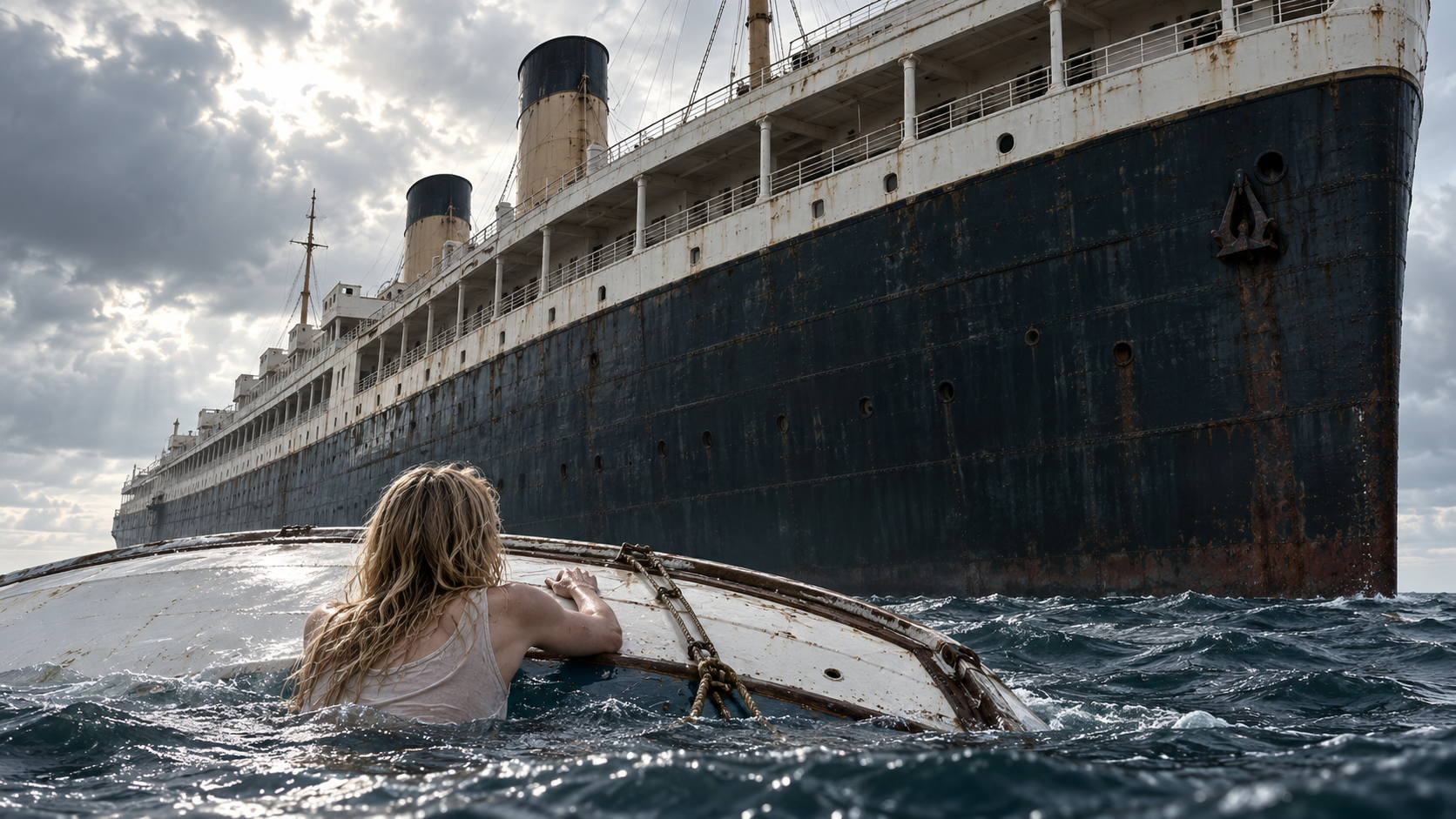
The ocean liner should be a rescue. After a storm overturns their yacht, a group of survivors find themselves facing something large enough to offer shelter, communications and a route home. They climb aboard expecting people. Instead, they enter a vessel whose empty spaces seem to be waiting for them.
For Jess, the unease is more personal. Something about this place is familiar, although she cannot explain why. While the others search for practical answers, she experiences the disturbing possibility that arriving somewhere and returning there might feel exactly the same.
Written and directed by Christopher Smith, Triangle is a 2009 British-Australian psychological horror film starring Melissa George. Its initial situation is straightforward: a boating trip goes wrong, and apparent safety becomes another danger. What follows gradually changes the meaning of almost everything established at the beginning.
The film rewards attention, but its power does not depend entirely on solving a puzzle. Its deeper concern is what happens when someone believes that understanding a disaster will give them the power to prevent it.
That belief sounds reasonable. We investigate mistakes so that we can avoid repeating them. We revisit difficult conversations, imagine different decisions and search for the moment when events might have gone another way.
Triangle takes that ordinary mental habit and gives it physical space. Regret has corridors. Suspicion can stand on another deck. An unanswered question can return carrying a weapon.
Before any explanation becomes available, however, there is a woman who seems exhausted, a trip she cannot comfortably enjoy and the unsettling impression that something has already happened.
A Passenger Who Cannot Settle
Jess joins Greg and the others for a sailing trip, but she seems disconnected from the social occasion. Her young son, Tommy, is absent. Her distracted manner makes her stand apart from companions who are more readily engaged with the day ahead. George plays this uncertainty without immediately clarifying whether Jess is frightened, preoccupied or simply overwhelmed.
That ambiguity matters because the audience instinctively starts completing the picture. A tired parent on a rare outing suggests a familiar story. We assume there is a difficult morning behind her and that a few hours away might help.
Smith allows that assumption to form without making it a reliable explanation.
The group includes Greg, Victor, Sally, Downey and Heather, played by Michael Dorman, Liam Hemsworth, Rachael Carpani, Henry Nixon and Emma Lung. Their presence gives the opening an ordinary social texture: friendships, tentative interest and the awkwardness of someone who does not quite fit the prevailing mood.
Jess becomes our point of orientation precisely because she appears least comfortable. We look at the others through her uncertainty and begin treating her discomfort as an early warning.
This is an effective way of organising sympathy. A protagonist does not need to understand a situation to become our guide through it. Sometimes confusion makes a character more persuasive, because it resembles our own experience of watching.
Yet the arrangement creates a vulnerability. We can observe what Jess encounters without knowing everything that has brought her there. Access to someone’s immediate experience is not the same as access to their history.
George keeps that distinction alive. Jess is emotionally readable from moment to moment, while remaining difficult to place within a larger account of events.
The Rescue That Removes Every Exit
The storm abruptly replaces social discomfort with physical danger. The yacht capsizes, Heather is lost from the surviving group, and the remaining passengers are left exposed at sea. When the liner appears, boarding it is an understandable decision. Their alternative offers little protection.
This gives the film a strong foundation. The characters do not need to behave foolishly to enter the threatening location. The circumstances make it attractive.
An ocean liner also carries particular expectations. Its size implies organisation: a crew, routines, machinery and somebody responsible for navigation. Even before finding another person, a passenger would reasonably assume that human systems are operating somewhere inside.
The absence of those people therefore feels more disturbing than an empty building on land. The ship seems to be performing its function without anyone visibly performing the work.
Its spaciousness offers little comfort. A corridor may lead to another corridor; an open deck may provide a view without providing an escape. The sea makes the boundaries obvious, but the interior prevents the survivors from understanding what those boundaries contain.
The ship is called the Aeolus. Its name introduces Greek mythology into a story that initially appears to be about a maritime emergency, although the significance of that reference takes time to emerge.
Smith has acknowledged The Shining as an influence, including the use of room number 237. More substantially, he was interested in the uncertainty between a threatening physical location and a place that might also express a character’s mental experience.
The Aeolus works because those possibilities remain compatible. It can be explored as a ship while also feeling like a space assembled around something Jess cannot yet confront.
When Recognition Becomes A Threat
Déjà vu is usually brief. A room seems familiar, a sentence feels previously heard, and the sensation passes without demanding much action.
In Triangle, familiarity becomes increasingly difficult to dismiss. Jess’s discomfort begins to look less like nervousness and more like partial knowledge. The problem is that partial knowledge can make someone act decisively before they understand what they know.
That distinction gives the film much of its tension. Recognition ought to help. If Jess can identify a location or anticipate a danger, she should gain an advantage. But every apparent advantage also raises another question about her relationship to the ship.
The audience experiences a similar disturbance. We begin storing details because we suspect they will matter later. Objects, movements and encounters become possible clues.
Then the film changes the task. Remembering a detail is no longer enough; we have to reconsider what kind of evidence it provides.
A familiar object might establish continuity. It might also establish duplication. Seeing someone in a particular place might explain where they went, or reveal that our understanding of who we saw was incomplete.
This is where Triangle becomes more demanding than a conventional mystery. In many thrillers, the world remains stable while information about it changes. Here, the audience must keep reconsidering the relationship between information, identity and sequence.
The result is not merely confusion. It is a carefully sustained uncertainty about how to interpret something apparently concrete.
A person can be standing directly in front of Jess and still be difficult to locate within the story. The question is no longer only where someone is. It is how much they have already experienced.
The Moment The Story Folds Back
The masked attacker initially gives the survivors a recognisable problem. There is someone aboard who intends to harm them, and survival appears to depend on avoiding or overcoming that person.
Then Jess sees the overturned yacht approaching again, carrying the same group of people who have already boarded.
This is the film’s decisive structural change. The earlier arrival has become an event that can be watched from another position. Jess is no longer simply moving through an unfamiliar ship; she is observing a sequence in which she has already participated.
The easiest way to understand this stage is to separate the experience of an individual from the activity occurring around them. Jess continues accumulating memories, while another version of the arriving group enters the same environment.
Consequently, several stages of a person’s experience can occupy the ship at once.
This differs from a simple reset in which everyone returns to the beginning and the previous attempt disappears. On the Aeolus, the relationship between successive arrivals and what remains aboard is much less forgiving.
It also makes communication unusually difficult. A warning that seems urgent and reasonable to someone with additional knowledge may sound threatening or absurd to someone encountering the situation for the first time.
Jess cannot transfer her experience merely by describing it. The people she wants to influence do not share the observations that make her conclusions plausible.
That is an important source of suspense. The obstacle is not just whether she can reach somebody before an attack. It is whether she can persuade them to act on information they have no reason to trust.
The film makes credibility into a survival problem.
The Evidence That Refuses To Disappear
Repeated objects and accumulated remains give the impossible situation a physical weight. The ship does not merely produce a feeling that something has happened before. It contains evidence of recurrence.
Among the most disturbing discoveries is a collection of Sally’s bodies. An individual death, which should be singular and irreversible, has become part of a visible accumulation.
The image works because it communicates duration without providing a reassuring measurement. There have been more attempts than the audience has followed. The portion of events we understand belongs to something larger.
It also changes the emotional meaning of repetition. In a more playful time-loop story, another attempt can feel like a fresh opportunity. A failed day disappears, leaving the protagonist with useful knowledge.
Here, consequences have a material presence. The environment seems to retain what the characters cannot collectively remember.
That creates an imbalance between personal experience and the evidence surrounding it. Jess may feel close to a discovery, while the ship suggests that discovery itself could be familiar territory.
The accumulated objects pose a related problem for any claim that the liner simply resets to an untouched starting state. Clearly, some things persist. Yet the film does not provide a comprehensive rule explaining every detail of that persistence.
It is reasonable to map the recurring encounters, but less reasonable to pretend that the film supplies a complete scientific model. Its most important distinction is between what Jess observes and what she concludes from those observations.
A repeated sequence can establish a pattern without explaining its cause.
That limitation matters because she is under immense pressure to turn a pattern into an escape plan. She needs an answer urgently enough that a plausible theory can begin to feel like certainty.
Why More Knowledge Does Not Guarantee Control
The usual promise of a puzzle is that understanding produces mastery. Once the mechanism becomes clear, the solver can operate it correctly.
Triangle steadily weakens that promise.
Jess gains information, but information changes her behaviour. Her interventions become additional events for other people to encounter, misinterpret and react to. She is trying to understand a system while actively participating in its operation.
This is why simply listing the scenes in chronological order cannot entirely explain the film’s tension. The important question is often what a particular version of a character believes at a particular moment.
Someone acting defensively can appear aggressive to someone who lacks the same knowledge. A person trying to prevent an event may create the circumstances in which it occurs.
The moral complication is equally significant. Once other people begin to seem like recurring elements in a sequence, it becomes easier to think about them as parts of a problem.
They still experience fear and pain individually. Repetition does not make their suffering less real within the story. But a person focused on escaping the overall pattern may start treating an immediate harm as a temporary cost.
That reasoning is particularly dangerous when the supposed future benefit cannot be verified.
The film invites us to understand Jess’s urgency without making her conclusions authoritative. We can recognise why an option appears necessary to her while still questioning the evidence behind it.
This is a stronger dramatic position than either uncomplicated sympathy or straightforward condemnation. It keeps intention, action and consequence separate.
A character can sincerely want to put things right and still become less capable of recognising what putting things right would require.
Melissa George Keeps The Puzzle Human
A film built around repetition risks turning its central performance into a demonstration. The actor has to distinguish stages of the story, communicate information and maintain continuity, potentially at the expense of a convincing person.
George gives Jess an emotional consistency that survives those demands.
Her performance makes uncertainty active. Jess is not simply waiting for explanations; she is watching, assessing and deciding, often with too little time. Her reactions suggest someone trying to close the distance between what she feels and what she can establish.
That makes her persuasive even when her behaviour becomes difficult to accept.
Smith has said that George’s work in In Treatment helped convince him she was right for the role. In another interview, he described wanting the audience’s feelings towards Jess to change as the story revealed more about her.
The performance supports that changing response without demanding that every revelation replace the previous one. Vulnerability does not vanish when a character becomes troubling. Nor does vulnerability automatically excuse what follows.
The supporting characters have less room to develop. Their restricted perspective is useful to the structure, but it also means that some remain more memorable for what happens to them than for their independent personalities.
That is a genuine limitation. Viewers who want a fully developed ensemble may find the film’s concentration on Jess narrowing.
Yet the narrowness also creates discomfort. We are encouraged to see the others through the central character’s urgent concerns, then made to confront the consequences of that arrangement.
They matter beyond their usefulness to her, even when the story gives us fewer opportunities to know them.
A Mystery With More Than One Kind Of Answer
There are two separate explanatory tasks in Triangle. One is to understand how encounters connect. The other is to decide what kind of reality could contain those encounters.
The first can be clarified considerably. Different versions of characters possess different knowledge; actions seen from one position acquire another meaning when viewed from elsewhere.
The second remains open.
Smith explicitly discussed several possible readings, including supernatural events, psychological breakdown and an interpretation involving concussion after an accident. He wanted uncertainty to survive rather than collapse into a single explanatory statement.
That does not mean every theory deserves equal weight. An interpretation becomes stronger when it accounts for details the film repeatedly emphasises. It becomes weaker when it needs an elaborate unseen history merely to repair its own assumptions.
The same caution applies to psychological readings. Saying that a film represents guilt, fractured perception or emotional distress is different from diagnosing its protagonist. The imagery can express those experiences without serving as a clinical description.
Smith’s interest in La Jetée and The Shining helps explain the combination of circular storytelling and unstable reality. Both were among the influences he identified when discussing the film’s origins.
Still, an influence does not provide an answer key.
The most productive approach is to ask what remains meaningful across the plausible readings. Jess struggles with knowledge, responsibility and the belief that another intervention might change everything.
Those concerns continue to matter whether the ship is understood as a supernatural location, a psychological construction or a meeting point between the two.
The uncertainty becomes frustrating only if the film’s emotional stakes disappear into it. The final movement prevents that by returning the story to something far more specific than the mechanics of the ship.
The Ending Reveals What Jess Is Trying To Undo
The masked attacker is Jess herself at another stage of the recurring sequence. The woman trying to survive and the person she fears occupy the same identity, separated by experience and desperation. Believing that killing the others will allow the cycle to restart and provide a route home, Jess takes on the role she previously fought against.
This is more disturbing than discovering an unexpected culprit. The revelation requires us to connect actions we have already judged with intentions we have been encouraged to understand.
After being knocked overboard, Jess reaches shore and returns home. There, she sees another version of herself mistreating Tommy. She kills that version, places the body in the car boot and leaves with her son. Her attempt to become a better mother begins by violently removing the person she believes she must stop being.
Then a seagull strikes the car. When Jess disposes of it, she discovers other dead birds in the same place. Leaving the liner has not freed her from recurrence. A subsequent collision kills Tommy, and the body she placed in the boot becomes part of the crash scene.
The domestic revelation should not be softened into an account of a parent merely having a difficult day. Tommy’s autism does not cause or excuse his mother’s cruelty. Her responsibility remains hers. At the same time, the film’s emotional force depends on recognising that her desire to protect him can coexist with conduct that harms him.
A taxi driver takes Jess back to the harbour. She promises to return, then rejoins the sailing trip. This completes the larger movement connecting the ship, the house, the road and the departure we initially understood as a beginning.
The mythological references make a punishment reading especially persuasive. Sisyphus is associated with defying death and endless, frustrated labour. Jess likewise appears to approach the possibility of recovery only to find herself returned to another attempt. The driver can be interpreted as a figure of Death or a ferryman-like guide, although the film never explicitly identifies him as either. A contemporary review reported Smith discussing the story’s connection to a bargain with death during a question-and-answer session.
On this reading, the loop is a form of torment sustained by Jess’s refusal to accept an irreversible loss. However, the stronger wording is that the film suggests this explanation. It does not conclusively establish when Jess originally died, identify a supernatural authority controlling events or show a guaranteed route out.
Nor does it establish the sometimes-repeated theory that she killed Tommy in an unseen earlier incident. What the film actually shows is abuse at home and his death in the collision. Additional origins remain speculation.
Her return to the yacht nevertheless makes emotional sense. If the journey once brought her back to a time when Tommy was alive, repeating it offers something ordinary reality cannot: another apparent chance.
The ending leaves hope entangled with denial. Jess may be undertaking the ordeal again because she cannot bear to abandon her son. She may also be preserving the very pattern that prevents her from confronting what happened.
Accepting responsibility would require more than recognising an earlier self as monstrous and trying to erase her. It would require understanding that the person making the correction is capable of continuing the harm.
That is why Triangle lasts beyond its puzzle. Its final terror lies in the gap between wanting another chance and becoming someone who could use it differently.
Jess boards because she believes she can still bring Tommy home. The film ends before that belief has to face the sea again.
