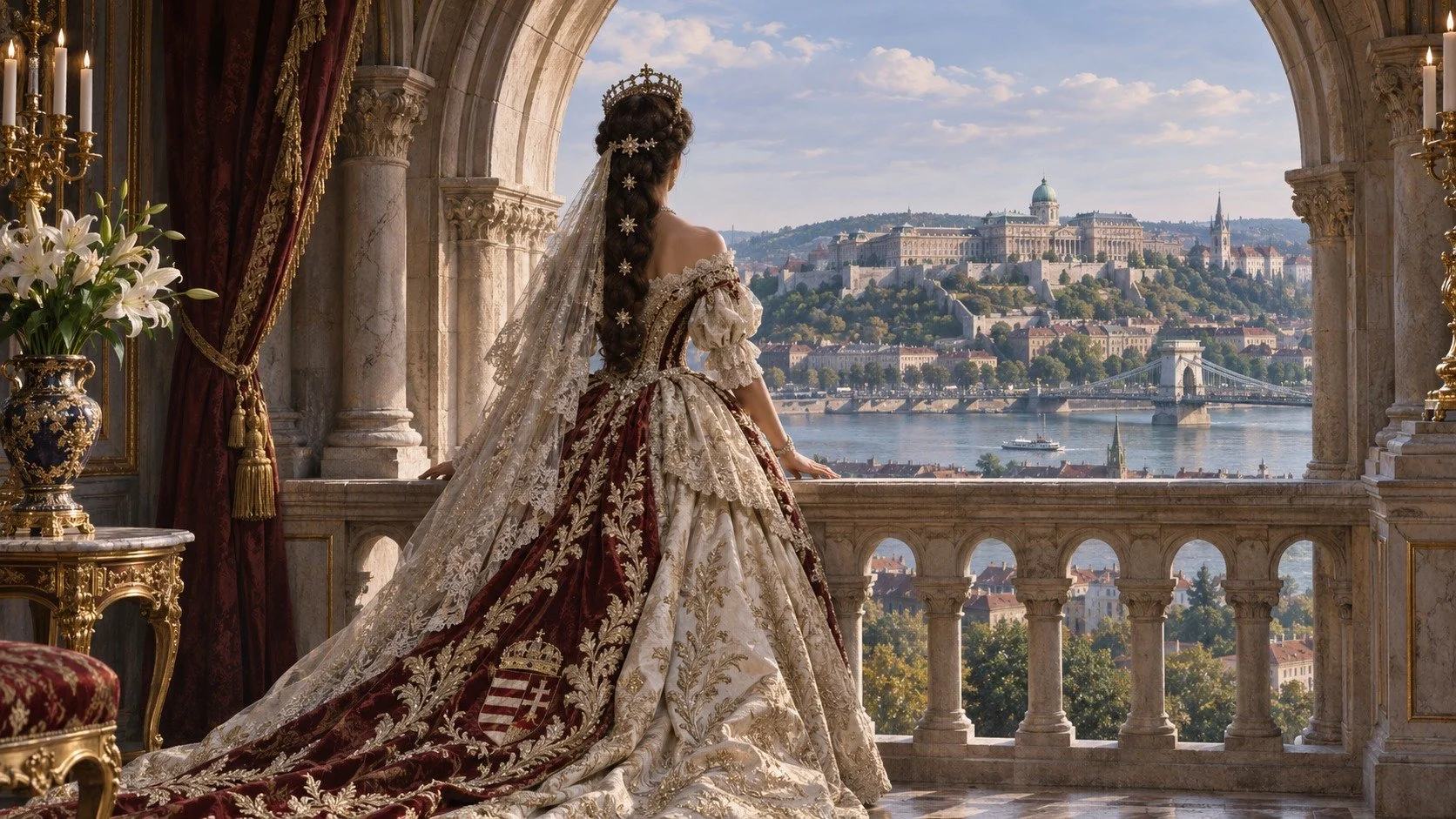
Why did Elisabeth learn Hungarian and return to Gödöllő? Explore the alliances, military defeat and constitutional bargain behind The Empress.
What Could Elisabeth Say In Hungarian That Vienna Needed To Hear?
In October 1868 Elisabeth wrote to her husband Franz Joseph from Gödöllő. The place stamped on the letter tells its own small part of the story. A year after the couple were crowned in Hungary, the empress was still spending time there. Her public duties might explain an appearance at a coronation. They are a less convincing explanation for why she kept going back.
Hungary occupies a prominent place in the third season of The Empress. The history behind that choice involves three relationships, each with a different set of stakes. Elisabeth wanted room to live on her own terms. Hungarian politicians wanted a constitutional relationship with the crown that recognised their country’s rights. Franz Joseph wanted to preserve a dynasty whose power recent wars had badly shaken. For a brief period, all three ambitions pointed in much the same direction.
Why Did Vienna Have A Hungarian Problem?
Hungary had its own political traditions and institutions. The upheavals of 1848 and the defeat of the Hungarian struggle in 1849 left a legacy of repression and mistrust. To imagine Elisabeth arriving among people who simply needed to get to know their emperor better is to miss what the dispute was about. The question was who could govern Hungary and on whose authority.
Franz Joseph carried the burden of those years personally. A concession from his government could be judged against the memory of what the dynasty had done when it possessed a freer hand. Elisabeth had entered the imperial family through marriage in 1854. She could listen to Hungarian concerns without being the sovereign who had taken the original decisions. That gave her unusual access to both sides of a deeply unequal relationship.
She learned Hungarian. In a multilingual empire, a choice of language could be a decision about whom one expected to do the work of understanding. For a Hungarian visitor to Vienna, encountering an empress willing to meet that visitor in Hungarian made a different sort of conversation possible. Ida Ferenczy, her Hungarian confidante, gave the language a lasting place in her daily life.
What Did Elisabeth See In Gyula Andrássy?
Count Gyula Andrássy understood Hungarian political ambitions and could talk directly to the empress. Their association has long tempted storytellers towards romance. Its demonstrable political importance lies in something less speculative. A Hungarian statesman could make his case to a woman with unusually intimate access to the emperor.
That access had limits. Elisabeth could convey urgency, recommend someone’s judgement and press her husband to listen. She could neither bind Hungarian representatives to a settlement nor determine what ministers in Vienna would accept. A drama can put two people in a room and allow their conversation to stand for a change in history. A constitutional agreement needs people outside the room to agree to govern under it.
Austria’s defeat by Prussia in 1866 altered the balance. The dynasty’s ability to dictate terms looked much less secure after a military reverse. Hungarian leaders had reasons of their own to negotiate, and Ferenc Deák’s work on a possible accommodation preceded the final settlement. Elisabeth’s intervention carried weight because there was already a political project for it to advance.
What Changed When Elisabeth Became Queen Of Hungary?
The Compromise of 1867 created the Dual Monarchy. Austria and Hungary shared a ruler and certain common affairs, including foreign policy and defence, while Hungary regained substantial authority over its internal government. Franz Joseph could now act in two distinct constitutional capacities. His coronation alongside Elisabeth in Buda gave that arrangement a public form people could see.
Andrássy became Hungarian prime minister. That outcome is a useful corrective to the habit of reading the story entirely through Elisabeth’s marriage. While one participant gained a crown, another gained an office with responsibilities that continued the following morning. The settlement redistributed governing power. It also left other peoples within the monarchy facing the question of whose national claims the new order recognised.
Elisabeth’s affection for Hungary was real enough to matter and selective enough to deserve scrutiny. The language, aristocratic friendships and country pursuits she valued connected her to particular Hungarian circles. They gave her insight into their aspirations. They offered a much narrower window onto the experiences of everyone who lived under the Hungarian crown.
Why Did Gödöllő Matter After The Coronation?
The Hungarian nation presented the royal couple with Gödöllő Palace through Andrássy. Elisabeth had already wanted the residence. Away from Vienna, she had more opportunity to ride, order her time and choose her company. A public gift met a private wish with unusual precision.
That convergence helps explain why Hungary mattered to her beyond the crisis of 1866. A monarch’s consort could spend a lifetime appearing in places selected for her and speaking at occasions organised around her husband. At Gödöllő, choosing to return was itself a way of speaking. The stamped letter survives as a modest trace of a larger freedom. On that October day, an empress who had helped bring Hungary closer to the dynasty could decide for herself how far away from Vienna she wanted to be.
