What Were the Actual Odds?
Five Years of Hunger Put Twenty Slips in the Bowl
At sixteen, Katniss Everdeen has five compulsory entries in the reaping. The other fifteen come from feeding three people. For each of the five years she has been eligible, she has taken a grain-and-oil allowance for herself, her sister Prim and their mother. Each allowance adds an entry that stays in the reckoning through her remaining years of eligibility. Five plus fifteen makes twenty. Then the hand goes into the bowl and draws Prim, whose name appears just once.
Suzanne Collins gives readers the arithmetic before she gives them the result. That order matters. If the novel opened with a girl volunteering for her sister, it would already be a story of sacrifice. By letting us work out who has been carrying the danger all along, Collins makes the volunteering scene the second time Katniss tries to stand between Prim and the Capitol.
How Do the Ordinary Entries Work?
Children enter the annual draw from twelve through eighteen. At twelve the ordinary entitlement to risk, if such a thing can be called an entitlement, is one slip. At thirteen it is two. By eighteen it is seven. Girls and boys are drawn separately. Siblings can therefore be exposed to different draws even when extra entries have paid for food eaten at the same table.
The baseline rule already distributes danger unevenly by age. A twelve-year-old and a sixteen-year-old standing in the same square have very different numbers of chances to be chosen. Yet the scene is staged as a single public ritual. Everyone must watch the same hand make the same apparently impartial gesture.
What Are Tesserae?
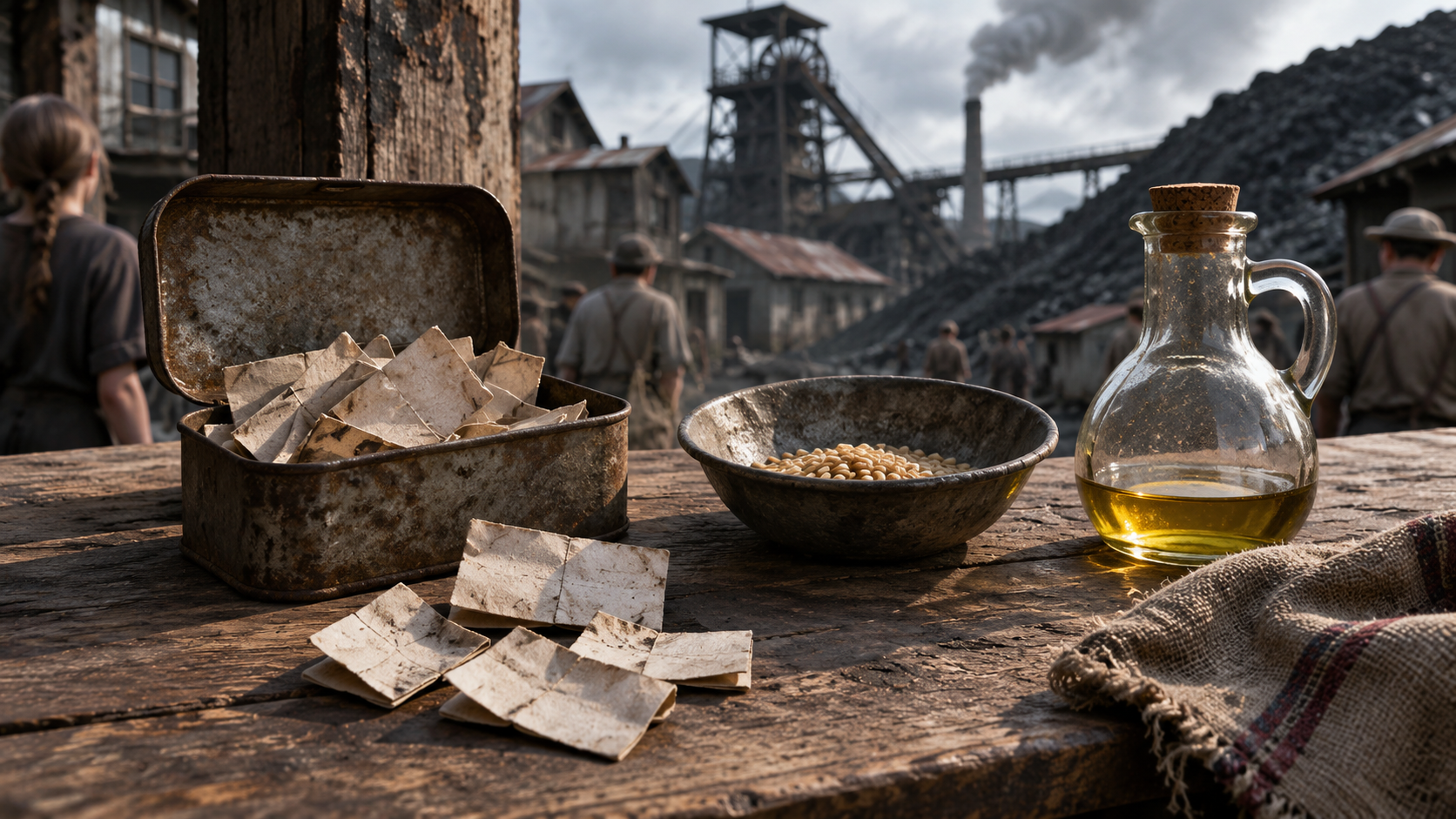
A tessera is a modest annual ration of grain and oil for one person. An eligible child can claim it for themselves and for family members by accepting extra entries in their own name. The allowance is measured per person. The additional risk belongs to the child who claims it. That difference is what makes the arrangement so potent in District 12.
For Katniss the relevant household has three members. In the first year she takes three allowances. Together with her one ordinary entry they put her name in four times. At thirteen she has two compulsory entries and six accumulated food entries, making eight. At fourteen the figures are three and nine, making twelve. At fifteen they are four and twelve, making sixteen. At sixteen they are five and fifteen, making twenty.
The number twenty describes the slips bearing her name in this year’s draw. Adding four, eight, twelve, sixteen and twenty would count her exposure across several different ceremonies. That total answers a different question. The novel is interested in what could happen when a hand reaches into the bowl today.
Why Is Prim’s Name There Only Once?
Prim is twelve and has reached her first reaping. Katniss has resisted letting her claim tesserae herself. The family has eaten food obtained by placing extra slips under Katniss’s name. It follows that Prim can benefit from a ration without having three or four entries of her own. Her compulsory first slip is enough to leave her exposed.
A reader who calls Prim’s selection impossible makes the same emotional leap Katniss has desperately wanted to make. Small risk feels like safety when everything you can do to reduce it has already been done. A lottery draws a particular slip. It does not inspect the family’s calculations and reward the sister who worked hardest to protect the other.
What Were the Actual Odds?
If there are N equally likely slips in the girls’ bowl and a single slip is drawn, Katniss’s chance is twenty divided by N. Prim’s is one divided by the same N. On those assumptions, Katniss is twenty times as likely to be called as Prim. The book gives enough evidence for that comparison. It does not supply the total needed for an exact percentage.
Gale, at eighteen, has forty-two slips. His number shows how large cumulative exposure can become in a household under pressure. It cannot simply be divided by Katniss’s twenty to get a precise comparison of their odds. The boys’ and girls’ bowls may contain different totals. What sounds like unusually precise world-building is also a lesson in recognising where precision ends.
What Do Grain and Oil Tell Us About District 12?
Collins could have invented a luxury that tempted ambitious children to risk a few extra slips. Instead she gives them the ingredients of bare subsistence. Grain provides the bulk of a meal. Oil makes a limited diet go further. Neither answers the desire for variety or comfort. The family has to do other work to turn those rations into the food on the table. The poverty of the bargain is part of its design.
Katniss hunts as well as claiming tesserae. That detail stops the reader making an easy assumption about effort. A family can have a resourceful provider who works extraordinarily hard and still need the ration. Nor can she simply become better at hunting and withdraw all the slips accumulated in earlier years. Once a family has eaten last winter’s grain, the Capitol keeps its claim on this summer’s draw.
The relationship between Katniss and Gale grows in the shadow of that knowledge. Time outside the fence gives them skills, companionship and food they have earned beyond official channels. As the reaping approaches, the state can call them back into an order neither chose. Their competence makes their vulnerability more visible. The most capable young hunter in the district still has to stand where she is told.
Why Tell the Story Through Katniss?
An official announcing total entries could make the system sound like an orderly census. Katniss remembers people, meals and who was old enough to take the risk. Her arithmetic has the rhythm of keeping a household alive. The scene teaches readers the rules because a girl has needed to understand those rules to feed her family.
It also makes the moment before Prim’s name is called almost unbearable on a reread. A first-time reader may expect the author to draw the twenty-slip girl conveniently into the arena. Someone returning to the novel knows exactly where the hand will land. The suspense changes from whose name will be called to how long Katniss gets to believe her plan has worked.
Why Does the Capitol Let Children Volunteer?
Katniss’s intervention reveals a crack in the meaning of public consent. The Capitol can present a volunteer as willing. Everyone who has watched Prim walk towards the stage knows what the choice actually costs. The same ambiguity runs through tesserae. A child formally elects to enter more times while hunger supplies the pressure. The state obtains a signature, a raised hand or a step forward and calls the outcome voluntary.
The Capitol also turns an economic relationship into a spectacle of chance. A wealthy household can keep to the compulsory entries. A poorer one may need more food every year. Once folded, the papers conceal those histories. On stage, Effie draws a name. At home, families have spent years deciding which names she will be most likely to find.
The cruelty of Prim’s selection is that the system works exactly as designed. Katniss can make her sister safer by taking the extra entries herself. She can never buy her sister complete safety. For that, when the moment comes, she has to walk forward.
