The Story, Clues and Ending
A New Home With Nowhere to Feel Safe
A family moves into a house expecting more space, greater stability and a chance to begin again. Soon, everyday disturbances make that promise difficult to believe. Things move, unfamiliar sounds interrupt the quiet, and the rooms seem less private than they should. In Philip Claydon’s 2016 American horror film Within, also known as Crawlspace, teenager Hannah Alexander must persuade the adults around her that their new home deserves closer attention.
Starring Erin Moriarty, Michael Vartan and Nadine Velazquez, the film builds its mystery around an uncomfortable practical problem: noticing danger does not necessarily give you the power to leave. Hannah can investigate what frightens her, but her father has already invested in the belief that this house will improve their lives.
Hannah Finds Reasons to Question the Move
John Alexander moves into the property with his daughter Hannah and his new wife, Melanie. The household is establishing a new arrangement as well as settling into a different address. John wants the purchase to work, while Hannah enters the move with less freedom to decide how she spends her time.
Her recent trouble over drinking gives John a reason to impose restrictions. Clearing belongings left by previous occupants becomes part of her responsibilities. What looks like an ordinary punishment also places her close to material that can explain the building’s past.
This is a useful starting point for the mystery because Hannah does not arrive as a determined investigator. She encounters questions while doing something mundane. The house begins to resist the family’s efforts to make it theirs before anybody possesses a convincing explanation.
Objects appear disturbed, and noises suggest activity beyond the movements of the people she knows are present. Hannah’s cat, Monty, reacts uneasily, including to a wall where family photographs have been hung. His attention directs suspicion towards a surface the adults have no immediate reason to examine.
The photographs are a particularly appropriate detail. Hanging family pictures is a way of claiming unfamiliar rooms and turning a property into a home. Here, the same activity draws attention to how little the newcomers understand about the structure supporting those reassuring images.
Individually, the early disturbances remain easy to dismiss. Moving house creates disorder, people misplace possessions, and unfamiliar buildings make unfamiliar sounds. The difficulty emerges through accumulation: each explanation can account for one incident without explaining why so many incidents keep occurring.
Hannah’s position becomes increasingly frustrating because she has to keep presenting that accumulating evidence to people who experience it less urgently. She cannot simply declare the house unsafe and arrange another place to live. Her father controls the decision that matters.
The Neighbour Makes an Uncomfortable First Impression
The family’s encounters with Ray, a neighbour who offers locksmith services, introduce a threat that seems easier to identify. His behaviour towards Hannah is intrusive, and his access to the house complicates the distinction between somebody helping the family and somebody taking advantage of them.
A locksmith occupies a position of unusual trust. The job involves the mechanisms intended to keep strangers outside, which makes inappropriate behaviour especially unsettling. Ray’s presence connects the family’s attempts to improve security with someone whose conduct gives them reasons to feel insecure.
When he handles Hannah’s camera and records her, the intrusion becomes personal. A device that belongs to her is being used to control how she is seen. Her discomfort is justified by his behaviour, independently of whatever else may be happening in the building.
This gives the film a plausible suspect without requiring Hannah to misunderstand an entirely innocent encounter. Ray is threatening. The uncertainty concerns the extent of his responsibility.
That distinction prevents the mystery from being reduced to a simple choice between believing Hannah and discovering that she has imagined everything. She has correctly recognised a violation of her boundaries, even before she understands the larger situation.
Ray also makes the problem appear potentially manageable. A recognisable person can be confronted, excluded or reported. Once suspicion has a face and an address, attention naturally moves towards that person rather than towards less obvious explanations.
The danger is that identifying one intrusive individual can create an expectation that every unexplained incident belongs to him. A partial explanation begins to look complete because it is concrete enough to act upon.
The House Has a History John Has Withheld
Hannah learns that a family died violently in the property. The accepted account describes a father killing his family before taking his own life. An address presented as an opportunity now carries a history that changes how its rooms are understood.
John already knew about the killings. His decision to withhold that information creates a separate conflict from the question of whether the house is dangerous now. Hannah and Melanie discover that they have been asked to share his confidence without receiving the facts on which he based it.
From John’s perspective, an old tragedy need not prevent a new family from living there. That position is understandable in isolation. A building does not become permanently uninhabitable because something terrible happened inside it.
His mistake is treating his conclusion as sufficient for everyone else. The people moving with him have their own interest in understanding the purchase, especially once disturbing events begin.
For Hannah, the history supplies a possible connection between the noises and the location. The film encourages the familiar haunted-house expectation: violent deaths may have left something behind. Yet learning about a murder establishes a past event, not the cause of a present disturbance.
The investigation therefore depends on testing the inherited account. Who was believed to have lived there? What happened to them? Does the material left behind fit the story being repeated?
An old family photograph becomes useful because it preserves more than the viewer initially notices. Hannah’s boyfriend, Tommy, spots a figure within the image that raises another question about the household. Looking again produces information that a quick glance missed.
The device works because photographs feel settled. They appear to offer a fixed record, but the meaning of that record depends on where attention falls. Something can remain visible for years without being properly recognised.
The tension between domestic certainty and overlooked evidence also drives The Others, where familiar rooms become harder to understand as competing accounts of their occupants emerge.
Evidence of Intrusion Changes the Stakes
Hannah’s experiences become more difficult to explain as ordinary unease. An alarming encounter in the attic intensifies her belief that somebody is present, but John’s subsequent search fails to produce the person she describes.
The failed search creates a familiar disagreement about evidence. Hannah knows what frightened her; John knows that he found nobody. Those observations are different, and the second does not automatically cancel the first.
For the household, however, an empty search offers an immediate way to stop worrying. Accepting Hannah’s account would require further action without a clear target. Dismissing it allows the family to resume normal life.
Melanie is more receptive to the possibility that something is wrong. Her relationship with Hannah gives the film an alternative to a uniformly hostile adult household. Being a stepmother does not automatically make her an obstacle, and Hannah’s need for support creates room for an alliance.
Recorded footage then brings the invasion of privacy into sharper focus. Images of the family asleep establish that someone has observed them during moments when they believed themselves unobserved.
The recording changes the meaning of the earlier disturbances. A displaced object might be forgotten or misremembered; footage of a sleeping person requires access and deliberate action. The household’s private space has been entered.
Ray remains an obvious suspect because of his earlier conduct with the camera. Yet knowing that he behaved improperly does not establish that he made every recording or caused every disturbance.
This is where the film begins separating suspicion from knowledge. The family can be correct to distrust someone while still being wrong about the full explanation. Their problem is becoming more specific, but it has not become simple.
For the audience, the camera also reverses its ordinary function. A family camera usually records occasions its owners choose to preserve. Here, it contains evidence of moments taken from them without their participation.
The Threat Acts While Hannah Searches
The film eventually shows that Ray is not the only person entering Hannah’s private space. When he intrudes into the house, another concealed attacker kills him. His death removes the possibility that he alone accounts for the danger.
This development changes the audience’s position before Hannah has assembled the complete answer. Viewers no longer need to ask only whether her fears are justified. They must watch her continue living near a threat whose reach they understand more clearly than she does.
The shift produces suspense through unequal knowledge. Hannah can behave normally because she lacks information that the audience has received. An ordinary pause or a return to her bedroom becomes uncomfortable because we know that her surroundings are being used against her.
Tommy is also attacked and taken captive. His involvement extends the danger beyond the household and gives Hannah a personal reason to keep searching when his absence becomes troubling.
Meanwhile, the intruder tampers with Hannah’s drink, leaving her incapacitated. John interprets the aftermath through her earlier drinking rather than recognising what has been done to her.
The incident makes the opening disciplinary conflict consequential. Hannah’s previous behaviour provides an explanation that is available, familiar and wrong. Her father does not need to know the attacker’s intentions for his assumption to help conceal the attack.
There is a precise failure of judgement here: a past mistake is treated as a reliable explanation for a new event. Hannah may have broken a rule before, but that does not settle why she is impaired now.
Her vulnerability also extends beyond the threat of immediate physical injury. Someone can approach her while she cannot respond, taking advantage of the bedroom’s assumed privacy. The film’s most disturbing intrusion is the removal of her ability to know when she is alone.
What Hannah Discovers About the Hidden Occupant
Hannah’s research uncovers records concerning David, a son of the earlier family. The documents describe serious problems and an intended psychiatric admission. They provide a connection between an overlooked family member and the violence associated with the property.
The explanation is that David killed his family before he could be taken away and remained concealed in the house. He uses hidden spaces, including a concealed area in the attic and routes within the structure, to move around the occupants.
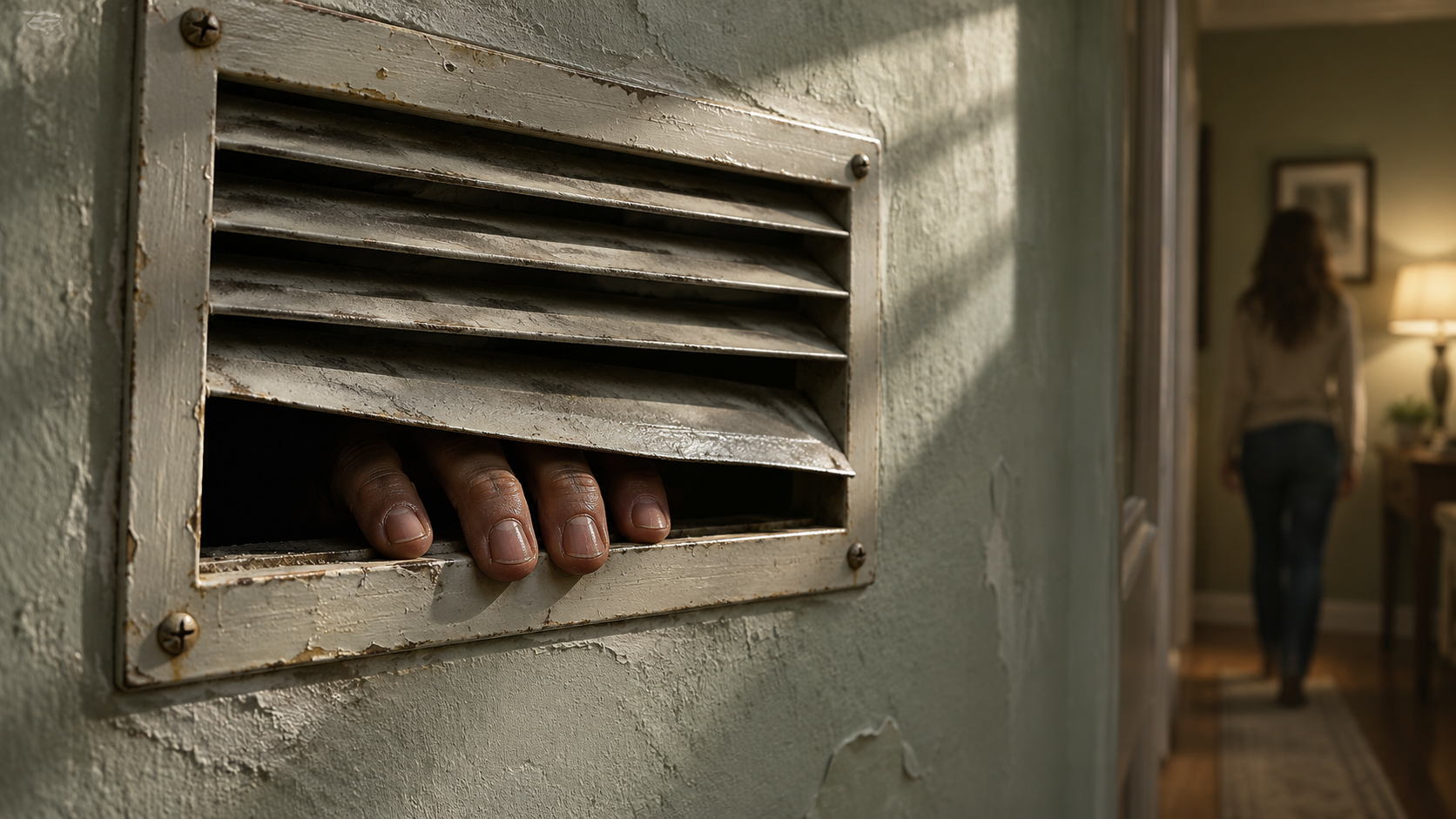
The apparent haunting has a human source. David can disturb possessions, watch the family and enter rooms because the building contains routes they do not know exist.
This revelation changes the function of the walls. For Hannah, they divide rooms and create privacy. For David, they provide access and concealment. The same structure supports two incompatible experiences of the house.
Its original title, Crawlspace, names that physical arrangement more directly. Within preserves the uncertainty for longer, identifying an interior without immediately explaining what occupies it.
The security problem now becomes clear. Locks can control recognised entrances, but the family has misunderstood where the danger is located. A person already concealed inside does not need to defeat the front door each time he approaches them.
The revelation also places demands on the film’s credibility. A human explanation invites practical questions about how such long-term concealment has escaped discovery. The story explains David’s access more convincingly than it explains every circumstance that has allowed him to remain undetected.
His records supply a fictional motive for resisting removal from the house. They should not be mistaken for a general explanation of real people with agoraphobia or other mental health conditions. David’s violence belongs to the character the screenplay constructs.
Once Hannah connects him to the property, investigation gives way to confrontation. The family is no longer trying to interpret unexplained sounds. It must respond to a living attacker who knows the building better than they do.
What Happens at the End of Within?
Police intervention appears to stop the attack, but the person officers shoot is Tommy, whom David has held captive. David remains inside the house. When Hannah is subsequently captured, her parents try to rescue her; both are killed, and her own attempt to escape ends with David dragging her back.
The mistaken identification is the crucial link between the apparent resolution and the final violence. The attacker has not returned from death. The family has been reassured before his removal has actually been established.
After the police response, the household prepares to leave. Hannah’s search for Tommy brings her into contact with his phone and draws her back towards the concealed spaces. She is seized and restrained.
Her screams alert John and Melanie. The hidden structure that previously allowed David to observe the family now becomes the place from which Hannah must be recovered.
She manages to free herself, but movement through the house remains dangerous. David kills Melanie, and John’s efforts to help Hannah through the attic lead into another confrontation. He is killed as their escape breaks down.
Hannah reaches the lower part of the house injured. She fights back, using broken glass against David, and gets close to the front door. The possibility of reaching the outside remains visible until he pulls her away and attacks her again.
The ending strongly implies that Hannah is killed. However, the film does not provide a later discovery of her body or a definitive account of what follows. Describing her as rescued or safely surviving would contradict the ending; inventing an unseen aftermath would go beyond it.
The distinction is narrow but useful. The immediate result is clear: her escape fails, David retains control, and no help arrives before the film leaves her. What remains unshown is her subsequent fate.
Why the Final Escape Fails to Bring Relief
The last movement gives Hannah knowledge without giving her enough control to survive. She understands the house, recognises the attacker and attempts to leave, yet each discovery arrives after David has already established an advantage.
That makes the conclusion more severe than a simple punishment for ignoring warnings. Hannah has been attentive throughout. Her problem is that noticing, persuading and escaping are separate tasks, and success at one does not guarantee success at the next.
John’s final efforts also complicate his earlier disbelief. He tries to help his daughter when the danger becomes undeniable. His actions show affection and courage, but they cannot recover the time lost while her reports were dismissed.
The police reversal introduces another failed source of reassurance. Their arrival should bring outside knowledge and practical protection into an enclosed situation. Instead, a mistaken identification allows the household to believe that a decisive question has been answered.
The film repeats its concern with incomplete inspection at a larger scale. Finding someone in the attic is insufficient without establishing who that person is. A visible result becomes dangerous when it receives more certainty than the evidence supports.
The final view of an apparently ordinary exterior extends that problem to everyone beyond the household. People outside have no immediate access to what has happened inside. The building can return to looking uneventful while the violence remains concealed.
This does not require the house to possess a supernatural will. Its ordinary appearance is enough. The horror depends on how much private life remains invisible from the street, even when the distance between danger and potential help is small.
Within ends with a home whose familiar boundaries have failed at every stage. Hannah can recognise the door that should lead to safety, but recognition cannot make it reachable. The film’s most effective idea survives its practical weaknesses: occupying a place does not mean understanding it. The family learns what shares its address, yet never gains the command of the building that it assumed came with moving in.
Sources
Within — Netflix — Official platform listing for the film. Netflix
Within: Film Review — Scream — Contemporary coverage of the family, neighbour, house mystery and narrative progression. THE HORROR ENTERTAINMENT MAGAZINE
Within (2016) Explained — Average Movie Reviews — Detailed sequence account used to check the camera, drink tampering and physical actions during the finale. Average Movie Reviews
Within – Presenze: la spiegazione del finale del film horror — Cinefilos — Corroboration of David’s identity, concealed living space and the police misidentification. Italian-language source. Cinefilos.it
Within – Presenze, come finisce il film? — CultWeb — Additional account of the family’s final escape attempt and the uncertainty surrounding Hannah’s subsequent fate. Italian-language source. CultWeb.it
Within (2016) — Cinema Cats — Illustrated documentation of Monty’s appearances and reactions inside the house. Cinema Cats
