Petrol Bombs on Independence Day: Albania's Protests Reach the Prime Minister's Door
Albania's anti-government protests turned violent again in Tirana on Saturday 28 November 2026, the country's Independence Day. Thousands of people marched to demand the resignation of Prime Minister Edi Rama, and groups of masked demonstrators threw stones and petrol bombs at riot police, who answered with water cannon, tear gas and, according to Reuters, rubber bullets. Protesters pelted a government building and tried to reach Rama's office before police pushed them back, a Reuters journalist reported. The clashes mark the latest escalation in a protest movement that began over a coastal tourism project and has grown into the most serious challenge of Rama's 13 years in power.
What Happened in Tirana
The march began peacefully, according to the PA news agency, which carried an Associated Press account from the capital. Small groups of masked demonstrators then broke away and began smashing the windows of ministry buildings along the route. Some used wooden sticks to try to break street cameras, while others threw rocks and Molotov cocktails at officers.
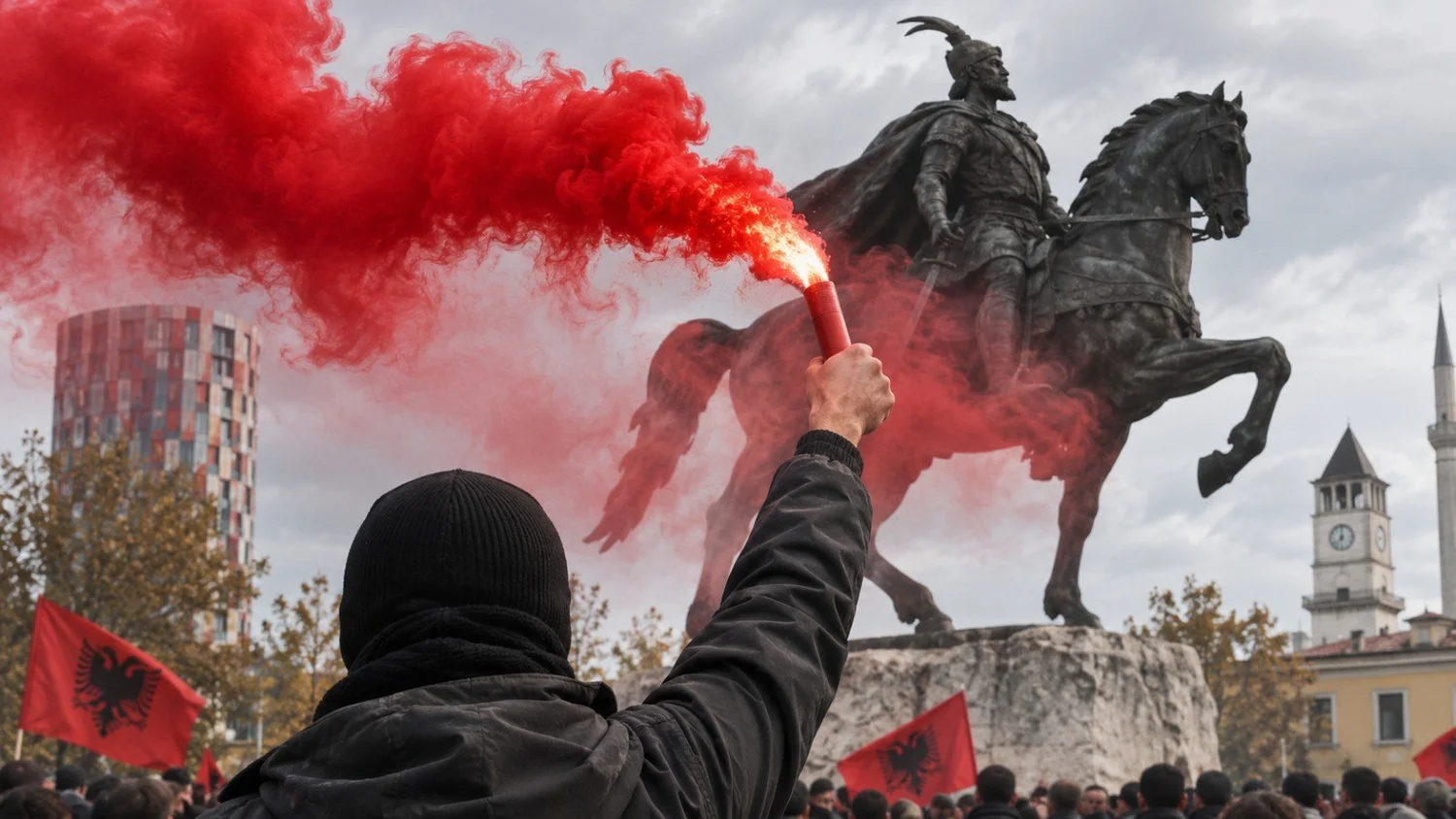
Police responded with tear gas and water cannon, and clouds of gas spread across several streets as protesters scattered. Reuters, which had a journalist on the ground, said riot police also fired rubber bullets. Images distributed by both agencies showed officers in riot gear, a petrol bomb bursting into flames beside police lines and a masked figure holding a lit flare by the Skanderbeg Monument in the city's main square.
Neither agency had reported casualty figures or arrest totals from Saturday's clashes when this article was published. One AP photograph carried by PA showed police detaining a protester.
A National Holiday Turned Into a Rally
The date was chosen deliberately. Saturday marked the 114th anniversary of Albania's declaration of independence in 1912, normally a day of celebrations and a public holiday. Instead, Albanians travelled to Tirana from across the country and from abroad to join the rally, PA reported. Police set up checks on the main roads into and out of the capital and stopped vehicles.
Protesters gathered in Skanderbeg Square chanting "Resignation!" One banner read "Albania is not for sale", Reuters reported.
Why Albanians Are Protesting
The movement's roots lie in a luxury tourism development on Albania's southern coast linked to an investment firm founded by Jared Kushner, the son-in-law of US President Donald Trump. Largely peaceful protests against the project began in late May, according to PA, and became known as the Flamingo movement. Rama has said the development is legal and that habitats will be protected.
The demonstrations then widened. PA reports that student protests in September, many of which turned violent, demanded better education and living standards. Reuters dates the latest, more confrontational wave to mid-October, when protests began rocking Tirana and spreading to other cities, with demonstrators at times setting fire to government buildings and banks, smashing shop windows and pulling up paving stones to throw at police. The demands have since broadened into calls for Rama to go.
The people who spoke to reporters on Saturday described grievances that go well beyond one building project. Eralda Baze, a 45-year-old engineer, told Reuters: "Enough is enough; the corruption, the poverty, the immigration." A student, Juna Vasili, told the Associated Press that life had become very difficult and that protesters wanted a change to the entire system. Suzana Gjeta, a pensioner, said she was marching for young people and for those like her living on 120 euros a month.
Arian Lleshi, 33, said he had travelled from the United Kingdom specifically for the protest. He argued that the parties that have dominated Albanian politics since the fall of communism no longer represent anyone and should make way for a new generation.
What the Government Says
Rama's government denies corruption and has called for dialogue on the protesters' demands, Reuters reported. It has also introduced measures aimed at easing the pressure, including cheaper fuel and more money for poor families. Rama has said his government is tackling corruption as never before.
Reuters notes that corruption scandals have tarnished Albania's image over the years and that analysts describe the country as a hub for gangs laundering money from drug and weapons trafficking. Those are assessments by analysts quoted by the agency, not findings against the current government.
Why It Matters Beyond Albania
Rama has governed since 2013 and won a fourth term last year. Reuters describes the unrest as the biggest challenge yet to his rule. It also comes at a sensitive moment for Albania's foreign ambitions: the country is leading a group of Balkan states seeking to join the European Union and is aiming for membership by 2030. Repeated scenes of petrol bombs and tear gas in the capital will be watched closely in Brussels, where governance, the rule of law and the fight against corruption are central to accession talks.
For the UK, Albania has been a focus of migration policy in recent years, and Saturday's protest drew members of the Albanian diaspora, including at least one protester who said he had travelled from Britain.
What Happens Next
The key questions now are whether Saturday's violence produces arrests or injuries on a scale that changes the government's approach, whether Rama offers any concession beyond the economic measures already announced, and whether the protest organisers can keep the movement's broad coalition of students, pensioners and diaspora Albanians together. With demonstrations having continued for six months and their demands now centred on the prime minister himself, there is little sign that the pressure on the government will ease soon.
Sources
- Reuters: Student-led protest against government turns violent in Albania (28 November 2026)
- PA News Agency (via North Norfolk News): Police and protesters clash as thousands call for resignation of prime minister (28 November 2026)
