Will They Change Putin’s Calculations?
Britain’s Latest Air-Defence Package Could Help Ukraine Protect The Infrastructure It Needs To Survive Winter.
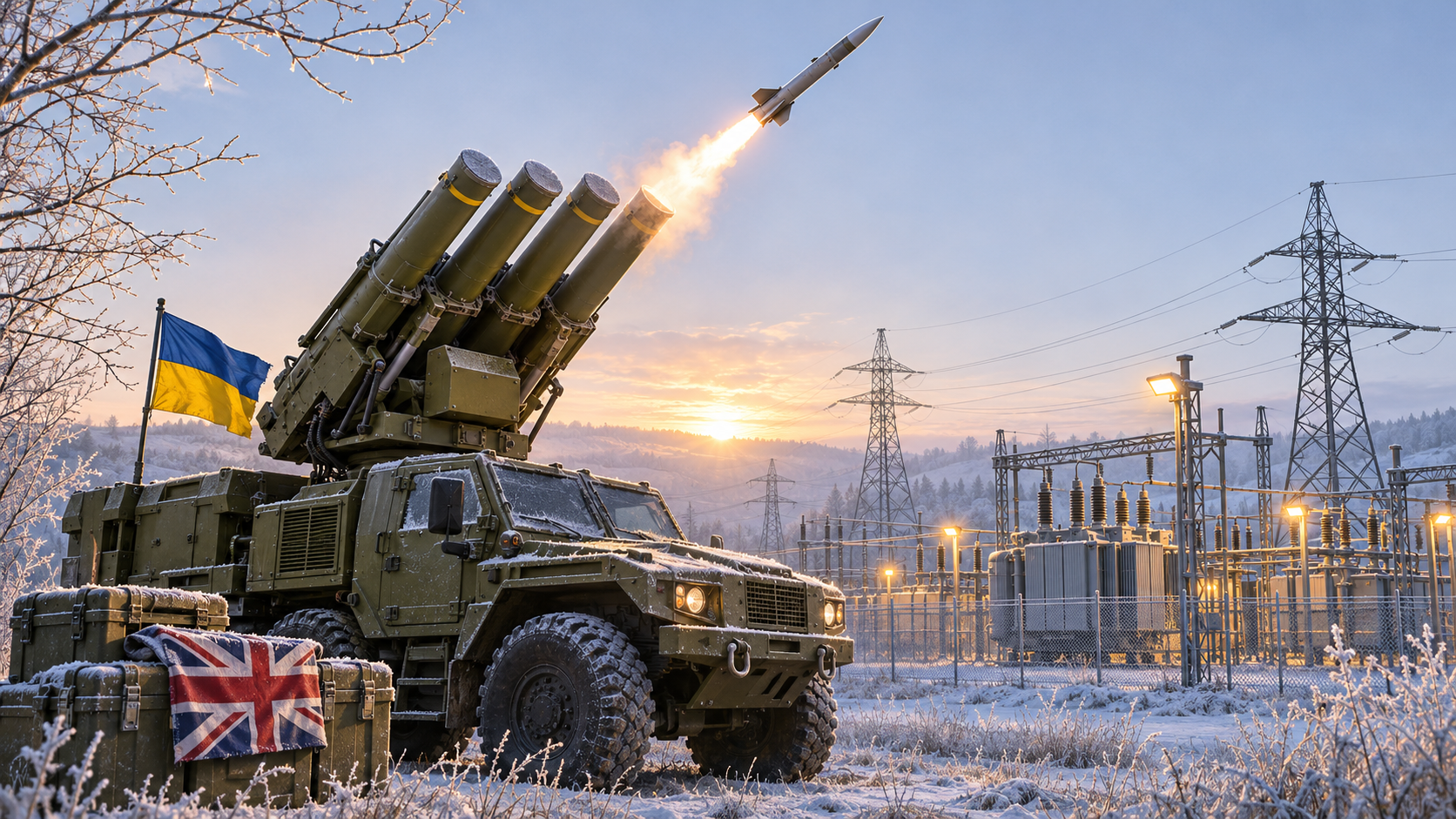
Britain announced on 17 November that it would supply Ukraine with more than 1,000 additional short-range air-defence missiles and launchers. The £240 million package includes over a dozen radars, with deliveries beginning in mid-December. It draws on October’s £500 million winter-support pledge.
The practical benefit is greater protection for selected locations against aerial attacks. The missiles cannot create an impenetrable shield over Ukraine, and the headline quantity does not establish how many incoming weapons they will destroy. Their value depends on the threats they can engage, the systems supporting them and whether supplies keep arriving.
For Ukrainians, the consequences extend beyond a military interception tally. Protecting electricity infrastructure can help preserve heating, water supplies, hospital services and the ability to repair equipment through winter.
What Will The Missiles Actually Do?
Short-range air defence protects a limited area around the equipment deployed there. Its role is to engage suitable incoming threats before they reach nearby forces, infrastructure or population centres.
Different air-defence weapons address different problems. A system suited to intercepting drones cannot automatically perform the same role against a fast ballistic missile. Ukraine therefore needs complementary layers of protection, with sensors, command systems and weapons working together.
NATO’s air-defence policy describes this approach explicitly: short-, medium- and long-range systems compensate for one another’s limitations. No individual weapon provides the whole solution.
Britain has previously supplied Lightweight Multirole Missiles, which its defence procurement agency identifies as capable of engaging drones, helicopters and other aircraft. However, earlier deliveries should not be treated as proof that every missile in the latest announcement is an identical model. The publicly available announcement examined here does not provide a complete breakdown.
That distinction prevents an attractive but misleading conclusion: more air-defence missiles do not necessarily mean more capability against every category of Russian attack.
How Much Will They Help Ukraine?
The strongest assessment is that they can make a meaningful difference at defended locations while leaving substantial gaps elsewhere.
Consider the value of protecting an electricity installation. Preventing one damaging strike could preserve services for people far beyond the immediate interception area. The outcome depends on what the incoming weapon would have hit, how vulnerable the installation is and whether alternative supplies exist.
Counting destroyed drones alone therefore misses part of the benefit. A successful interception above an important energy site may matter more than several interceptions elsewhere.
Nevertheless, the quantity announced cannot be translated into a reliable number of days of protection. That would require information about deployment, attack frequency, ammunition expenditure, operational availability and replenishment. Those details are not established by the headline.
Nor does one missile guarantee one destroyed target. Operational conditions and engagement decisions affect the number of weapons used and the eventual result.
There is also a difference between surviving individual attacks and sustaining a defence campaign. A delivery can restore options to a unit running short of ammunition. Continued supplies determine whether those options remain available after repeated attacks.
Britain’s earlier support has also included counter-drone turrets and plans for interceptor drones. The Ministry of Defence has described these as ways to address attack drones at lower cost. The wider challenge is to build a defence that Ukraine can afford to keep using, alongside the more specialised weapons required for harder targets.
Why Air Defence Matters To Peace Negotiations
The geopolitical argument rests on what Russia gains when attacks damage Ukraine’s ability to function.
If strikes interrupt electricity, industrial activity and ordinary life, they can increase pressure on Ukraine’s government while consuming resources needed for recovery. Stronger protection can reduce that pressure.
The inference is that air defence may help Kyiv negotiate with greater resilience. A government facing fewer successful attacks on essential infrastructure has more room to make decisions without the immediate consequences of another major outage.
That does not mean additional missiles will force Vladimir Putin to accept a settlement. Air defence cannot resolve disputes over territory, security guarantees or enforcement. It can influence the conditions under which those disputes are negotiated.
This is also why Britain’s place in Ukraine peace talks matters alongside military support. Supplying equipment and influencing a diplomatic settlement are related ambitions, but one does not automatically secure the other.
For Britain, sustained assistance communicates that Ukraine’s ability to resist remains a European security priority. The credibility of that message depends on implementation: equipment delivered, maintained and replenished carries more weight than repeated announcements.
The broader debate over US troop numbers in Europe raises a related question about how much responsibility European governments are prepared to carry themselves.
How Is Putin Likely To Respond?
A specific Kremlin response to this package was not verified at the time of writing. Any forecast must therefore remain an assessment.
The most plausible political response is condemnation of continued British military support, potentially accompanied by claims that Western governments are prolonging the conflict. Such messaging would give Moscow a way to challenge the package without demonstrating that it has defeated the additional protection.
A plausible military response would be continued efforts to overcome Ukrainian air defences. NATO’s assessment already describes Russia’s use of attacks involving different weapons, directions, altitudes and speeds. Additional defensive equipment does not remove that underlying contest.
However, a subsequent Russian strike would not, by timing alone, prove retaliation for Britain’s announcement. Establishing that connection would require evidence.
The package also offers no sound basis for predicting an imminent Russian attack on Britain. Supplying defensive equipment and entering direct combat are different decisions with different consequences.
The more immediate strategic question is whether Russia can continue inflicting damage faster than Ukraine and its partners can prevent it, repair it and replace exhausted defensive stocks.
What Does It Cost British Taxpayers?
The funding relationship matters. The announced package uses part of the winter allocation already made public in October. Adding both figures together as entirely separate new commitments would double-count that portion of the support.
The Treasury’s October announcement also combined several kinds of assistance, including military support, grants, guarantees and export-finance capacity. These are not interchangeable measures of cash expenditure.
A guarantee creates a potential liability under specified conditions. A grant is expenditure. Export-finance capacity establishes the scope for supported transactions. A large combined headline does not mean that the same amount has immediately left the Treasury.
For this missile package, the available total is not a published price for each missile. Launchers and radars are included, so dividing the package value by the missile quantity would produce a misleading unit cost.
There is still an opportunity cost. Public resources committed to Ukraine cannot simultaneously fund every competing domestic or defence priority. A responsible case for the expenditure must explain what Britain expects to achieve and how that result will be assessed.
The government’s argument is that supporting Ukraine helps protect British security and prosperity. That is a strategic judgement, rather than a demonstrated financial saving.
The strongest scrutiny would examine delivery times, effectiveness, procurement value and the implications for Britain’s own military readiness. Those questions remain legitimate whether someone supports or opposes continued assistance.
Is There A Backlash In Britain?
There is evidence of concern about overseas military commitments, but that should not be presented as proof of a backlash against this particular announcement.
YouGov research published on 29 October identified public worries about stretched finances, domestic services and escalation. Other respondents supported assisting allies and protecting people facing aggression.
Its quantitative findings were also more complicated than a simple rejection of involvement. Asked about British armed forces participating in shooting down missiles and drones aimed at Ukraine, 42% supported the idea and 30% opposed it.
That question concerned direct participation, rather than this equipment package. It cannot be used as an approval rating for today’s spending.
Earlier research published in February found that 46% of Britons favoured supporting Ukraine until Russia withdrew, even if the war and its effects lasted longer. That provides historical context, not a current verdict on the new announcement.
The available evidence therefore supports a divided debate with substantial backing for Ukraine and real concerns about cost and risk. It does not establish that this package has triggered widespread public anger.
The Real Test Will Come After Delivery
The most useful measure of success will be whether the equipment preserves something Ukraine would otherwise lose: a functioning installation, an operational unit or the ability to recover between attacks.
That requires more than an initial consignment. Maintenance, trained personnel, reliable supplies and protection suited to the changing threat all affect the outcome.
Britain’s contribution can help sustain Ukraine’s defence through a difficult season. Whether that becomes a lasting advantage will depend on what arrives after the first missiles have been used.
Sources
Reuters — Britain to supply Ukraine with more than 1,000 short-range missiles — Announcement, package value, equipment and delivery schedule.
HM Treasury — Further support for Ukraine — October funding commitment and distinctions between forms of financial support.
NATO — Integrated Air and Missile Defence Policy — Complementary defensive layers and the evolving aerial threat.
Defence Equipment & Support — DE&S orders more Lightweight Multirole Missiles for UK Armed Forces — Earlier missile capabilities and supply context.
Ministry of Defence — UK sends automated turrets and missiles to shoot down Russian drones — Earlier assistance and lower-cost counter-drone approaches.
YouGov — What do Britons think about UK military involvement in conflicts overseas? — October findings on support, domestic priorities and escalation concerns.
YouGov — Four years into the Ukraine war, where does Western European opinion stand? — Earlier British attitudes towards continued support.
Next Reads
Will Britain Get a Seat at the Next Ukraine Peace Talks? Washington and Putin Disagree. — Britain’s diplomatic role alongside its military assistance.
Russia Says It Downed 1,336 Ukrainian Drones in One Night. What Is Known About the Damage? — Why interception claims and damage assessments answer different questions.
Could the US Cut Troop Numbers in Europe? — The wider debate over Europe’s defence responsibilities.
