Britain Is Quietly Preparing For A Russia War Scenario Beneath The Streets Of London
Why British Soldiers Are Training For A Future Russia Conflict In Tube Tunnels
The London Underground Has Become A NATO War Command Centre In Chilling Russia Conflict Simulation
Deep beneath one of Britain’s busiest transport networks, NATO forces are already rehearsing what a future war with Russia could actually look like.
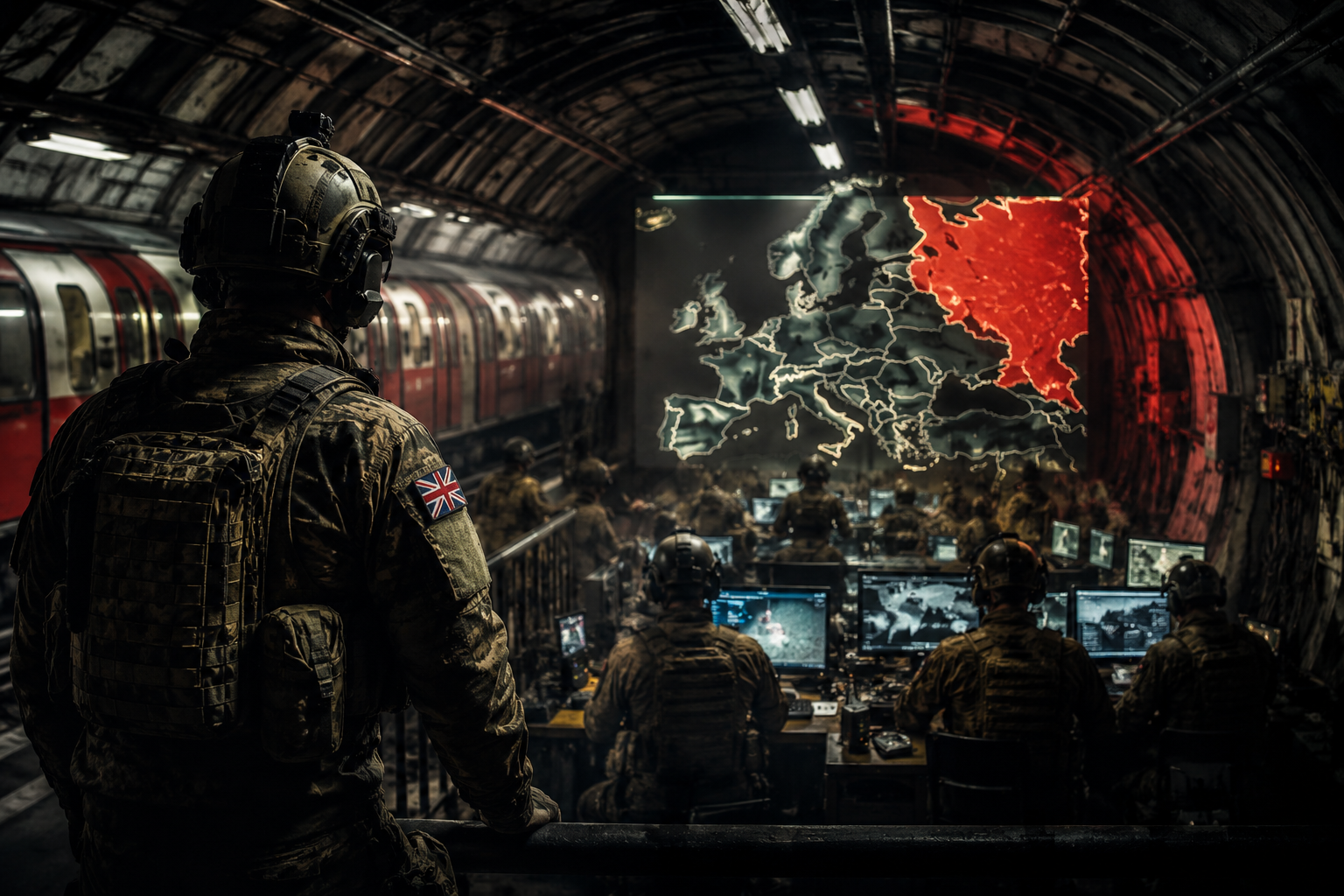
British troops and allied soldiers have been using a disused section of the London Underground to simulate a future NATO response to a Russian attack on the Baltic states. The exercise, set in a fictional 2030 scenario, transformed part of Charing Cross station into a wartime headquarters coordinating operations against a Russian advance into Estonia.
The images alone feel surreal. Soldiers operating from abandoned Tube platforms. Underground command rooms glowing red beneath central London. AI-assisted battlefield systems directing drone operations while commuters move overhead without realizing what is happening below them. Yet behind the cinematic visuals sits a much more serious message: parts of the British military increasingly believe a confrontation with Russia is no longer an impossible scenario that belongs only in Cold War fiction.
The Exercise Was Designed To Feel Uncomfortably Real
The scenario reportedly imagined Russian forces launching an attack against the Baltic states, triggering a rapid NATO deployment led by British forces. Charing Cross station was repurposed into a simulated command center representing Tallinn, Estonia’s capital.
Military planners deliberately chose 2030 as the setting because senior commanders increasingly describe that period as the point where the threat from Russia could become significantly more dangerous if current trends continue. The exercise reportedly focused heavily on drones, AI-assisted targeting, electronic warfare, and rapid decision-making systems designed to compress battlefield response times from days into hours.
That detail matters more than most people realize.
This was not simply soldiers running through old-style battlefield drills. The entire structure of the simulation reflected how modern war is changing at extraordinary speed. Ukraine has already shown how drones, autonomous systems, surveillance networks, and digital command infrastructure can reshape combat almost overnight. NATO planners now appear deeply focused on avoiding technological lag if a larger European conflict ever emerged.
The London Underground Choice Sends Its Own Message
The decision to stage the exercise beneath London was not random.
Part of the exercise reportedly examined how civilian infrastructure could be repurposed during wartime emergencies. That instantly changes the psychological tone of the story because it moves war preparation away from distant military bases and into ordinary public spaces.
The London Underground carries millions of passengers. It symbolizes civilian normality, routine, and everyday life. Turning abandoned parts of it into a NATO war headquarters creates a very deliberate image: modern conflict would not remain neatly separated from civilian infrastructure.
That reflects a wider shift already visible across Europe.
Countries bordering Russia increasingly talk less about “peacekeeping” and more about resilience, mobilization, infrastructure protection, cyber warfare, energy vulnerability, and supply chain defense. The assumption underneath many NATO discussions now appears to be that future conflict would target entire societies, not simply front-line soldiers.
The Bigger Story Is Britain’s Fear Of Falling Behind
One of the most revealing parts of the exercise was not the fictional war itself, but the apparent concern over Britain’s current military readiness.
Reports surrounding the exercise repeatedly referenced drone shortages, capability gaps, and concerns over funding. Some commanders reportedly warned that Britain currently has only a fraction of the drone capability it may need in a major future conflict.
That is the part of the story that should probably worry policymakers most.
Modern warfare is becoming brutally industrial again. Ukraine demonstrated that large-scale conflict consumes enormous quantities of drones, missiles, artillery, electronic systems, replacement equipment, and logistics support at staggering speed. Western militaries spent years optimized for smaller counterterrorism operations rather than attritional state-on-state warfare.
Now many NATO planners appear to believe the alliance is under pressure to adapt.
The exercise reportedly showcased systems intended to speed battlefield targeting and decision-making dramatically using AI-assisted command structures. The underlying fear seems clear: whoever processes information fastest may increasingly dominate future battlefields.
Russia Remains The Shadow Hanging Over European Security
Even though the exercise was fictional, its geopolitical logic was very real.
British and NATO military planning has increasingly focused on the possibility that Russia could test NATO’s eastern flank, particularly around the Baltic region. Estonia, Latvia, and Lithuania remain strategically sensitive because they border Russia and depend heavily on NATO’s rapid response credibility.
The concern is not necessarily that a major European war is imminent tomorrow morning.
The concern is that deterrence only works if military readiness looks believable.
That explains why NATO increasingly stages highly visible exercises near Russia’s borders, why Britain continues to deploy into Estonia, and why military leaders keep warning about future capability gaps. Recent exercises near the Russian frontier have already involved British troops rehearsing defensive operations only miles from Russian territory.
The deeper strategic message underneath the London exercise appears aimed at multiple audiences simultaneously: Russia, NATO governments, defense industries, and domestic political leaders debating military spending.
The Psychological Shift May Matter More Than The Exercise Itself
The most important part of the story may not be the war simulation itself.
It may be the fact that people now openly discuss this type of scenario.
For years, mainstream public discussion often treated direct large-scale war between NATO and Russia as almost unthinkable. Now senior military officials increasingly discuss preparedness, mobilization, stockpiles, drone warfare, infrastructure resilience, and rapid deployment with striking openness.
That does not automatically mean war is coming.
But it does suggest that many Western defense planners believe the strategic environment has fundamentally changed after Ukraine.
The Cold War mentality that once dominated Europe is quietly returning in a modernized form—only this time the battlefield includes AI systems, cyber infrastructure, autonomous drones, satellite networks, and information warfare operating at speeds previous generations could barely imagine.
Why This Story Feels Bigger Than One Military Exercise
On the surface, the exercise is a story about soldiers using abandoned Tube tunnels for training.
Underneath, it is really a story about how Britain sees the future becoming more dangerous, more technologically unstable, and potentially far less predictable than many people assumed only a few years ago.
Exercises like this are designed partly for readiness, partly for deterrence, and partly for signaling. They tell allies that preparations are happening. They tell adversaries that NATO is adapting. They also tell domestic audiences that governments may soon face uncomfortable decisions about defense spending, industrial production, and national resilience.
Because once military planners start rehearsing future wars beneath one of the most recognizable civilian systems in Britain, it becomes much harder to pretend these risks still belong only to history books.
