Britain Quietly Sent A New Drone-Killer Into The Middle East — And It Changes The Cost Of Modern War
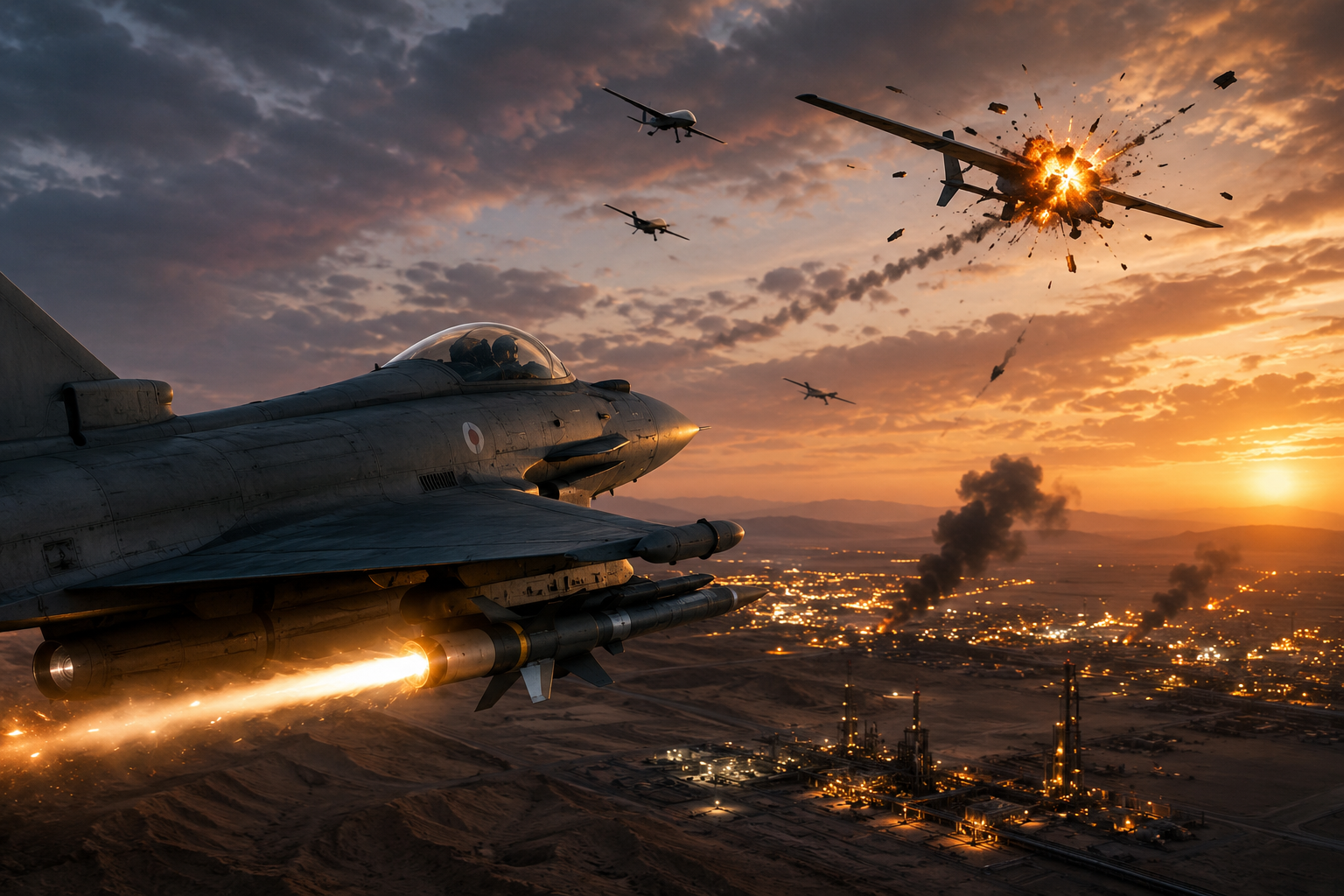
Britain’s Silent Middle East Deployment Reveals The Future Of Air Warfare
Britain’s latest military deployment may look small on paper, but it reveals how rapidly modern warfare is changing beneath the surface.
The UK has quietly deployed a new low-cost anti-drone weapon system into the Middle East after a rapid testing and procurement process that moved from trials to live operations in under two months. Official statements confirm the system is now operational on RAF Typhoon fighter jets conducting missions across the region.
At first glance, it sounds like another routine military technology update. It is not. The deeper story is that modern warfare is entering a dangerous economic phase where relatively cheap drones are increasingly capable of exhausting and overwhelming vastly more expensive defense systems. Britain’s response suggests military planners now believe the old model is becoming financially unsustainable.
The Real Threat Is Not The Drone Itself
The new system being deployed is the Advanced Precision Kill Weapon System, or APKWS, which converts unguided rockets into precision anti-drone weapons using laser guidance. The RAF says the missiles can destroy drones at a fraction of the cost of traditional air-to-air interceptors.
That detail matters enormously.
One of the defining military problems of the last few years has been the rise of cheap attack drones and Shahed-style loitering munitions. A drone costing tens of thousands of pounds can force militaries to fire interceptor missiles costing hundreds of thousands or even millions. Analysts increasingly describe the situation as an “attrition economics” problem rather than simply a battlefield problem.
That imbalance changes the logic of war. It means weaker actors can potentially drain stronger militaries financially even without dominating technologically.
Britain’s deployment is therefore about far more than simply shooting down drones. It is about finding a sustainable way to survive a future in which drones become constant, mass-produced, and relentless.
The speed of the deployment should raise eyebrows.
The Ministry of Defense confirmed the system moved from testing to operational deployment in less than two months, following successful test strikes in March and April.
That timeline is unusually fast for modern Western defense procurement.
Military procurement is normally associated with delays, bureaucracy, and years-long development cycles. The fact this moved so quickly strongly suggests the perceived threat level has changed dramatically behind closed doors. British officials are clearly treating drone warfare as an urgent operational issue rather than a future theoretical risk.
The deployment also reflects lessons learned from conflicts in Ukraine and the wider Middle East, where low-cost drones have repeatedly demonstrated their ability to damage infrastructure, threaten bases, and pressure advanced air defense systems.
Military planners are increasingly confronting a reality where swarms of cheap autonomous or semi-autonomous systems may become more strategically disruptive than some traditional aircraft fleets.
Britain’s Middle East Military Footprint Is Expanding Quietly
The anti-drone deployment does not exist in isolation.
The UK has already increased military activity across the region with Typhoon deployments, counter-drone systems, naval assets, and additional air defense support. Official statements confirm British systems including Sky Sabre, Rapid Sentry, and ORCUS are already deployed across Gulf partner states, including Saudi Arabia, Bahrain, and Kuwait.
The Royal Navy is also preparing expanded deployments linked to maritime security operations around the Strait of Hormuz, one of the world’s most strategically sensitive shipping chokepoints.
That matters because the wider regional environment remains unstable even during periods of reduced headline tension.
Drone attacks, missile threats, and proxy warfare have become deeply embedded into the security architecture of the Middle East. Britain appears to be preparing for a long-term environment in which persistent drone threats are simply treated as a normal operational condition.
Cheap drones are forcing militaries into a new arms race.
The psychological shift here may be even bigger than the technological one.
For decades, military prestige centered around advanced fighter jets, aircraft carriers, and expensive precision weapons. Those systems still matter enormously, but drones are changing the battlefield from the bottom up. Small, disposable, and relatively cheap systems are now capable of forcing strategic reactions from some of the world’s most advanced militaries.
That is why countries across Europe, the Gulf, and NATO are suddenly accelerating anti-drone programs simultaneously.
The race is no longer only about building better aircraft. It is increasingly about building cheaper interception systems, electronic warfare capabilities, AI-assisted tracking, and sustainable layered defenses capable of surviving mass drone attacks without bankrupting the defender.
Britain’s APKWS deployment sits directly inside that wider shift.
The Most Important Part Of The Story Is What Comes Next
The most revealing detail may be what officials are not saying openly.
If low-cost drone interception becomes central to modern defense strategy, the implications spread far beyond the Middle East. The same technologies and battlefield assumptions now shape military planning in Europe, NATO airspace, and critical infrastructure defense.
British officials have already linked typhoon operations in the Middle East with wider NATO defensive roles linked to Russian drone incursions near Europe’s eastern flank.
That means the anti-drone systems being tested operationally today could rapidly become standard defensive architecture across Western militaries tomorrow.
The deeper warning buried inside this deployment is simple: drone warfare is no longer emerging technology. It is already reshaping military economics, procurement speed, alliance planning, and strategic deterrence in real time.
The countries adapting fastest may hold a major advantage in the conflicts that come next.
