China And Russia Push Their Naval Alliance Deeper Into The Pacific
China-Russia Naval Drills Show A Pacific Power Shift
China-Russia Naval Drills Show A Pacific Power Shift
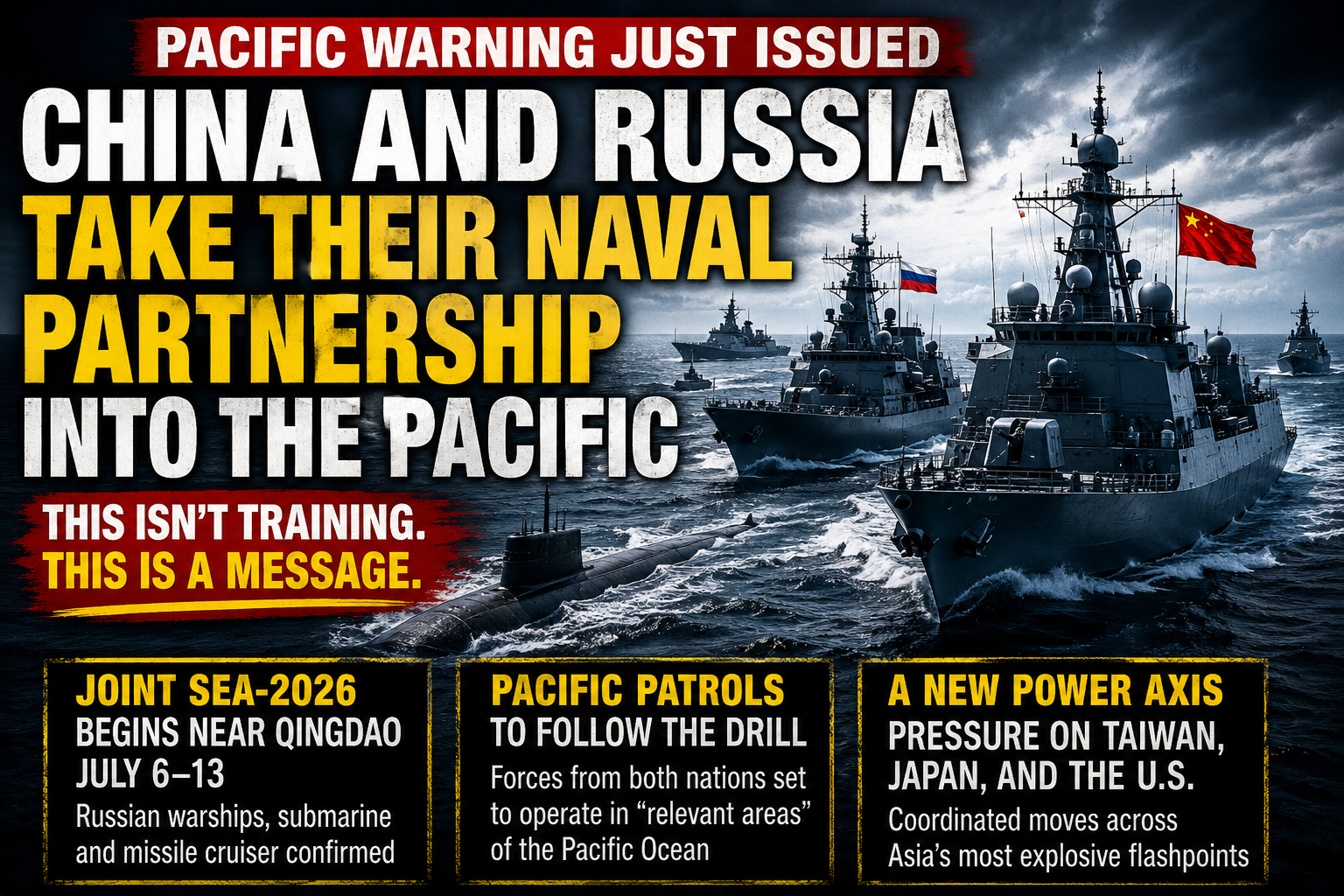
China and Russia are turning another naval exercise into a wider message of military coordination in the Pacific. The two navies are set to hold the Joint Sea-2026 exercise this month near Qingdao, before some forces move on to joint maritime patrols in relevant areas of the Pacific Ocean.
That detail matters. A coastal drill near China is one thing; a follow-on patrol into the Pacific is a broader signal to the United States, Japan, South Korea, Taiwan, the Philippines, and every government watching the balance of naval power in Asia.
The Drill Is Not Just A Drill
China’s Ministry of National Defense said the exercise will take place in waters and airspace near Qingdao in eastern China’s Shandong province. The official framing is familiar: the two sides say the activity is intended to address security challenges and maintain regional peace and stability.
Russia’s Pacific Fleet involvement gives the exercise extra weight. Reported Russian participation includes the missile cruiser Varyag, a corvette, a diesel-electric submarine, and a rescue vessel, with the exercise scheduled to run from July 6 to July 13.
The important point is not that China and Russia are training together. They have done that repeatedly. The sharper point is that these drills now sit inside a pattern of increasingly visible coordination across the Asia-Pacific, where naval movements, bomber patrols, coast guard activity, and anti-submarine exercises all carry political meaning.
Why The Pacific Patrols Matter
The Pacific is not neutral space in strategic terms. It is the operating theatre around Taiwan, Japan, South Korea, Guam, the Philippines, and the sea lanes that connect American power to its Asian alliances.
A joint patrol lets Beijing and Moscow show that their military relationship is not confined to statements, summits, or symbolic friendship. It puts ships at sea together, tests coordination, and reminds Washington that two major powers can apply pressure across the same maritime map.
This comes as Chinese activity around Taiwan has already intensified. China launched a new coast guard patrol east of Taiwan on July 4, drawing a sharp response from Taipei, which called the move illegal and destabilising.
That timing gives the Qingdao exercise a harder edge. Even if the drill is planned and officially routine, it lands in a region where every patrol, route, vessel class, and follow-on movement is read as part of a wider contest over access, deterrence, and control.
A Partnership Built For Pressure
China and Russia still do not have a formal NATO-style alliance. But their military cooperation has become more frequent, more complex, and more useful as a pressure tool.
A recent Congressional Research Service report said Russia and China conducted seven combined exercises or patrols in 2022, seven in 2023, and eleven in 2024, mostly in the Asia-Pacific region. It also said the trend continued in 2025 with Joint Sea activity in the Sea of Japan and a joint air patrol over the East China Sea and Western Pacific.
The Pentagon’s 2025 report on China’s military development said China-Russia exercises in 2024 were used in part to signal strength to the United States and its allies. It cited combined bomber patrols near Alaska, coast guard activity in the Bering Sea, and repeated strategic air patrols over regional flashpoints.
That makes Joint Sea-2026 part of a larger story. Beijing gains a partner that can complicate American planning across the north Pacific. Moscow gains a way to show it is not strategically isolated despite the cost of its war in Ukraine.
What Washington And Its Allies Will Watch Next
The next question is where the follow-on patrols go. The official language refers only to relevant areas of the Pacific Ocean, which leaves the most sensitive part of the story unresolved.
If the ships remain close to China’s coast, the signal is limited. If they move through routes near Japan, Taiwan, the Philippine Sea, or toward the wider western Pacific, the patrol becomes a more direct test of allied monitoring and regional nerves.
The military value may be less important than the political message. China and Russia are showing that their navies can assemble, train, separate from port, and move into the Pacific as a shared strategic statement.
That is the real consequence. The Pacific is becoming the stage where Beijing and Moscow can turn partnership into pressure, and where every joint patrol forces America’s allies to ask whether they are seeing routine training or the rehearsal of a more coordinated challenge.
