China’s Nuclear Build-Up Just Entered A New Phase — And The World Is Only Starting To Notice
The Hidden Military Expansion Reshaping The Global Balance Of Power
Deep In The Desert, China Is Quietly Building The Infrastructure Of A Nuclear Superpower
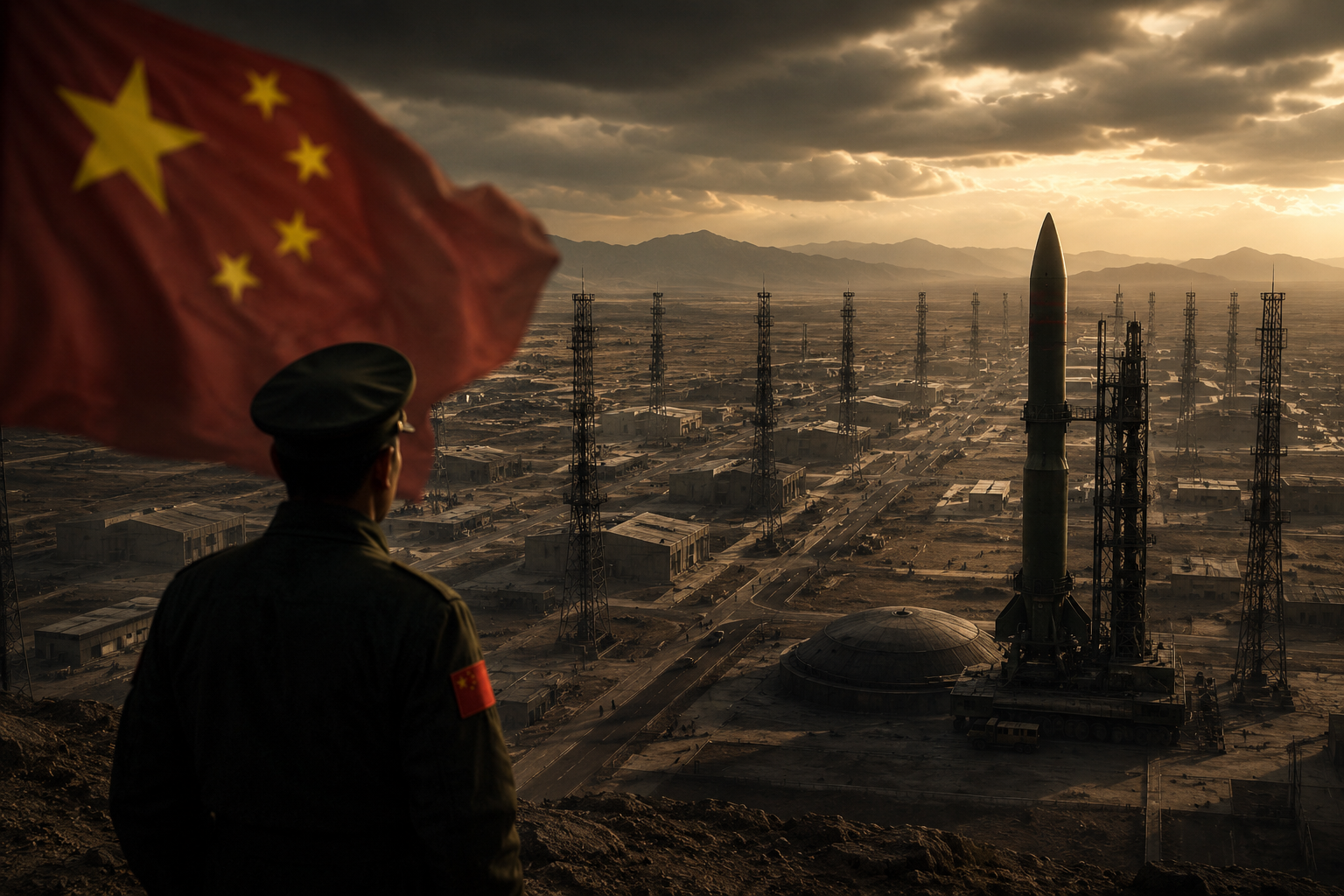
New satellite imagery has revealed an enormous network of military construction across remote regions of Xinjiang and Gansu. Analysts examining the images identified launch pads, hardened facilities, communications nodes, support infrastructure, roads, airfields and fortified compounds positioned around China's expanding missile silo fields.
The scale is what makes the story difficult to ignore. Reports indicate more than 80 launch-pad locations may be under construction or development, alongside major logistical and command infrastructure stretching across thousands of square kilometres. Rather than isolated military projects, the imagery suggests an integrated strategic network designed to survive conflict and maintain operational capability under extreme conditions.
That distinction matters. Building missiles is one thing. Building an entire ecosystem capable of protecting, coordinating and sustaining nuclear forces during a crisis is something very different.
This Looks Bigger Than A Simple Missile Expansion
The most striking aspect of the imagery is not necessarily the missile silos themselves. Analysts reviewing the sites point toward communications systems, possible electronic warfare facilities, command-and-control infrastructure and defensive military positions supporting the broader network.
In nuclear strategy, survivability is everything. A nuclear deterrent only works if an opponent believes it cannot eliminate your ability to retaliate. Much of the new construction appears aligned with strengthening exactly that capability. The infrastructure seems designed to ensure that even after a major attack, command systems, launch capabilities and communication links could remain operational.
That shifts the discussion from simple warhead counts toward something more consequential: strategic resilience.
China’s Nuclear Arsenal Has Been Growing Rapidly
The infrastructure expansion is occurring alongside a broader modernization of China's nuclear forces. Independent nuclear researchers estimate China now possesses roughly 600 nuclear warheads, with projections suggesting the total could exceed 1,000 by 2030 if current trends continue.
Multiple assessments over the past two years have pointed toward large-scale silo construction, increased deployment of intercontinental ballistic missiles and growing investment in delivery systems across land, sea and air. The result is a nuclear force that looks increasingly different from the smaller deterrent posture traditionally associated with China.
Officially, Beijing continues to maintain its long-standing no-first-use nuclear policy. Yet outside observers increasingly focus on capabilities rather than declarations. The physical infrastructure now appearing across western China suggests preparation for a more complex and durable nuclear posture than many analysts expected a decade ago.
The Real Story Is About Strategic Competition
The deeper significance of these developments extends beyond China alone. Nuclear strategy is fundamentally relational. When one major power expands capabilities, others reassess their own assumptions, force structures and defence planning.
This is why China's infrastructure programme is attracting attention far beyond Asia. Military planners in Washington, allied capitals and defence institutions increasingly view China's nuclear modernization as one of the defining strategic developments of the century. The concern is not simply the number of weapons involved. It is the possibility that the world is entering a more competitive and less predictable nuclear environment.
The erosion of arms-control frameworks, growing tensions surrounding Taiwan and accelerating military modernization across multiple countries create conditions that many strategists find increasingly uncomfortable.
Why Taiwan Changes The Equation
One reason these developments receive such scrutiny is their connection to broader regional tensions. Taiwan remains one of the most sensitive geopolitical flashpoints in the world, and many defence analysts view it as the scenario most likely to generate direct military confrontation between major powers.
Research released this week by strategic analysts warned that any major conflict involving Taiwan could create pathways toward nuclear escalation, particularly if command systems, communications networks or strategic assets become targets during a wider war.
That does not mean nuclear conflict is likely. But it does explain why hardened infrastructure, dispersed launch facilities and resilient command networks attract so much attention. These systems are built specifically for worst-case scenarios.
The World May Be Entering A New Nuclear Era
For decades, discussions about nuclear weapons largely centred on the United States and Russia. That framework increasingly appears outdated.
China's growing arsenal, expanding infrastructure and long-term modernization programmes suggest the emergence of a more complex nuclear landscape involving three major powers rather than two. The strategic calculations become harder. The signalling becomes more complicated. The potential for misunderstanding grows.
The most important takeaway is not that war is imminent. It is that the physical architecture of global power is changing in ways most people never see. Deep in remote desert regions, far from public attention, enormous projects are being built that could influence military strategy, diplomacy and international security for decades to come.
And by the time most people notice, the balance may already have shifted.
