Could the Iran War Trigger a Global Recession?
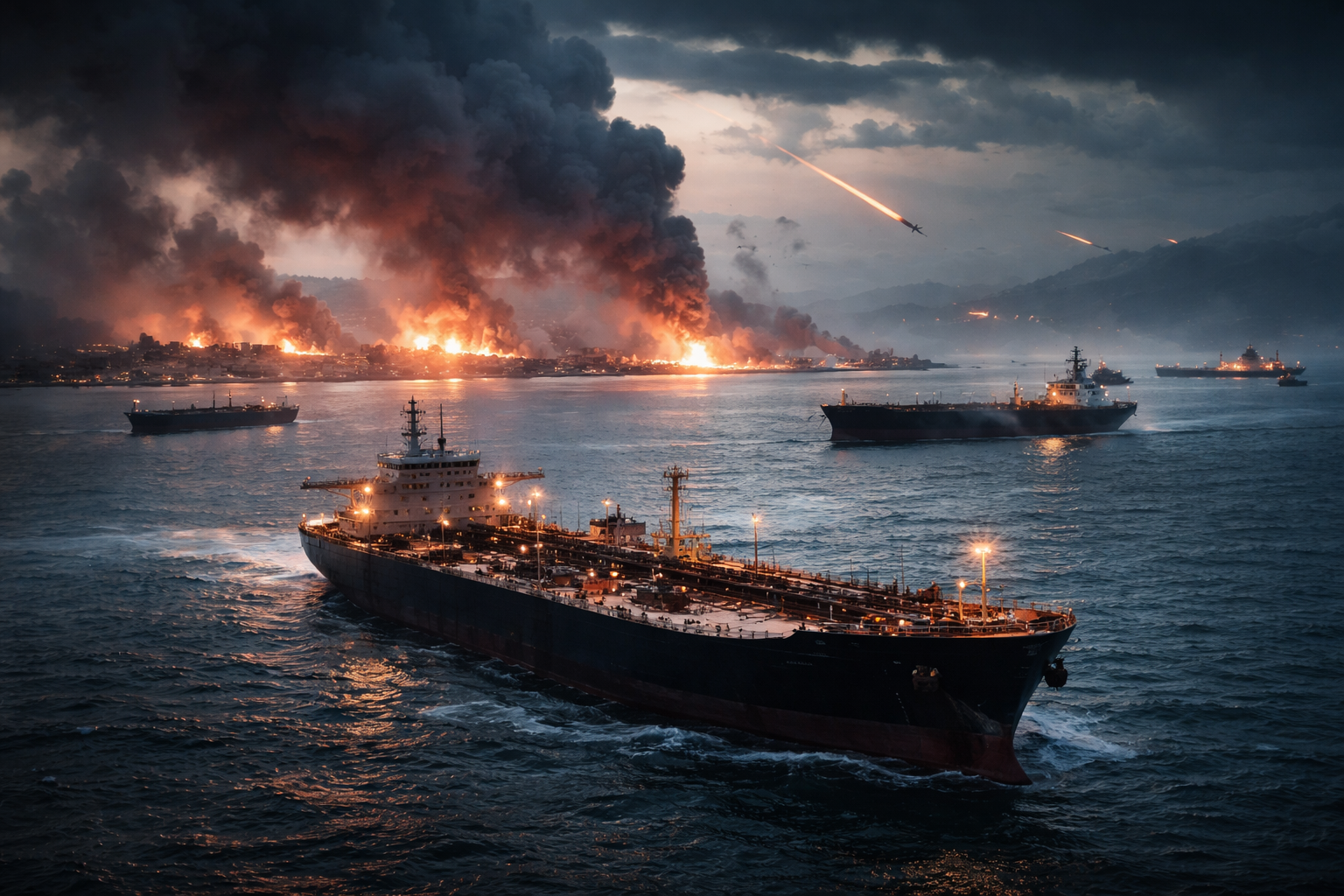
Energy Panic: Iran Conflict Sends Oil Prices Soaring
Where Is the Strait of Hormuz and Why It Controls Global Oil
Oil Surges Toward $120 as Iran War Escalation Threatens Global Economy
Oil markets have been jolted by one of the sharpest price spikes in years as escalating war around Iran disrupts energy flows through the Middle East. As of March 9, 2026, Brent crude briefly surged to about $119.50 per barrel, roughly a 29% jump from last week, as traders reacted to mounting fears that the conflict could choke off a major portion of global supply.
The surge is not simply a market reaction to violence in the region. A deeper structural vulnerability underlies this surge: a handful of narrow maritime chokepoints still disrupt the world's oil supply almost overnight.
With shipping through the Strait of Hormuz severely disrupted and energy infrastructure in the region under threat, the shock has rippled across global stock markets, inflation forecasts, and fuel prices almost instantly.
The story turns on whether the conflict becomes a sustained disruption to global oil transport rather than a short-lived geopolitical scare.
Key Points
Oil prices surged sharply as the war involving Iran intensified, pushing Brent crude near $120 per barrel, one of the biggest single-day gains in years.
The main trigger is disruption around the Strait of Hormuz, a maritime chokepoint that normally carries about 20% of the world’s oil supply.
Tanker traffic has dropped dramatically, and shipping companies are avoiding the area due to military risks.
The spike has already triggered sharp sell-offs in global equities and renewed fears of inflation and recession.
Energy analysts warn that if disruption lasts weeks rather than days, oil prices could remain near or above $120, amplifying economic pressure worldwide.
How the War Shocked the Oil Market
Oil markets respond to two things: physical supply and fear of future shortages. The Iran conflict has hit both simultaneously.
Fighting in and around the Persian Gulf has already affected oil infrastructure and shipping routes across several countries. Attacks on refineries and energy facilities in the region, combined with military threats to shipping, have pushed tanker operators and insurers to withdraw from the area.
At the center of the disruption lies the Strait of Hormuz, the narrow channel connecting the Persian Gulf to global markets. Roughly one-fifth of the world’s oil and a major share of liquefied natural gas exports pass through the strait every day.
When military escalation caused tanker traffic to collapse and ships began anchoring outside the strait, traders immediately priced in the possibility of a supply shock.
The result was a rapid surge in oil futures trading, with Brent crude oil, a major benchmark for global oil prices, briefly hitting about $119.50 before fluctuating lower during volatile trading sessions.
In commodity markets, perception often matters as much as actual shortages. Even a temporary risk to such a large share of supply can trigger dramatic price swings.
Why the Strait of Hormuz Matters So Much
Geographically, energy markets exhibit an unusual concentration. The Persian Gulf contains some of the largest oil producers in the world, including Saudi Arabia, Iraq, Kuwait, and the United Arab Emirates.
Despite decades of diversification efforts, the vast majority of that oil still exits the region through the same narrow sea corridor.
At its narrowest point, the Strait of Hormuz is only about 21 miles wide. A disruption in this channel can instantly trap millions of barrels of oil per day inside the Gulf.
That is why even the possibility of mines, missile strikes, or drone attacks against shipping can have a massive economic effect long before actual supply runs out.
The current crisis has already caused shipping companies to suspend routes and insurance premiums for tankers to spike.
The Immediate Economic Shock
The oil spike has quickly spread beyond energy markets.
Stock markets around the world have reacted with sharp declines as investors price in higher inflation and weaker economic growth. In Australia, for example, equity markets briefly lost more than four percent of their value during the shock.
Economists warn that sustained oil prices near $120 could produce a familiar chain reaction:
Fuel costs rise for households and businesses
Transport and shipping costs increase
Food and manufacturing prices climb
Central banks delay or cancel interest-rate cuts
In other words, the oil shock risks undoing recent progress in controlling inflation.
That dynamic is why analysts often compare modern oil spikes to earlier geopolitical crises that triggered global recessions.
What Most Coverage Misses
Much of the early reporting focuses on military escalation. But the real lever in this crisis is not the war itself. It is logistics and insurance.
Energy markets do not require the physical destruction of oil facilities to seize up. Simply making shipping routes too dangerous to insure can stop exports.
If tanker insurers refuse to cover voyages through the Gulf, or if shipping companies judge the risk too high, oil supply can drop suddenly even if wells keep pumping.
That mechanism is historically powerful. During earlier Middle East crises, oil output often fell only slightly, yet prices doubled because transportation networks froze.
This scenario means the economic trajectory of the crisis may hinge less on battlefield outcomes and more on maritime risk calculations by insurers, shipping firms, and naval forces.
Who Gains and Who Loses
High oil prices reshape power and profit across the global economy.
Energy exporters benefit immediately. Oil producers outside the conflict zone—such as the United States, Brazil, and Norway—gain higher revenues as global prices rise.
Oil companies also tend to see profits surge during such periods.
Import-dependent economies face the opposite problem. Countries in Europe and Asia rely heavily on Middle Eastern energy flows, making them especially vulnerable to price spikes.
Airlines, shipping companies, and manufacturing firms are among the hardest hit sectors because fuel is a major cost input.
For households, the impact appears most visibly at petrol pumps and in rising transport costs embedded across the economy.
The Historical Echo of Past Oil Crises
Oil shocks have repeatedly reshaped the global economy.
One of the most famous examples occurred after the Iranian Revolution in 1979, when disruptions in oil production triggered a global energy crisis and a surge in prices.
Although the actual supply drop at the time was relatively modest, market panic and geopolitical uncertainty drove prices dramatically higher.
The current crisis carries echoes of that period. Even if supply losses remain limited, the fear of prolonged disruption could sustain elevated prices.
The Next Signals to Watch
The trajectory of the oil market now depends on several critical developments.
The first is shipping traffic through the Strait of Hormuz. If naval escorts or diplomatic efforts restore tanker movement, prices could stabilize quickly.
The second is regional infrastructure. Any confirmed damage to major refineries, pipelines, or export terminals would likely send prices even higher.
The third is production policy. Major producers outside the conflict zone may attempt to increase output to stabilize markets, though spare capacity is limited, and any increase in production may not be sufficient to offset the potential price increases caused by disruptions in supply.
For now, the oil spike is a warning signal rather than a settled trend.
The global economy can absorb a brief price shock. A prolonged disruption to Middle Eastern energy flows would be far harder to contain—and could mark the first true geopolitical energy crisis of the decade.
