The Secretive History Of HALO Jumps And Their Most Dangerous Missions
The Most Dangerous Part Of A HALO Jump May Begin Long Before The Parachute Opens.
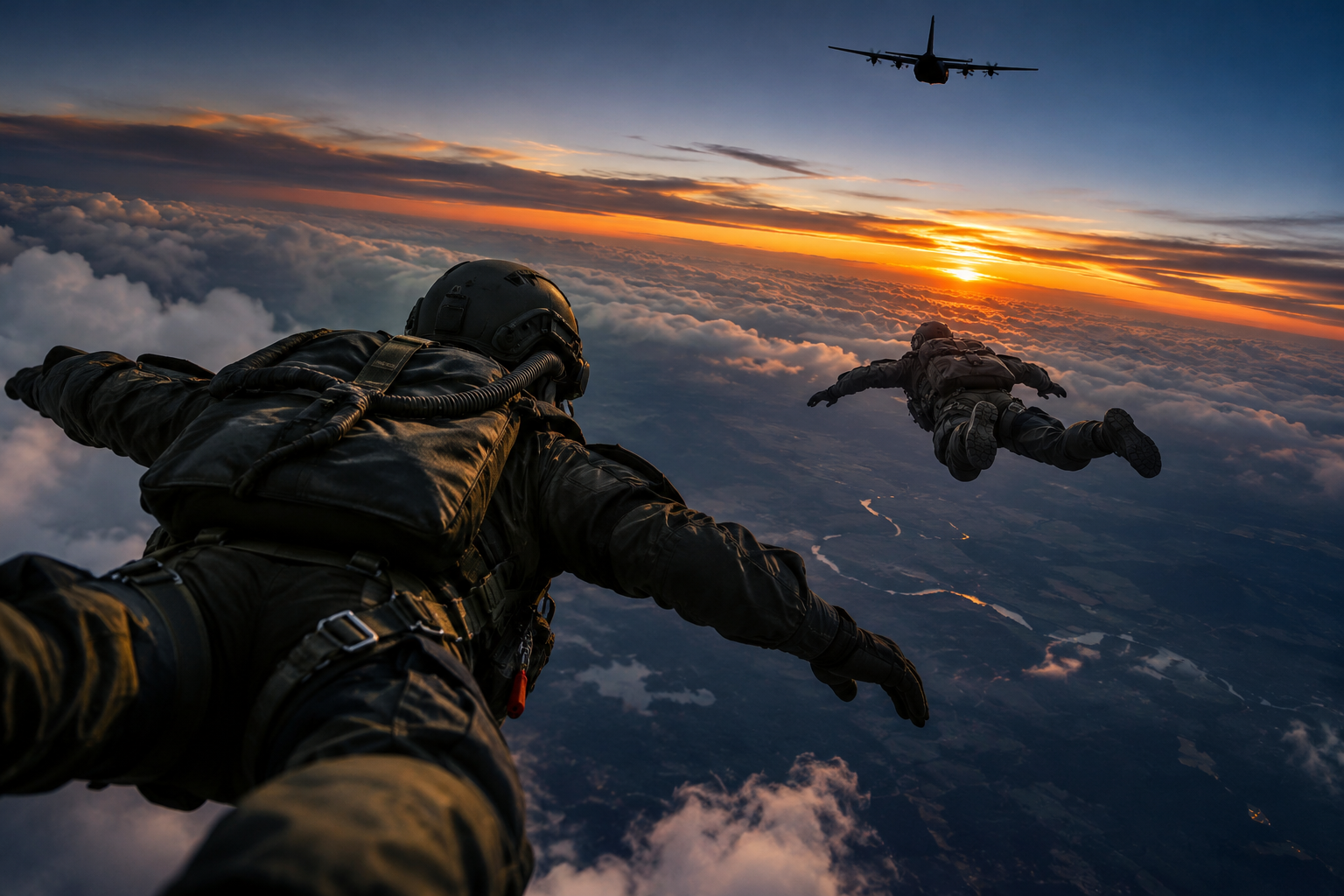
Imagine leaving a military aircraft at 30,000 feet, high above the clouds, in freezing conditions where the atmosphere contains too little oxygen to sustain normal consciousness. Below lies hostile territory. The objective is to reach the ground without attracting attention.
For several minutes, the parachutist falls through the atmosphere, controlling their descent with small adjustments to their body. Only much closer to the ground does the parachute deploy.
This is a HALO jump: High Altitude, Low Opening.
Originally developed for military infiltration, HALO parachuting allows specialist soldiers to enter difficult or hostile areas without requiring an aircraft to land. Its defining advantage is the combination of a high exit and a relatively short period beneath an open parachute.
The technique is associated with elite units such as the US Navy SEALs, Army Special Forces and other military special operations organisations. It also gained wider recognition through Tom Cruise's extraordinary stunt in Mission: Impossible – Fallout.
But the reality is more complicated than the film suggests. HALO jumping is not simply extreme skydiving with military equipment. It is one component of a carefully planned operation involving aviation, meteorology, navigation, physiology and the calculated management of risk.
What Exactly Is A HALO Jump?
HALO stands for High Altitude, Low Opening.
The name describes the two defining features of the technique: the parachutist exits an aircraft at high altitude and remains in freefall until deploying their parachute much lower in the atmosphere.
US military doctrine describes HALO operations involving aircraft exits at altitudes up to 35,000 feet, with parachute deployment at or below 6,000 feet above ground level.
Not every HALO jump starts at 35,000 feet, and opening altitudes depend on the circumstances, equipment and operational requirements.
The essential difference from conventional parachuting is the relationship between the height of the aircraft exit and the height at which the parachute opens.
Traditional military airborne operations often employ static-line parachutes. A line connected to the aircraft initiates parachute deployment shortly after the soldier exits.
This makes it possible to deliver relatively large numbers of troops without requiring each soldier to manage a prolonged freefall.
HALO jumping takes a different approach.
The parachutist controls their body during freefall, deploys their own parachute and then navigates towards a designated landing area.
The method requires substantially greater specialist training than basic military parachuting.
Why Would Special Forces Jump From Such Extreme Heights?
The principal military purpose is infiltration.
Special forces frequently need to enter locations where conventional aircraft landings are impractical, exposed or impossible.
An aircraft flying low over hostile territory may be heard, seen or detected. A helicopter approaching a defended area may face considerable danger. A runway may not exist, and an overland approach might take too long.
High-altitude parachuting provides another option.
By releasing personnel at altitude, military planners may reduce some of the immediate risks associated with low-flying aircraft. The parachutists can then descend towards their destination without requiring an aircraft to land.
Keeping the parachute closed during much of the descent also reduces the time the jumper spends travelling slowly beneath a relatively visible canopy.
This does not make HALO jumping invisible.
Modern radar, aircraft tracking, thermal sensors and other surveillance systems can complicate the assumption that a high-altitude approach will go undetected. High-flying aircraft remain vulnerable to capable air-defence networks.
The real advantage is flexibility.
A commander gains an additional method of delivering small specialist teams into areas that might otherwise be extremely difficult to reach.
The Five Main Military Uses Of HALO Jumping
1. Covert Infiltration Behind Enemy Lines
The classic HALO mission involves inserting a small team into hostile territory while reducing the chance of early detection.
Unlike conventional airborne assaults, which may involve hundreds or thousands of troops, military freefall is generally associated with comparatively small specialist groups.
Their purpose is not necessarily to seize territory immediately.
They might be entering an area to establish a concealed position, prepare for another operation or reach a location inaccessible by conventional transport.
The parachute is simply the means of arrival.
Much of the operation's success depends on what happens after the team lands.
2. Reconnaissance And Intelligence Gathering
Special reconnaissance units may need to observe an area without announcing their presence.
Such missions can involve monitoring military activity, assessing infrastructure or gathering information for future operations.
A HALO insertion offers one potential way to position a team without requiring a helicopter landing or extended ground movement.
However, the parachute approach carries its own difficulties.
Personnel must arrive with their essential equipment, remain sufficiently close to one another and navigate from the landing area to their intended observation position.
Even a successful descent is of little value if the team lands somewhere that makes its subsequent mission impossible.
3. Counterterrorism Operations
Military special operations forces involved in counterterrorism may train in high-altitude parachuting because it expands their available insertion methods.
A remote location, inaccessible landing strip or heavily monitored approach route might make an airborne insertion attractive.
Nevertheless, HALO jumping is not automatically the preferred choice for a counterterrorism mission.
Helicopters, ground vehicles, maritime insertion and other approaches may offer better speed, coordination or safety.
The choice depends on the objective, available intelligence, threat environment and practical constraints.
4. Hostage Rescue Support
One of the most famous historical examples associated with HALO operations is the 2009 rescue of Captain Richard Phillips, who had been held hostage by Somali pirates.
Specialist US Navy personnel parachuted into the wider operational area in the Indian Ocean.
The parachute insertion helped position forces and equipment needed for the rescue.
This illustrates an important distinction: high-altitude parachuting is not necessarily the final action in a mission.
In the Phillips operation, the decisive hostage-rescue action took place later, involving Navy SEAL personnel positioned aboard a US Navy vessel.
The airborne insertion was one part of a much larger operation involving ships, aircraft, intelligence and military coordination.
5. Reaching Remote And Difficult Terrain
HALO capabilities can also be useful when personnel must reach remote locations with few suitable landing facilities.
Mountains, isolated regions and other difficult environments may restrict the available methods of transport.
A parachute insertion can overcome some access problems, but it introduces additional hazards.
Mountain weather, wind conditions, altitude, unfamiliar terrain and the practical difficulty of recovering personnel can all complicate the mission.
Consequently, commanders must weigh the benefits of an airborne approach against the risks of landing far from conventional support.
HALO Versus HAHO: The Critical Difference
Military freefall operations include another closely related technique: HAHO, or High Altitude, High Opening.
Both methods involve leaving an aircraft at significant altitude.
The difference is when the parachute opens.
During a HALO jump, the parachutist remains in freefall for a substantial portion of the descent.
During a HAHO jump, the parachute opens relatively soon after leaving the aircraft.
This allows the parachutist to travel horizontally for considerable distances under a steerable canopy.
In favourable conditions, HAHO parachutists can cover tens of kilometres before reaching the ground.
The distinction has major military implications.
HALO can reduce the amount of time a parachutist spends under an open canopy, but typically requires the aircraft to fly closer to the intended landing area.
HAHO can permit the aircraft to release personnel much farther away, allowing them to glide towards the destination.
Where sophisticated enemy air defences pose a serious threat to an approaching aircraft, HAHO may offer a particularly useful alternative.
That benefit comes at a cost.
Remaining beneath a parachute at high altitude requires prolonged exposure to cold, low oxygen levels and demanding navigation conditions.
Neither technique is universally superior.
They solve different operational problems.
What Happens To The Human Body At 30,000 Feet?
Above 9,000 metres, the environment becomes one of the greatest challenges of military freefall.
At 30,000 feet, atmospheric pressure is approximately one-third of that at sea level.
The proportion of oxygen in the atmosphere remains roughly the same, but the reduced pressure means substantially less oxygen is available to enter the bloodstream.
Without adequate supplemental oxygen, the brain and other organs may quickly become impaired.
This condition is called hypoxia.
Its symptoms can include confusion, poor coordination, impaired judgement, visual disturbances and eventually loss of consciousness.
That is particularly dangerous for a parachutist who must remain aware of their altitude and manage safety-critical equipment.
Specialist high-altitude systems therefore provide oxygen during appropriate phases of the flight and jump.
Personnel also follow procedures intended to reduce the risk of decompression sickness, which can occur when dissolved gases form bubbles as surrounding pressure decreases.
Another significant challenge is the cold.
At high altitude, temperatures can fall far below freezing. The exact conditions vary with altitude, weather and atmospheric structure.
Suitable protective clothing is essential.
Even apparently minor equipment problems can become serious when they occur while the wearer is exposed to low oxygen pressure, extreme cold and limited time to respond.
A scientific study examining simulated high-altitude oxygen-system failure demonstrated how rapidly severe hypoxia can develop.
Military training therefore treats physiological preparation as an essential part of parachute operations, rather than merely an additional safety precaution.
How Dangerous Are HALO Jumps?
HALO parachuting involves risks beyond those encountered in conventional recreational skydiving.
The combination of high altitude, specialist equipment, prolonged freefall and difficult operational conditions creates numerous potential failure points.
One is oxygen-system malfunction.
Another is losing stability during freefall, which can make altitude awareness and controlled movement more difficult.
Parachute problems, collisions with other jumpers and hazardous landing conditions present further risks.
Visibility also matters.
Military personnel may train at night, carrying weapons, supplies and other equipment that can affect body position and manoeuvrability.
They may need to land on unfamiliar terrain rather than a prepared recreational drop zone.
US military public-health guidance identifies specialised high-altitude operations among parachuting activities associated with elevated injury risks.
However, it would be misleading to claim a universal HALO fatality rate.
Risk varies substantially depending on training, equipment, operating conditions and mission requirements. Publicly available figures do not establish one reliable probability of death applicable to every HALO jump.
Professional military training seeks to reduce these dangers through progressive instruction, equipment inspection, rehearsals and standardised procedures.
How Do Special Forces Train For HALO Jumps?
The US Army's Military Free Fall School at Yuma Proving Ground in Arizona provides a useful insight into the demands involved.
In September 2026, the Army described a four-week basic programme that trains qualifying personnel in military freefall techniques.
Students do not immediately begin with the most demanding high-altitude exercises.
Their training builds upon prior military parachuting experience.
At Yuma, students practise body stability and movement in a vertical wind tunnel before applying those skills in the air.
This controlled environment allows them to develop muscle memory and correct instability without requiring an aircraft for every training session.
During the course, jumps are conducted from altitudes ranging from approximately 9,500 to 25,000 feet.
Training incorporates increasingly demanding conditions.
Students practise with combat equipment, oxygen systems and night-vision equipment, as well as during daylight and darkness.
They must learn to control their movements, manage parachute equipment and reach designated landing areas.
Further courses provide instruction for jumpmasters, instructors and personnel conducting more advanced infiltration operations.
The training demonstrates why HALO is a specialist military skill rather than simply a more extreme version of ordinary parachuting.
When Were HALO Jumps First Used In Combat?
The development of modern military freefall techniques accelerated during the Cold War.
The US Army traces its basic freefall training programme to 1957, with a formal HALO development project beginning in 1958.
Early programmes explored whether soldiers could leave aircraft at high altitude and descend accurately while limiting their exposure to detection.
The Vietnam War became an important operational testing ground.
The Military Assistance Command, Vietnam – Studies and Observations Group, commonly known as MACV-SOG, used specialist airborne infiltration techniques during clandestine operations.
HALO became part of the wider evolution of special operations, alongside improvements in parachute design, oxygen equipment, navigation and aircraft capability.
The formal US Military Free Fall School graduated its first class in August 1971.
Since then, high-altitude parachuting has become an established specialist capability within several armed forces.
The technology has developed considerably, but the underlying principle remains recognisable: use an aircraft to reach an area from above, then allow personnel to arrive without requiring that aircraft to land.
Tom Cruise's HALO Jump In Mission: Impossible – Fallout
The sequence in Mission: Impossible – Fallout brought military HALO parachuting to a huge worldwide audience.
In the 2018 film, Ethan Hunt and CIA agent August Walker jump from a military aircraft high above Paris.
The fictional sequence involves dangerous weather, a mid-air emergency and an attempt to save Walker before reaching the ground.
The remarkable element is that Tom Cruise genuinely performed high-altitude parachute jumps for the film.
Cruise exited an aircraft at approximately 25,000 feet during filming in Abu Dhabi.
The production involved extensive specialist training, including work in a wind tunnel and repeated parachute jumps.
Stunt coordinator Wade Eastwood reported approximately 150 jumps during the Abu Dhabi production, with more than 100 takes contributing to the sequence.
One of the greatest challenges was filming Cruise close enough for his face and performance to remain visible while both he and the camera operator were falling through the atmosphere.
The production also developed a specialised helmet that could supply oxygen without obscuring Cruise's face.
The finished sequence appears to be a continuous descent, but it was assembled from separate shots.
Digital effects added elements including the storm and Parisian setting.
The military freefall itself, however, was real.
How Realistic Was The Mission: Impossible Jump?
The fundamental HALO technique was authentic.
The altitude, oxygen requirements, protective equipment and freefall manoeuvring reflected genuine high-altitude parachuting challenges.
However, the dramatic rescue and storm encounter were designed for cinema.
A real military team would not ordinarily attempt deliberately choreographed, close-range aerial manoeuvres simply to create a dramatic visual effect.
Operational parachuting prioritises the safe delivery of personnel and equipment.
The film's achievement was bringing genuine military-style freefall into an exceptionally demanding cinematic sequence, not reproducing a routine special forces mission.
Are HALO Jumps Still Useful Against Modern Air Defences?
Modern military technology presents a serious challenge to the traditional image of undetected high-altitude infiltration.
Advanced air-defence systems can engage aircraft at considerable altitudes and distances.
Radar and integrated surveillance networks can detect threats that earlier generations of military planners could not reliably identify.
Consequently, flying high does not necessarily mean flying safely.
Military forces must consider whether an aircraft can approach a suitable release location without unacceptable exposure.
This is one reason that HAHO techniques, with their potential for long-distance gliding, remain important.
Uncrewed systems and improved reconnaissance technologies also create alternative ways of performing some missions that previously required personnel on the ground.
Yet drones cannot replace every task.
Certain operations still require people to assess complex environments, work with local personnel, recover equipment or perform tasks beyond the capabilities of remotely operated systems.
The continuing relevance of military freefall lies in its ability to provide commanders with another option when other approaches are unsuitable.
It is a specialised capability, not a universal solution.
Why Do Special Forces Still Risk Jumping From Such Heights?
The most important point about HALO jumping is that altitude is not the objective.
Reaching the ground with the right people, equipment and capabilities is the objective.
Every operational insertion method has disadvantages.
Helicopters can be vulnerable. Ground movement can be slow. Maritime approaches depend on geography. Aircraft landings require suitable facilities and may expose personnel to danger.
HALO parachuting can overcome some of those limitations, although it introduces serious physiological and operational risks of its own.
The decision to use it depends on whether those additional risks are justified by the mission.
That is also why the technique remains the domain of specialised, extensively trained personnel.
The dramatic image of someone falling towards Earth from 30,000 feet captures the public imagination. But the real achievement is the coordination required to make such a descent serve a practical purpose.
A successful military HALO jump is not measured by how spectacular the fall appears.
It is measured by whether the team reaches the ground, remains capable of carrying out its assignment and achieves its objective without unnecessary exposure.
Sources
United States Army — Free Fall School Trains Students In High-Altitude Infiltration — September 2026 account of military freefall training, equipment, altitudes and operational applications.
Smithsonian National Air and Space Museum — High Adrenaline, High Altitude: HALO Jumps — Military history, HALO principles, operational examples and the Mission: Impossible – Fallout stunt.
US Government Accountability Office — Military Parachutes: Observations On Army And Marine Corps Acquisition Programs — Official explanation of HALO and HAHO classifications, parachute capabilities and military requirements.
Journal of Applied Physiology — Acute Hypoxia In A Simulated High-Altitude Airdrop Scenario Due To Oxygen System Failure — Scientific evidence concerning oxygen-system failure and high-altitude physiological risk.
