Islamabad’s Barricades Remain — And Imran Khan’s Delayed March Is Setting Up A Bigger October 4 Showdown
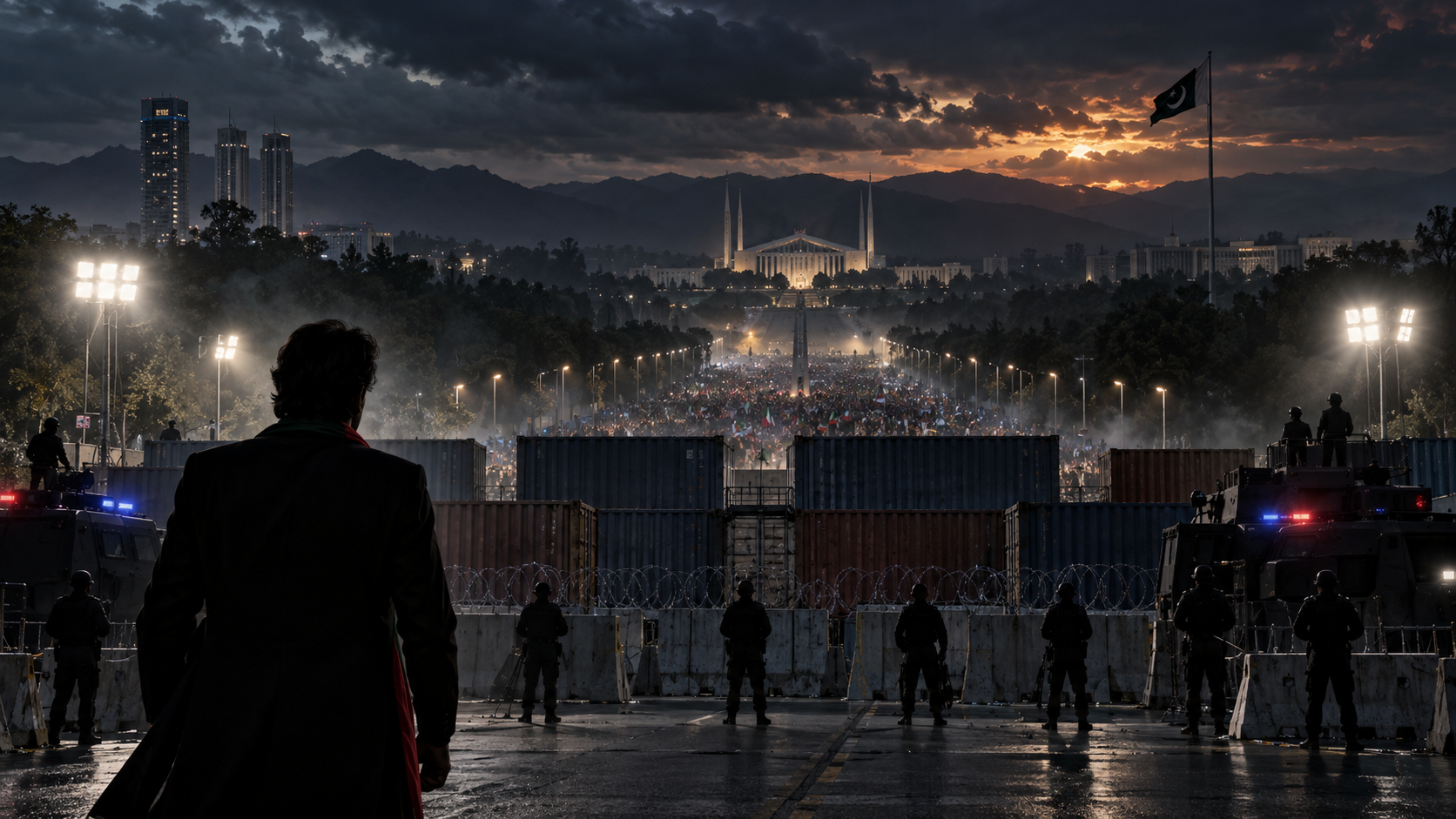
Pakistan’s Capital Is Covered In Containers — And The Protest Has Only Been Delayed
The Protest Was Delayed — The Confrontation Was Not
Islamabad entered the final week of September looking less like a capital preparing for ordinary political dissent and more like a city preparing to prevent a mass mobilisation from reaching its centre. Shipping containers appeared across key approaches and sensitive areas, security personnel were deployed, gatherings were restricted and major transport routes were disrupted as Pakistan Tehreek-e-Insaf prepared to march in support of jailed former prime minister Imran Khan.
Then the timetable changed. PTI postponed the long march originally planned for September 27 and moved it to October 4, a decision confirmed by Khyber Pakhtunkhwa Chief Minister Sohail Afridi. The opposition alliance Tehreek-i-Tahafuz-Ayin-i-Pakistan has subsequently said it intends to participate in the rescheduled protest.
That postponement matters, but it does not mean Islamabad has simply returned to normal. Containers and barriers have remained part of the capital’s landscape, while the political dispute that produced them is unresolved. At the same time, some important transport restrictions are easing: the National Highways and Motorway Police listed the M-1 between Peshawar and Islamabad as clear shortly after midnight on September 29.
The picture is therefore more complicated than either “lockdown” or “normality.” Pakistan has entered an uneasy interval between two protest dates — one that passed without the planned march and another that could bring the confrontation straight back to the capital.
The Containers Have Become Part Of The Political Message
Shipping containers are supposed to move goods. In Islamabad, they have increasingly become instruments of crowd control.
Placed across roads and around politically sensitive areas, they provide authorities with a fast physical barrier against large convoys and crowds. They also create highly visible consequences for people with no role in the political dispute: commuters face diversions, businesses can lose passing trade and ordinary journeys become tied to calculations about where the next roadblock might appear. Containers were deployed around Islamabad’s government district and major routes during the build-up to the September march.
For the federal government, the justification centres on public order and compliance with the courts. The Islamabad High Court ruled on September 14 that political parties and public office holders have no lawful right to block roads or obstruct citizens’ freedom of movement in the federal capital. The court also directed provincial chief ministers to ensure government resources and machinery were not used in political protests.
Interior Minister Mohsin Naqvi subsequently said the government would implement that ruling and prevent a march into Islamabad that violated the court’s directions. That is the government’s stated legal and security case for acting before protesters arrive rather than waiting for disruption to begin.
PTI, meanwhile, is seeking to mobilise around the continued detention of its founder and its wider political grievances. Khan has been imprisoned since 2023, while his party describes the cases against him as politically motivated. Pakistani authorities reject the broader claim that he is being imprisoned simply for political reasons.
October 4 Is Now The Date That Matters
The postponement has effectively created a second countdown.
Instead of an immediate confrontation on September 27, both sides gained another week. For PTI, that means additional time to mobilise supporters and coordinate with allied opposition groups. For the federal authorities, it provides more time to decide which security restrictions should remain, which roads can reopen and how to respond if large convoys again begin moving towards Islamabad.
That makes developments on Pakistan’s motorways particularly important. Routes connecting Khyber Pakhtunkhwa with Islamabad are politically significant because the province is governed by PTI and has been central to the party’s mobilisation plans. Earlier closures affected the M-1, parts of the M-14 and the N-5, but by early September 29 the official motorway advisory showed the M-1 from Peshawar to Islamabad as clear.
That reopening should not be interpreted as proof that the security standoff has ended. It does show something more precise: the authorities are adjusting restrictions rather than maintaining a complete, unchanged seal around the capital.
The distinction matters because October 4 could force those measures to change again rapidly.
Imran Khan Is Still The Centre Of The Crisis
At the heart of the mobilisation is a politician who has been outside government for more than four years and behind bars for more than three, yet remains capable of shaping Pakistan’s political agenda.
Khan was removed as prime minister through a parliamentary no-confidence vote in April 2022. Since then, his confrontation with Pakistan’s political and institutional establishment has moved through elections, criminal cases, mass demonstrations, arrests and repeated disputes over the treatment of PTI. Khan and PTI allege political persecution; the state disputes that characterisation.
The latest protest campaign has also unfolded amid detentions of members of Khan’s family and PTI activists. Amnesty International criticised the detention of Khan’s three sisters and party activists ahead of the originally planned September 27 march, describing the detentions as arbitrary. That is Amnesty’s assessment; Pakistani authorities have presented the wider security measures around the protests as necessary to preserve law and order.
That dispute over legitimacy is why the October 4 mobilisation carries consequences beyond a single demonstration. PTI sees protest as a means of applying political pressure around Khan’s imprisonment and other grievances. The government says political mobilisation cannot override court orders, road access and public security.
Neither position disappears because the date on the calendar moved by seven days.
Pakistan Is Already Under Wider Security Pressure
The confrontation is also developing during an unusually difficult period for Pakistan’s security environment.
Khyber Pakhtunkhwa has faced deadly militant violence, including the September attack on a police compound and mosque in Kohat. Pakistan is simultaneously dealing with a dangerous confrontation along the Afghan frontier, where accusations over militant sanctuaries, drones and cross-border attacks have escalated into direct military strikes.
Taylor Tailored has been tracking how Pakistan’s confrontation with Afghanistan is moving into a more dangerous drone-driven phase, while the deadly attack on the police compound and mosque in Kohat demonstrated the scale of the internal security pressure facing the country.
Those issues are separate from PTI’s political campaign and should not be conflated. But they compete for the attention, manpower and resources of the same state.
The federal government has explicitly argued that attention should be directed towards terrorism rather than disruptive political confrontation. PTI and its allies, by contrast, continue to insist that their political grievances warrant mobilisation.
That overlap makes October 4 harder to treat as an isolated protest-management problem.
The Real Test Is Whether Islamabad Can Avoid Another Cycle
The most important development between now and October 4 may not be the number of containers on a particular road.
It will be whether either side changes the dynamics that produced them.
If authorities ease barriers while maintaining security around sensitive areas, Islamabad may regain some normality before the new protest date. If PTI presses ahead with a mass mobilisation towards the capital, restrictions could tighten again. And if political negotiations gain traction, there remains the possibility that the scale or form of the confrontation changes before supporters begin moving.
There have already been attempts at political contact, but no publicly confirmed settlement has removed the underlying dispute.
For residents, that leaves an uncomfortable reality. A motorway can reopen one day and political calculations can change it again days later. Containers can be moved without the conflict that brought them onto the streets being resolved.
That is why Islamabad’s barricades matter beyond their immediate inconvenience.
They are the physical expression of a deeper problem: Pakistan’s government and its largest opposition movement remain locked in a contest over how political pressure can be exercised, where protest rights end, where state authority begins and what happens when neither side accepts the other’s version of political legitimacy.
September 27 passed without the march originally expected to test those limits.
October 4 now carries that burden instead.
